YOUR ACHILLES’ HEEL (Armor of God – 3)

Let no one say when he is tempted, “I am being tempted by God,” for God cannot be tempted with evil, and he himself tempts no one. But each person is tempted when he is lured and enticed by his own desire. [James 1:13-14 (ESV)]
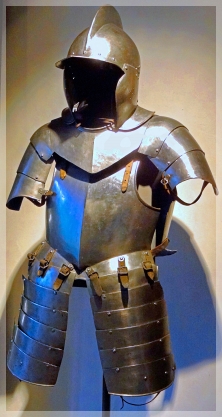
armor - Castle of SpiezBack in in 1586, during the Eighty Years’ War, Sir Philip Sidney was fighting for the Protestant cause against the Spanish when he noticed another soldier was without leg armor. Believing that he shouldn’t be better protected than his men, Sidney gave the man his cuisses (armor that covered the thigh). During the Battle of Zutphen, Sidney was fatally wounded in his thigh during the final charge and, three weeks later, he died of gangrene from the injury. While heroic, his death was avoidable if the man had worn his complete set of armor!

In Greek mythology, Achilles was the son of Thetis, a powerful sea goddess. When a seer told her that Achilles would be a great warrior but would die young, Thetis dipped her infant son in the river Styx to make him invincible. The boy became invulnerable everywhere but at his heel where his mother held him. Although Achilles was a great warrior, the god Apollo was angry with him. Knowing of his unprotected heel, Apollo directed a soldier’s arrow to the warrior’s one vulnerable spot and Achilles was killed in battle by that well-aimed arrow. Because of this myth, an “Achilles’ heel” has come to mean a person’s only weakness.

I tell these stories because both Sir Philip Sidney and Achilles were missing part of their protective covering and the Apostle Paul made it clear that the full armor of God is necessary if we are to defeat Satan. Let’s not fool ourselves, just as Apollo knew about Achilles’ unprotected heel, Satan knows exactly where to attack us! The area we leave unprotected is the place where Satan will strike.

While he doesn’t use arrows, canon balls, or bullets, Satan has an arsenal of weapons at his disposal. After bombarding Job with loss of family, finances, status, and health, he continued the attack with intense pain, depression, and doubts about God’s goodness. Satan mistakenly thought God was protecting Job with a fence of prosperity but the man remained impervious to Satan’s arrows because he was wearing God’s spiritual armor.

Satan may have failed with Job but he was successful with others. Finding a chink of pride and self-reliance in David’s armor, Satan tempted him to take a census. Knowing that David’s Achilles’ heel was his eye for the ladies, Satan tempted him with the beautiful but married Bathsheba. Whether it was Judas’ lust for money or a Zealot’s disappointment in the Messiah’s role, Satan knew where his weakness lay and entered Judas through that missing piece of armor.

We all have a weak spot (or spots). After all, even Superman’s Achilles’ heel was kryptonite! For some of us, it is doubts about God’s goodness, pride, fear, unforgiveness, or a wandering eye. For others, it is love of money, a quick temper, a critical tongue, or chronic impatience. What is your Achilles’ heel? Be alert; Satan knows exactly what and where it is and will do his best to take you out of action with what he hopes to be a fatal shot.

Although God’s armor is tailor-made for us, it does us no good if we fail to put all of it on. Are you missing a piece of God’s armor?

He [the devil] will attack you sometimes by force and sometimes by fraud. By might or by sleight he will seek to overcome you, and no unarmed man can stand against him. Never go out without all your armor on, for you can never tell where you may meet the devil. He is not omnipresent, but nobody can tell where he is not, for he and his troops of devils appear to be found everywhere on this earth. [Charles Spurgeon]

Be sober-minded; be watchful. Your adversary the devil prowls around like a roaring lion, seeking someone to devour. [1 Peter 5:8 (ESV)]

Copyright ©2024 jsjdevotions. All rights reserved.

DENYING HIM (Part 2)

But Peter denied it again. A little later some of the other bystanders confronted Peter and said, “You must be one of them, because you are a Galilean.” Peter swore, “A curse on me if I’m lying—I don’t know this man you’re talking about!” [Mark 14 (NLT)]

goatDescribed as a “preaching genius…like no other preacher you have ever heard,” the late Rev. Fred Craddock was well-known for including stories in his sermons. He told one that took place during the early 60s in a diner in the deep South. Although the white Craddock sat in a booth and was served with courtesy and consideration, he silently watched the diner’s manager treat a Black man at the counter with rudeness, disdain, and open contempt. Although offended by the man’s racist behavior, Craddock remained silent. It was when he walked out of the diner after finishing his meal that the preacher heard a rooster crow. A signal of his betrayal, the crowing told the preacher that, by ignoring one of the “least of these”, he’d ignored Jesus! His silence was as much a betrayal of the Lord as were Peter’s denials!

Of course, to understand the impact of Craddock’s story on him and those who heard him tell it, you must be familiar with the story of Peter and his denial of Jesus. After finishing what would be known as the “Last Supper,” Jesus and the disciples went out to the Mount of Olives. When Jesus predicted that all the disciples would desert Him that night, Peter and the others protested saying they’d never deny Him. Outraged at the thought of denying the Lord, Peter insisted, “Even if I must die with you, I will not deny you!” Jesus, however, told the overconfident disciple that he would, indeed, deny knowing the Lord three times before the rooster crowed. Within a few hours, the man who claimed a willingness to join Jesus in prison and death denied knowing Jesus three times before the rooster announced the break of day with his crow.

The stories of Peter and Fred Craddock remind us that our faith is more vulnerable than we think. While I’ve never heard an actual rooster crow after denying the Lord, like those men, I’ve denied Jesus every time I’ve ignored His face in the faces of God’s children. While we may not have denied knowing Jesus as did Peter, like Craddock, we’ve denied Him when, like the goats in Jesus’ parable, we fail to be His disciples. We deny following the Galilean whenever we fail to be the hands of Jesus and serve the needy, to be the voice of Jesus and speak for the disenfranchised, or be the feet of Jesus and walk the extra mile for our neighbor.

Although Scripture assures us of God’s provision, presence, and power, when push comes to shove, it’s hard to fully trust a God we don’t see and whose ways we can’t fully understand! That’s when Satan gets busy behind the scenes instilling doubt, cowardice, and shame into our hearts. Rather than trust God’s strength more than our own, we begin to fear failure, rejection, and involvement. Rather than hear His call and cede control to Him, we’re like the priest and Levite in the parable of the Good Samaritan—we turn a blind eye to the suffering and a deaf ear to their cries!

We are fallen people living in a fallen world and, at times, we will fail to be the people Jesus calls us to be. We will fail to see Jesus in our midst and the cock will crow! Nevertheless, we must never allow those failures to defeat us. Peter—the one who lied three times with his blatant denial of Jesus—did not remain a prisoner to his fear or shame. He became the Apostle who boldly spoke of Jesus to the high council and, despite the threats, continued to speak of Christ until he, like his Lord, was crucified! Craddock didn’t let his failure stop him either. He told his story and others like it and, thirty years later, the man who remained silent when he should have spoken was named one of the twelve most influential preachers in America. Neither man was defined by his failures and neither are we. In nature, goats can never become sheep but, in God’s kingdom, by the power of the Holy Spirit, they can!

All men will be Peters in their bragging tongue, and most men will be Peters in their base denial; but few men will be Peters in their quick repentance. [Owen Feltham]

Your love for one another will prove to the world that you are my disciples. [John 13:35 (NLT)]

And he will answer, “I tell you the truth, when you refused to help the least of these my brothers and sisters, you were refusing to help me.” [Matthew 25:45 (NLT)]

Copyright ©2024 jsjdevotions. All rights reserved.

JUST LIKE US

But Moses protested to God, “Who am I to appear before Pharaoh? Who am I to lead the people of Israel out of Egypt?… What if they won’t believe me or listen to me?… I’m not very good with words. I never have been, and I’m not now, even though you have spoken to me. I get tongue-tied, and my words get tangled….Lord, please! Send anyone else.” [Exodus 3:11,4:1,10,11 (NLT)]

castle of spiez - knightWhen I learned about people like Abraham, David, Moses, and Samson as a girl, they were the Bible’s version of super-heroes like Batman or Superman. The Bible’s heroes were larger than life, obedient, invincible, and seemed to overcome their obstacles effortlessly. Appearing perfect in their faith and actions, they weren’t people to whom I could relate. In reality, they were as flawed as the rest of us but, for the most part, their imperfections and failures were redacted from the stories we learned in Sunday school.

As a child, I learned that David killed Goliath, was a great warrior, and wrote psalms but I didn’t learn about the 70,000 Israelites who died because he took a census or his sins of rape, adultery, and murder. When I colored pictures of Samson destroying Dagon’s temple, I didn’t know about the disobedience, lust, and pride that got him in such trouble! Although I learned that King Solomon was wise and wealthy, I didn’t know he disobeyed his father, broke God’s law, and over-worked and over-taxed his people.

Truth be told, the Bible’s heroes and heroines were as fallible, insecure, and willful as you and me. The apprehensive Moses listed all his shortcomings while arguing with God and the faint-hearted Gideon tested Him! Barren Hannah struggled with her sense of worth and Naomi grew bitter in widowhood. Moses let his anger get the best of him and Elijah prayed for death in the depth of despair. Abraham was a coward who, to save his skin, gave his wife to another man twice! Timothy’s youth made him timid and insecure and even John the Baptizer had doubts!

The families of our Biblical heroes were as dysfunctional as ours. There were bad marriages—Abigail was married to a brute and Gomer wasn’t faithful to Hosea. There was bad parenting—Eli and Samuel turned a blind eye to their sons’ sins, David failed to discipline his boys Amnon and Adonijah, and Abraham, Isaac, and Jacob played favorites with their sons. There was sibling rivalry—Miriam and Aaron grew jealous of Moses, Jacob stole Esau’s birthright and blessing, Joseph’s brothers sold him into slavery, Leah and Rachael competed for Jacob’s attention, and Martha and Mary had issues! There even was fratricide—Absalom murdered Amnon, Solomon had Adonijah killed, and both Jehoram and Abimelech executed their brothers! Their tangled stories rival the drama of “reality television.”

Indeed, there’s enough sex and violence in the Bible that children only learn the G versions of its stories in Sunday school. We, however, are not children and we need to look at the heroes and heroines of the Bible with the eyes of an adult. My purpose is not to throw mud on the Bible’s heroes and heroines—it’s to make them relatable.

Rather than super heroes, God used people as flawed and imperfect as we are and from families as screwed up as ours. Like us, they struggled with challenges, pain, infertility, temptation, impatience, anger, jealousy, depression, and even their faith. They faced real challenges, made mistakes, sinned more than once, questioned God, and even failed at times. If God could use such flawed people to accomplish His purpose, think of what He can do with you and me!

There will be no “knights in shining armor” in God’s kingdom; our armor will have many dings and dents. No, no perfect Hollywood heroes will ride to save the day; just wearied saints to look to God and, in weakness, find Christ’s strength. This, indeed, is the essence of God’s kingdom: divine greatness manifest in common people. [Francis Frangipane]

Each time he said, “My grace is all you need. My power works best in weakness.” So now I am glad to boast about my weaknesses, so that the power of Christ can work through me. [2 Corinthians 12:9 (NLT)]

Copyright ©2024 jsjdevotions. All rights reserved.

APPROVAL RATINGS

Obviously, I’m not trying to win the approval of people, but of God. If pleasing people were my goal, I would not be Christ’s servant. [Galatians 1:10 (NLT)]

green heronThe email from my dentist asked, “Would you recommend us?” When I answered in the affirmative, I was hyperlinked to a site that added my five-star rating to that of other patients. The following day, I received a longer survey regarding my recent visit. Once done, it again asked if I would recommend his services and requested use of my name in an on-line testimonial. It’s clear that my dentist wants more than feedback; he wants the public approval of his patients. Although I like him, I like my privacy more, so I declined!

Like my dentist, we all want to be noticed, liked, approved, applauded, and endorsed but, unlike him, we probably don’t employ a company to do surveys for us. Nevertheless, we tend to measure approval in other ways—the website’s metrics, “friends” on Facebook/Meta, and followers on Twitter/X, Instagram, TikTok, or Snapchat. Approval is determined by the number of compliments received, memberships (and offices held) in various organizations, honors awarded, likes on the posting, hearts on the text, or the quantity of Christmas and birthday cards received and invitations extended or accepted. We judge admiration on the number and expense of gifts we get, the reviews on Yelp or Trip Advisor, the size of the obituary, and the length of the line offering condolences at the funeral home.

Of course, it’s only natural to want the admiration of our family, friends, peers, and employers. Nevertheless, we must never seek their approval at the expense of pleasing God. When Saul initiated a sacrifice rather than wait for Samuel, he was seeking his men’s approval rather than God’s; as a result, he lost his kingdom. When we seek the approval of others, God does not approve! According to the Apostle John, many Jewish leaders would not admit their faith in Jesus for fear of being put out of their synagogues because they “loved human praise more than the praise of God.” Jesus warned us about trying to impress people with our righteousness by putting on a show of our giving, praying, or fasting. While we might be praised by others, the One who sees into our hearts is not impressed.

In Bill Watterson’s comic Calvin & Hobbes, there were several instances (usually after having been disciplined or given a chore) when the precocious Calvin informed his father that his approval ratings were dangerously low, especially among six-year-olds and stuffed tigers. To Calvin’s surprise, his dad seemed unconcerned about his approval ratings’ ups and downs. Like this wise comic strip father, we can’t let approval ratings determine our behavior! As much as we want to be liked and admired, Jesus made it clear that we must not seek the approval of people rather than that of God! Our job is to please Him and His approval rating is the only one that truly counts!

When we try to please both the world and God, the interests of our two masters eventually will collide. When that happens, and it will, whose approval will we seek—man’s or God’s?

Fear of man is the enemy of the fear of the Lord. The fear of man pushes us to perform for man’s approval rather than according to God’s directives. [Paul Chappell]

For we speak as messengers approved by God to be entrusted with the Good News. Our purpose is to please God, not people. He alone examines the motives of our hearts. [1 Thessalonians 2:4 (NLT)]

No one can serve two masters. For you will hate one and love the other; you will be devoted to one and despise the other. [Matthew 6:24a (NLT)]

Copyright ©2024 jsjdevotions. All rights reserved.

THE BIRD’S NEST (Matthew 5:18-19 – Part 2)

For truly, I say to you, until heaven and earth pass away, not an iota, not a dot, will pass from the Law until all is accomplished. Therefore whoever relaxes one of the least of these commandments and teaches others to do the same will be called least in the kingdom of heaven, but whoever does them and teaches them will be called great in the kingdom of heaven. [Matthew 5:18-19 (ESV)]

osprey nestWhile we now know what is meant by an iota and dot, jot and tittle, or yod and kots, we wonder what Jesus means by “the least of these commandments!” If the smallest letter is as important as the largest and the smallest flourish on the smallest letter in Scripture was not to be eliminated, how can there be a “lesser” commandment? The confusion again comes from reading an English translation of a Greek rendering of the original Hebrew. Jesus probably was using a popular Jewish idiom “mitsvot kalot” meaning “light” commandments, rather than “mitsvot ketanot,” meaning less important or small commandments. While this seems a bit like splitting hairs, it reflects Jewish thinking in Jesus’ day when a distinction was made between “light” and “weighty” commandments when comparing one to another.

The rabbis regarded Deut. 22:6-7, a law prohibiting taking a mother bird if you happen upon her in a nest with eggs or young in it, as the least or lightest commandment. They regarded the one about honoring one’s parents in Ex. 20:12 and Deut. 5:16 among the greatest or weightiest. If you look at those very two different commandments, one of which seems more important than the other, you’ll find they both promise a reward for obedience—a long life in which things will go well. These are the only two commandments promising a specific reward and, with both the light and weighty commandments promising the same reward, the rabbis taught that each was to be obeyed.

People were to be as conscientious about heeding a light or minor commandment as they were of obeying a weighty or major one. Reflecting this thought, the late 1st century Jewish teacher Simeon ben Azzai taught, “Be quick in performing a minor commandment as in the case of a major one, and flee from transgression; For one commandment leads to another.” Two completely unrelated commands that both offered the same reward illustrated the importance of the entire law and Jesus’ words reiterated that same concept!

With His words, Jesus was making it clear that the Pharisees and scribes didn’t have a monopoly on zealousness for Scripture. Although He often was accused of being against the law, Jesus’ disagreement with the religious leaders of His day wasn’t with the law; it was with their addition of hundreds of man-made petty rules that were elevated to the level of God’s word. In true rabbinic fashion, they even added extra rules to the “lightest” commandment, adding that it only applied to wild birds and didn’t apply if the mother bird was just hovering over the nest (unless her wing touched the nest)!

Jesus’ reference to these laws further emphasizes what He said about the yod and kots—that God’s law is changeless, eternal, and complete. His reference to these two specific laws shows God’s concern for both significant and seemingly insignificant acts and makes it clear there is no such thing as a “little sin.” It also points to God’s compassion and love. Since He cared enough for His creation to give a commandment protecting the welfare of a baby birds, consider how much more He cares for the welfare of His own children—the ones made in His image!

Let us remember that, when Jesus freed us from the burdensome commands of the Old Testament Law, He did not free us from God’s law.

And he said to him, “You shall love the Lord your God with all your heart and with all your soul and with all your mind. This is the great and first commandment. And a second is like it: You shall love your neighbor as yourself. On these two commandments depend all the Law and the Prophets.” [Matthew 22:37-40 (ESV)]

Copyright ©2024 jsjdevotions. All rights reserved.

OUT OF LOVE, NOT FEAR

But if you refuse to listen to the Lord your God and do not obey all the commands and decrees I am giving you today, all these curses will come and overwhelm you… The Lord himself will send on you curses, confusion, and frustration in everything you do, until at last you are completely destroyed for doing evil and abandoning me. [Deuteronomy 28:15,20 (NLT)]

Moses - Michaelkirsche - MeiringenThere are 613 commandments in the Torah/Pentateuch (the first five books of the Bible). But, as seen in Jesus’ interaction with the lawyer who wanted “neighbor” defined, there was room for interpretation. For example, what exactly does it mean to “honor” one’s parents? When Deuteronomy 11:18-20 says to bind “these words” to one’s hands and forehead and place them on doorposts and gates, exactly what words and how was it to be done? Work on the Sabbath is prohibited in twelve places but is the command limited to the few types of work mentioned? For that matter, what defines work?

Jesus criticized the Pharisees over their pettiness regarding the law but it’s easy to see how the system of laws governing Jewish life became so complex. After listing the blessings for obedience to God in Deuteronomy, Moses laid out the many curses for disobedience. Those curses include everything from wasting diseases, plagues, drought, boils, military defeat, and scorching heat to becoming food for scavenging birds, madness, swarms of insects, starvation, oppression, and exile. Moses painted a graphic and gruesome picture when warning the people to obey all the words of the law.

Since people will use any possible excuse to break a rule, it’s easy to see how fear of punishment led to Jewish legalism—especially in the Second Temple period when the Jews returned to Judah from Babylon. Having seen Jerusalem’s rubble and the Temple’s ruins, religious leaders knew firsthand the steep price Israel paid for their disobedience. Fearful of punishment and striving for absolute obedience, they wanted to cover every eventuality by putting a “fence around the Torah” with the Oral Law.

To clarify honoring and reverencing one’s parents, the oral law obligated children to care for their parents’ needs and prohibited things like sitting or standing in their place, contradicting them, or calling them by their first names. As for the binding and posting of words, the oral law specified tefillin (phylacteries), mezuzahs, and the verses that were to be placed in them. Rather than simplifying obedience, however, they complicated it with several thousand laws governing everything from the text, writer, pen, and ink to letter shape, parchment, and placement.

Based on the work required in building the tabernacle, 39 classes of prohibited work were specified in the Oral Law. Then, lest someone unintentionally work on the Sabbath, more rules were added. Tools used in prohibited work couldn’t be handled on the Sabbath which meant that touching things like scissors or needles was forbidden. Any action resembling prohibited work also was prohibited on the Sabbath so things like braiding hair (weaving) or separating good fruit from spoiled (winnowing/sifting) were banned. When the disciples were criticized for breaking the Sabbath by plucking off and eating some heads of grain, it was because the Pharisees considered their action the work of harvesting.

Jesus’ grievance wasn’t with the Law; it was with the Pharisees who had allowed the minutiae of the law to become more important than a relationship with the One who gave them the Law. Although the law pointed out sin, they didn’t understand that no matter how intricately it was interpreted or followed, the law never could keep people from sin. People are sinful and, try as they may, they always will fall short of perfect obedience.

As Christians, we must never make the mistake of thinking we can reach a level of perfection good enough for God; in spite of all their laws, the people of Judah couldn’t and neither can we. Jesus didn’t abolish the law—He fulfilled it! Our righteousness is attained only through faith in Him. We can’t obey God’s law on our own but, by the grace of God and the power of the Holy Spirit, we can begin to be the people He created us to be. Christians don’t obey God’s law to work our way into His good graces, to earn our way into heaven, or to avoid captivity or pestilence. We obey God out of love! If we genuinely love Him with all our being, obedience isn’t a burden because we want to do only what pleases Him.

The law tells me how crooked I am. Grace comes along and straightens me out. [D.L. Moody]

And he said to him, “You shall love the Lord your God with all your heart and with all your soul and with all your mind. This is the great and first commandment. And a second is like it: You shall love your neighbor as yourself. On these two commandments depend all the Law and the Prophets.” [Matthew 22:37-40 (ESV)]

Copyright ©2024 jsjdevotions. All rights reserved.