
And she brought forth her firstborn son, and wrapped him in swaddling clothes, and laid him in a manger; because there was no room for them in the inn. [Luke 2:7 (KJV)]
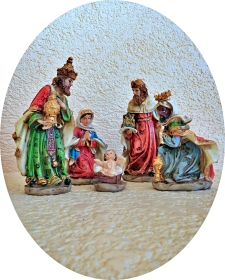
Between countless Christmas pageants, Christmas card illustrations, nativity sets, and the words of our favorite carols, the Christmas story we know actually may not be the one told by Luke. Although most translations say Mary laid Jesus in a manger because there was “no room for them in the inn,” it probably wasn’t an inn and no mention is made of an innkeeper (or his wife). The word usually translated as “inn” in this verse was kataluma and it appears one more time in Luke 22:11 and Mark 14:14 when Jesus sent Peter and John to Jerusalem to determine the location of the kataluma where they would celebrate their Passover meal. Here kataluma is translated as guest room or guestchamber and Luke described it as a large upstairs room in a person’s house. Rather than kataluma , the word Luke used for inn when telling the Parable of the Good Samaritan was pandocheion which clearly meant inn or public house.
Rather than staying in the 1st century equivalent of a Motel 6, the couple would have stayed with relatives, as was the custom of the time. But, since everyone else in the family also was in Bethlehem for the census, the house would have been overflowing with people. Even though Mary was pregnant, the older family members had priority on rooms. Rather than no room at the inn, there was no room for them in the normal living quarters.
We wrongly assume Jesus was born in a barn or a stable because of the manger (an animal’s feeding trough) but animals usually weren’t housed in an exterior building. To keep them safe from theft and the elements, they were kept on the ground floor of the house, often under the living quarters. Because of the manger’s mention, it probably was here that Mary gave birth. Had I been Mary and about to give birth, I would have preferred the relative quiet and privacy afforded in the animals’ quarters to the commotion of a house filled with people! While it makes for great drama to think of a cruel innkeeper refusing them a room, it’s rather nice to picture the savior of mankind being welcomed into the wonderful chaos of an extended family oohing and aahing over Him!
Even though animals are included in every pageant and nativity, Scripture doesn’t mention Mary riding a donkey into Bethlehem, the shepherds bringing any sheep, or even camels. Because of the manger, we assume the presence of a cow but that’s mere speculation.
As for the angels—the only mention of angels in Luke’s account is when they announce Messiah’s birth to the shepherds. While it’s logical to think angels watched over the Holy Family that night, Scripture doesn’t say so and there’s no reason to think they were visible. Moreover, as much as I love singing the long “Gloria in excelsis Deo,” in the carol, Scripture only says the angels praised God and spoke their message.
In Matthew’s gospel we read of the wise men (magi) from the east who visited Jesus. While “magi” came to mean astrologers, sorcerers, or magicians, these men probably were Magians, a priestly caste from Media, Persia, Assyria, or Babylonia. Learned in the prophecies of Hebrew Scripture, they were worshipful seekers of the truth. Their number (three) and names come from song rather than Scripture and their kingship and camels may come from their mention in Isaiah 60. Careful reading, however, tells us Isaiah’s prophecy refers to Christ’s return rather than His birth. Nevertheless, an unknown number of Magi brought this young king gifts of gold, frankincense, and myrrh. Whether such costly offerings were theirs or on behalf of a foreign king is unknown.
Even the Magi’s appearance in our pageants and nativities is incorrect. Because the Holy Family fled to Egypt immediately after their departure, the Magi must have arrived after Mary’s purification and Jesus’ presentation in the Temple 40 days after His birth. When the Magi arrive, Matthew refers to Jesus as a child rather than an infant and, based on the age of the boys Herod ordered slaughtered, their visit probably occurred when Jesus was a toddler.
Christmas is a time of great pageantry and kings kneeling in front of an infant in a manger, surrounded by animals, shepherds, and angels, makes for great theater. The facts surrounding Jesus’ birth, however, are more marvelous that any we could imagine! The message that the Son of God came in human form to sacrifice Himself for our sins and provide eternal life to all who believe in Him needs no embellishment.
It is here, in the thing that happened at the first Christmas, that the most profound unfathomable depths of the Christian revelation lie. God became man; Nothing in fiction is so fantastic as this truth of the incarnation. [J.I. Packer]


 Although Jesus performed many miracles, when compared to the illusions performed by various well-known magicians, they aren’t all that impressive. Jesus emerged from the tomb on the third day but David Blaine buried himself alive in a plexiglass coffin under a 3-ton water-filled tank for seven days and nights! Calling Lazarus out of the tomb after several days was impressive but only his family and some mourners were there to see it. When David Blaine emerged from the 6-ton block of ice in which he’d been encased for over 63 hours, thousands in Times Square were there and even more watched it on television. Granted, Blaine fell short of his 72-hour goal but the man knows how to draw crowds! Couldn’t Jesus have done something similar?
