DEBORAH 

One day she sent for Barak son of Abinoam, who lived in Kedesh in the land of Naphtali. She said to him, “This is what the Lord, the God of Israel, commands you: Call out 10,000 warriors from the tribes of Naphtali and Zebulun at Mount Tabor. And I will call out Sisera, commander of Jabin’s army, along with his chariots and warriors, to the Kishon River. There I will give you victory over him.” [Judges 4:6-7 (NLT)]

rainbowSince the judges usually were military leaders, it’s not surprising that only one of the twelve, was female: Deborah. Normally, the culture of the day wouldn’t support a woman in this role. Judges were called to save Israel from their enemies and to restore peace and prosperity. They did it by driving out or annihilating Israel’s oppressors—not considered women’s work in 1150 BC. Nevertheless, God designated the prophet Deborah as Israel’s judge. At the risk of sounding sexist, it could be that God appointed a woman as the judge because there were no qualified men at the time!

Deborah served during the time Canaanite King Jabin oppressed Israel. After summoning Barak, she revealed God’s plan—promising victory, God commanded him to gather an army of 10,000 men and go to war. Even though Barak was assured of success, the warrior’s reluctance is understandable. Israel was nearly weaponless at the time. Either they lacked the technology to make weapons or had been required to turn in their weapons to their Philistine and Canaanite oppressors. The Canaanites, however, had 900 chariots (the superweapons of their time) at their disposal! The odds were against Israel!

Barak accepted God’s call on one condition—that Deborah join him! Deborah was a wife, prophet, and judge but she wasn’t a warrior; nevertheless, Barak wanted this woman at his side. Perhaps he trusted Deborah’s relationship with God more than he trusted his! After agreeing to go to battle, Deborah warned Barak that, if she did go, he would not be the battle’s hero—that honor would belong to a woman.

As Deborah prophesized, Barak’s troops were victorious. They killed every Canaanite warrior save one—the army’s commander, Sisera. And, as Deborah predicted, the honor for the battle’s victory went to a woman—but not to Deborah. While both Deborah and Barak are mentioned in the victory song, the honor went to Jael. The wife of Heber the Kenite, Jael sized up the situation when the fleeing Sisera arrived in her campsite. After welcoming him into her tent, she fed him and covered him with a blanket. Then, in what can only be called a serious breach of hospitality, Jael hammered a tent peg through Sisera’s skull after the exhausted man fell asleep!

Deborah’s story closes with a beautiful song of victory attributed to her. Believed to be some of the oldest poetry in the Bible, it is a beautiful narrative of the battle. When God caused a storm, the heavy rain caused the river to rise and the Canaanites’ chariots became stuck in the mud. The panicked troops were sitting ducks when Israel’s army descended upon them. The song pays tribute to all of the people and tribes who fought (and berates those who didn’t). As Jael’s part is recounted, she is called the “most blessed among women” and a prayer is offered that Jael “be blessed above all women who live in tents.” Deborah’s song, however, really wasn’t about giving Jael the honor of victory. That honor was given to God. Deborah gave credit where credit was due as she celebrated God’s righteous act in bringing the power of the heavens against their enemies!

When Barak insisted that Deborah come to battle with him, he seemed to forget that she was not the one guaranteeing victory; that guarantee came from God. The question before Barak wasn’t one of Israel’s success or defeat in battle. The question of victory was answered the moment God promised it. The question before Barak was simply whether or not He would believe God enough to claim that victory! He almost didn’t! May we remember to claim the victories that God promises to us!

So on that day Israel saw God defeat Jabin, the Canaanite king. And from that time on Israel became stronger and stronger against King Jabin until they finally destroyed him. [Judges 4:23-24 (NLT)]

Copyright ©2022 jsjdevotions. All rights reserved

GOOD INTENTIONS

This is why I remind you to fan into flames the spiritual gift God gave you when I laid my hands on you. For God has not given us a spirit of fear and timidity, but of power, love, and self-discipline. [2 Timothy 1:6-7 (NLT)]

rocky mountain national parkBritish mystery author Ruth Rendell often received letters from would-be authors who wanted to know how to get started. Her response was simple: “I tell them to stop writing to me and get on with it.” Author Jodi Picoult said when she can’t write a good page, she simply revises a bad one while pointing out, “You can’t edit a blank page.” If we want a page filled with words, we’ve got to sit down and write them.

Even when working for God, we need more than good intentions or even prayer. Ten years ago, I was part of a Christian women’s ministry that hosted a web site for twelve writers all of whom believed they’d been called by God to expand His kingdom through their writing. We were a diverse multi-generational group and the website offered links to our individual blogs. We regularly shared our prayer concerns with one another and rarely a week went by without a prayer request for divine inspiration for someone’s writing. Sadly, the ministry disbanded within two years because only a few of the writers ever wrote anything. Apparently, good intentions and even prayer were no substitute for actually sitting down and doing the work!

By simply leaving things up to God and giving Him the entire responsibility for our work, we yield to the temptation not to take any initiative. While God is the one who enables us and deserves the glory, we are His hands and feet here on earth and the ones who are called to do His work! Remember, the Israelites had to take the initiative by stepping into the Jordan River before God stopped its flow and they were the ones who marched around Jericho for seven days before God made its walls come tumbling down! I believe in the power of prayer but prayer alone didn’t get the Israelites across the river or defeat Jericho; the people had to do the walking and the wielding of the swords. In the same way, prayer alone doesn’t provide us with the words for a devotion, sobriety, a job, health, good grades, a thriving business, a successful marriage, a college degree, or a speaking ministry. God gives us the power, guidance, inspiration, and even victory, but we still have to do the work!

When we’re called by God, He will provide us with the talent, tools, situation, time, assistance, and spiritual gifts necessary for that task. The one thing He won’t provide is the finished product. He expects us to do the labor and, as powerful as prayer is, it is no substitute for work. When Jesus spoke of moving mountains and promised us, “You can pray for anything, and if you have faith, you will receive it,” He wasn’t offering us a magic wand to capriciously move mountains into the sea. If God really wants that mountain moved, however, He might just provide the shovel and tell us to start digging!

In Eden, God gave man the gift of work and a sense of purpose. After the fall, however, thistles and thorns appeared and man’s work became difficult. Work was still good; it just wasn’t easy. When faced with a garden full of weeds, we can pray those weeds will disappear and wait for divine intervention or, while praying, we can put on our work gloves and start pulling them out!

I consider it an error to trust and hope in any means or efforts in themselves alone; nor do I consider it a safe path to trust the whole matter to God our Lord without desiring to help myself by what he has given me; so that it seems to me in our Lord that I ought to make use of both parts, desiring in all things his greater praise and glory, and nothing else. [St. Ignatius]

Pay careful attention to your own work, for then you will get the satisfaction of a job well done, and you won’t need to compare yourself to anyone else. For we are each responsible for our own conduct. [Galatians 6:4-5 (NLT)]

Copyright ©2022 jsjdevotions. All rights reserved.


TAKE THE RISK

Be strong and courageous! … Do not be afraid or discouraged, for the Lord will personally go ahead of you. He will be with you; he will neither fail you nor abandon you. [Deuteronomy 31:6a,8 (NLT)]

Let all who fear the Lord repeat: “His faithful love endures forever.” … The Lord is for me, so I will have no fear. What can mere people do to me? [Psalm 118:4,6 (NLT)]

great egret
Judge Guido Calabresi regularly asks his Yale law students to imagine receiving an offer of an amazing invention that could improve people’s lives in every imaginable way. In exchange for this invention, however, the lives of at least 1,000 randomly selected young people would be taken every year. When asked if they’d accept the deal, his students inevitably conclude they wouldn’t. Calabresi then asks them the difference between that offer and the automobile. The very thing that allows us to travel, see loved ones, easily move products across the country, and do things that couldn’t be done otherwise, kills even more than that! Over 2,600 teens (16-20) accounted for auto accident fatalities in 2019 and, with over 46,000 car fatalities last year, more than 150 people of every age die each day because of a car. Be that as it may, we’re not about to give up driving!

Calebresi uses his example to illustrate how selective we are in our fears. We underestimate and accept chronic risks like riding in a car while overestimating prominent ones like a terrorist attack or plane crash. In actuality, rather than dying from either of those things, we’re more likely to die by choking on food or slipping in the shower or tub but, preferring bathing, eating, and even driving to the alternatives, we decide they’re worth the risk. On the other hand, after assessing the perils involved in things like free solo climbing, running with the bulls, or base jumping, most of us probably decide they’re not worth the risk.

In contrast, any risk we take in obedience to God always is worth it. Regardless of the danger, we must obediently accept the risks in the challenges and tasks He gives us. Think of what Abraham risked by packing up his family and leaving Haran for an unknown destination. Think of the risks taken by the midwives Shiphrah and Puah when they defied Pharaoh by letting boy babies live or the risk Moses took when he returned to Egypt and confronted Pharaoh. It was a huge risk when Gideon and his 300 men took on an army 400 times their size and when David faced Goliath with just a sling and stones. In spite of the risk, Esther approached the king, Daniel defied the law by praying, and the bleeding woman touched Jesus’ robe. Joseph of Arimathea took a risk when he asked Pilate for Jesus’ body and Peter and John risked imprisonment and worse when they defied the Council by continuing to share the gospel. When we search Scripture, we don’t find people who assessed the risks and played it safe. We find God’s version of bungee jumpers and wing-suit flyers—faith-filled and obedient risk takers.

Every God-sent risk comes with a God-sent promise. He will remain faithful to us and be present in the risk. He will protect and empower us and we’ll never need more than what He supplies. As followers of Jesus, we don’t walk by sight. In spite of the risks, we walk by faith because faith means we’re willing to risk anything for God!

Trust is faith that has become absolute, approved, and accomplished. When all is said and done, there is a sort of risk in faith and its exercise. But trust is firm belief; it is faith in full bloom. Trust is a conscious act, a fact of which we are aware. [E.M. Bounds]

Don’t be afraid, for I am with you. Don’t be discouraged, for I am your God. I will strengthen you and help you. I will hold you up with my victorious right hand. [Isaiah 41:20 (NLT)]

…For God has said, “I will never fail you. I will never abandon you.” So we can say with confidence, “The Lord is my helper, so I will have no fear. What can mere people do to me?” [Hebrews 13:5-6 (NLT)]

Copyright ©2022 jsjdevotions. All rights reserved.

WHAT HAPPENED TO THEM?

He said to them, “The Son of Man is going to be betrayed into the hands of his enemies. He will be killed, but three days later he will rise from the dead.” They didn’t understand what he was saying, however, and they were afraid to ask him what he meant. [Mark 9:31-32 (NLT)]

Although crucifixion probably began with the Assyrians and Babylonians, the first historical record is of Persia’s King Darius I crucifying 3,000 political opponents in 519 BC. Alexander the Great adopted the practice when he crucified 2,000 survivors of the siege of Tyre in 332 BC. In 88 BC, the Hasmonean king of Judea, Alexander Jannaeus, crucified 800 Jewish rebels after killing the rebels’ wives and children in front of them. Following a massive slave revolt against Rome in 71 BC, 6,000 rebels were crucified along the Appian Way. The crosses stretched for miles and the bodies were left there as a clear message that any rebellion would end in a violent death. After the death of Herod the Great in 4 B.C., a failed rebellion in Judea led to the crucifixion of 2,000 rebellious Jews.

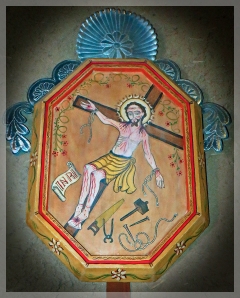
While the Romans didn’t invent crucifixion, they had perfected it by the time of Jesus and the torture began long before the cross. The condemned were stripped naked, tied to a post, and flogged across the back, legs, and buttocks by Roman soldiers using whips called flagrums consisting of small pieces of bone and metal attached to a number of leather strands. The scourging left the victims’ skin ripped to the bone. If they survived the scourging, they were taunted and forced to carry the crossbar of their death instrument to the place of execution. According to Josephus, sometimes Roman soldiers further tortured the condemned by blinding them or cutting off a body part (like the tongue). Arms were nailed or strapped to the cross beam and feet to the upright. Once upright, a massive strain was put on the wrists, arms and shoulders often resulting in dislocated shoulder and elbow joints. The rib cage was constrained in a fixed position making it extremely difficult to exhale and impossible to take a full breath. While death came from suffocation, loss of body fluids, and multiple organ failure, it did not come quickly.

According to Josephus, crucifixion in Palestine was a common sight so Jesus’ disciples knew all too well what carrying a cross meant. They heard stories of Roman cruelty, saw the bloodied and battered condemned carrying their crosses, and passed by the dead bodies left decaying on crosses as a warning to those who dared challenge Rome. But, for all of their lives, these same men had been waiting for the promised Messiah to come and deliver them from Roman oppression.

Perhaps, when Jesus spoke of the cross, they thought He was referring to the many Jewish rebels who had carried their crosses for defying Rome. But, unlike those times, this time they had Jesus—the promised Messiah who finally would bring victory to the Jewish nation. Even though they believed Jesus was the Messiah, they didn’t fully understand what that meant. They thought He came to defeat Rome, rather than death, and to save a nation, not the world. Even after Jesus spoke of His death on the way to Jerusalem, we have James and John ignoring that prediction and asking Jesus for positions in His kingdom. They still pictured a political victory!

The disciples abandoned Him at His arrest and, in spite of His repeated warnings, were not prepared for His death. Surely, the man who raised Lazarus from the dead wasn’t going to die a criminal’s death, but He did and there was no doubt that He was dead. When the Sabbath was over, two disappointed followers returned to Emmaus, the women went to the tomb to anoint a dead body, and the frightened disciples were gathered in a locked room. They weren’t proclaiming Jesus that morning and didn’t even believe the women when told the tomb was empty. They were a defeated, disappointed, and frightened group of men.

So, what happened to change this group of disheartened disciples? What turned them into enthusiastic evangelists? What turned them into men who willingly followed Jesus to their own equally horrific deaths? It was seeing the risen Christ! May we always remember the truth of this message: Christ has died, Christ is risen, Christ will come again!

God raised Jesus from the dead, and we are all witnesses of this. Now he is exalted to the place of highest honor in heaven, at God’s right hand. And the Father, as he had promised, gave him the Holy Spirit to pour out upon us, just as you see and hear today. [Acts 2:32-33 (NLT)]

Copyright ©2022 jsjdevotions. All rights reserved.

FLYING AWAY

Oh, that I had wings like a dove; then I would fly away and rest! I would fly far away to the quiet of the wilderness. [Psalm 55:6-7 (NLT)]

mourning doveEaster is over and “season” here in southwest Florida is winding down. More people are departing than arriving as our seasonal visitors return north, transport trucks laden with cars are moving up the interstate, and we finally can get a table at our favorite restaurant! It’s been said that there is no escape from death or taxes but we usually try to flee from just about every other unpleasant thing. Thinking their lives would be better here, our snowbirds came south to escape sub-zero temps, heating bills, and shoveling snow. While the climate here is nicer, our tropical paradise doesn’t come with a guarantee and none of us can flee from life’s uncertainties and problems.
Rather than escaping from winter weather, Naomi and Elimelech fled from Bethlehem to escape a famine. Instead of trusting God, they ran away to Moab, a pagan nation hostile to Israel. They intended staying briefly but remained for ten years during which time their sons broke Jewish law by marrying Moabite women. Moab, however, didn’t turn out to be the sort of get-away for which they hoped; sadly, Elimelech and both sons died. A widow with no sons in a hostile and pagan land was in worse straits than a family in their homeland during a famine. Having literally fallen out of the frying pan into the fire, Naomi decided to flee from Moab. At least this time, she went in the right direction—back to Bethlehem and the God of Israel!

We’re not much different from Naomi and some of our snowbirds; we want to escape to a place where life will be better, simpler, happier, easier, less costly, or more fun. Like Naomi, however, we’re likely to be disappointed because the baggage we’ve packed contains more than our clothes. Tucked in with the sunglasses and beach attire are things like problems at work, disappointments, worries, responsibilities, lack of faith, ill health, guilt, unmet deadlines, family strife, or financial problems. If we can’t physically flee from our troubles, some people try escaping through things like procrastination, alcohol, shopping, drugs, busyness, codependency, or denial. Disregarding the bills doesn’t get them paid, ignoring the lump won’t make it disappear, and taking a vacation, moving to a new house, or having another baby won’t fix a broken marriage. There is no way to escape from life’s problems, obligations, or consequences. We carry that baggage with us wherever we go.

In Naomi and Elimelech’s day (the time of the judges), famine was a test of faith but the couple missed what God planned for them by fleeing from their challenge. If we simply suffer through our troubles and allow them to be our master, we lose hope and become bitter, as did Naomi. Having resigned herself to being an embittered penniless widow with no grandchildren, upon her return to Bethlehem the woman whose name meant pleasant called herself Mara, meaning bitter. Rather than running from or resigning ourselves to our troubles, we can endeavor to change them by trusting God—exactly what Naomi and Elimelech failed to do. Instead, it was the Moabite woman Ruth who showed more faith in Israel’s God than did her in-laws. Trusting in Him, she bravely faced the challenges of widowhood by gleaning in the fields of Boaz. Ruth, however, wasn’t alone in those fields; God was at her side! No matter how bleak the situation may seem, there’s no need to flee when we remember that God is with us in our troubles.

Good people must never expect to escape troubles; if they do, they will be disappointed, for none of their predecessors have been without them. [Charles Spurgeon]

The Lord hears his people when they call to him for help. He rescues them from all their troubles. The Lord is close to the brokenhearted; he rescues those whose spirits are crushed. The righteous person faces many troubles, but the Lord comes to the rescue each time. [Psalm 34:17-19 (ESV)]

Don’t be afraid, for I am with you. Don’t be discouraged, for I am your God. I will strengthen you and help you. I will hold you up with my victorious right hand. [Isaiah 41:10 (NLT)]

Copyright ©2022 jsjdevotions. All rights reserved.

ON HIS HANDS

Yet Jerusalem says, “The Lord has deserted us; the Lord has forgotten us.” “Never! Can a mother forget her nursing child? Can she feel no love for the child she has borne? But even if that were possible, I would not forget you! See, I have written your name on the palms of my hands.” [Isaiah 49:14-16a (NLT)]

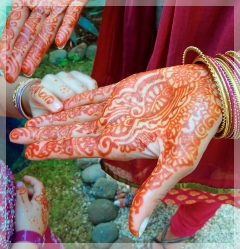
mehndiTo the delight of the girls who attended the party, my daughter-in-law hired a Mehndi artist for my grand-daughter’s birthday celebration. Using a red-orange paste made from the dried leaves of the henna plant, the artist adorned the girls’ hands or arms with assorted intricate floral motifs. Since all of the family on her mother’s side is from India, this ancient form of body art is familiar to my grand. Although she’s attended several Mehndi parties, most of her guests have not. A Mehndi party for close friends and family is an important pre-wedding tradition in any Indian wedding. Along with plenty of food and music, there are henna artists. While they take only a few minutes painting designs on the guests, they spend several hours painting intricate geometric shapes and floral and paisley motifs on the bride’s hands, arms and feet. Hidden somewhere among the elaborate patterns on her body is the groom’s name.

Tradition holds that finding the hidden name is a game the newlyweds play on the wedding night. If the groom manages to find his name hidden among all of the designs, he will be the boss of the marriage; if he doesn’t, his wife rules the roost! Determining the boss in the relationship, however, isn’t why God says He’s written Israel’s name on the palms of His hands. Nevertheless, having the name of the bride’s beloved written on her hands always reminds me of God’s words in Isaiah 49.

At the time of Isaiah’s prophecies, Israel was facing hard times and captivity. Although they were the ones who abandoned God, they thought God had forgotten them and no longer cared whether or not they existed. In these verses, God reassures Israel that He will never forget them and, as a sign of His commitment, He’s even written Israel’s name on the palms of his hands.

Assuring Israel that He loves them like a mother, God compares forgetting them to the impossibility of a nursing mother forgetting her suckling child. Having nursed my children, I guarantee a nursing mother can’t forget her infant. If her hungry baby doesn’t make his presence known with howling, her uncomfortably full breasts will remind her that it’s time to feed him. Nursing mothers aren’t likely to forget their babies but, even if they could, God says He won’t because Israel’s name is inscribed on His hand.

The Hebrew word used was chaqaq and meant far more than just applying dye to someone’s skin; it meant to cut in, carve, or engrave. Unlike Mehndi which fades in two to three weeks, Israel’s name was permanently cut into God’s hands. Used figuratively, these two analogies symbolized God’s eternal commitment to His people and His covenant promises.

As Christians, what do promises made to Israel mean to us? In the Old Testament, Israel is used in several ways: Israel is a person (Jacob), a people (the descendants of Jacob’s twelve sons), the “promised land” (a mass about the size of Rhode Island), the northern kingdom after the kingdom divided, and sometimes even the southern kingdom of Judah. In the New Testament, however, Israel takes on a new meaning. Rather than a person, people, land mass, or political nation, Israel is a spiritual kingdom. Before Jesus, it was one’s bloodline that defined an Israelite; it’s different now. As the Apostle Paul explains, a true Israelite now is someone who believes in the Messiah Jesus Christ. It is faith, rather than things like circumcision and descending from Abraham’s bloodline, that makes us “sons of Abraham.” God’s promises to Israel are promises made to us because they’ve been received by faith rather than bloodline.

Fear not, no matter how dark the days, God will never forget us—our names are etched into the palms of His hands!

…for not all who are born into the nation of Israel are truly members of God’s people! Being descendants of Abraham doesn’t make them truly Abraham’s children…. Abraham’s physical descendants are not necessarily children of God. Only the children of the promise are considered to be Abraham’s children. [Roman 9:6b-7a,8 (NLT)]

The real children of Abraham, then, are those who put their faith in God. … God gave the promises to Abraham and his child.  And notice that the Scripture doesn’t say “to his children,” as if it meant many descendants. Rather, it says “to his child”—and that, of course, means Christ. [Galatians 3:7,16 (NLT)]

Copyright ©2022 jsjdevotions. All rights reserved