
SEEING THE OTHER SIDE

Monarch buttefliesNow all glory to God, who is able, through his mighty power at work within us, to accomplish infinitely more than we might ask or think. [Ephesians 3:20 (NLT)]

“He’s so young!” said my husband when my brother died at the age of fifty-six. I reminded him that my dad was the same age when he died. “But he was old!” my husband exclaimed. The difference, of course, is that we were in our fifties when my brother died but only in our twenties when my father did. That the same thing can look so different from two viewpoints makes me think of those tilt or magic motion cards that used to come in Cracker Jack© boxes. Done by something called lenticular printing, one card holds two or more different images. Titled one way, there might be the traditional Mona Lisa but, tilted the other way, she would be winking with a goofy grin on her face. Just as whether someone seems young or old depends as much on our age as theirs, what is perceived on a tilt card depends on the angle at which it is viewed.

When we look at a magic motion card, we only see what’s right in front of us but, when God looks at one, He sees if from all sides. Looking at life from just our viewpoint, we only see what’s happening now and how it affects us and those we love. We see the delay and feel the frustration of waiting but, from His viewpoint, God also sees us learning patience. We see the task and protest that our work is too demanding but He sees that we’re learning determination. We see the unknown and hesitate in fear but He sees us learning to trust Him. We see the betrayal and feel resentment but He sees us learning to forgive. We see the burden of caregiving and grow tired but He sees us learning about sacrifice. We see the cranky in-laws and get exasperated but He see us learning about unconditional love. We see the failure and are disheartened but He sees us developing resilience. Rather than looking at circumstances from just our viewpoint, we need to tilt the picture and look at circumstances through the eyes of God.

One of my favorite Bible verses is Jeremiah 29:11: “For I know the plans I have for you,” says the Lord. “They are plans for good and not for disaster, to give you a future and a hope.” Unfortunately, that’s about as specific as God gets in detailing those plans. So, just as I can’t see both pictures on a tilt card at once, I have no idea what is on the other side of today’s challenges. I will just have to settle for knowing that our loving God sees it all and His plans for me are good ones.

God allows us to experience the low points of life in order to teach us lessons we could not learn in any other way. The way we learn those lessons is not to deny the feelings but to find the meanings underlying them. [Stanley Lindquist]

We can rejoice, too, when we run into problems and trials, for we know that they help us develop endurance. And endurance develops strength of character, and character strengthens our confident hope of salvation. And this hope will not lead to disappointment. For we know how dearly God loves us, because he has given us the Holy Spirit to fill our hearts with his love. [Romans 5:3-5 (NLT)]

Copyright ©2018 jsjdevotions. All rights reserved.

CROWNING GLORY

Gray hair is a crown of glory; it is gained by living a godly life. [Proverbs 16:31 (NLT)]

The glory of the young is their strength; the gray hair of experience is the splendor of the old. [Proverbs 20:29 (NLT)]

GrandmaGrey hair may be a crown of glory and the splendor of old age, but that’s about all the splendor and glory I see in advanced years. As my mother-in-law approaches her 102nd birthday, there is little about her quality of life that I consider glorious or splendid. Her sparkling personality, vigor and enthusiasm, along with her hearing, visual perception, ability to reason, and memory are vanishing. Occasionally a spark of her old self resurfaces but, for the most part, the essence of the woman who has been a mother to me for over fifty years has disappeared.

When I join my mother-in-law for meals at her senior residence, along with gray hair, I see plenty of stooped, shuffling, and incapacitated people. While speaking with them, rather than words of wisdom, I often hear the words of confused and failing minds. While writing about fear yesterday, I realized that, while I’m not afraid of old age, I am afraid of the infirmities that can come with it.

Fear may lie about plenty of things but he doesn’t lie when he tells me I’m getting old. The mirror, arthritis, my worsening eyesight, and my less than sharp memory tell me that every day. Fear, however, doesn’t stop at telling me I’m old. When I walk into a room and forget why I went there or fail to recall someone’s name, he whispers “dementia.” When my knees scream or my back aches, he flashes an image of an old woman hunched over a walker. If I need a magnifying glass to read directions or a small flashlight to scan a menu, he tells me it’s only a matter of time before I’m blind as a bat. Fear, however, doesn’t know what the future holds and neither do I.

My life expectancy at birth was almost 70 years of age. Having passed that milestone, I took an online test to determine my expected expiration date. Based on my zip code, marital status, and present health and weight, it’s a high probability that I’ve got twenty-five more years. Rather than finding that number reassuring, I find it terrifying. I don’t want to require help to bathe or dress and I don’t want to give up hikes through the woods or riding a bike. I don’t want there to be a time when I can’t read my Bible, remember the verses I’ve worked so hard to memorize, or do a crossword puzzle or Sudoku. I don’t want to need Depends, use a wheelchair, or forget my children’s names. I want to stay the way I am now but, short of dying today, that’s not likely to happen. Moreover, what I want doesn’t matter. Time will take its toll on all of us and, for some, that toll will be great. All we can do is take care of ourselves the best we can and trust the rest to God. As long as He gives us breath, He has a purpose for us. Our job is to live purposefully, thankfully, and joyfully all the days He’s given us.

As for my mother-in-law, in spite of her loss of vitality and mental faculties, she remains cheerful, pleasant and friendly (and she looks fabulous). Her younger tablemates tell me she’s an inspiration to them. Indeed, when I think about it, she’s an inspiration to me. She is facing the ailments and indignities that come with advanced age with faith, grace, and love. With God’s power, I can do the same. I will make the most of today, send fear packing, and let God worry about my tomorrows!

God never said that the journey would be easy, but He did say that the arrival would be worthwhile. [Max Lucado]

My health may fail, and my spirit may grow weak, but God remains the strength of my heart; he is mine forever. Psalm 73:26 (NLT)]

That is why we never give up. Though our bodies are dying, our spirits are being renewed every day. [2 Corinthians 4:16 (NLT)]

Copyright ©2018 jsjdevotions. All rights reserved.

LEAVING THE COMFORT ZONE

snake river raftingHe said, “That’s what I mean: Risk your life and get more than you ever dreamed of. Play it safe and end up holding the bag.” [Luke 19:26 (MSG)]
If I am never tempted, and cannot even imagine myself being tempted, to gamble, this does not mean that I am better than those who are. The timidity and pessimism which exempt me from that temptation themselves tempt me to draw back from those risks and adventures which every man ought to take. [From “Reflections on the Psalms” by C.S. Lewis]

We were accompanied by two grandchildren, ages fifteen and eighteen, during part of our trip west. When my husband mentioned taking them on a raft trip, I pictured a scenic float down the Snake River and readily agreed. What got booked, however, was a white water adventure. Not a thrill seeker, adrenaline inducing adventures are not my thing. I was not happy about the scheduled activity and began thinking of ways to gracefully bow out of it. By coincidence (or what I call God-incidence), the above quote by C. S Lewis arrived in my email. I realized that my fear of stepping out of my rather narrow comfort zone was threatening to keep me from sharing this once-in-a-lifetime experience with my precious grands. Lewis’ words (and some much needed prayer) convinced me that this was one adventure I should not miss.

Prayer got me in the raft and I bravely paddled through the rapids. Even after we tipped and lost six of the eight passengers on the third set of rapids, witnessing the grins on the kids’ faces as they were pulled back into the raft made both the dunking and the adrenaline spike worth it. All’s well that ends well and, in spite of the soaking in the rapids, the rafting wasn’t nearly as terrifying as I’d imagined. When asked to name the highlight of their twelve days with us, our grands both mentioned the raft trip—and to think I nearly missed sharing that experience with them! The pictures taken from the photographer’s spot on shore would not have captured their smiles and whoops of delight at the rapids or the thrill of the ride!

While a certain amount of caution is wise, as C.S. Lewis pointed out, there are certain risks and adventures that none of us should miss. Timidity, pessimism, faint-heartedness, fear, and anxiety can keep us from unsafe behavior like drugs, gambling, or adultery but they shouldn’t make us retreat “from those risks and adventures which every man [and woman] ought to take.” Consider what they would have missed if Peter had allowed fear to keep him from stepping out of the boat onto the water, if David had allowed faint-heartedness to keep him from facing Goliath, or if Moses and Gideon had allowed their pessimism to prevent them from accepting the tasks given them by God.

God invites us to participate in world-changing adventures that probably have nothing to do with white water rafting. We mustn’t allow a reticence to step out of our comfort zones prevent us from accepting His invitation to go on that journey. While the adventure may involve an element of risk, the rewards will be well worth it!

Summing it all up, friends, I’d say you’ll do best by filling your minds and meditating on things true, noble, reputable, authentic, compelling, gracious—the best, not the worst; the beautiful, not the ugly; things to praise, not things to curse. Put into practice what you learned from me, what you heard and saw and realized. Do that, and God, who makes everything work together, will work you into his most excellent harmonies. … Whatever I have, wherever I am, I can make it through anything in the One who makes me who I am. [Philippians 4:8-9,13 (MSG)]

Copyright ©2018 jsjdevotions. All rights reserved.

UNIMAGINABLE  BUT TRUE

Then the rich man said, “O Father Abraham, then please send him to my father’s home—for I have five brothers—to warn them about this place of torment lest they come here when they die.” But Abraham said, “The Scriptures have warned them again and again. Your brothers can read them any time they want to.” The rich man replied, “No, Father Abraham, they won’t bother to read them. But if someone is sent to them from the dead, then they will turn from their sins.” But Abraham said, “If they won’t listen to Moses and the prophets, they won’t listen even though someone rises from the dead.” [Luke 16:27-31 (TLB)]

A land of contradictions, a spectacular pageant, a world incomprehensible…a wonderful gift to men from a benign God—all this and more. [Olin Wheeler, 1914]

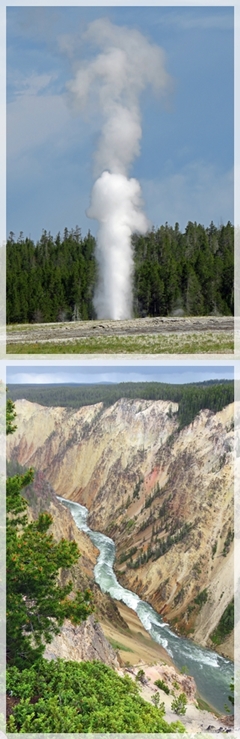
lion geyser - grand canyon of yellowstone

Although Native Americans have existed in the Yellowstone area for as long as 11,000 years, it took three major expeditions before the American public finally believed that the wonders in what is now Yellowstone National Park actually existed. The earlier descriptions of “fire and brimstone,” huge waterfalls, exploding geysers, boiling mud pots and other strange features of the region were met with unbelief until William Jackson’s photographs and Thomas Moran’s paintings from their 1871 Yellowstone expedition were presented to Congress. Once people had visual proof of the area’s bizarre geothermal wonders, they finally believed and Yellowstone became our nation’s first national park.

Indeed, having recently toured this park that sits on atop of the largest super-volcano in North America, I can understand how unbelievable those first mountain men’s stories must have seemed. In my wildest dreams, I couldn’t have imagined either the beauty or the strangeness of Yellowstone—colored travertine terraces, mud volcanos, steaming caves, a 24-mile long canyon, over 200 waterfalls, and more than 10,000 geysers and hot springs. Other worldly, it is something that truly must be seen to be believed.

Jesus told the Pharisees a parable about two men: the unrighteous rich man who died and went to a place of torment and the beggar Lazarus who died and went to a heavenly banquet. The rich man wanted to send Lazarus back to warn his brothers to change their ways. His request was denied since, like him, his brothers had ignored the warnings found in the Law and the Prophets so they wouldn’t be convinced by someone returning from the dead. Indeed, even though Jesus did return from the dead, there are many who do not believe.

We often wonder what heaven and/or hell will be like. Jesus didn’t mince any words when he spoke of the final judgment and it doesn’t sound pleasant. When the Apostle John was given a glimpse of heaven, his words in Revelation seem almost as incomprehensible to us as the words the mountain men used to describe Yellowstone’s bubbling mud pots and hissing fumaroles were to nineteenth century Americans. Father Abraham didn’t send back Lazarus and no one is going to return from death with photographs or paintings to prove what happens when we take our last breath.

Words can’t adequately describe Yellowstone and the few Biblical descriptions of both heaven and hell don’t do them justice, either. Nevertheless, like the rich man’s brothers, we have all the information we need in Scripture. As the American public learned in 1871, just because we can’t imagine something doesn’t mean it isn’t there!

Just as in this story the thistles are separated and burned, so shall it be at the end of the world: I will send my angels, and they will separate out of the Kingdom every temptation and all who are evil, and throw them into the furnace and burn them. There shall be weeping and gnashing of teeth. Then the godly shall shine as the sun in their Father’s Kingdom. Let those with ears, listen! [Matthew 13:40-43 (TLB)]

Copyright ©2018 jsjdevotions. All rights reserved.

HIS TIME IS THE RIGHT TIME

butterfly weedBut when the right time came, God sent his Son, born of a woman, subject to the law. [Galatians 4:4 (NLT)]

When an angel of the Lord told the elderly priest Zechariah that his barren wife, Elizabeth, would conceive a son, the old man was struck dumb because of his unbelief. As happened with Samuel more than 1,000 years earlier, this child’s future was decided even before his conception. This time, however, it was God who decided the boy would be a Nazirite, have the spirit and power of Elijah, prepare the people for the coming of the Lord, and be named John. Imagine the mute Zechariah, with gestures and writing, trying to explain his supernatural encounter to Elizabeth and her reaction to his shocking news.

As strange as God’s timing must have seemed to the elderly Elizabeth, God’s timing probably seemed even stranger to Elizabeth’s cousin, a young virgin in Nazareth named Mary. While Elizabeth’s unexpected pregnancy seemed late in coming, Mary’s must have seemed terribly premature to her and her betrothed, a carpenter named Joseph. Nevertheless, both of these unexpected pregnancies were part of God’s enigmatic plan and came at exactly the right time, at least for Him.

We don’t know why God chose that particular time in history for the births of John and Jesus. Did God pick it because He had the right people to be the parents he needed? The priest and his wife were “righteous in God’s eyes, careful to obey all of the Lord’s commandments and regulations,” [Luke 1:6] which certainly qualified them as a prophet’s parents. For the parents of Jesus, God needed a both a virgin and lineage to King David. Rather than glowing words to describe Mary, we only have the virgin’s obedient and willing response. Risking rejection, disgrace, and even stoning, she willingly offered herself as God’s vessel. As for Joseph, he was a righteous man, of the house of David, and, like Mary, obedient to the Lord. Perhaps God chose that time because conditions were favorable for the start of a ministry: there was peace in the empire, Greek had become the universal language, an excellent road system enabled easy travel, and a postal service existed. Was it a perfect combination of both people and conditions? We’ll never know; we only know that the time was right for God.

Nevertheless, I’m sure God’s timing didn’t make much sense to either woman. For Elizabeth, God seemed late and, for Mary, He seemed way too early. Let us remember, however, that God is neither late nor early; He’s always right on time!

In the infinite wisdom of the Lord of all the earth, each event falls with exact precision into its proper place in the unfolding of His divine plan. Nothing, however small, however strange, occurs without His ordering, or without its particular fitness for its place in the working out of His purpose; and the end of all shall be the manifestation of His glory, and the accumulation of His praise. [B.B. Warfield]

Yet God has made everything beautiful for its own time. He has planted eternity in the human heart, but even so, people cannot see the whole scope of God’s work from beginning to end. [Ecclesiastes 3:11 (NLT)]

Copyright ©2018 jsjdevotions. All rights reserved.

THE PLAN

“For this child I prayed, and the Lord has granted me my petition that I made to him. Therefore I have lent him to the Lord. As long as he lives, he is lent to the Lord.” [1 Samuel 1:27-28 (ESV)]

Maligne Lake - CanadaRichard Williams was watching TV when he saw a tennis player awarded a $40,000 check for winning a tournament. He decided then that his as yet unborn children would become tennis stars. Williams wrote a 78-page plan detailing their future, taught himself how to play tennis and, when his girls were four, started teaching them to play the game. Before they were even born, he’d planned the future for tennis greats Serena and Venus Williams.

Hannah did much the same thing for her child Samuel. Heartbroken at her inability to get pregnant, she promised God that, if He gave her a son, she would give him back to God as a Nazirite. Although the Nazirite vow was to be voluntary and temporary, Hannah committed her as yet unconceived child to a lifetime of separating himself from the world, dedicating himself to the Lord, and never cutting his hair, consuming wine (or any grape product), or getting near a dead body. After giving birth to Samuel, she fulfilled her vow; once he was weaned, she brought him to Shiloh and left him in the care of Eli the priest.

Can you imagine the youngster’s tears as he watched his parents leave? Every year, when his family returned to Shiloh for worship and sacrifice, Hannah brought a new coat for the boy and, every year, Samuel remained in Shiloh while his family went back home with the five siblings that arrived after his birth. Instead of playing whatever little boys played in 1100 BC, Samuel remained as an apprentice to an old priest in the temple. Can you imagine his loneliness and grief? Nevertheless, this is the life Hannah decided he should have.

Perhaps, however, it wasn’t Hannah but rather God who wrote the plan for Samuel. Hannah had no children because “the Lord had closed her womb.” Could He have been waiting to open her womb until she became desperate enough to make such an amazing sacrificial vow?

The priest Eli had two grown sons, Hophni and Phinehas. In spite of being priests, they were wicked worthless men who cheated, seduced women, stole from the people, and were unworthy to carry on Eli’s priestly duties. Could God have arranged circumstances so that someone worthy of the task could grow in godliness while apprenticing to Eli? When Eli and his sons died, it was Samuel who became the priest, prayer warrior, first of the prophets, and last (and most effective) of Israel’s judges. It was Samuel who anointed both Saul and David. It was Samuel, the child given to God before his conception, who was listed by Paul in the Hall of Faith.

At first glance, Hannah seemed a bit like Richard Williams (and a host of stage moms and sport dads) who decide their children’s dreams for them. Looking closer, we see that God mapped out a scenario even more elaborate than Richard William’s 78-page plan. I’m sure it didn’t make much sense to Hannah when she made the vow that took her son from his family and it certainly didn’t make sense to the young Samuel when he watched them wave farewell. In retrospect, however, it makes all the sense in God’s world; He has a way of making sense of it all!

And Samuel grew, and the Lord was with him and let none of his words fall to the ground. And all Israel from Dan to Beersheba knew that Samuel was established as a prophet of the Lord. [1 Samuel 3:19-20 (ESV)]

Copyright ©2018 jsjdevotions. All rights reserved.