OR ELSE

My child, do not reject the Lord’s discipline, and don’t get angry when he corrects you. The Lord corrects those he loves, just as parents correct the child they delight in. [Proverbs 3:11-12 (NCV)]

little blue heron“Baby Blues,” a comic strip by Rick Kirkman and Jerry Scott, portrays the MacPherson family and the frustration, craziness, and humor that come with parenthood. Perhaps because I had a boy like him, my favorite character is the middle child, Hammie. Without a doubt, the inventive boy is a handful but he’s delightful in his own special way. When Zoe, his older sister, comments that he’s stopped making his usual annoying noise, he explains: “Mom used the three magic words.” When Zoe asks, “Please and thank you?” he clarifies, “Stop or else!”

Like the MacPhersons, the three magic words at our house were “please” and “thank you.” However, like Hammie’s mother, there were times I gave my children the option of obedience or facing the consequences with the other three: “Stop, or else!” Of course, the “or else” is an empty caution unless there’s an understanding of what “or else” entails.

The Old Testament is filled with God’s warnings of “or else” to the Israelites; sadly, it’s also a chronicle of their repeated failure to listen and obey Him. Time and time again, they disregarded God’s law, rejected His prophets, fought among themselves, worshipped other gods, and participated in pagan practices. They couldn’t say they weren’t warned by all the judges, kings, and prophets God sent to them so they shouldn’t have been surprised by the famines, floods, droughts, wars, exile, and oppression that resulted from their disobedience. Those afflictions, however, didn’t mean God had been unfaithful to His people. On the contrary, He was completely faithful to his words of warning. By withholding His blessings, the people got exactly what God said they would.

The book of Judges is a series of “Stop or else!” stories. Time and time again, after their disobedience, the Israelites faced the consequences of oppression by people like the Philistines and Ammonites. They eventually repented, called to God for help, and were granted relief. Although a period of peace followed, they were slow learners and the cycle would repeat: obedience gave way to disobedience and they again faced God’s “or else.” Nevertheless, just like Hammie’s patient and loving mother in the comic strip, God never gave up on His people.

Like a good parent, God gives fair warning and provides his people with plenty of opportunities to change their ways. Jesus warned us about sin, Satan, hypocrisy, pride, selfishness, materialism, greed, and false teachings. He clearly told us there are consequences to sinful behavior: the wages of sin is death, there will be a day of judgment, the unrighteous won’t enter the Kingdom, unbelief brings death but belief brings life, and the day of His return will come without warning. Scripture tells us how it will end—we can’t say we haven’t been warned!

It is the wonder of the grace of God that he has given such warnings. If we do not listen and turn from our evil ways, and so suffer awful judgment, then it is not the grace and love of God that is lacking, but the fault of our unrepentant hearts which refuse to heed the revelation of God, and spurn his love. [Georgina W. Everingham]
Our fathers on earth disciplined us for a short time in the way they thought was best. But God disciplines us to help us, so we can become holy as he is. We do not enjoy being disciplined. It is painful at the time, but later, after we have learned from it, we have peace, because we start living in the right way. … So be careful and do not refuse to listen when God speaks. Others refused to listen to him when he warned them on earth, and they did not escape. So it will be worse for us if we refuse to listen to God who warns us from heaven. [Hebrews 12:10-11, 25 (NCV)]

Copyright ©2021 jsjdevotions. All rights reserved.

THE MAIN THING

Martha was frantic with all the work in the kitchen. “Master,” she said, coming in to where they were, “don’t you care that my sister has left me to do the work all by myself? Tell her to give me a hand!” … He replied, “You are fretting and fussing about so many things. Only one thing matters. Mary has chosen the best part, and it’s not going to be taken away from her.” [Luke 10: 40-42 (NTE)]

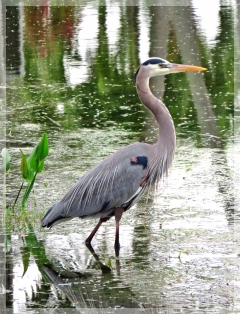
great blue heronThe guest pastor shared an experience when he was an intern at a large church. Posted on the door leading into the senior pastor’s office was this quote by Stephen Covey: “The main thing is to keep the main thing the main thing.” At eye level and in large letters, anyone entering the pastor’s office was sure to see it. He’d given the sign little thought until one day, hot under the collar and ready to voice a complaint, he started to knock on his boss’s door. Seeing the sign, he paused, quietly returned to his desk, gave his complaint more thought, and asked himself if he was keeping the main thing main with his grievance.

Of course, to keep the main thing main, we must identify it first. Scripture, however, makes the main thing rather clear: love God, love others, and follow Jesus. Nevertheless, even when we’ve determined the main thing, it’s easy to get distracted and shift our focus. Like a reader who nitpicks over semi-colons and spelling while ignoring the significance of the words, we frequently cease focusing on God and His purpose to focus on ourselves and our interests.

Martha, for example, lost sight of the main thing when she complained to Jesus about her sister Mary. The mother of James and John lost sight of the main thing when she demanded special treatment for her boys and the disciples lost sight of the main thing when they squabbled over who was the greatest. Losing sight of the main thing, Elijah threw himself a pity party when things got tough, Jonah tried to escape his assignment in Nineveh, and the Pharisees carefully tithed their spices but neglected their parents and neighbors.

Our complaints to others (and to God) usually have little or nothing to do with God’s plan but rather with how it affects us. I’m busy, tired, bored, annoyed, angry, unappreciated, taken advantage of, better than him, too good for that, underpaid, or over-scheduled. Maybe some of our complaints are true. The question, however, remains—are any of them the main thing? If not, what is?

Father in heaven, help us keep our eyes on the main thing—you, accepting your plan, and furthering your kingdom. May we always remember that the main thing is never about us and always about you!

Let the king’s word dwell richly among you, as you teach and exhort one another in all wisdom, singing psalms, hymns and spiritual songs to God with grateful hearts. And whatever you do, in word or action, do everything in the name of the master, Jesus, giving thanks through him to God the father. [Colossians 3: 16-17 (NTE)]

Look at it like this. People whose lives are determined by human flesh focus their minds on matters to do with the flesh, but people whose lives are determined by the spirit focus their minds on matters to do with the spirit. [Romans 8:5 (NTE)]

Copyright ©2021 jsjdevotions. All rights reserved.

GETTING OUT OF THE PIT

Dear brothers and sisters, when troubles of any kind come your way, consider it an opportunity for great joy. For you know that when your faith is tested, your endurance has a chance to grow. So let it grow, for when your endurance is fully developed, you will be perfect and complete, needing nothing. … God blesses those who patiently endure testing and temptation. Afterward they will receive the crown of life that God has promised to those who love him. [James 1:2-4,12 (NLT)]

donkeyThe story is told of a donkey who fell into a deep pit. Unable to get out, the animal brayed loudly until the farmer came to investigate. Seeing no way to get his donkey out of the pit, the farmer decided the only thing he could do was to put the poor animal out of its misery. Since the pit needed to be filled anyway, he got a spade and started to shovel dirt into it. When the donkey felt those first clods of dirt on his back, he lost all hope of rescue and brayed even louder. As he shook the dirt off his back, however, he discovered a growing mound of dirt beneath his feet. Seeing a possible solution, the donkey grew silent as he continued to shake dirt off his back and started tamping it down with his hooves. As the dirt piled up beneath his feet, the donkey got higher and higher in the pit. Paying no attention to the now silent animal, the farmer kept shoveling until he finally stopped for a rest. When he turned around, the man was shocked to see the donkey step out of the pit and trot away. The animal could have chosen to wallow in his misery—simply hung his head and let that dirt cover him up—but he didn’t. Instead, he took steps to change his situation.

Giving up is often our first response when we get buried in our troubles. Deciding the marriage can’t be saved, the situation is hopeless, we’ll never beat the addiction, we’re worthless sinners, we failed, no one understands, or that the pain will never end, we don’t even try to find a fix! That, however, means we’ve ceded control of our lives to something or someone other than God. By giving up, we’ve stopped living God’s will because we’re not letting Him shape and mold us in our circumstances. God’s not done with us until He says so!

When I look back at some of my worst experiences, heaviest trials, and most heartbreaking times, I see my greatest emotional and spiritual development. Growth seems to occur in the valleys (or pits) rather than on the hilltops. Perhaps that’s because we want to maintain the status quo in the good times; when all is going smoothly, we certainly don’t want to rock the boat with any change. Bad times, however, make us as uncomfortable as that trapped animal. Like the donkey, when we are buried in trouble, we have a choice: wallow in misery or make a change.

Instead of letting the dirt bury him, the donkey turned it into a gift. We can see our troubles as penalties or gifts, endings or beginnings, impediments or opportunities. The choice is ours. Life is always going to try to weigh us down; the trick is in deciding to get out of the pit. The donkey did it by shaking off the dirt. As people of hope who know that Jesus can do within us that which we can’t do for ourselves; let us do the same!

We are always on the anvil; by trials God is shaping us for higher things. [Henry Ward Beecher]

We can rejoice, too, when we run into problems and trials, for we know that they help us develop endurance. And endurance develops strength of character, and character strengthens our confident hope of salvation. And this hope will not lead to disappointment. For we know how dearly God loves us, because he has given us the Holy Spirit to fill our hearts with his love. [Romans 5:3-5 (NLT)]

Copyright ©2021 jsjdevotions. All rights reserved.

TOO HEAVY

My thoughts are nothing like your thoughts,” says the Lord. “And my ways are far beyond anything you could imagine. For just as the heavens are higher than the earth, so my ways are higher than your ways and my thoughts higher than your thoughts. [Isaiah 55:8-9 (NLT)]

mockingbirdAfter Jane Marczweski’s stunning performance on America’s Got Talent last June, I posted a devotion (It’s Okay) about her. Known as Nightbirde, the 30-year-old vocalist (and three-time cancer survivor) sang an original song called “It’s Okay” and received the “golden buzzer” from judge Simon Cowell. Last week, the brave young woman had to withdraw from the competition because her health has taken a turn for the worse. In an interview on CNN with Chris Cuomo, she shared that her metastatic breast cancer has now invaded both lungs and liver and her fight with cancer is demanding all of her energy and attention.

When we see a young person like Nightbirde, a beautiful person both inside and out who seems so deserving of good future, it’s easy to ask the age-old question of “Why?” Why do some of the best people, the ones with the most to offer, seem to suffer the most or have their futures cut short when many of the worst and worthless seem to breeze along without a problem? Why, when life begins to look up does God so often pull out the rug? “Life doesn’t always give breaks to those that deserve it,” said the singer while adding, “but we knew that already.” Indeed, we did; nevertheless, we don’t like it!

When Cuomo asked Nightbirde if she ever wonders, “Why?” the young woman replied, “I try not to occupy myself with questions that are too big for myself to answer. It’s a waste of time. You know, just because it’s a mystery doesn’t mean it’s the absence of meaning. Sometimes, the mystery means there is more meaning there than we can even understand and so I accept that and I let go of the question because it’s too heavy.”

Indeed, much in our lives seems inexplicable and far beyond our comprehension. But, as the young singer pointed out, incomprehensible or unknowable doesn’t mean meaningless or pointless. It’s a mystery why Nightbirde’s promising future probably will be cut short; then again, it’s a mystery why my mother died when I was fifteen, why my brother was struck with inoperable cancer at the moment his life finally took an upturn after years of trouble, and why the God-fearing believers on my prayer list have been burdened with things like mesothelioma, Alzheimer’s, Parkinson’s, MS, schizophrenia, and chronic pain. This young woman’s words remind us all that our lack of understanding of God’s purpose doesn’t mean that what happens is without meaning.

I can’t understand quantum physics any more than I can understand the ways of God. The difference between the two is that, given enough time, effort, and tutoring, I eventually could understand quantum physics but I will never be able to fully understand God. While we can come to know and love Him, we never will be able to comprehend His mysterious ways. Indeed, some questions are so weighty that we’d never make sense of God’s answer even if He explained it to us!

This optimistic young woman says she’s planning for her future rather than her legacy and says, “I want to be the bird that sings in anticipation of the good things that I trust are coming.” As a Christian, Nightbirde doesn’t need to ask God “Why?” because she knows good things are coming, whether in this world or the next!

Oh, how great are God’s riches and wisdom and knowledge! How impossible it is for us to understand his decisions and his ways! For who can know the Lord’s thoughts? Who knows enough to give him advice? And who has given him so much that he needs to pay it back? For everything comes from him and exists by his power and is intended for his glory. All glory to him forever! Amen. [Romans 11:33-36 (NLT)]

Copyright ©2021 jsjdevotions. All rights reserved.

SHOW US

Always celebrate, never stop praying; in everything be thankful (this is God’s will for you in the Messiah Jesus). [1 Thessalonians 5:16-18 (NTE)]

green heronEarlier this week, I wrote about the ten Boom sisters giving thanks in their horrible circumstances. Because of the physical pain I’ve been experiencing these last several weeks, I know how easy it is to talk the talk but how hard it is to actually walk it. Indeed, when you’re hurting, giving thanks in all circumstances is far easier said than done.

1 Thessalonians 5:18, however, doesn’t say we must give thanks for everything; we are to give thanks in everything and there’s a big difference between the two. Knowing that God’s love and mercies never cease and that we are His well-loved children, even though we don’t welcome our circumstances, we can be thankful in them. Even when we can’t see His purpose in our present situation, we know that God is intimately involved in them and is working for our good through them. We can be thankful that we are not facing our affliction alone. Jesus was with Corrie and Betsie ten Boom in Ravensbrück, He’s here with me, and He’s there beside you wherever and whatever you’re going through. Knowing this enables us to give thanks in all circumstances!

While writing about Betsie and Corrie ten Boom, I remembered Betsie’s response to Corrie when she asked how they could live in the deplorable conditions of the Ravensbrück concentration camp. Rather than answering her sister, Betsie immediately started to pray, but she didn’t ask God to change their situation. Instead, she simply asked God to show them how to live in their present one; “Show us. Show us how,” she prayed.

Recalling Betsie ten Boom’s prayer of “Show us,” I realized that, along with discerning God’s purpose for my pain and giving thanks in my circumstances, I needed to ask Him to show me how to function in my new normal. If given a choice, I wouldn’t have selected back and neck pain from life’s menu but my pastor friend wouldn’t have chosen stage-4 cancer nor would my sister have selected MS. The ten Boom sisters wouldn’t have chosen a concentration camp and none of us would have selected a pandemic. As unwanted as they were, however, they were what we got. Let us graciously accept them as we ask for God’s guidance and the power to live in them. Someday, it all will make sense. Until that time, as we wonder how we can function in our difficult circumstances, we can pray Betsie’s prayer: “Show us. Show us how.” God answered me and He will answer you!

There is nothing—no circumstance, no trouble, no testing—that can ever touch me until, first of all, it has gone past God and past Christ right through to me. If it has come that far, it has come with a great purpose, which I may not understand at the moment. But as I refuse to become panicky, as I lift up my eyes to Him and accept it as coming from the throne of God for some great purpose of blessing to my own heart, no sorrow will ever disturb me, no circumstance will cause me to fret, for I shall rest in the joy of what my Lord is—that is the rest of victory! [Alan Redpath]

For this reason we don’t lose heart. Even if our outer humanity is decaying, our inner humanity is being renewed day by day. This slight momentary trouble of ours is working to produce a weight of glory, passing and surpassing everything, lasting for ever; for we don’t look at the things that can be seen, but at the things that can’t be seen. After all, the things you can see are here today and gone tomorrow; but the things you can’t see are everlasting. [2 Corinthians 4:16-18 (NTE)]

Copyright ©2021 jsjdevotions. All rights reserved.

HIS MEGAPHONE

We know, in fact, that God works all things together for good to those who love him, who are called according to his purpose. [Romans 8:28 (NTE)]

Pain insists upon being attended to. God whispers to us in our pleasures, speaks in our conscience, but shouts in our pain: it is His megaphone to rouse a deaf world. [C.S. Lewis]

columbineWhen we’re hurting, it’s not easy to reconcile how an entirely good, ever-loving, and all-powerful God can allow pain and suffering. The simplest answer is that, since He gave us free will, we can’t hold Him responsible for what mankind has done with that free will. We can’t blame God for global warming, tooth aches, concentration camps, genocide, cancer, red tide, wars, tornadoes, torn ligaments, or rising COVID cases. We alone are the ones responsible for mankind’s poor choices and the disease, death, destruction, and suffering that have accompanied us since we were evicted from Eden.

Pain tells us something is wrong and often begins with little nudges, ones that are easy to disregard. However, when the pain gets bad enough, it can’t be ignored. C.S. Lewis calls pain God’s “megaphone to rouse a deaf world.” I don’t know how well the world is listening to Him but I know that my recent issues with neck and back pain got my attention!

While discerning the physical reason for my pain was relatively easy, I suspected there was more to it than arthritis, herniated discs, bone spurs, ergonomics, posture, and too many hours at the computer. God doesn’t haphazardly distribute pain and trials. If pain is God’s way of getting our attention, we need to understand what God is telling us with it—to discern God’s purpose so that we can get on board with His plan.

A little soul searching and prayer told me that it wasn’t just my body that had gotten out of alignment—so had my priorities. Like the busy Martha, I’d lost sight of Jesus while serving Him. I’d been busy asking what God wanted me to do for Him when I should have been asking what He wanted to do with me. My pain knocked me to my knees in such a way that I had to surrender to God, abide in Him, and trade self-sufficiency for God-dependence.

Pain and adversity in our fallen world can’t be avoided. Perfect health isn’t promised any more than are perfect marriages, spouses, children, weather, or jobs. When God gets out His megaphone, we must step back to get some perspective so that, instead of focusing on what is happening to us, we can discern how God is using the circumstances for us.

“If this is the worst thing that’s happened to me, I’m way ahead of the game,” said a friend who is enduring her own share of pain. That sort of puts things in perspective, doesn’t it? One glance at the people on my prayer list tells me it could be far worse! In the meantime, may we always remember that it is God’s presence in our painful circumstances that gives them meaning.

God has no pleasure in afflicting us, but He will not keep back even the most painful chastisement if He can but thereby guide His beloved child to come home and abide in the beloved Son. [Andrew Murray]

Though the Lord gave you adversity for food and suffering for drink, he will still be with you to teach you. You will see your teacher with your own eyes. Your own ears will hear him. Right behind you a voice will say, “This is the way you should go,” whether to the right or to the left. [Isaiah 30:20-21 (NLT)]

In his kindness God called you to share in his eternal glory by means of Christ Jesus. So after you have suffered a little while, he will restore, support, and strengthen you, and he will place you on a firm foundation. [1 Peter 5:10 (NLT)]

Copyright ©2021 jsjdevotions. All rights reserved.