NOT TO BE IGNORED (Revelation – Part 1)

Behold, I am telling you a mystery; we will not all sleep, but we will all be changed, in a moment, in the twinkling of an eye, at the last trumpet; for the trumpet will sound, and the dead will be raised imperishable, and we will be changed. [1 Corinthians 15:51-52 (NASB)]

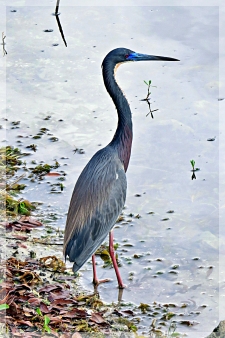
little blue heronWhen researching another devotion, I learned that a Jeopardy contestant missed this $1,000 clue: “It’s the ascension heavenward by true Christians both living & dead at Christ’s second coming.” Although the answer was the Rapture, the contestant, an Episcopal priest, remained silent. He later explained that he didn’t believe in the Rapture or hold to a literal reading of Revelation, adding that the literal reading of Revelation is a “a product of the modern era.” His words gave me pause.

In the decades I attended denominational churches, I never heard any reference to the Rapture and can’t recall ever hearing a sermon about the tribulation or Christ’s return. While I’d read bits and pieces of Revelation, it seemed so bizarre after the first three chapters that I thought the Apostle John might have imbibed in the 1st century version of LSD. It was not until I began attending more evangelical and Bible-based churches that I became familiar with both the Rapture and Revelation.

Although not found in Scripture, the word “rapture” comes from the Latin rapiõ meaning “to seize, snatch away,” which is equivalent to the Greek word harpazõ or “caught up” that is found in 1 Thessalonians 4:13-18 and 1 Corinthians 15:50-52. In the Rapture, dead and living believers will be caught up together to meet Jesus in the clouds to make way for God’s judgment and wrath that will be poured out on the earth during the Tribulation. Because Scripture is unclear about how and when this will occur, Paul called it a mystērion—something that only can be known through God’s revelation. Being a mystery, however, doesn’t mean something like it won’t happen.

While there is general agreement throughout the Church about the resurrection of the dead and Christ’s return, there is a diversity of thoughts about the particulars. Unlike essential doctrine in which Christians have unity (e.g. the forgiveness of sins and Christ’s deity, death, and resurrection), there’s plenty of liberty about the specifics of the end times and Christ’s return. That Episcopal priest is just one of many Christians who don’t believe in the Rapture.

My issue is with the priest’s easy dismissal of Revelation. Perhaps he’s like a mainstream pastor friend who questions whether Revelation belongs in the Bible. Even though the New Testament canon was not firmly established until 397, the book of Revelation was considered part of the Church’s holy Scriptures in the early stages of Christianity. It was listed as part of the canon around 180 AD in both Irenaeus’ Against Heresies and on the Muratorian Fragment. Church fathers like Irenaeus (bishop of Lyons), Papias (bishop of Hierapolis), Theophilus (bishop of Antioch), Justin Martyr, Tertullian, and Clement of Alexandria all accepted the Apocalypse as revealed in John’s vision.

While a renewed interest in Revelation may be “a product of the modern era,” the earliest church fathers like Irenaeus and Justin Martyr took a literal view of the thousand-year reign with Christ. It was only after Constantine awarded full legal recognition and favor to the Christian church in 313 and Christianity became the official religion of the Roman Empire in 380 that the focus of the church changed. No longer being persecuted for their faith, Christians went from looking for their ultimate comfort in the world beyond the grave to seeking comfort in this world. As believers became more content in the here and now, they became less eager for the Apocalypse, God’s future judgment, and Jesus’ return.

While we don’t know whether the end is near or in another 2,000 years, we should look to Christ’s promised return. As the final chapter of our salvation, Revelation never should be ignored, scorned, or forgotten. It can be confusing, intimidating, and mind-boggling at times, and we’ll probably never fully understand it. Nevertheless, Revelation is worth reading; after all, it’s the only book in the Bible promising a blessing to those who read its words and do what it says!

Blessed is the one who reads, and those who hear the words of the prophecy and keep the things which are written in it; for the time is near. [Revelation 1:3 (NASB)]

Copyright ©2023 jsjdevotions. All rights reserved.

UNEXPECTED DESTINATIONS

But I am trusting you, O Lord, saying, “You are my God!” My future is in your hands. [Psalm 31:14-15a (NLT)]

Sometimes God doesn’t give you what you want not because you don’t deserve it but because you deserve better. [Anonymous Internet wisdom]

black vultures - corkscrew swampBecause the nearby bird sanctuary/swamp gets its water from rainfall, the size of its lakes fluctuates substantially with the seasons. During the dry seasons of winter and spring, the swamp’s lakes gradually recede until the summer rains begin. When this annual dry-down occurs in springtime, the wading birds congregate in the shallow lakes. With the fish having no place to hide the shallow water, it’s as easy as catching fish in a rain barrel for the birds!

Anticipating a feeding frenzy as the swamp’s wading birds gathered in the receding lakes, we went out to the bird sanctuary. The dry-down happened faster than we expected. Instead of a shallow lake covered with water lettuce, we found only mud. Rather than a plethora of egrets, herons, wood storks, and roseate spoonbills, we encountered dozens of black vultures enjoying the remains of the stinking fish in the muck! What we got certainly wasn’t what we wanted or expected.

Since vultures are known for projectile vomiting if startled or threatened, I admit to some trepidation as I walked between the perched birds on the boardwalk. Nevertheless, seeing all those vultures was an amazing experience. In spite of our initial disappointment, we were thankful for the opportunity to witness nature’s clean-up crew at work.

In spite of our best-laid plans, we don’t always get what we pray for or expect. Emily Perl Kingsley, a mother of a child with a disability, wrote a beautiful essay titled “Welcome to Holland” in which she likens having a child with a disability to someone planning a fabulous trip to Italy. After months of eager expectation, however, she discovers the flight plan unexpectedly changed and she’s landed in Holland. Even though there’s nothing wrong with Holland, it’s not Italy! Admitting the pain in losing her longed-for destination, Kingsley adds, “But, if you spend your life mourning the fact that you didn’t get to Italy, you may never be free to enjoy the very special, the very lovely things….about Holland.”

Unlike Kingsley, I’ve never arrived in Holland after expecting to touch down in Italy. Nevertheless, like her, God has changed my flight plans mid-air and I’ve landed in unplanned-for destinations. Sometimes, God’s plan is even better than we imagined and He takes us to Paris or Madrid when all we prayed for was St. Louis or Minneapolis! On the other hand, sometimes God’s plan takes us places we never wanted to visit—Al-Anon meetings, hospital rooms, nursing homes, grave sites, divorce court, or even Holland. Either way, God’s answer to our prayers is the right one—even though it’s different and unexpected. Trusting in God’s infinite love and wisdom, let us accept God’s plan with joy. Whether it’s vultures instead of roseate spoonbills, Keukenhof Gardens instead of the Colosseum, Edam cheese instead of pizza, or a special needs child instead of an honor student, may we seek to appreciate everything in our present situation and be thankful for our many blessings.

It’s just a different place. It’s slower-paced than Italy, less flashy than Italy. But after you’ve been there for a while and you catch your breath, you look around…. and you begin to notice that Holland has windmills….and Holland has tulips. Holland even has Rembrandts. [Emily Perl Kingsley]

I pray that God, the source of hope, will fill you completely with joy and peace because you trust in him. Then you will overflow with confident hope through the power of the Holy Spirit. [Romans 15:13 (NLT)]

Copyright ©2023 jsjdevotions. All rights reserved.

LUCK

We may throw the dice, but the Lord determines how they fall. [Proverbs 16:33 (NLT)]

blue-eyed daisyWhenever we play Yahtzee, my younger grands blow on the dice to ensure their good luck. Like Yahtzee, life often seems a game of chance where sometimes we’re lucky and sometimes we’re not. Luck, however, has nothing to do with it. For example, King Ahab seemed to have incredibly bad luck when a soldier randomly shot an arrow and accidently hit him right between the joints of his armor. In spite of appearances, however, that wasn’t because of Ahab’s bad luck. Before going into battle, God had pronounced the evil king’s doom through His prophet Micaiah.

It wasn’t luck that caused the sleepless King Xerxes to read about Mordecai saving his life just moments before the evil Haman wanted a death sentence pronounced on the Jew. It was God’s hand that caused the king’s insomnia and turned his attention to that specific event in Babylon’s history. It wasn’t just a lucky break that, out of all the fields in Bethlehem, the widowed Ruth ended up gleaning in the fields of Boaz (who just happened to be Naomi’s kinsman-redeemer). Our sovereign God was firmly in control then and it was He who directed those seemingly chance events.

On the other hand, rather than cause something to happen, God sometimes allows them to happen. He allowed Satan to plague Job, David to take a lustful look at Bathsheba, and He’s allowed me to make a number of bad decisions. While I would prefer attributing their consequences to bad luck, I can’t. They simply were the result of my foolishness, pride, pigheadedness, or disobedience.

As the creator of the universe, God also set a certain number of “laws” in place that keep our lives somewhat predictable. Principles like the laws of gravity, motion, and conservation of energy determine how things will operate in our world. We have twenty-four hours in a day, the sun sets in the west, water flows from a higher to a lower elevation, and if a equals b then b equals a. There even are laws of probability!

These “laws,” however, can be broken by their creator. For example, it wasn’t luck that kept Joshua from running out of sunlight while battling the Amorites; God prolonged the day at his request. Although time may have stopped for Joshua, God made it move backwards for Hezekiah and Isaiah when the sundial’s shadow moved back ten steps. Natural laws were suspended when a three-day plague of darkness descended on the Egyptians (but not the Israelites) and when the Red Sea parted for the Israelites but consumed the Egyptians. Surely turning water into wine broke some laws of chemistry and Jesus and Peter walking on water broke the laws of flotation. None of these, however, were the result of luck.

While we see the practice of casting lots in the Scripture, nothing really is known about the lots themselves. The Israelites cast lots when dividing land among the tribes and when determining positions and duties in the Temple. After Achan wrongly took prohibited plunder from Jericho, it was by casting lots that he was singled out as the guilty party. In Jonah’s story, the sailors cast lots to determine who brought God’s wrath upon their ship and the eleven disciples cast lots to determine who would replace Judas. In those cases, there is no doubt that God stepped in and determined the outcome.

As for my grands and the dice—if He so wanted, God easily could have them throw five of a kind every time but that wouldn’t be luck; it would be God’s will. Nevertheless, I doubt God is going to interfere in a friendly game of Yahtzee. I suspect He’ll allow the dice to fall where they may according to His laws of probability—in which case the end result still will be according to God’s will!

Even though much of life seems random, we live by God’s sovereignty and not by luck. There is no force of good luck that can be coaxed into finding us a parking place, turn lights green, or roll a yahtzee nor is there a force of bad luck that we can blame when those parking places are filled, the lights are red, and we can’t even roll a pair. Whether God is actively causing something to happen or passively allowing it, nothing is a matter of luck. As for the favors and blessings of life—let’s always give credit where credit is due—not to our good luck but to the grace of God.

Nothing whatever, whether great or small, can happen to a believer, without God’s ordering and permission. There is no such thing as “chance,” “luck” or “accident” in the Christian’s journey through this world. All is arranged and appointed by God. And all things are “working together” for the believer’s good. [J.C. Ryle]

And we know that God causes everything to work together for the good of those who love God and are called according to his purpose for them. [Romans 8:28 (NLT)]

Remember the things I have done in the past. For I alone am God! I am God, and there is none like me. Only I can tell you the future before it even happens. Everything I plan will come to pass, for I do whatever I wish. [Isaiah 46:10 (NLT)]

Copyright ©2023 jsjdevotions. All rights reserved.


THE BEST THING ABOUT HEAVEN

Whoever believes in him is not condemned, but whoever does not believe is condemned already, because he has not believed in the name of the only Son of God. And this is the judgment: the light has come into the world, and people loved the darkness rather than the light because their works were evil. [John 3:18-19 (ESV)]

As Christ’s followers, we look forward to our heavenly home. On the other hand, we also cherish life here and now and, unless severely incapacitated or wracked in pain, we aren’t in a rush to depart. Nevertheless, our faith in what lies ahead keeps us from wanting to prolong the inevitable or fearing the unknown. As beautiful as life is on earth, we know that what awaits us is far better than anything we could envision. As the Apostle Paul told the Philippians, “Christ will be honored in my body, whether by life or by death. For to me to live is Christ, and to die is gain.” [1:20-21] Whether living or dead, it’s all good for a believer!

While Christians should have no qualms about death, one Christian friend is approaching her departure date with misgivings. It’s not because of fear; as a follower of Christ, she knows she holds a ticket on the train to Heaven. Her reluctance is because many of her loved ones are unbelievers whose train won’t be bound for glory. Imagining she will eternally mourn their absence in the hereafter, she can’t picture any joy in heaven without them.

Entrance through the pearly gates isn’t earned by good works because even our most righteous deeds fall short of God’s glory. Moreover, no one gets into heaven just because they were baptized as an infant, attended Sunday school, or can recite the Lord’s Prayer, the books of the Bible, and the Apostles’ Creed. Works, water, knowledge, and words mean nothing without the change of heart that comes with faith in Jesus and the work of the Holy Spirit. It is faith in Christ that saves us and, unlike traits such as brown eyes or curly hair, faith isn’t in people’s DNA; it’s in their hearts. While our example and message may influence our loved ones, ultimately, each person has to make a personal decision whether or not to believe in Jesus. As believers, all we can do is pray, share, and continue to witness with our words and lives—the rest is up to them.

Since our Good Shepherd does not want to lose any sheep, we can be sure that He will offer our loved ones every opportunity to come into the fold. Moreover, it’s impossible for any of us to know what someone else truly believes. We are neither judge nor jury; only God knows what is in people’s hearts and only He will determine their final destination. We may be pleasantly surprised on the other side of those pearly gates!

Nevertheless, it’s a painful reality that not everyone we love will choose Jesus. The good news is that some eventually do! Several years ago, a friend expressed distress that her unbelieving and skeptical husband was not destined for God’s kingdom. Without nagging or whining, she encouraged him to join her at church, read Scripture, and to freely seek answers to his many questions. Like St. Augustine’s mother Monica, my friend also prayed for him relentlessly. Not long ago, her husband professed his belief and was baptized!

We know that God is perfect and everything about him is perfection—His judgment, His plan of salvation, and His dwelling place. Yet, how could heaven be perfect if the people we love aren’t with us? While Scripture doesn’t give us the answer, it does tell us that God is compassionate, merciful, and “filled with unfailing love and faithfulness.” As such, He would never condemn his faithful children to an eternity of sorrow in His heavenly home. Wiping every tear from our eyes, He promises “there will be no more death or sorrow or crying or pain.” [Revelation 21:4]

Let’s remember that being reunited with loved ones isn’t the best thing about Heaven. The best thing about Heaven is being in the presence of God and face to face with Jesus!

It is not darkness you are going to, for God is Light. It is not lonely, for Christ is with you. It is not unknown country, for Christ is there. [Charles Kingsley]

Let not your hearts be troubled. Believe in God; believe also in me. In my Father’s house are many rooms. If it were not so, would I have told you that I go to prepare a place for you? And if I go and prepare a place for you, I will come again and will take you to myself, that where I am you may be also. [John 14:1-3 (ESV)]

Copyright ©2023 jsjdevotions. All rights reserved.

YEAST AND THE KINGDOM (Yeast – Part 1)

Jesus also used this illustration: “The Kingdom of Heaven is like the yeast a woman used in making bread. Even though she put only a little yeast in three measures of flour, it permeated every part of the dough.” [Matthew 13:33 (NLT)]

Immediately after the Parable of the Mustard Seed, Jesus compared the Kingdom of Heaven to the yeast a woman added to “three measures of flour” when making bread. While “measures” seems vague, the original word used wasn’t. It was seah (about a peck and a half of flour) and three seahs were over 167 cups (nearly 50 pounds) of flour. This was an enormous amount of flour for just “a little yeast” and, as He did in the previous parable, Jesus used hyperbole to emphasize the power of something very small. The question in this parable is whether the yeast is a metaphor for a bad or a good thing.

This is the first mention of leavening in the New Testament but, by the 1st century, yeast had come to represent sin. Sticking to yeast’s traditional symbolism, some commentators liken the story’s yeast to false doctrine that can sneak into the Kingdom and see this parable as a warning about the dangerous power of false teaching in the Church. Enekrupsen is the Greek word used to describe the woman’s action in adding the yeast and this is its only use in Scripture. From egkruptó, which literally meant to bury within, enekrupsen has been translated with different meanings. Some translate it as hid or concealed (which implies she did something sneaky and devious in adding yeast) while others merely translate it as put, blended, or mixed in. Since enekrupsen is used both ways in other Greek literature, we can’t be sure which correctly communicates Jesus’ meaning. Considering that bread was being made, it seems that burying yeast in the dough would be expected rather than sneaky.

I find it hard to interpret this parable in a way that associates anything sinful or evil with the Kingdom of Heaven. Although His listeners may have expected yeast’s power to represent something bad, Jesus’ parables rarely fit his listeners’ expectations. When they anticipated one thing, He usually gave them another! That a Levite and priest had failed their fellow Jew while a hated Samaritan was the hero of one parable was as surprising as a beggar ending up in Abraham’s bosom at a heavenly banquet when the rich man ended up tormented in Hades. Jesus threw society’s expectations out the window when telling of a father who’d been offended and hurt by his wastrel son. Upon the boy’s return, rather than rejecting him as the law required, the father ran to welcome him home, restored him to the family, and even had a festive celebration in the boy’s honor. Equally unexpected was the story of vineyard workers getting the same pay regardless of how long they worked and the prayers of a tax collector being heard when the Pharisee’s were not.

I agree with the commentators who take this parable at face value. Believing Jesus simply is speaking of the pervasiveness and power of yeast, they see this analogy as a continuation of the lesson in the mustard seed parable. Rather than a corrupting influence, the leaven, like the mustard seed, illustrates that great things can come from small beginnings. Yeast is even smaller than the tiny mustard seed and yet both are powerful enough to expand and effect change. While both parables illustrate the extensive growth of the Kingdom, the second parable emphasizes the Kingdom’s transformative power. Just as yeast changes dough, the Kingdom will transform the world! In both parables, the message is clear—the Messianic Kingdom comes from small beginnings, operates quietly, but has the power to accomplish great things! That God’s Kingdom would start from small and humble beginnings to grow and change a much larger entity (the world) would have been reassuring news to Jesus’ small band of disciples.

Like the Kingdom of Heaven, yeast is a living organism. Like the Holy Spirit, yeast is invisible once in the dough and yet its effect, like that of the Spirit, becomes obvious as it permeates the mixture. Just as leavened dough grows from inside out, the Kingdom moves from our hearts into our actions and from our actions into the world. Yeast transforms what it mixes with and, as we are transformed, we transform those with whom we interact. Just as yeast needs certain conditions to grow, so does the Kingdom and, just as there are 1,500 different kinds of yeast, God’s Kingdom is made up of a wide assortment of people. Yeast is found everywhere—from the bottom of the ocean to the Arctic and from flower nectar to the lining of our stomachs—and God’s Kingdom should be as pervasive! Indeed, the Kingdom of Heaven is alive, it’s everywhere, it takes attention and patience to grow, and it transforms all it touches.

What Jesus’ listeners probably didn’t understand was that the Kingdom already had arrived. But, like a tiny mustard seed, a bit of yeast, or a baby in a manger, it entered the world quietly without fanfare. Like a small yellow flower, a lump of dough, or an itinerant rabbi from Nazareth, the Kingdom didn’t look that impressive at first. Appearances, however, can be misleading. Like a mustard seed that grows 1,440 times its original size or the more than fifty loaves of bread leavened by that bit of yeast, the Kingdom will increase and prevail. In the end, when Christ returns as a conquering king, no one will be able to miss its arrival. Until then, like a small amount of yeast, God’s Kingdom will transform the hearts and lives of all it touches! May we always remember that little things become great when God is at work!

When the dough is leavened, then to the oven with it; trials and afflictions commonly attend this change; but thus saints are fitted to be bread for our Master’s table. [Matthew Henry]

I will build my church, and all the powers of hell will not conquer it. [Matthew 16:18 (NLT)]

MUSTARD

black mustard - Brassica nigra
The Kingdom of Heaven is like a mustard seed planted in a field. It is the smallest of all seeds, but it becomes the largest of garden plants; it grows into a tree, and birds come and make nests in its branches. [Matthew 13:31-32 (NLT)]

Following the Parable of the Four Soils and the Parable of the Weeds, Jesus told a third parable of growth by comparing the Kingdom of Heaven to a mustard seed. I know little about farming and soil but I’m familiar with black mustard, (Brassica nigra), the kind of mustard grown in Palestine in Jesus’ day. Its clusters of bright yellow flowers are a common sight in the meadows, thickets, vacant lots, and fallow fields in my home state of Illinois.

Both times Jesus mentioned the mustard seed, He referred to its small size. When comparing the size of our faith to that of a mustard seed, He told us even if our faith were as small as a mustard seed that, “Nothing would be impossible.” When comparing the Kingdom of Heaven to a mustard seed, He called it the “smallest of all seeds.” Having admired the mustard seed charm my sister had on her bracelet, I questioned His statement. While it was small, I knew other seeds are even smaller. Surely the One who was there at creation’s beginning knew that the almost dust-like seeds of orchids and begonias are smaller. Additionally, while the mustard plant can grow as tall as 10 to 12 feet, it’s not a tree!

Jesus, however, wasn’t teaching botany, He was telling a parable and hyperbole (an exaggerated statement not taken literally that’s used to emphasize a point) was a common technique in rabbinic teaching. Jesus used it when speaking of recognizing a speck in our neighbor’s eye but not seeing the log in ours, Pharisees straining the gnats out of their water while drinking a camel, and trying to put a camel through a needle. When we look at the original Greek, however, we find less exaggeration. Jesus refers to the mustard seed as the smallest seed which a man sows in his field. While not the smallest seed in existence, mustard was the smallest seed that would have been sown in a Palestinian field. Jesus says it grows larger than a lachanōn (a garden herb or vegetable) and, indeed, black mustard does seem like a tree when compared to most herbs! That a seed measuring less than a tenth of an inch can grow 1,440 times its original size into a 12-foot plant in just one season is impressive and that was His point!

While most of America’s farmers consider this pervasive plant a noxious weed, it’s been cultivated as a crop for thousands of years in the Holy Land. Its seeds were powdered or made into a paste for medicinal and culinary purposes. Unlike most of us, Jesus’ listeners were familiar with mustard’s characteristics. As I describe those qualities, consider how they might apply to God’s Kingdom here on earth.

With its narrow clusters of small yellow flowers, mustard isn’t a showy flower—one might even call it a humble little thing. Nevertheless, a golden field of mustard is a thing of beauty. For a variety of scientific reasons, black mustard has a competitive advantage over most other plants. It’s one of the first plants to spring up after a fire and can out-compete anything else growing in the same field. It produces thousands of seeds every season and mustard’s long-lasting seeds can survive underground for as long as 50 years. An annual, while it dies at the end of a season, it regenerates at the next rainy season.

Although mustard was welcome as a cash crop in Palestine, because of its characteristics, black mustard is considered invasive in 44 of the 48 contiguous states. Nevertheless, in spite of the Midwest’s farmers’ persistent efforts to eradicate it, black mustard returns every year. Nature Collective describes it as “an ornery guest that refuses to take the hint.” In spite of persecution from Jewish leaders and Rome, the early church was just as defiant, determined, and persistent as black mustard!

Jesus’ listeners would have been familiar with the plant’s beauty and ability to self-seed, lay down a deep root system, and grow almost anywhere, along with mustard’s knack of surviving and thriving in less-than-ideal conditions. Jesus’ point was that from small and humble beginnings, the Kingdom of Heaven—Jesus’ domain as Messiah—would gradually grow into a large and beautiful entity. Once seeded, nothing seems to stop mustard and the same goes for the Kingdom!

May our faith be as persistent, hardy, determined, steadfast, and as difficult to destroy as the mustard seed!

“You don’t have enough faith,” Jesus told them. “I tell you the truth, if you had faith even as small as a mustard seed, you could say to this mountain, ‘Move from here to there,’ and it would move. Nothing would be impossible.” [Matthew 17:20 (NLT)]

Copyright ©2023 jsjdevotions. All rights reserved.