ONCE AND FOR ALL – YOM KIPPUR

He will lay both of his hands on the goat’s head and confess over it all the wickedness, rebellion, and sins of the people of Israel. In this way, he will transfer the people’s sins to the head of the goat. Then a man specially chosen for the task will drive the goat into the wilderness. As the goat goes into the wilderness, it will carry all the people’s sins upon itself into a desolate land. [Leviticus 16:21-22 (NLT)]

While the year is 2024 on most calendars, it is year 5785 on the Hebrew calendar and the tenth day of Tishri begins at sunset tomorrow. For our Jewish brothers and sisters, it will be the Day of Atonement or Yom Kippur. With its themes of atonement and repentance, it the holiest day of the year for a Jew.

The book of Leviticus describes the rituals the Israelites were to perform on this holy day every year. In ancient Israel, this was the only time the high priest could come into the Holy of Holies (the innermost sacred area of the tabernacle or temple) where the Ark of the Covenant was housed. But, before coming into the presence of God and the Ark and beginning the ritual of atonement, he had to ritually cleanse himself from sin by bathing and dressing in spotless plain linen garments. The high priest then atoned for his own sins and those of his family with the sacrifice of a bull.

Two unblemished male goats were taken from the community and lots were cast to determine which goat would be given to the Lord. The first goat was sacrificed and its blood sprinkled on the mercy seat of the Ark. This was the sin offering and made to appease the wrath of God and atone for the sins of the people. Then, having received forgiveness, the second goat was brought before the altar. As a way of transferring the sins of the people to the goat, the priest laid his hands on its head and confessed all the peoples’ sins and transgressions. This goat, the “scapegoat,” was then sent out into the wilderness to carry those sins into the wasteland. In this ancient ritual, the blood of the first goat provided propitiation by appeasing God’s wrath and the second goat provided expiation by atoning for and removing those sins. This atonement ritual was to be repeated year after year.

Without a temple in Jerusalem, there no longer are animal sacrifices or scapegoats. Nevertheless, Jews throughout the world continue to observe this holy day. When a fast day occurs on the Sabbath, it is postponed until Sunday but Yom Kippur is the exception to that rule. Referred to as the Shabbat Shabbaton (the Sabbath of Sabbaths), our observant Jewish friends will fast from all food and drink (including water) from just before sunset Friday until after sunset Saturday. Along with fasting, many Jews will abstain from wearing leather footwear, washing or bathing, applying lotions and creams, or having marital relations. Most of Yom Kippur is spent in the synagogue in intensive prayer, introspection, and the asking of God’s forgiveness for the past year’s sins. The day ends with a single blast of the shofar (ram’s horn trumpet) followed by the proclamation, “Next year in Jerusalem.”

Unlike the yearly sacrifice of goats, the sacrifice of Jesus upon the cross needed to be done only once. Christ was both our sinless high priest and the unblemished sacrifice. When He gave himself up for us, Jesus took God’s wrath upon himself as His blood dripped on the ground beneath Him. When He suffered and died on the cross, Jesus was both the propitiation and expiation of our sins for all time. By dying, this sinless man took on God’s wrath—the wrath we sinners deserved. Rather than take our transgressions into the wilderness, He “removed our sins as far from us as the east is from the west” for all time. [Psalm 103:12] Thank you Jesus!

If you are ready to partake of grace you have not to atone for your sins—you have merely to accept of the atonement. All that you want to do is to cry, “God have mercy upon me,” and you will receive the blessing. [D.L. Moody]

We are made right with God by placing our faith in Jesus Christ. And this is true for everyone who believes, no matter who we are. For everyone has sinned; we all fall short of God’s glorious standard. Yet God, in his grace, freely makes us right in his sight. He did this through Christ Jesus when he freed us from the penalty for our sins. [Romans 3:22-24 (NLT)]

Copyright ©2024 jsjdevotions. All rights reserved.

HE NEVER DISAPPOINTS

Jesus told them, “Tonight all of you will desert me.” … Peter declared, “Even if everyone else deserts you, I will never desert you.” Jesus replied, “I tell you the truth, Peter—this very night, before the rooster crows, you will deny three times that you even know me.” “No!” Peter insisted. “Even if I have to die with you, I will never deny you!” And all the other disciples vowed the same. [Matthew 26:31a,33-35 (NLT)]

I think the worst thing my parents could say was that they were disappointed in me. Knowing I hadn’t lived up to their high expectations, I’d hang my head in shame as they added, “We expected far better from you.” I never wanted to disappoint them but, unfortunately, like every child, I often did.

While parents tend to envision having the perfect child—one who never disobeys, makes unwise choices, or gets a bad grade—God doesn’t operate under that delusion. Knowing us, He has realistic expectations of His fallen children. Nevertheless, while He understands that we can’t live up to His standard of perfection, God does expect us to do our best and He provides the guidance and power to do so. Even so, we’ll falter more times than we can count and, when that happens, rather than being disappointed in us, God is disappointed for us.

When they deserted the Lord that Thursday evening in Gethsemane, none of the disciples behaved much like true believers. Although the others also may have denied knowing Jesus that night, only Peter’s denials were recorded for posterity. While Jesus was being questioned, slandered, spit upon, blindfolded, and beaten, Peter was warming himself by a fire. Then the disciple who claimed to be ready to die for Jesus failed Him miserably by denying even knowing the Lord. Jesus wasn’t surprised in the disciples’ desertion and Peter’s betrayal; He expected it. In fact, He predicted it.

When Jesus appeared Easter morning, He didn’t tell the disciples how disappointed He was in them or shame them for their desertion. Instead, Jesus’ first words were words of love and reconciliation, “Shalom…peace be with you.” Then, instead of chastening them for their fear and doubt at His resurrected presence, Jesus ate with them! Rather than single out Peter and censure him for his denials, Jesus simply asked the disciple if he loved Him. Despite Peter’s previous failures, Jesus loved and forgave the man and appointed him to “feed my sheep.”

Peter’s failings didn’t define him and neither should ours. Peter denied Christ and yet he was in that room with the other disciples on Easter morning. A betrayal doesn’t have to send us away from Jesus into the depths of despair, as it did for Judas. A betrayal can bring us closer to Christ, as it did for Peter. Repentance and forgiveness turned Peter, the betrayer, into Peter, the Rock, the powerful preacher and fearless leader of the early Church!

Like Peter and the disciples, we are flawed people. As much as we want to honor and please God, there will be times we make poor choices and disappoint Him. The good news is that God never will disappoint us! Although He grieves for every one of our bad choices, He never will leave us, stop believing in us, or take His Holy Spirit from us.

And do not bring sorrow to God’s Holy Spirit by the way you live. Remember, he has identified you as his own, guaranteeing that you will be saved on the day of redemption. [Ephesians 4:30 (NLT)]

The faithful love of the Lord never ends! His mercies never cease. Lamentations 3:22 (NLT)]

Copyright ©2024 jsjdevotions. All rights reserved.

HE WAS BETRAYED

On the way, Jesus told them, “All of you will desert me. For the Scriptures say, ‘God will strike the Shepherd, and the sheep will be scattered.’ But after I am raised from the dead, I will go ahead of you to Galilee and meet you there.” [Mark 14:27-28 (NLT)]

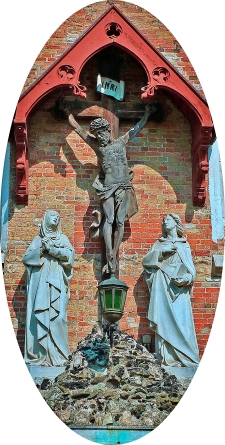
Church of our Lady - Netherlands

In the days leading up to his crucifixion, the people who claimed to love Jesus the most failed him in many ways. We know about Judas—the disciple trusted enough to carry the money bag who betrayed Jesus for thirty pieces of silver. That last night, the deceitful man had the audacity to have his feet washed by the Lord and to drink from His cup! But what of the other disciples? During that same meal, Peter vowed he’d never deny Jesus, even if it meant his death and the rest of the disciples echoed his pledge. Yet, within a matter of hours, those brave disciples would desert Jesus and Peter would deny Him three times. Even though Jesus asked Peter, James, and John to pray and keep watch with him in the Garden of Gethsemane, they fell asleep, not once but twice!

Where were the disciples when the mob shouted for Barabbas to be freed? For that matter, where were all of those people who had been healed or fed by Jesus? Just a few days earlier, a crowd had shouted, “Hosanna! Blessed is he who comes in the name of the Lord!” Where were they? Why were they silent? Instead of calling for Jesus’ freedom, the mob called, “Crucify him! Crucify him!”

The disciples weren’t even there to carry the cross for Jesus; that task fell to Simon, a stranger from Cyrene. Only John, Mary the mother of Jesus, Mary Magdalene, and some other women followers were at the foot of the cross when Jesus was crucified. Disillusioned and fearful for their lives, the other disciples were absent in His dying hours.

Rather than a disciple, it was a dying criminal who attested Jesus’ innocence, showed his faith, and asked the Lord, “Remember me when you come into your Kingdom.” When Jesus took His last breath and died, it was a Roman soldier and not a disciple who declared, “This man truly was the son of God!” The eleven remaining disciples didn’t even help bury their beloved rabbi. That responsibility was taken by Joseph of Arimathea and Nicodemus, members of the Jewish high council and secret followers of Jesus.

The disciples, confused and frightened, failed Jesus both as disciples and as friends. Nevertheless, despite the way they failed Him, Jesus didn’t fail them. Instead, after His resurrection, Jesus greeted them with words of peace and forgiveness. He then opened their minds to understand the Scriptures and charged these men—the same men who once failed Him—with the task of spreading the good news of His resurrection. Jesus knew it is better to be a believer who sometimes fails than not to believe at all.

Be assured, if you walk with Him and look to Him, and expect help from Him, He will never fail you. [George Mueller]

Jesus came and told his disciples, “I have been given all authority in heaven and on earth. Therefore, go and make disciples of all nations, baptizing them in the name of the Father, and the Son and the Holy Spirit. Teach these new disciples to obey all the commands I have given you. And be sure of this: I am with you always, even to the end of the age.” [Matthew 28-18-20 (NLT)]

Copyright ©2024 jsjdevotions. All rights reserved.

SHED THE SHROUD

Then Jesus shouted, “Lazarus, come out!” And the dead man came out, his hands and feet bound in graveclothes, his face wrapped in a headcloth. Jesus told them, “Unwrap him and let him go!” [John 11:43-44 (NLT)]

roseUnlike Lazarus, we haven’t had a four-day encounter with death. Our family didn’t wash us with warm water, anoint us with myrrh and aloe, wrap us in a shroud with herbs and spices, lay us in a tomb, and mourn our passing. Most of us haven’t even endured a months-long coma, flatlined, or been brought back to life with an AED. How does such an experience affect someone? Without a doubt, the man who emerged from the tomb differed from the man who died four days earlier. Did Lazarus return to life with the 1st century equivalent of a “bucket list” of things to accomplish, places to go, things to do, and adventures to have?

When Jesus called Lazarus out of the tomb, the once dead man emerged from the tomb with his face wrapped in a head cloth and his body bound in burial garments. Jesus told the people to unbind him and free him from the trappings of the grave. Something tells me that, after four days in a tomb, Lazarus left behind more than some linen cloth soiled with the detritus of the tomb and death. While we don’t know what he experienced during those four days, He must have returned to life with a new perspective. As he walked into the sunlight he never expected seeing again and inhaled the air he never anticipated breathing again, can you imagine how much he appreciated his new lease on life? Given a second chance, Lazarus probably wasn’t about to bring any regrets, resentment, anger, or guilt with him. Raised from the dead, he probably shed much of his past along with that shroud as he stepped from the tomb’s gloom.

Unlike Lazarus, we haven’t physically died. Nevertheless, we were spiritually dead until we responded to Christ’s call. Now, born again into a new spiritual life, our grave clothes are no longer necessary. Lazarus shed his; have we? Even through we’re reborn in Christ, we tend to carry the detritus and debris of our yesterdays into our new life. After putting on the new clothes of salvation and righteousness, rather than leave our graveclothes behind, we drag along the shroud of the past—a shroud stained with betrayals, anger, disappointment, loss, or hurt and embellished with things like remorse and disgrace. Even when we think we’ve donned the fresh clothes of a new life in Christ, we often tuck a pang of guilt or shame into a pocket. We have trouble believing that we’re forgiven, but we are; that change is possible, but it is; that we have a relationship with the Creator of the Universe, but we do; or that He could possibly love us, but He does! Lazarus shed his shroud; so should we.

As for bucket lists—they seem more a way of denying death than living life to the fullest. I don’t think Lazarus emerged from his tomb with a to-do list of things to accomplish before his next trip to that tomb. I suspect he emerged with a new appreciation for the everyday things of life—his family, the sound of laughter, the embrace of a friend, a sip of cool water, morning dew glistening in the sunlight, sunsets and sunrises, the chirp of a sparrow, worship at the Temple, the taste of a rip fig, a beautiful rose, a buzzing bee, the aroma of fresh baked bread, the earthy smell of rain, and a relationship with Jesus. Death taught Lazarus that he didn’t need more; he just needed to fully appreciate what he already had—Jesus and life!

Lazarus heeded Jesus’ call. When he stepped into the light from that dark tomb, he shed his shroud and embraced his new lease on physical life. When we responded to Jesus’s call, we were given a new spiritual life. Let us leave the despair, doubt, shame, sorrow, and sin behind as we clothe ourselves with the joy of life in Jesus Christ.

And all who have been united with Christ in baptism have put on Christ, like putting on new clothes. [Galatians 3:27 (NLT)]

You have turned my mourning into joyful dancing. You have taken away my clothes of mourning and clothed me with joy. [Psalm 30:11 (NLT)]

Copyright ©2024 jsjdevotions. All rights reserved.

FORGIVENESS  (Matthew 18:23-35 — Part 2)

Then his master summoned him and said to him, “You wicked servant! I forgave you all that debt because you pleaded with me. And should not you have had mercy on your fellow servant, as I had mercy on you?” And in anger his master delivered him to the jailers, until he should pay all his debt. So also my heavenly Father will do to every one of you, if you do not forgive your brother from your heart. [Matthew 18:32-35 (ESV)]

great blue heronAt first, it seems that the “Parable of the Unforgiving Servant” should be called the “Parable of the Forgiven Servant.” After all, the king forgave his servant’s debt of 10,000 talents—the equivalent of billions of dollars. While the first part of the parable illustrates the value and extravagance of God’s forgiveness, it takes a dark turn in the second part when illustrating the reciprocal nature of His forgiveness—something the servant learned the hard way!
After leaving the king, the forgiven servant went to a fellow servant who owed him 100 denarii and demanded payment. Representing 100 days’ wages, this was a sizeable sum. Nevertheless, unlike the first servant’s massive debt to the king, it feasibly could be repaid in time. Just as his creditor had done with the king, this servant begged for patience and promised repayment. That the debtor was a fellow servant and an equal didn’t matter to his creditor. Moreover, the money he’d loaned hadn’t even been his—it had been money taken from the king! Unlike the king, however, this unforgiving servant had no mercy and put his debtor in prison until the debt was fully paid!

Wickedly, the unforgiving servant wrongly demanded more from his fellow worker than the king had asked of him. By throwing his debtor into jail, he acted as if he were more worthy of justice and repayment than was the king. Distressed at the man’s hard-heartedness, the other servants reported his behavior to the king. Enraged that his servant had not appreciated the gift of mercy he’d received by forgiving another servant in the way he’d been forgiven, the king sent the unforgiving man to prison to be tortured until his debt was paid.

Before trying too hard to read extra meaning into this parable, let’s put it in context. Peter had just asked Jesus how often he should forgive someone who sinned against him. While Jewish tradition valued forgiveness, the rabbis held that someone would be forgiven for the same transgression only three times. So, when Peter suggested forgiving seven times, the disciple probably thought he was being generous. When Jesus replied that he was to forgive seventy times seven, He wasn’t suggesting keeping count to 490 before quitting. His point was not to keep count at all! After all, if God stopped forgiving us at the 491st time we disrespected our parents, gossiped, lost patience with our children, lied, cursed, or failed to honor His name, we’d be goners! God is holding us to His standard and it was to illustrate the reciprocal nature of forgiveness that Jesus told this story.

If we take a good look at the king’s servant, we see that he never fully understood or appreciated the king’s mercy. When he promised the king that, with patience, he would repay the debt, he was delusional. The debt represented over 164 years of labor without a break! Although repayment was an impossibility, the servant never admitted his inability to pay such an enormous sum. His refusal to release a fellow servant’s debt shows that he neither understood nor appreciated his own forgiveness. The unforgiving man’s punishment makes it clear such unforgiveness is not what our King wants from His servants! He calls us to forgive with a heart of gratitude for the forgiveness that has been given to us. A person who sees the enormity of their own sins and appreciates the largess and forgiveness of his Savior will, in turn, be magnanimous and generous in bestowing forgiveness upon others.

The second servant’s debt was one six-hundred-thousandth of the amount owed by the unforgiving servant. Just as his debt to his co-worker pales in comparison to the unforgiving servant’s debt to the king, whatever wrongs (real or imagined) we have suffered from our fellow servants pale in comparison to the countless ways we sin against our King every day of our lives! Jesus taught the disciples to pray, “and forgive us our debts, as we also have forgiven our debtors,”  and this parable tells us we are to forgive our debtors as our King has forgiven us!

For if you forgive others their trespasses, your heavenly Father will also forgive you, but if you do not forgive others their trespasses, neither will your Father forgive your trespasses. [Matthew 6:14-15 (ESV)]

Copyright ©2024 jsjdevotions. All rights reserved.

THE DEBT  (Matthew 18:23-35 — Part 1)

Therefore the kingdom of heaven may be compared to a king who wished to settle accounts with his servants. When he began to settle, one was brought to him who owed him ten thousand talents. [Matthew 18:23-24 (ESV)]

Jesus told several parables about the Kingdom of Heaven and, in Matthew 18, He compared it to a king who wanted to bring his accounts up to date with the servants who owed him money. The parable is pretty straight-forward; the king symbolizes God, the servant each one of us, and the debt our sins. One servant owed the king ten thousand talents but was unable to pay. There were serious consequences for not paying debts so the king ordered that the servant’s home and possessions be sold off and that the man and his family be sold into slavery until the debt was paid.

Jesus often used hyperbole to make his point but, unfamiliar with the talent or tálanton, 21st century readers may miss it, even when the debt is translated as several or even ten million dollars. Weighing about 75 pounds, the talent had the value of 6,000 drachmas or denarii, the Greek and Roman coins used in 1st century Judah. Generally speaking, one denarius was a laborer’s wage for a day. According to Forbes and the Bureau of Labor Statistics, the average hourly wage is about $28 and, figuring an eight-hour day, a denarius would be worth about $224 today. Since 6,000 denarii equaled one talent, a talent would be worth about $1,344,000 (6,000 days of work) in 2024. The servant, however, owed 10,000 talents and  his debt would require 60 million days of work. In today’s dollars, that is more than $13.44 billion. To put his 10,000-talent debt into 1st century perspective, the yearly tax revenue collected by Herod the Great was only about 800 talents!

Moreover, because “ten-thousand” was the largest number used in Jesus’ day, it also meant “beyond measure.” The servant’s debt was so enormous that it was incalculable. Although he promised to make payment, Jesus’ listeners knew the promise was absurd—repayment of such an astronomical amount was impossible!

Jesus deliberately chose such an outrageous number because there is absolutely no way any of us could ever work hard enough or give the Lord enough to repay Him for his never-ending mercies. This illustration makes it clear that, “The wages of sin is death,” because the enormous debt of sin never can be re-paid! Fortunately, the parable doesn’t stop there.

Asking for patience, the man begged for mercy and the king, filled with compassion, released his servant and forgave the debt entirely. The servant did nothing to deserve forgiveness; in fact, he may have incurred that debt through his mismanagement or embezzlement of the king’s funds. Nevertheless, as undeserved as it was, the debt was forgiven because of the king’s grace and mercy. While the wages of sin is death, “the free gift of God is eternal life in Christ Jesus our Lord.” [Romans 6:23]

When the king forgave the debt, however, the debt wasn’t paid; justice had not been served. The king remained 10,000 talents the poorer for it! When God canceled the payment due for our sins, however, justice was served because someone else paid our debt—Jesus! We are no more deserving of God’s forgiveness than was the king’s servant but, out of God’s merciful grace, our sin debt was paid in full by God’s only Son!

When the parable continues, it takes a dark turn but, for now, consider the first part of the story and the size of the servant’s debt—a debt so massive that it was incalculable—but was forgiven. Those, my friend, are our sins—countless sins forgiven by the grace of God!  Thank you, Jesus!

In him we have redemption through his blood, the forgiveness of our trespasses, according to the riches of his grace. [Ephesians 1:7 (ESV)]

And you, who were dead in your trespasses and the uncircumcision of your flesh, God made alive together with him, having forgiven us all our trespasses, by canceling the record of debt that stood against us with its legal demands. This he set aside, nailing it to the cross. [Colossians 2:13-14 (ESV)]

Copyright ©2024 jsjdevotions. All rights reserved.