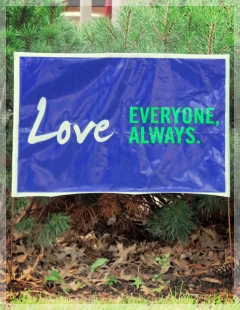
BURDENS (Galatians 6:2-5 – Part 1)

Carry each other’s burden; that’s the way to fulfill the Messiah’s law. [Galatians 6:2 (NTE)]

dog sleddingSince we tend to think of burdens as demanding and often unwelcome duties or responsibilities, we’re certainly not anxious to take on a burden, especially one that actually belongs to someone else! Yet, that is exactly what we’re told we must do if we are going to fulfill Christ’s mandate. And what is that command? To love one another in the way God loves us.

Nevertheless, the concept of carrying someone’s burden makes me think of beasts of burden like mules, donkeys, or oxen. I find it hard to associate the joy of Christianity with an image of myself as a pack animal lugging a heavy load for miles on rough terrain or an ox being poked with an ox goad while plowing a rocky field. Then again, recalling the Alaskan huskies kenneled just west of our favorite Colorado mountain town, I realize I might be thinking of the wrong beasts of burden.

For thousands of years, dogs like them have pulled people and goods long distances. Experienced mushers say that sled dogs are born loving to pull and it certainly seemed that way whenever we went dog sledding. When we arrived at their kennel, the dogs were quietly resting by their shelters or enjoying attention from their future passengers. Once the sleds and harnesses were taken from the storage shed, it was another story. The noise was nearly deafening as the dogs pulled at their chains and barked excitedly as if calling, “Take me!” While the teams were being harnessed and hooked up, the sleds had to be chained to posts to keep the eager dogs from pulling them out on the trail prematurely.

Mushers say teaching one of these dogs to pull is unnecessary—just put on a harness, hook him up, and the dog will do the rest! We barely needed to say “mush” to get them moving and it’s almost impossible to hold them back once they get started. For sled dogs, carrying a burden is joy rather than a chore; carrying one another’s burdens should be that way for a Christian, as well.

A non-believer tends to react to other people’s burdens the way a poodle would to the sight of a heavily loaded sled. Unlike a husky, it probably would whine about the cold and snow and resist being harnessed. If you managed to harness up a poodle, it probably would lie down and refuse to move and, if you ever got a team of them harnessed and moving, they’d certainly find no joy in running across the frozen tundra pulling a sled. Poodles probably can’t understand why huskies enjoy mushing but the love of sledding isn’t in their breeding. Non-believers can’t understand a Christian’s willingness to carry another person’s burden either but that’s because they’re not reborn in Christ. Rather than a genetic predisposition, it’s the Holy Spirit who enables us to love others enough to willingly and joyfully carry their burdens.

When thinking of those dogs so eager to pull us through the mountains, I realize that even substantial burdens can be borne without great difficulty, especially when it’s a team effort. Indeed, the burdens of our brothers and sisters are meant to be shared and, when shared, they cease to be a heavy load for anyone. For the Christian, carrying one another’s burdens isn’t a chore; it’s a privilege and a joy. One musher described his team this way, “They just live their life the way they love to live it…a life that they can be proud of.” Shouldn’t the same be said of us?

Whoever is spared personal pain must feel himself called to help in diminishing the pain of others. We must all carry our share of the misery which lies upon the world. [Albert Schweitzer]

I’m giving you a new commandment, and it’s this: love one another! Just as I have loved you, so you must love one another. This is how everybody will know that you are my disciples, if you have love for each other. [John 13:34-35 (NTE)]

Copyright ©2021 jsjdevotions. All rights reserved.

THE PRIVILEGE OF PRAYER

I urge you, first of all, to pray for all people. Ask God to help them; intercede on their behalf, and give thanks for them. [1 Timothy 2:1 (NLT)]

Those who deny their neighbors prayers of intercession deny them a service Christians are called to perform. … Intercessory prayer is a gift of God’s grace for every Christian community and for every Christian. Because God has made us such an immeasurably great offer here, we should accept it joyfully. [Dietrich Bonhoeffer]

zebra longwing butterflyIntercessory prayer simply is praying on behalf of others and we find it throughout Scripture. After Israel’s shameful behavior with the golden calf, for example, Moses interceded for a sinful people before an angry God who was ready to wipe them out. The man pled for mercy rather than condemnation. Later, he interceded for his sister Miriam when God struck her with leprosy after her opposition to Moses’ leadership. When the Israelites again rebelled, refused to enter Canaan, and talked of choosing another leader to take them back to Egypt, Moses again interceded for the Israelites.

Abraham prayed for Ishmael, Sodom and Abimelech; Samuel prayed for Saul and the people of Israel; Daniel prayed for Jerusalem; Job prayed for his family and friends; Stephen prayed for his executioners; Paul prayed for the churches at Corinth and Ephesus; and Jesus prayed not only for his disciples but also for the people who crucified Him. There was, however, nothing weak or wishy-washy about any of these prayers; they were specific, heartfelt and urgent pleas.

While reading Dietrich Bonhoeffer’s words about intercessory prayer in a recent Lenten devotion, I felt them convict me. I have a list of people for whom I regularly offer prayers. Unfortunately, unless there is an urgent need, my prayers are often more perfunctory than earnest and more superficial than thorough. I confess to thinking of praying for others as more of an obligation than a gift from God. Bonhoeffer’s words point out that we are part of a community and, therefore, are touched by everything that touches our brothers and sisters. When they hurt, we hurt; when they mourn, we mourn; when they hunger, we hunger; and when they are joyful, so are we. His words reminded me that we should approach intercessory prayer not as a duty but rather as a privilege, not half-heartedly but enthusiastically.

It is an honor to thank God for the people for whom we pray and to bring them into His presence with our prayers. There’s no need to worry about having the right words, the Holy Spirit will see to that, but we must offer our prayers with the faith, joy, fervor and love of a true member of the Christian family!

So we have not stopped praying for you since we first heard about you. We ask God to give you complete knowledge of his will and to give you spiritual wisdom and understanding. Then the way you live will always honor and please the Lord, and your lives will produce every kind of good fruit. All the while, you will grow as you learn to know God better and better. We also pray that you will be strengthened with all his glorious power so you will have all the endurance and patience you need. May you be filled with joy, always thanking the Father [Colossians 1:11 (NLT)]

Copyright ©2021 jsjdevotions. All rights reserved.

DAILY MAINTENANCE – VALENTINE’S DAY

Relish life with the spouse you love each and every day of your precarious life. [Ecclesiastes 9:9 (MSG)]

in the hammock

When getting out a chip n’ dip bowl for some Super Bowl noshing, I noticed the heavy tarnish on the silver candle holders. Because COVID and social distancing have kept us from entertaining, they’ve been ignored in the back of the cupboard for nearly a year. Feeling guilty about letting them get so black, I started polishing off the tarnish. They were a wedding gift to my parents more than 80 years ago and my thoughts turned to marriage as I worked. It’s easy it is to allow our marriages to grow as dull as those candlesticks had. Marriages, like silver, shouldn’t be ignored or neglected.

A pastor friend once remarked that the relationship we have with our spouse is probably the one thing in our lives about which we truly care but which we regularly neglect. We care about our houses, so we paint, repair, renovate, remodel, vacuum, dust, mop, and mow the lawn to maintain them. When we value our health, we take vitamins, get vaccinated, eat healthy food, and exercise. If our children’s education is important to us, we volunteer at school, help with homework, drill them on their spelling, and shuffle them to assorted activities. When we care about our community, we vote, attend meetings, volunteer, or even run for office. If church is important, we tithe, regularly worship, attend Bible study, and serve on committees. Although we usually work at preserving or bettering anything we hold precious, we tend to take the relationship with our spouse for granted.

Marriage is the second most important relationship we have (God, of course, being first) and yet it’s often neglected. Unless we’re experiencing serious marital difficulties, most of us do little to consciously improve it. In fact, we probably spend more time perusing the catalogues and magazines that fill our mailboxes, watching our favorite television programs, or browsing the internet than we do on consciously bettering our marriages. Just because we’re secure in a relationship doesn’t mean we shouldn’t put a little shine on it.

It isn’t that we’re not spending time with one another! Because of this pandemic, couples probably spend more time together than they ever expected. Instead of kissing each other before leaving for work, they just clear off the kitchen counter or move to the dinner table and open their computers. The lines between jobs, home, school, family, entertainment, and leisure have become blurred. Yet, in spite of all the time we’re spending with our loved one (or perhaps because of it), we may have settled into a routine where we’ve stopped noticing one another. We don’t have to ask how their day went or what they did because we already know! Even though we’re together all day in the same house, our lives are more parallel than intersecting.

Sunday is Valentine’s Day—a day we traditionally celebrate romance and love. Even a marriage of more than 50 years needs some tweaking occasionally. Candlelight dinners aren’t just for newlyweds or guests and celebrating pandemic style doesn’t have to be fancy. Like shining silver, it just takes a little effort to shine up a relationship. It can be as simple as grocery store flowers, playing a game together, an unexpected kindness, changing out of the sweat pants, a love note, shaving or putting on make-up, skipping Netflix for a night, taking a walk together while holding hands, having a picnic in the park (or in front of the fireplace), or dancing to slow music (even if it’s in the kitchen and the kids are there). It’s noticing, listening, caring, encouraging, sharing and praying together and often takes less effort than polishing silver. Marriages may be made in heaven but their maintenance work is done here on earth!

Rather than put those now polished candlesticks back into the cupboard, I put them out on the table. They’ve gotten a few dents over the years, just as marriages do, but the dents remind me that marriage is beautiful even when it’s less than perfect. Any tarnish that appears on them will remind me that a good marriage takes effort. While God should be our first priority, our spouse needs to be our second one and not just on Valentine’s Day! Our significant others should be of significance every day; let us be sure to let them know it!

 Remember that children, marriages and flower gardens reflect the kind of care they get. [H. Jackson Brown, Jr.]

Summing up: Be agreeable, be sympathetic, be loving, be compassionate, be humble. That goes for all of you, no exceptions. No retaliation. No sharp-tongued sarcasm. Instead, bless—that’s your job, to bless. You’ll be a blessing and also get a blessing. [1 Peter 3:8-9 (MSG)]

Copyright ©2021 jsjdevotions. All rights reserved.

THE LAMPLIGHTER

You light a lamp for me. The Lord, my God, lights up my darkness. [Psalm 18:28 (NLT)]

moonflowerWhen Robert Louis Stevenson was just a boy, he was gazing out the window one evening and saw the lamplighter lighting the street lights. The future poet is reported to have said, “Look, Nanny! That man is putting holes in the darkness.” While it makes for a good sermon illustration, a more accurate version of his words is found in an essay he wrote in 1878, “A Plea for Gas Lamps,” in which the man expressed his opposition to the “ugly blinding glare” of the electric lights that were beginning to replace the gas lamps of Edinburgh. After asking God to bless the lamplighter, the poet described him as “speeding up the street and, at measured intervals, knocking another luminous hole into the dusk.” The lamplighter, said Stevenson, “distributed starlight, and, as soon as the need was over, re-collected it.”

The first gas lighting systems in Edinburgh were installed in 1819. At dusk, teams of lamplighters called “Leeries” would stream through the city. Using long poles, they’d ignite the gas in every lamp, whether on street corners, in front of businesses, or on people’s porches. After turning the city from darkness to light at dusk, the men would return in the morning to extinguish the lights. Responsible for trimming wicks along with cleaning and repairing the lamps, theirs was an important job until automation and electricity eventually eliminated the need for them.

A few years after his plea to keep the gas lamps, Stevenson published his poem “The Lamplighter.” In it, the speaker is a boy who says, “My tea is nearly ready and the sun has left the sky; it’s time to take the window to see Leerie going by.” Picture the boy looking out into the dark and, even before he can see the lamplighter, he sees the lamps Leerie illuminates as he approaches. Once past the boy, the lamplighter will have left a trail of lights behind him that will be visible long after he’s disappeared into the dark.

Before gas lamps became common, the streets were dark and dangerous. Pick-pockets and robbers roamed freely and people were afraid to go out at night. Although they could pay a “link boy” to guide them with a torch, there was a real risk the fellow might lead them into an alley to be robbed. When gas lamps were first introduced, The Westminster Review reported that they would do more to eliminate immorality and criminality on the streets than any number of church sermons.

Our pastor frequently closes services with the reminder to be light into darkness. Indeed, we are to be like the lamplighters who illuminated the darkened streets of the 19th century. Turning night into day, we are to put “holes in the darkness” of the world and let God’s light through. As Christians, it’s not enough that we bring the light. Like the Leeries of old, ours is an important job—we must light the lamps of others and help to keep them lit. As we point their way to Jesus, people should be able to trace the course of where we’ve been by the light we’ve left behind us. Like the lamplighters, our actions will speak louder about the light of Christ than any number of church sermons.

Unlike lamplighters who snuffed out the street lights in the morning, we must never extinguish the light of Christ or the flame of God’s love. With the advent of automation and electricity, there was no more need for lamplighters and they disappeared, except for a few whose job has more to do with tourism than bringing light into darkness. Our job as bringers of light, as the people who distribute God’s light by knocking luminous holes into the dusk, will never end. Like the lamplighter of old, let us poke holes into the darkness of the world and leave a trail of light and love wherever we’ve walked.

You are the light of the world—like a city on a hilltop that cannot be hidden. No one lights a lamp and then puts it under a basket. Instead, a lamp is placed on a stand, where it gives light to everyone in the house. In the same way, let your good deeds shine out for all to see, so that everyone will praise your heavenly Father. [Matthew 5:14-16 (NLT)]

For once you were full of darkness, but now you have light from the Lord. So live as people of light! For this light within you produces only what is good and right and true. … So be careful how you live. Don’t live like fools, but like those who are wise. Make the most of every opportunity in these evil days. [Ephesians 5:8-9,15-16 (NLT)]

Copyright ©2021 jsjdevotions. All rights reserved.

IDLE WORDS

For whatever is in your heart determines what you say. A good person produces good things from the treasury of a good heart, and an evil person produces evil things from the treasury of an evil heart. And I tell you this, you must give an account on judgment day for every idle word you speak. The words you say will either acquit you or condemn you. [Matthew 12:34-37 (NLT)]

sanfoin - Onobrychis viciifoliaSince we’ll be held accountable for our words, I wondered how many words that might be. In 1984, Gyles Brandreth claimed that by the time a typical American dies, he (or she) will have uttered more than 860 million words. Since Brandreth is an actor, writer, and Scrabble fanatic rather than a scientist, his number seems questionable. In 2006, Louann Brizendine claimed that women speak an average of 20,000 words per day while men speak a mere 7,000. Based on her numbers, in a lifetime of seventy years, women would have to account for over 511 million words while men would answer for about 179 million. While Brizendine’s qualifications as a neuro-psychiatrist lend credence to her statements, she provided no source for her statistics. Skeptical of her lopsided numbers, psychology professor James Pennebaker conducted a systematic study in 2007 that recorded the daily conversational word output of both men and women. He found that women averaged 16,215 words a day and men 15,669. Based on his numbers, both men and women will speak well over 400 million words in a seventy-year lifetime.

It’s no surprise that the biggest difference between sexes was the way they used their words: women used more pronouns and talked about relationships while men used more numbers and talked about gadgets and sports. Common among both sexes was that most of the words spoken were mundane and seemingly unimportant.

Nevertheless, come Judgment Day, we’ll be held accountable for all of our words simply because they reveal what’s in our hearts. Jesus’ warning wasn’t about blasphemy, a sin well covered elsewhere in Scripture; He specifically spoke of “idle” words. The original Greek phrase is rhema argon meaning unproductive, unprofitable, ineffective, empty, or careless words. Jesus seems to be speaking of the words that spill out: the spur-of-the-moment utterances, the unrehearsed speech, the words that reveal what we’re truly thinking, and the ones said under our breath so no one will hear. He’s speaking of the offhand remarks, insensitive comments, slips of the tongue, little digs, snide asides, thoughtless words, sarcasm, spite, and insult that come from our mouths. Remember—words have tremendous power. After all, God spoke the world into existence!

Our whole lives will come under review on Judgment Day—including those over 400 million spoken words along with the millions of written ones. How have we used our words? Have they wounded or healed, cut down or built up, disparaged or encouraged, cursed or blessed, rebuffed or embraced, insulted or honored? There are consequences to our careless and thoughtless words because our words reveal the true state of our heart! If what comes out of our mouths is faulty, our hearts are equally flawed.

Whether we speak 150 or 15,000 words today, may all of them be worthy of a Christ follower!

His heart cannot be pure whose tongue is not clean. [D.L. Moody]

But no one can tame the tongue. It is restless and evil, full of deadly poison. Sometimes it praises our Lord and Father, and sometimes it curses those who have been made in the image of God. And so blessing and cursing come pouring out of the same mouth. Surely, my brothers and sisters, this is not right! Does a spring of water bubble out with both fresh water and bitter water? Does a fig tree produce olives, or a grapevine produce figs? No, and you can’t draw fresh water from a salty spring. [James 3:8-12 (NLT)]

Copyright ©2021 jsjdevotions. All rights reserved.

HOLIDAY GATHERINGS

zebras - serengettiAvoid foolish controversies, arguments about genealogies, quarrels, and fights about Moses’ Teachings. This is useless and worthless. [Titus 3:9 (GW)]

Four years ago, our Thanksgiving weekend was a busy one, in large part to the celebration of my mother-in-law’s 100th birthday. While the results of the presidential election weren’t disputed four years ago, the political mood that November was just as divisive as it is today, making for some awkward and challenging gatherings. Today’s contentious political climate can be problematic at holiday get-togethers this year, as well. With the rhetoric even more heated, conspiracy theories running wild, and the prevalence of vicious postings on social media, even Zoom calls with family could be challenging!

Recognizing that the next several weeks will require diplomacy, tact, restraint, and a great deal of love, I thought I’d repeat the following devotion that was first published on Thanksgiving eve, 2016.

“Our days are few, and far better spent in doing good than in disputing over matters which are, at best, of minor importance,” were the words in my morning’s devotion by Charles Spurgeon. Although they were in reference to Paul’s words to Titus regarding divisive arguments in the early church, they are words to remember as we gather with family and friends at our tables tomorrow. Let’s face it, for the next several weeks, we’ll be thrown together with a wide assortment of people, all of whom will have at least one opinion that differs from ours. Moreover, while we share genealogy and genes with family members, we often have little else in common. Some people say Thanksgiving dinner without an argument or two is like turkey with no stuffing or Macy’s Thanksgiving Day parade without helium balloons. Nevertheless, I’m not so sure acrimony has to ruin our day of national thanks. Remembering Paul’s words to Titus can help us through tomorrow and the rest of the holiday season.

All of us have dropped our anchors on certain issues and we’re not about to change our opinions on those. Let’s honor the rights of others to drop anchor on their beliefs, as well. There are, however, far more issues where, rather than dropping anchor, we could tie up to the pier and quietly listen to the person berthed across the dock; we just might have more in common than we realize. Fearless listening occurs when we’re not afraid to truly hear another person’s point of view.

Keep in mind that holiday get-togethers are not debate stages or battle grounds and a friendly discussion should remain amicable. Although a friendly discussion is never about winning, I have one friend who actually prepares for disputes by packing news articles supporting her viewpoints in her purse and suitcase. Although out-of-tune pianos can be tuned, some minds can’t be changed and it is foolish to even try. Moreover, even when people have well-founded opinions, many differences will never be reconciled. Wisdom is knowing when to stop a discussion and true wisdom is knowing enough not to start!

We will gather with twenty-eight people tomorrow and seventy-five the following day. In spite of the old saying never to talk about religion or politics, considering the recent election, there is sure to be discussion of at least one of those topics. In addition to people with diverse (and strong) opinions, any holiday gathering has its share of conspiracy theorists, whiners, complainers, nitpickers, and over-indulgers. Getting through a holiday dinner can be like traversing a mine field!

Being a vegetarian, I’m used to politely saying, “Thank you, no,” when the shrimp, turkey, gravy and sausage stuffing are urged on me. Being a follower of Christ, I’ll silently say, “Thank you, no!” every time an opportunity for dissension, anger, criticism, pettiness, or insult comes passing my way. I’ll also pray a lot! Personally, I’ve found, “Please, God, put your arm around my shoulder and your hand over my mouth!” to serve me well.

Blessings, peace, and joy to you tomorrow!

Our business is neither to ask nor answer foolish questions, but to avoid them altogether. [Charles Spurgeon]

Don’t have anything to do with foolish and stupid arguments. You know they cause quarrels. A servant of the Lord must not quarrel. Instead, he must be kind to everyone. He must be a good teacher. He must be willing to suffer wrong. [2 Timothy 2:23-24 (GW)]

Copyright ©2020 jsjdevotions. All rights reserved.