IN PAIN

So to keep me from becoming conceited because of the surpassing greatness of the revelations, a thorn was given me in the flesh, a messenger of Satan to harass me, to keep me from becoming conceited. Three times I pleaded with the Lord about this, that it should leave me. But he said to me, “My grace is sufficient for you, for my power is made perfect in weakness.” [2 Corinthians 12:7-9 (ESV)]

But pain insists upon being attended to. God whispers to us in our pleasures, speaks in our conscience, but shouts in our pain: it is His megaphone to rouse a deaf world… [C.S. Lewis]

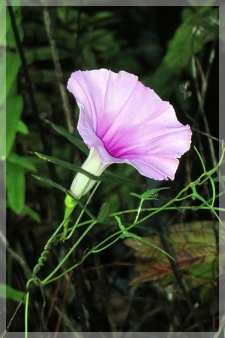
morning gloryDuring that dark time about which I recently wrote, I was in intense pain and it seemed like God had turned His back on me. When I confided to a friend that God seemed deaf to my pleas, she asked the simple question, “Have you turned it over to the Lord?” I assured her I had but, as the day wore on, I wondered if that were true.
In my prayers for relief, I was telling God the outcome I desired, but that really isn’t “turning it over” to Him. If any human had a direct line to God’s heavenly office, it would have been the Apostle Paul and yet God didn’t relieve him of whatever his thorn was! Instead of demanding the result I wanted, I had to place myself in God’s loving hands as did Paul and pray for God’s grace and the power to accept what He’d placed in my lap.

Each morning, I prayed for grace enough for the day—for the strength, endurance, peace, patience, courage, and joy needed to get through the next twenty-four hours. I asked God to reassure me of His lovingkindness and to protect me from the doubt, fear, and negativity Satan was whispering in my ears. The hardest thing, however, was to hand the outcome of my upcoming surgery into His loving hands. I had to trust in His plan and presence regardless of its outcome. The physical pain remained but, with the power of the Spirit, I dealt with it.

I don’t think God decides our fate with a toss of the dice and, while a quick view of my MRI told me the why of my present physical pain, I asked God to help me understand its purpose. Paul knew his thorn was to keep him from being conceited; what was my pain telling me? In The Problem of Pain, C.S. Lewis points out how easy it is to ignore God when all is well. “We will not seek it [our happiness] in Him as long as He leaves us any other resort where it can even plausibly be looked for. While what we call ‘our own life’ remains agreeable we will not surrender it to Him.” Admittedly, I’d been in a state of “meh” and become self-sufficient rather than God-dependent and lax in my spiritual disciplines. Like the Apostle Paul, perhaps I’d become too sure of myself; the intense pain reminded me of my need for God!

As C.S. Lewis wisely pointed out, an intellectual understanding of pain is far easier than the fortitude, courage, and patience needed to endure it. It’s far easier to talk the talk than walk the walk! Nevertheless, endure it we must and through the power of the Holy Spirit, we can!

By the time this devotion is published, I will have had the surgery that, God willing, will relieve my pain. While I don’t know what my future holds, I do know who holds it in His loving hands and I trust that He will supply me with all I need to face whatever it may be.

And we know that for those who love God all things work together for good, for those who are called according to his purpose. … Who shall separate us from the love of Christ? Shall tribulation, or distress, or persecution, or famine, or nakedness, or danger, or sword?… No, in all these things we are more than conquerors through him who loved us. For I am sure that neither death nor life, nor angels nor rulers, nor things present nor things to come, nor powers, nor height nor depth, nor anything else in all creation, will be able to separate us from the love of God in Christ Jesus our Lord. [Romans 8:28, 35, 37-39 (ESV)]

Copyright ©2025 jsjdevotions. All rights reserved.

WHERE IS HE?

How long, Lord? Will you forget me forever? How long will you hide your face from me? How long must I wrestle with my thoughts and day after day have sorrow in my heart? How long will my enemy triumph over me? Look on me and answer, Lord my God. Give light to my eyes, or I will sleep in death, and my enemy will say, “I have overcome him,” and my foes will rejoice when I fall. [Psalm 13:1-4 (NIV)]

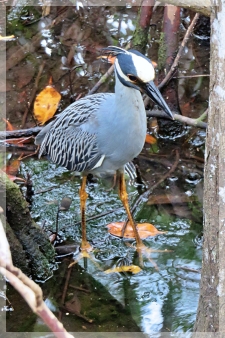
yellow crowned night heronWhen I first started reading the psalms, I suspected David might have been bi-polar—his highs seemed so high and his lows so very low; now I understand that he was just being truthful. In his psalms, David unabashedly expressed his deepest feelings to God. Pouring out his soul, he openly shared his emotions—whether anger, disappointment, sorrow, regret, shame, joy, love, fear, doubt, or even his desire for vengeance upon his enemies. No matter how troubled he was, David never was afraid to speak from his heart. I’m not sure we are willing to be as vulnerable and straightforward in our prayers as was David.

Thinking God had forgotten him (or was deliberately ignoring him), David dared to complain of the Lord’s unkindness in Psalm 13. In A Grief Observed, C.S. Lewis expressed a similar feeling of being ignored by the Lord. After noting how present God seemed in the good times, Lewis asked “where is God?… Go to Him when your need is desperate, when all other help is vain, and what do you find? A door slammed in your face, and a sound of bolting and double bolting on the inside. After that, silence.” He asked, “Why is He so present a commander in our time of prosperity and so very absent a help in time of trouble?”

Indeed, it is easy to see God in times of safety, prosperity, and health. We perceive in Him a hillside of flowers but not when a wildfire destroys an entire town. We see His work in the birth of a child but not in a child’s death at the hands of a school shooter. We feel His presence when a loved one defeats cancer but He seems absent when we suffer from chronic pain. C.S. Lewis warned that the danger we face in those dark times is not so much that we’ll stop believing in God but that we’ll come to believe that God is not good! We’re tempted to give up on Him because it seems He’s given up on us!

In this fallen world, there will be times when, like C.S. Lewis and David, it seems that God has turned his back to us. We feel forsaken and disregarded. Having recently gone through a dark time when it felt like God’s office door was closed to me, I found myself praying the words of Psalm 13. Fortunately, I didn’t stop at the first four verses. After expressing his feeling of being abandoned, David turned to praise and proclaimed his confidence in God’s love, faithfulness, and deliverance.

Like David, I will trust in the Lord’s goodness in all things—even those things I don’t understand. Rather than believing in the goodness of life, I will choose to believe in the goodness of God.

But I trust in your unfailing love; my heart rejoices in your salvation. I will sing the Lord’s praise, for he has been good to me. [Psalm 13:5-6 (NIV])

But this I call to mind, and therefore I have hope: The steadfast love of the Lord never ceases; his mercies never come to an end; they are new every morning; great is your faithfulness. “The Lord is my portion,” says my soul, “therefore I will hope in him.” [Lamentations 3:21-24 (ESV)]

Copyright ©2025 jsjdevotions. All rights reserved.

THE FIG TREE – Part 2

As they passed by in the morning, they saw the fig tree withered away to its roots.  And Peter remembered and said to him, “Rabbi, look! The fig tree that you cursed has withered.” And Jesus answered them, “Have faith in God. Truly, I say to you, whoever says to this mountain, ‘Be taken up and thrown into the sea,’ and does not doubt in his heart, but believes that what he says will come to pass, it will be done for him. [Mark 11:20-23 (ESV)]

The next morning, while Jesus and the disciples walked from Bethany to Jerusalem for yet another confrontation with Judea’s religious leaders, the disciples saw the tree Jesus cursed the previous day. The disciples had witnessed Jesus cast out demons and still a storm with a just a word but, when they saw the withered and dead fig tree, they were amazed. Normally, trees die slowly from the top down but this tree instantly withered from the roots up. With dead roots, no amount of water or fertilizer would revive it. Having witnessed the tree go from abundance to ruin with just a word from the Lord, rather than asking Jesus to explain cursing the tree, the disciples focused on the speed with which the fig died.

Rather than focusing on spiritual hypocrisy and the significance of the dead fig, Jesus focused on how He performed the miracle and spoke about the power of genuine faith. This wasn’t faith in something vague like positive thinking or an object; it wasn’t faith in faith or faith in the power of prayer. He made it clear that the sole object of this faith must be God! After all, faith is only as good as the object in which it trusts and God is all-powerful, ever-faithful, and trustworthy to His promises.

Pause for a moment and consider—even though Jesus was God, He was living as a man with the limitations of humanity. By saying, “Have faith in God,” He displayed both His humanity and His dependence upon God. Jesus’ power to speak with authority, forgive sins, calm a storm, heal the sick, raise the dead, provide food for a multitude, and wither that fig tree came from His faith in God and the indwelling of the Holy Spirit.

Explaining the power of faith in God, Jesus told them that, with faith, they could move the mountain on which they were standing (the Mount of Olives) into the sea (probably the Dead Sea 15 miles away). Moving a mountain is even more inconceivable than killing a tree with a word but Jesus uses this hyperbole to emphasize that what is impossible with man can be accomplished through faith in the power of God!

We tend to say that prayer changes things—but it is God who does the changing! Although we speak of the power of prayer, prayer alone has no power; the power comes from God who hears that prayer. We often lament, “If only I had more faith!” The disciples even asked Jesus to increase their faith. Jesus, however, told them that the size of their faith doesn’t matter—even a mustard seed of faith is enough! (With a diameter of 1 to 2 millimeters, the mustard seed was used proverbially to represent the smallest of things.) It’s not the amount of faith that matters—as long as we put our faith completely in God’s power rather than ours. It’s not faith that moves those mountains—it’s God! Even if our faith is not great, our God is!

The apostles said to the Lord, “Increase our faith!” And the Lord said, “If you had faith like a grain of mustard seed, you could say to this mulberry tree, ‘Be uprooted and planted in the sea,’ and it would obey you.” [Luke 17:5-6 (ESV)]

But he said, “What is impossible with man is possible with God.” Luke 18:27 (ESV)]

Copyright ©2025 jsjdevotions. All rights reserved.

ANSWERED PRAYERS – ST. NICHOLAS (2)

He went on a little farther and bowed with his face to the ground, praying, “My Father! If it is possible, let this cup of suffering be taken away from me. Yet I want your will to be done, not mine.” [Matthew 26:39 (NLT)]

St. NicholasSometime near the end of the 3rd century, the Bishop of Myra died and a conclave was held to elect his replacement. Legend has it that the bishops kept praying and voting but could not come to an agreement. In a stalemate, they prayed all night for God’s guidance. That night, one bishop heard a voice telling him that, at the hour of matins, the man who walked into the church was the one God wanted to shepherd His flock.

A young man was the first to come in the door and, when asked his name, it is said he replied, “Nicholas, the sinner.” The man was brought into the sanctuary, placed on the bishop’s seat, and consecrated as the new Bishop of Myra. In spite of the odd manner of Nicholas’ selection, from what we know of the man—his good deeds, wisdom, generosity, and deep faith are legendary—God knew what He was doing.

When those bishops first got together to select the new bishop, I suspect each man had his favorite candidate and his prayers probably were that the other bishops would see the light and vote for his man. Busy telling God the outcome they desired rather than asking Him to reveal who He wanted, it’s no surprise the bishops came to an impasse. Once they agreed to ask God for His divine wisdom, their prayers were answered.

There’s no point asking God for His guidance, however, if we’re unwilling to accept His answer. Granted, selecting the first man into church seems rather strange but God knew who that would be. While there are variations in the story’s details, most agree that Nicholas was no more than thirty. While he was devout and well-versed in Scripture and even may have been a monk, the man was a complete stranger and not even a priest. Could some of the bishops have had second thoughts at that point? Here was an unknown entity: someone who’d never been deacon or priest, inexperienced in the church and its politics, who would now be on an equal footing with the other bishops and in charge of the deacons and priests of Myra. And what of young Nicholas? Many stories mention his hesitation at taking on such an undeserved honor. Nevertheless, both the young man and the bishops were obedient to God’s plan; Nicholas became the Bishop of Myra and history tells us he was the right man for the job.

Do we really think God needs our advice in running the world and our lives? When we pray, do we tell Him what we want Him to do and the outcome we desire or are our prayers open-ended, leaving the end result up to God’s will? God is not a cosmic vending machine and even He can’t please all the people all of the time. If I get every green light, then someone else is getting all the reds! We all can’t get what we want but we all can get what God wants for us! In Gethsemane, Jesus asked for release but He finished His prayer with acquiescence to God’s will. We must do the same in our prayers. When we say, “Thy will be done,” however, we can’t have the unspoken proviso of, “as long as I like Your answer.”

For me, the story of his ordination is the best part of the St. Nicholas legend and yet the saint plays a minor role in it. It’s both a story of faith—faith in a loving and wise God, a God who answers the right prayers—as well as a story of submission—submission to God’s will and the immediate acceptance of His answer, strange as that answer seemed.

If you need wisdom, ask our generous God, and he will give it to you. He will not rebuke you for asking. But when you ask him, be sure that your faith is in God alone. Do not waver, for a person with divided loyalty is as unsettled as a wave of the sea that is blown and tossed by the wind. Such people should not expect to receive anything from the Lord. [James 1:5-7 (NLT)]

Copyright ©2024 jsjdevotions. All rights reserved.

ADVENT HOPE

I pray that your hearts will be flooded with light so that you can understand the confident hope he has given to those he called—his holy people who are his rich and glorious inheritance. I also pray that you will understand the incredible greatness of God’s power for us who believe him. This is the same mighty power that raised Christ from the dead and seated him in the place of honor at God’s right hand in the heavenly realms. [Ephesians 1:18-20 (NLT)]

Without Christ there is no hope. [Charles Spurgeon]

According to the Greek myth, when Zeus presented a beautiful jar to Pandora as part of her dowry, he forbade her to open it. Curiosity, however, got the best of her. When she lifted its lid to peek into the jar, all the malevolence and afflictions Zeus hid inside were released. As evils like sickness, chaos, death, conflict, hatred, jealousy, sorrow, envy, lust, famine, and violence came rushing out , the terrified woman quickly replaced its lid. All that remained in the jar was hope—the only consolation humans have for the trouble and suffering Pandora let loose upon the world.

Of course, it wasn’t Pandora who brought misery into the world—it was Adam and Eve who brought sin, misery, and death into the world with their disobedience. Rather than remaining in Pandora’s jar, hope came to the world in a baby born in Bethlehem about 2,000 years ago.

How many times this past week did you hope? Did you hope the family would arrive safely, the turkey would be done on time, the rolls wouldn’t burn, or that no one would argue about politics at dinner? We hope for things both large and small—getting a raise, excellent grades, better health, reconciliation, a good night’s sleep, a winning season for our team, a cure for cancer, an on-time departure, finding the perfect gift, world peace, the winning lottery ticket, or a better tomorrow.

Biblical hope, however, isn’t about expecting better circumstances. Biblical hope is living through the storms, loss, pain, and disorder of this life while holding on to the hope that God will show up right in the middle of our mess! In the darkness of our lives and today’s troubled world, Christ’s followers have hope regardless of whether our circumstances change for the better or the worse. We have hope because we know the One who holds our future in His hands. We have hope because we know that He is with us every step of the way. Best of all, we have hope because we know how the story ends—and its end is better than anything we possibly could imagine!

Yesterday was the first Sunday in Advent—the four-week season in the Church calendar dedicated as much to the Messiah’s second arrival as to His first! In observance of this season of preparation, last night we lit the first candle (the candle of hope) in our Advent wreath. A circular garland of evergreen, the wreath’s greens represent eternal life and its round shape represents God’s unending love. Often called the prophecy candle, it reminds us that the Messiah’s arrival, death, resurrection, and return in final victory were prophesied hundreds of years before His birth. This first candle represents mankind’s past hope for the coming of the promised Messiah, our present hope because of Jesus’ presence in our lives, and our future hope for His promised return.

Hope came into the world with the birth of Jesus—Immanuel—God with us. God gave us hope with His forgiveness of sins, our salvation, and His promise of peace. He gave us hope with the resurrection of the dead, the communion of saints, the redemption of creation, the Holy Spirit, the return of Christ, and the life of the world to come. Thank you, Heavenly Father, for the gift of hope.

The Christmas message is that there is hope for a ruined humanity—hope of pardon, hope of peace with God, hope of glory—because, at the Father’s will, Jesus became poor and was born in a stable so that thirty years later He might hang on a cross. [J.I. Packer]

I pray that God, the source of hope, will fill you completely with joy and peace because you trust in him. Then you will overflow with confident hope through the power of the Holy Spirit. [Romans 15:13 (NLT)]

THE DARK VALLEY

Yea, though I walk through the valley of the shadow of death, I will fear no evil: for thou art with me; thy rod and thy staff they comfort me. [Psalm 23:4 (KJV)]

deer - young buckIn Psalm 23, the King James version translates the original Hebrew “gay tsalmaveth”  as “valley of the shadow of death.” A more accurate translation, however, would be a dark valley or a valley of death-like darkness. While people often associate this psalm with death, it uses the metaphor of sheep and their shepherd and sheep have no concept of death. But, because of their near-sightedness and poor depth perception, they are reluctant to move into dark places. Nevertheless, whether referring to the unknown, danger, or even death, David’s words are ones of comfort and hope to all who read them—we are not alone as we travel through the dark valleys of life.

My friend Joe recently told me about his sister’s final hour after a long and grueling battle with cancer. As Joe sat on the bed beside the dying woman, she suddenly sat up and stared ahead at a painting on the opposite wall. When he asked what had her attention, she replied with a question of her own: “Don’t you see?” Looking at the picture, all he saw was a landscape with trees, rolling hills, and a few birds high in the sky. “What?” he asked his sister as she kept her eyes straight ahead. “Him! Don’t you see Him?” When Joe asked who, she said it was Jesus, adding, “He’s smiling at me.” Smiling herself, his sister lay back against her pillow, closed her eyes, and died within the hour. Since that day, Joe has looked at that picture many times and can find nothing that even resembles a person, let alone Jesus. I suggested that, rather than seeing something in the painting, his sister was seeing someone in front of the painting—the good shepherd who would accompany her through the dark valley into the light.

My friend Carol’s Uncle Stan was an avid outdoorsman and lover of nature. Having been defeated by heart disease, Stan’s hospital bed was placed by the picture window in his Northwoods home. Shortly before his passing, a three-point buck emerged from the woods and slowly approached the house. The magnificent creature stood by the window and seemed to stare in at him. Eventually, the buck lay down beneath the window and, like the rest of Stan’s family, kept the man company for the next few hours until he peacefully passed into God’s arms. Carol believes the buck’s presence was God’s way of comforting Stan as he took his final journey.

Death is inevitable and as much a part of life as birth; as Christians, we have no reason to fear it. Nevertheless, we still face the end of life with some trepidation. After all, it is our final surrender. Even though Scripture assures us that death takes us home to the Lord, the moment of death remains a mystery. Will there be a flash of light, a heavenly chorus, or a dark tunnel? Lazarus didn’t say and neither Trip Advisor nor Yelp have posted any reviews. I suspect it is both the most terrible and yet the most beautiful moment of our lives. Let us take comfort from the encouraging words of the 23rd Psalm that we are under God’s care and safe in His presence when we enter any shadowy valley—even the valley of death.

Was the buck’s extraordinary visit just a coincidence or was it a gift from God? Did Joe’s sister see Jesus or was it the hallucination of a dying woman on opioids? We’ll never know. I tend to think it was God’s way of assuring both of those dying believers (and their families) that they would not be making their final journey through that dark valley alone. The good shepherd was right beside them.

Death is not the end of the road; it is only a bend in the road. The road winds only through those paths through which Christ Himself has gone. This Travel Agent does not expect us to discover the trail for ourselves. Often, we say that Christ will meet us on the other side. That is true, of course, but misleading. Let us never forget that He walks with us on this side of the curtain and then guides us through the opening. We will meet Him there, because we have met Him here. [Erwin Lutzer]

Jesus said unto her, I am the resurrection, and the life: he that believeth in me, though he were dead, yet shall he live: And whosoever liveth and believeth in me shall never die. [John 11:25-26 (KJV)]

Copyright ©2024 jsjdevotions. All rights reserved.