HOPE

It is the same way with the resurrection of the dead. Our earthly bodies are planted in the ground when we die, but they will be raised to live forever. Our bodies are buried in brokenness, but they will be raised in glory. They are buried in weakness, but they will be raised in strength. [1 Corinthians 15:42-43 (NLT)]

lake lucerne sailboatThe anchor, the Christian symbol of hope, is the most prevalent of all the Christian symbols found in the Roman catacombs. In fact, all of the symbols, paintings, mosaics, and reliefs found in the miles of labyrinth-like narrow tunnels and thousands of graves in the catacombs reflect hope in some way. Instead of the dark funereal images you might expect in an underground cemetery, the white walls of the Christian catacombs feature living things like flowers and birds along with Bible stories expressing hope in God’s plan of salvation. Prominent themes from the Old Testament include Daniel emerging untouched from the lions’ den and Shadrach, Meshach, and Abednego exiting unharmed from the fiery furnace. Frequently depicted are the stories of Noah, who escaped from the flood, and Jonah who was delivered from the sea monster. Continuing the theme of deliverance are many images of the good shepherd so frequently mentioned in Psalms. New Testament stories usually showed Jesus raising the dead (with over fifty representations of Lazarus), healing people, and feeding the multitude. The art of the catacombs is all about man’s hope in God’s deliverance, provision, and plan of salvation.

As I read about the displays of hope found in this ancient place of grief and death, I thought of my mother’s final days. I was only fifteen when I sat at her hospital bedside. Even though she knew her end was near, my mother had no tears. Instead of worry or fear, she radiated a sense of peace and hope. I recall my father reaching under the plastic of her oxygen tent, brushing back her hair, caressing her face, and saying, “You look like an angel tonight.” Indeed, no angel could have been more beautiful that she was that night. My mother smiled back at him and said in a voice filled with hope, “Maybe tomorrow, I’ll be with them!” She could say those words so confidently because my mother was a believer and, like those early Roman Christians, she knew Jesus and trusted the promises of God.

The stories and symbols found in those ancient catacombs remind us that, for a Christian, death is not something to fear. Going beyond the here and now, Christian hope reaches past the grave into the glorious tomorrow promised by God! Death, for a Christian is not an end but a beginning; it is like emerging from the trials of a lion’s den, fiery furnace, or whale’s belly unharmed. When that last breath is taken, the Christian simply pulls up anchor and sets sail for a new land—one where tears, pain, and sorrow are replaced by peace, joy, and praise. That is the hope seen in the art found in the catacombs of Rome and the hope I saw firsthand in a Detroit hospital room nearly sixty years ago.

Death to the Christian is the exchanging of a tent for a permanent palace. Here we are as pilgrims or gypsies living in a frail, flimsy home subject to disease, pain and peril. But at death we exchange this crumbling, disintegrating tent for a house not made with hands, eternal in the heavens. [Billy Graham]

And we believers also groan, even though we have the Holy Spirit within us as a foretaste of future glory, for we long for our bodies to be released from sin and suffering. We, too, wait with eager hope for the day when God will give us our full rights as his adopted children, including the new bodies he has promised us. [Romans 8:23 (NLT)]

Copyright ©2021 jsjdevotions. All rights reserved.
 

THE ANCHOR

So God has given both his promise and his oath. These two things are unchangeable because it is impossible for God to lie. Therefore, we who have fled to him for refuge can have great confidence as we hold to the hope that lies before us. This hope is a strong and trustworthy anchor for our souls. It leads us through the curtain into God’s inner sanctuary. [Hebrews 6:18-19 (NLT)]

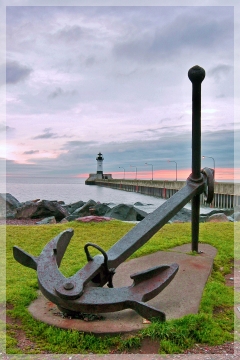
duluth MN harbor - anchorThe sign in front of a nearby church read, “Our hope is anchored in the Lord,” which got me thinking about anchors. I’d never given them much thought until we took a Windjammer cruise off the coast of Maine many years ago. Accompanied by four friends and a crew of two, we sailed for a week. At dusk, we’d lower the sails and anchor in a harbor for the night. After breakfast, we’d pull up anchor for another relaxing day of sailing by lighthouses, granite cliffs, fishing villages, and even a few seals. One day, however, gale force winds replaced the gentle breeze and the calm sea turned violent. The sky darkened as rain and hail poured down on us. We immediately pulled into the nearest inlet, lowered the sails, and dropped two anchors to keep from being blown into the rocks! If we’d had two more anchors (as did the sailors in Acts 27), I suspect we would have dropped them, as well. After donning my life jacket and slicker, all I could do was pray and hope those anchors held. You really don’t appreciate the worth of an anchor until you’ve needed one in a storm!

Since the anchor symbolized hope in the ancient secular world, the recipients of the letter to the Hebrews would have understood the author’s use of the anchor as a metaphor for hope. It is a vivid picture of what keeps us steady and safe in the storms of life—times of trial, danger, hardship, anxiety and uncertainty. An anchor, however, is only as secure as that to which it is fastened. The anchor of hope is not buried in sand or hooked onto a rock that might pull loose. The believer’s hope in Christ is secure, because it is fixed in the very presence of the Almighty.

When the epistle writer says that hope “leads us through the curtain into God’s inner sanctuary,” he’s referring to the Holy of Holies—the inner room of the Temple holding the Ark of the Covenant. Only the high priest could go into this holy place (anyone else would be killed). The priest entered just one day a year, on the Day of Atonement, and only to offer a blood sacrifice. The Holy of Holies was the special dwelling place of God and the curtain emphasized His inaccessibility because of man’s sins. When Jesus died, the curtain tore in half, symbolizing that the way to God was now open to all.

Just as a boat’s anchor holds it safely in position, a Christian’s hope keeps him safe and secure. Like an anchor, God will keep us steady in the storms of life—when the wind of fear blows, suffering rains down, opposition crashes into us, trials threaten us, and uncertainty rocks us to and fro. A boat’s anchor goes down and digs into the bottom of the sea but a Christian’s hope goes up to the heavenly sanctuary and attaches itself to God!

What an anchor is to a vessel in its tossings, so the hope is to us in our times of trial, difficulty and stress. The anchor is outside the ship, is connected with it, and keeps it secure. [W.E. Vine]

Let us hold tightly without wavering to the hope we affirm, for God can be trusted to keep his promise. [Hebrews 10:23 (NLT)]

I pray that God, the source of hope, will fill you completely with joy and peace because you trust in him. Then you will overflow with confident hope through the power of the Holy Spirit. [Romans 15:13 (NLT)]

Copyright ©2021 jsjdevotions. All rights reserved.


JOB’S LAMENT (Part 2)

My God, my God, why hast thou forsaken me? Why art thou so far from helping me, from the words of my groaning? O my God, I cry by day, but thou dost not answer; and by night, but find no rest. [Psalm 22:1-2 (RSV)]

taos NMYesterday, I wrote about Job’s lamentation. 19th century bible scholar George Granville Bradley said this about Job 3: “Where in the world will you find a sadder strain of more hopeless, uncontrolled, and unbroken lamentation and mourning? … Filled to the brim, they run over with pain.” I have to agree.

Nevertheless, as sad as that chapter is, there is beauty in its words. Job’s anguished speech lets us know that it’s okay to express our emotions. It tells us that God doesn’t expect us to stoically maintain silence in the face of tragedy and pain. Job’s words, like those in the many psalms of lament, are the anguished cries of a faithful believer—someone who can uninhibitedly express his pain and grief to God.

Job’s lament, however, is not a laundry list of grievances. He’s not complaining about his sudden poverty, that no one will carry on his name, his loss of status, or going into gory detail about his physical maladies and grumbling that scraping his skin with potsherds brings no relief. Rather than an account of his misery, grief, and misfortune, his is simply a cry to escape his suffering. When God finally speaks to Job, He doesn’t take the man to task for his honesty in pouring out his deepest emotions; it is for accusing God of acting unjustly and questioning His wisdom.

Faith in God and despair in our situation are not incompatible. Out of the 150 psalms, one third are considered psalms of lament. Considered a man after God’s heart, David is credited with writing 73 psalms and many of those are laments. Clearly, ours is a God who allows us to be brutally honest with Him as we voice our anger, distress, fear, anguish, frustration, doubt, shame, heartache, and disappointment.

For some unknown reason, David felt that God has abandoned him in Psalm 22 and he echoed Job’s question of “why?” These same words were repeated by Jesus as He hung on the cross and, in His torment, cried out, “Eloi, Eloi, lema sabachthani?” Jesus was sinless, which means His anguished words were not sinful; feeling God is absent is not the same as believing it. Like Job and David, Jesus was calling out to God in His misery but their words of lament didn’t mean they’d lost faith in God. They wouldn’t have called out to God in their despair had they not believed their words would reach God’s ears!

As happened with Job, one moment it can seem like God is smiling down at our lives when, suddenly, life goes down the tubes and it seems like God has turned His back on us. Feeling abandoned and alone in our suffering and sorrow, we must never be afraid to express our heartfelt emotions to the God who created us with the ability to have those very emotions! Dark and silent brooding turns us inward and away from God while expressing our shock, grief, and despair turns us outward toward Him!

Let us never be hesitant to approach the Lord in our tears and despondency. A child instinctively calls out to a parent when he’s hurting, sick, frightened, or lost; we should be no different. Rather than a denial of our Father in Heaven, a lament directed toward Him is both a plea for help and an affirmation of His presence and power.

Cast your burden on the Lord, and he will sustain you; he will never permit the righteous to be moved. [Psalm 55:22 (RSV)]

Humble yourselves therefore under the mighty hand of God, that in due time he may exalt you. Cast all your anxieties on him, for he cares about you. [1 Peter:5:6-7 (RSV)]

Copyright ©2021 jsjdevotions. All rights reserved.

CURSE THE DAY! (Part 1)

Curse that day for failing to shut my mother’s womb, for letting me be born to see all this trouble. Why wasn’t I born dead? Why didn’t I die as I came from the womb? [Job 3:10-11 (NLT)]

baby feetAfter Satan took Job’s loved ones and wealth, the grieving man remained a pillar of patience and faith. Rather than blaming God, the stoic man acknowledged God’s sovereign authority saying, “The Lord gave me what I had, and the Lord has taken it away. Praise the name of the Lord!” [1:21]

Things took a turn for the worse when Satan attacked Job’s body. With boils from head to foot, Job’s body was covered with scabs, pus oozed from his sores, his skin was black and peeling, and maggots fed on him. As if that weren’t enough, the man suffered from insomnia, nightmares, fever, and pain in his bones. His symptoms sound as horrific and deadly as Ebola Hemorrhagic Fever.

When Job’s wife told him to curse God and die, the faithful man responded, “Should we accept only good things from the hand of God and never anything bad?” [2:10] Although he seemed resigned to his fate, the despondent Job came dangerously close to falling into Satan’s trap when, in Job 3, he questioned God’s wisdom in giving him life.

I can understand someone like Job, someone suffering terribly who sees no end to the misery, wishing for a quick end to his life and praying for the release offered by death. What I find difficult to understand is Job’s wish that he’d never been born. Cursing the day of his birth and the night of his conception, the despairing man literally wished his life erased from its existence.

Until Satan’s attack, Job’s life appears to have been picture perfect for decades. With his many servants and more than 10,000 head of livestock, he was the richest man around. The father of seven sons and three daughters, he probably had numerous grandchildren. The family regularly gathered together for long feasts so they must have enjoyed each other’s company. A prominent man, well-respected in the community, Job was principled, generous and charitable. In spite of having everything his heart desired, Job’s heart remained set on God and the Lord called him, “the finest man on earth…blameless…a man of complete integrity.” [1:8] Yet, by cursing his very existence, Job wanted to obliterate all the blessings and joy that existed between his birth and his affliction.

In his pain, Job forgot about growing up in a loving home, playing with his brothers and sisters, the bliss of young love, the wonder of touching his wife’s belly and feeling his unborn child move, the delight of holding his children in his arms, the laughter of his family, the satisfaction that came from being able to right a wrong or help the poor, and the joy of bouncing a grandchild on his knee. If he’d never been born, he would have missed sunrises and sunsets, the taste of grapes, the sound of birds’ songs, the pleasure of a kiss, and the joy of praising the Lord. Although Job began his story as a sterling example of accepting of God’s will when disaster strikes, cracks developed in his spirit as his suffering intensified.

Job’s outburst of despair, however, does not mean that Satan won. While Job cursed his day of birth, he never cursed God. Moreover, even though he wondered why people who longed for death continued to live, Job never considered suicide. Because he operated on a false retribution theology, Job believed that God had forsaken him. Rather than losing faith in God, he lost faith in himself.

For many of us, these last several months have challenged our physical, emotional, spiritual, and financial resources and, like Job, we may feel overwhelmed by all that has beset us. Job lost perspective; let us not do the same. God did not forsake Job and He has not forsaken you! We must never forget our past blessings or rue the day of our birth. After all, had we never been given life, we wouldn’t have had the opportunity to know Jesus, be born again, or enjoy eternal life!

For God has said, “I will never fail you. I will never abandon you.” So we can say with confidence, “The Lord is my helper, so I will have no fear. What can mere people do to me?” [Hebrews 13:5-6 (NLT)]

Why am I discouraged? Why is my heart so sad? I will put my hope in God! I will praise him again—my Savior and my God! [Psalm 43:5 (NLT)]

Copyright ©2021 jsjdevotions. All rights reserved.

THE DRAWING ROOM

If we claim we have no sin, we are only fooling ourselves and not living in the truth. But if we confess our sins to him, he is faithful and just to forgive us our sins and to cleanse us from all wickedness. [1 John 1:8-9 (NLT)]

Blackpoint - Lake Geneva WIMy grandmother lived in a beautiful large house. To the left of the foyer, behind closed French doors, was an elegant room she called the “drawing room,” but it wasn’t an artist’s studio where people drew. With its grand piano, silk draperies, formal furniture, and crystal chandelier, it was a room saved for entertaining special guests. Strategically placed near the front door, guests could go directly into it without passing through the rest of the house. As splendid as the room was, I never saw anyone in it; family and close friends always gathered in the “library.”

Instead of a drawing room, Aunt Ruby’s large farm house had a front parlor reserved for special guests (like the pastor). Close friends and family, however, always gathered on the front porch or around the farmhouse table in the kitchen. When I grew up, our special room for guests was called the living room even though we really lived in the den! Whether it was called a drawing room, parlor, living room, salon, or just the “good” room, many homes had a room set apart with the best furniture (sometimes covered in plastic) for company. This room was off-limits and kept pristine for special occasions and honored guests.

While we might conceal unfolded laundry or dirty dishes from guests, what do we keep hidden from God? Do we keep Jesus out of the dark corners of our lives and only allow Him into the “good” room? Do we hide our faults and weaknesses from Him the way we would unmade beds from a guest? Are we so ashamed of things both done and left undone or of the scars left by things done to us that we keep them hidden behind closed doors? Or, are we humble enough to open those doors, turn on the lights, and show Jesus everything there is, including our lapses, laziness, and lies? Do we trust Him enough to let Him see the mess left by our impatience, anger, and every stupid selfish decision we’ve made?

If our sins are forgiven, why do we need to confess them? Why do we need to let Jesus out of the parlor to see the real us? It’s not that He doesn’t already know what’s in the rest of our messy lives. Our sins were forgiven at the moment of salvation but it’s through confession that we lay claim to that forgiveness! By keeping Jesus in the pristine parlor, we’re denying, diminishing, concealing, excusing, or blaming others for our sins. Confession is trusting Jesus enough to let Him all the way into the house—into the dirty corners and locked rooms of our lives. Confession is how we build a relationship with Him and begin to be the people Jesus wants us to be. Don’t keep Jesus in the fancy drawing room; let Him into your heart!

Then Christ will make his home in your hearts as you trust in him. Your roots will grow down into God’s love and keep you strong. And may you have the power to understand, as all God’s people should, how wide, how long, how high, and how deep his love is. May you experience the love of Christ, though it is too great to understand fully. Then you will be made complete with all the fullness of life and power that comes from God. [Ephesians 3:17-19 (NLT)]

Copyright ©2021 jsjdevotions. All rights reserved.

PREFECT TIMING

God makes everything happen at the right time. Yet none of us can ever fully understand all he has done, and he puts questions in our minds about the past and the future. [Ecclesiastes 3:11 (CEV)]

Big Cypress Fox SquirrelSaturday mornings we usually walk through a nearby park that is home to a unique subspecies of squirrel found here in southwest Florida: the Big Cypress fox squirrel (or BCFS for short). Larger than a common gray squirrel, the BCFS has a black head and back, buff sides and belly, white ears and nose, and a long bushy tail.

We’re always on the lookout for these black-masked critters, but they are cautious and secretive and it had been two years since spotting one. Thinking the endangered rodent no longer inhabits the park, I’d given up hope of seeing one again. Recently, while trying to focus my camera on some holly berries, the shaking branches above them caused me to look up. A large BCFS was staring down at me and even stayed long enough for a photo! Our brief encounter was exactly what I needed to lift my spirits after several discouraging weeks. As I thanked God for the “Aha!” moment, I pondered how God’s timing is both unpredictable and perfect.

I’m not sure David thought God’s timing perfect while spending fifteen years on the run hiding from Saul and his army and I suppose the Israelites questioned God’s timing as they waited 400 years in Egypt and 40 more in the desert before entering the land promised to them. Joseph may have questioned God’s timing during the years he spent as a slave in prison before becoming Pharaoh’s second in command. Sarah and Abraham waited twenty-five years between God’s promise of a son and Isaac’s birth and, after waiting decades, Zechariah and Elizabeth had given up any hope of a child when she became pregnant with John. I look at my prayer list and see that God often seems painfully slow. Nevertheless, the squirrel’s unexpected appearance reminded me that God is present whether or not we see Him. Rather than losing hope, we must trust in His perfect timing.

Rather than providing photo ops, the squirrels’ lives revolve around berries, seeds, nuts, one another, and avoiding predators. They’ve been in the park all the time but, because my timing isn’t perfect, I missed seeing them. God’s timing, however, always is perfect. Like the squirrels, His purpose is not to satisfy or entertain us. God wants to teach us to trust Him as we grow more like Christ. While we may not always understand or appreciate His timing, the appearance of that BCFS was a reminder that faith in God means faith in His presence, plan, and timetable.

If the Lord Jehovah makes us wait, let us do so with our whole hearts; for blessed are all they that wait for Him. He is worth waiting for. The waiting itself is beneficial to us: it tries faith, exercises patience, trains submission, and endears the blessing when it comes. The Lord’s people have always been a waiting people. [Charles Spurgeon]

The Lord says: “My thoughts and my ways are not like yours. Just as the heavens are higher than the earth, my thoughts and my ways are higher than yours. [Isaiah 55:8-9 (CEV)] 

Dear friends, don’t forget that for the Lord one day is the same as a thousand years, and a thousand years is the same as one day. [2 Peter 3:8 (CEV)]

Copyright ©2021 jsjdevotions. All rights reserved.