NEHEMIAH’S PROJECT (Nehemiah – 2)

But now I said to them, “You know very well what trouble we are in. Jerusalem lies in ruins, and its gates have been destroyed by fire. Let us rebuild the wall of Jerusalem and end this disgrace!” Then I told them about how the gracious hand of God had been on me, and about my conversation with the king. They replied at once, “Yes, let’s rebuild the wall!” So they began the good work. [Nehemiah 2:17-18 (NLT)]

white peacock butterflyWhen Nehemiah arrived in Jerusalem, over ninety years had passed since the first of the exiled Jews had returned to Judah. Although the temple had been rebuilt for seventy years, Jerusalem’s city walls and gates were still in ruins. Nevertheless, within fifty-two days of his arrival, the walls were reconstructed and new gates installed. That Nehemiah managed to accomplish in less than two months what hadn’t been done in ninety years is a case study in Management 101.

Like any good leader, Nehemiah started with a plan. Knowing he needed timber, he requested access to the king’s forest and, knowing he would face opposition, he asked for letters ensuring his safe passage to Jerusalem. Upon his arrival, Nehemiah took several days to evaluate both the wall and the city’s residents. Then because Nehemiah knew both who and what he was dealing with, he knew the right approach. Rather than pointing out the exiles’ failure as might a superior, he became one with the people by using the pronouns “we” and “us.”

The priests worked near the Temple at the Sheep Gate (where sacrificial sheep entered) and continued west to the towers that served to protect the northern approach to Jerusalem and the Temple. Just as the priests repaired the area nearest the Temple (an area in which they had a vested interest), the other residents repaired the parts of the wall closest to their homes. Not only was this more efficient but, by having a personal stake in their section of the wall, it was a great incentive. The people labored to protect their own homes and businesses! Even though he was in charge, Nehemiah worked alongside the people of Jerusalem.

Like any project, however, there were difficulties! As often happens when a big project is started, discouragement set in when only half finished. Reminding them of their goal, Nehemiah assured the people that God would help them succeed and work resumed. When their neighboring enemies ridiculed, harassed, and threatened to attack them, Nehemiah reassured the people of the Lord’s protection and eased their fears by setting up a plan of defense and devising a warning system in case of an attack.

The non-stop construction work also took a financial toll on the people. During a time of famine before Nehemiah’s arrival, the poorer Judeans borrowed money from their brethren to purchase food and pay their taxes. Although the Torah prohibited a Jew charging another Jew interest, interest had been charged. Now, working from sunrise to sunset on the walls and unable to work their fields or ply their trades, they were behind in their interest payments and faced losing their property or selling their children into slavery. Nehemiah put an end to the charging of interest and demanded that previous interest payments be repaid. Finally, because Nehemiah knew the heavy financial burden the people carried, he refused to profit from his position and declined the food allowance that was his to claim. Although his enemies tried to discourage, discredit, intimidate, and even assassinate him, Nehemiah never wavered in his task.

Today’s business executives could learn from Nehemiah. He had a vision, knew both who and what it would take to accomplish the task, and recognized the obstacles he’d face in building the wall. He inspired and motivated his workers, worked alongside them, was respectful and compassionate, and used them wisely. Moreover, the security, safety, and financial needs of his workforce was important to him.

Nehemiah was a man of wisdom, courage, integrity, and determination but all of that would have come to nothing had he not also been a man of God! His leadership skills would have been meaningless without his relationship with the Lord. From the first to the last chapter of Nehemiah’s story, we find him continually in prayer. Every moment he spent leading the people of Judah, Nehemiah was following God! While that’s not usually something taught in Management 101, perhaps it should!

When we rely upon organization, we get what organization can do; when we rely upon education, we get what education can do; when we rely upon eloquence, we get what eloquence can do. And so on. But when we rely upon prayer, we get what God can do.
[A.C. Dixon]

So on October 2 the wall was finished—just fifty-two days after we had begun. When our enemies and the surrounding nations heard about it, they were frightened and humiliated. They realized this work had been done with the help of our God.  [Nehemiah 6:15-16 (NLT)]

Copyright ©2023 jsjdevotions. All rights reserved.


PUT AWAY YOUR CALCULATORS AND CALENDARS! (Revelation – Part 3)

blood moon - lunar eclipse

Photo Courtesy Dennis Johnson


However, no one knows the day or hour when these things will happen, not even the angels in heaven or the Son himself. Only the Father knows. [Matthew 24:36 (NLT)]

I couldn’t finish writing about Revelation without a caution to beware of end times predictions. If someone claims to have secret knowledge or frightens you with their teaching—abandon them ASAP! If Jesus didn’t know when the end would occur, I can guarantee that no mortal will!

Nevertheless, in 1994, radio evangelist Harold Camping predicted the world would end on September 6. When it didn’t, explaining his mistake was a mathematical error, Camping got out his calculator again and predicted the apocalypse would begin precisely at 5:59 PM, May 21, 2011. At that time, those chosen by God would ascend to heaven in the Rapture and cataclysmic earthquakes would rock the earth. After finding himself still here May 22, Camping admitted his understanding of God’s plan was slightly off but continued predicting the world’s end on October 21. When October 22 dawned, the evangelist confessed such predictions were “incorrect and sinful” and finally conceded that God might not tell people the date of Christ’s return. Camping’s apology, however, was little comfort to his followers who’d given up jobs and families to warn people of God’s coming judgment!

Because Joel 2:31 and Revelation 6:12 describe the sun growing dark and the moon turning red as blood before the great day the Lord arrives, we frequently read of “blood moon” predictions! A “blood moon” is a total lunar eclipse during which we see the moon slowly darken and change color from bright white to an orange-red coppery color. Not a rare event, one occurred last November and another will in 2025. On September 28, 2015, however, the fourth such lunar eclipse occurred within two years (a “tetrad event”) and coincided with the Jewish celebration of Sukkot. The concurrence isn’t surprising since Sukkot always occurs on the first full moon following the autumn equinox. Nevertheless, this caused some Christian evangelists to warn of imminent world-shaking events or that the Four Horsemen of the Apocalypse would reveal their missions. They didn’t! Nevertheless, we’ll probably hear more tribulation prophecies in 2033 when the last full moon in the tetrad occurs on October 8—the first day of Sukkot!

Because Revelation calls “666” the number of the Beast, people try to use 666 to predict the end. Although Revelation’s message shouldn’t frighten believers, many Christians in 17th-century Europe feared the world’s end in 1666. When the Great London Fire that year destroyed much of the city, they thought it the end of the world but, since it lasted only four days and left only ten dead, that wasn’t much of an end!

To determine the Beast’s name, some people use gematria (a system of assigning numeric values to letters or words in the Hebrew language). Although originally limited to Hebrew, they also use Greek, Latin, English, or whatever suits them. Depending on the language, whether first and/or last name is used, and the number of mathematical applications employed, just about any name can be made to total 666 (including Nero Caesar, Julius Caesar, Domitian, Vespasian, Caligula, Mohammed, Pope Benedict IX, Luther, Ronald Reagan, and Mikhail Gorbachev). Don’t fret about 666 or its meaning. We aren’t going to know the Beast’s identity until it appears but we’ll recognize the Beast by the mark!

Last week I wrote about the Episcopal priest Jeopardy contestant and his easy dismissal of Revelation. His dismissal is understandable. False prophecies, outlandish predictions, and farfetched interpretations of Revelation bring shame and ridicule to John’s vision and, by extension, to Jesus. False rapture and end-of-the-world predictions do more than embarrass and discredit the false prophet, they dishonor the Lord and the Christian doctrine of Christ’s return!

It is only by studying Revelation that we can maintain both our hope in the return of Jesus and dispel the doomsday delusions of today’s false prophets. Let us remember that God doesn’t want us to speculate about the timing of His return; He wants us to remain faithful, righteous, watchful, and ready. In the meantime, rather than being sign watchers, we should be disciple makers!

So when the apostles were with Jesus, they kept asking him, “Lord, has the time come for you to free Israel and restore our kingdom?” He replied, “The Father alone has the authority to set those dates and times, and they are not for you to know. But you will receive power when the Holy Spirit comes upon you. And you will be my witnesses, telling people about me everywhere—in Jerusalem, throughout Judea, in Samaria, and to the ends of the earth.” [Acts 1:6-8 (NLT)]

Copyright ©2023 jsjdevotions. All rights reserved.

DAMAGED GOODS

But when the teachers of religious law who were Pharisees saw him eating with tax collectors and other sinners, they asked his disciples, “Why does he eat with such scum?” When Jesus heard this, he told them, “Healthy people don’t need a doctor—sick people do. I have come to call not those who think they are righteous, but those who know they are sinners.” [Mark 2:16-18 (NLT)]

pipevine swallowtail butterflyWhile editing photos, I came to one of a pipevine swallowtail. Seeing it on my computer rather than the camera’s viewfinder, I realized it had seen far better days. Its once beautiful wings were tattered and torn, only one “tail” remained, an antenna was missing, and, with many of its scales gone, its wings were more translucent than iridescent blue. Perhaps it had a close call with a predator, the wind had tossed it around, or it simply was old. In any case, it was damaged goods and no longer beautiful.
We tend to discard broken things, battered items, and damaged goods without giving them a second thought and I was ready to delete the less than perfect butterfly. What if God tossed us away because of our imperfections, scars, and defects? What if He stopped caring for us because we were scratched, broken, dented, or wearing out? Unlike the butterfly, it’s not birds, hail, or blowing twigs that leave us ragged and torn; its things like illness and injury, betrayal, loss, dysfunctional families, abuse, mental illness, broken relationships, addiction, financial crises, and sin. Even though the resulting damage isn’t always visible, we’re marred with pain, shame, regret, rejection, disappointment, disgrace, anger, apathy, loneliness, and fear. No one gets through life without getting a few bumps and bruises along the way and we all are damaged goods. Our scuff marks, scars, and brokenness may not be as obvious as the butterfly’s; nevertheless, they are there.

Jesus came for the less than perfect. Think of the people he loved, touched, healed, welcomed, and forgave. Sinners all, they included hated Samaritans and disparaged Gentiles, pariahs like lepers and the bleeding woman, the blind and crippled, an adulterous woman, some traitorous taxmen, political zealots, people with sordid pasts, the demon-possessed, a repentant thief, a prostitute, the disciple who denied Him, the one who doubted Him, and even the one He knew would betray Him! Jesus didn’t come for the perfect; He came for the defeated, damaged, disheartened, and sinful. While the butterfly’s wings will never heal, Jesus can heal the brokenness in our hearts and souls.

Originally, I hadn’t detected the butterfly’s damaged state because it flitted about so quickly that I barely had time to focus before it flew off to another flower. While it may have been damaged, that pipevine certainly wasn’t defeated. In God’s wisdom, He made butterflies more resilient than they appear. While the loss of an antenna means they have some trouble navigating, the loss of scales changes their aerodynamics, and the loss of much of their wings makes flight slower and more demanding, butterflies can thrive and survive, as that battered pipevine proved! It never allowed its tattered wings to deter it from making the most of the sunny day or the remaining days God allotted it. Instead of hiding under a leaf feeling sorry for itself and complaining about the unfairness of life, it was dancing in the flowers and sipping sweet nectar! Rather than being deleted, it belonged in a butterfly hall of fame.

Now, whenever I come across a damaged butterfly, I’m reminded that God loves all of His beautiful children, imperfect and broken creatures that we are. No matter how flawed, He will never discard us or toss us in the trash heap! God made us even more resilient than a fragile butterfly. Because of His power, we never need surrender to life’s challenges. We may be battered by this world but, because God’s grace is more than sufficient, we can carry on. If tattered wings can carry a battered butterfly through the flowers, we know that God can carry us through anything.

That is why we never give up. Though our bodies are dying, our spirits are being renewed every day. For our present troubles are small and won’t last very long. Yet they produce for us a glory that vastly outweighs them and will last forever! So we don’t look at the troubles we can see now; rather, we fix our gaze on things that cannot be seen. For the things we see now will soon be gone, but the things we cannot see will last forever. [2 Corinthians 4:16-18 (NLT)]

Copyright ©2023 jsjdevotions. All rights reserved.

UNEXPECTED DESTINATIONS

But I am trusting you, O Lord, saying, “You are my God!” My future is in your hands. [Psalm 31:14-15a (NLT)]

Sometimes God doesn’t give you what you want not because you don’t deserve it but because you deserve better. [Anonymous Internet wisdom]

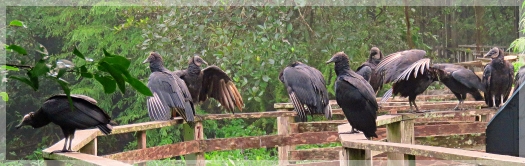
black vultures - corkscrew swampBecause the nearby bird sanctuary/swamp gets its water from rainfall, the size of its lakes fluctuates substantially with the seasons. During the dry seasons of winter and spring, the swamp’s lakes gradually recede until the summer rains begin. When this annual dry-down occurs in springtime, the wading birds congregate in the shallow lakes. With the fish having no place to hide the shallow water, it’s as easy as catching fish in a rain barrel for the birds!

Anticipating a feeding frenzy as the swamp’s wading birds gathered in the receding lakes, we went out to the bird sanctuary. The dry-down happened faster than we expected. Instead of a shallow lake covered with water lettuce, we found only mud. Rather than a plethora of egrets, herons, wood storks, and roseate spoonbills, we encountered dozens of black vultures enjoying the remains of the stinking fish in the muck! What we got certainly wasn’t what we wanted or expected.

Since vultures are known for projectile vomiting if startled or threatened, I admit to some trepidation as I walked between the perched birds on the boardwalk. Nevertheless, seeing all those vultures was an amazing experience. In spite of our initial disappointment, we were thankful for the opportunity to witness nature’s clean-up crew at work.

In spite of our best-laid plans, we don’t always get what we pray for or expect. Emily Perl Kingsley, a mother of a child with a disability, wrote a beautiful essay titled “Welcome to Holland” in which she likens having a child with a disability to someone planning a fabulous trip to Italy. After months of eager expectation, however, she discovers the flight plan unexpectedly changed and she’s landed in Holland. Even though there’s nothing wrong with Holland, it’s not Italy! Admitting the pain in losing her longed-for destination, Kingsley adds, “But, if you spend your life mourning the fact that you didn’t get to Italy, you may never be free to enjoy the very special, the very lovely things….about Holland.”

Unlike Kingsley, I’ve never arrived in Holland after expecting to touch down in Italy. Nevertheless, like her, God has changed my flight plans mid-air and I’ve landed in unplanned-for destinations. Sometimes, God’s plan is even better than we imagined and He takes us to Paris or Madrid when all we prayed for was St. Louis or Minneapolis! On the other hand, sometimes God’s plan takes us places we never wanted to visit—Al-Anon meetings, hospital rooms, nursing homes, grave sites, divorce court, or even Holland. Either way, God’s answer to our prayers is the right one—even though it’s different and unexpected. Trusting in God’s infinite love and wisdom, let us accept God’s plan with joy. Whether it’s vultures instead of roseate spoonbills, Keukenhof Gardens instead of the Colosseum, Edam cheese instead of pizza, or a special needs child instead of an honor student, may we seek to appreciate everything in our present situation and be thankful for our many blessings.

It’s just a different place. It’s slower-paced than Italy, less flashy than Italy. But after you’ve been there for a while and you catch your breath, you look around…. and you begin to notice that Holland has windmills….and Holland has tulips. Holland even has Rembrandts. [Emily Perl Kingsley]

I pray that God, the source of hope, will fill you completely with joy and peace because you trust in him. Then you will overflow with confident hope through the power of the Holy Spirit. [Romans 15:13 (NLT)]

Copyright ©2023 jsjdevotions. All rights reserved.

YEAST AND THE KINGDOM (Yeast – Part 1)

Jesus also used this illustration: “The Kingdom of Heaven is like the yeast a woman used in making bread. Even though she put only a little yeast in three measures of flour, it permeated every part of the dough.” [Matthew 13:33 (NLT)]

Immediately after the Parable of the Mustard Seed, Jesus compared the Kingdom of Heaven to the yeast a woman added to “three measures of flour” when making bread. While “measures” seems vague, the original word used wasn’t. It was seah (about a peck and a half of flour) and three seahs were over 167 cups (nearly 50 pounds) of flour. This was an enormous amount of flour for just “a little yeast” and, as He did in the previous parable, Jesus used hyperbole to emphasize the power of something very small. The question in this parable is whether the yeast is a metaphor for a bad or a good thing.

This is the first mention of leavening in the New Testament but, by the 1st century, yeast had come to represent sin. Sticking to yeast’s traditional symbolism, some commentators liken the story’s yeast to false doctrine that can sneak into the Kingdom and see this parable as a warning about the dangerous power of false teaching in the Church. Enekrupsen is the Greek word used to describe the woman’s action in adding the yeast and this is its only use in Scripture. From egkruptó, which literally meant to bury within, enekrupsen has been translated with different meanings. Some translate it as hid or concealed (which implies she did something sneaky and devious in adding yeast) while others merely translate it as put, blended, or mixed in. Since enekrupsen is used both ways in other Greek literature, we can’t be sure which correctly communicates Jesus’ meaning. Considering that bread was being made, it seems that burying yeast in the dough would be expected rather than sneaky.

I find it hard to interpret this parable in a way that associates anything sinful or evil with the Kingdom of Heaven. Although His listeners may have expected yeast’s power to represent something bad, Jesus’ parables rarely fit his listeners’ expectations. When they anticipated one thing, He usually gave them another! That a Levite and priest had failed their fellow Jew while a hated Samaritan was the hero of one parable was as surprising as a beggar ending up in Abraham’s bosom at a heavenly banquet when the rich man ended up tormented in Hades. Jesus threw society’s expectations out the window when telling of a father who’d been offended and hurt by his wastrel son. Upon the boy’s return, rather than rejecting him as the law required, the father ran to welcome him home, restored him to the family, and even had a festive celebration in the boy’s honor. Equally unexpected was the story of vineyard workers getting the same pay regardless of how long they worked and the prayers of a tax collector being heard when the Pharisee’s were not.

I agree with the commentators who take this parable at face value. Believing Jesus simply is speaking of the pervasiveness and power of yeast, they see this analogy as a continuation of the lesson in the mustard seed parable. Rather than a corrupting influence, the leaven, like the mustard seed, illustrates that great things can come from small beginnings. Yeast is even smaller than the tiny mustard seed and yet both are powerful enough to expand and effect change. While both parables illustrate the extensive growth of the Kingdom, the second parable emphasizes the Kingdom’s transformative power. Just as yeast changes dough, the Kingdom will transform the world! In both parables, the message is clear—the Messianic Kingdom comes from small beginnings, operates quietly, but has the power to accomplish great things! That God’s Kingdom would start from small and humble beginnings to grow and change a much larger entity (the world) would have been reassuring news to Jesus’ small band of disciples.

Like the Kingdom of Heaven, yeast is a living organism. Like the Holy Spirit, yeast is invisible once in the dough and yet its effect, like that of the Spirit, becomes obvious as it permeates the mixture. Just as leavened dough grows from inside out, the Kingdom moves from our hearts into our actions and from our actions into the world. Yeast transforms what it mixes with and, as we are transformed, we transform those with whom we interact. Just as yeast needs certain conditions to grow, so does the Kingdom and, just as there are 1,500 different kinds of yeast, God’s Kingdom is made up of a wide assortment of people. Yeast is found everywhere—from the bottom of the ocean to the Arctic and from flower nectar to the lining of our stomachs—and God’s Kingdom should be as pervasive! Indeed, the Kingdom of Heaven is alive, it’s everywhere, it takes attention and patience to grow, and it transforms all it touches.

What Jesus’ listeners probably didn’t understand was that the Kingdom already had arrived. But, like a tiny mustard seed, a bit of yeast, or a baby in a manger, it entered the world quietly without fanfare. Like a small yellow flower, a lump of dough, or an itinerant rabbi from Nazareth, the Kingdom didn’t look that impressive at first. Appearances, however, can be misleading. Like a mustard seed that grows 1,440 times its original size or the more than fifty loaves of bread leavened by that bit of yeast, the Kingdom will increase and prevail. In the end, when Christ returns as a conquering king, no one will be able to miss its arrival. Until then, like a small amount of yeast, God’s Kingdom will transform the hearts and lives of all it touches! May we always remember that little things become great when God is at work!

When the dough is leavened, then to the oven with it; trials and afflictions commonly attend this change; but thus saints are fitted to be bread for our Master’s table. [Matthew Henry]

I will build my church, and all the powers of hell will not conquer it. [Matthew 16:18 (NLT)]

MUSTARD

black mustard - Brassica nigra
The Kingdom of Heaven is like a mustard seed planted in a field. It is the smallest of all seeds, but it becomes the largest of garden plants; it grows into a tree, and birds come and make nests in its branches. [Matthew 13:31-32 (NLT)]

Following the Parable of the Four Soils and the Parable of the Weeds, Jesus told a third parable of growth by comparing the Kingdom of Heaven to a mustard seed. I know little about farming and soil but I’m familiar with black mustard, (Brassica nigra), the kind of mustard grown in Palestine in Jesus’ day. Its clusters of bright yellow flowers are a common sight in the meadows, thickets, vacant lots, and fallow fields in my home state of Illinois.

Both times Jesus mentioned the mustard seed, He referred to its small size. When comparing the size of our faith to that of a mustard seed, He told us even if our faith were as small as a mustard seed that, “Nothing would be impossible.” When comparing the Kingdom of Heaven to a mustard seed, He called it the “smallest of all seeds.” Having admired the mustard seed charm my sister had on her bracelet, I questioned His statement. While it was small, I knew other seeds are even smaller. Surely the One who was there at creation’s beginning knew that the almost dust-like seeds of orchids and begonias are smaller. Additionally, while the mustard plant can grow as tall as 10 to 12 feet, it’s not a tree!

Jesus, however, wasn’t teaching botany, He was telling a parable and hyperbole (an exaggerated statement not taken literally that’s used to emphasize a point) was a common technique in rabbinic teaching. Jesus used it when speaking of recognizing a speck in our neighbor’s eye but not seeing the log in ours, Pharisees straining the gnats out of their water while drinking a camel, and trying to put a camel through a needle. When we look at the original Greek, however, we find less exaggeration. Jesus refers to the mustard seed as the smallest seed which a man sows in his field. While not the smallest seed in existence, mustard was the smallest seed that would have been sown in a Palestinian field. Jesus says it grows larger than a lachanōn (a garden herb or vegetable) and, indeed, black mustard does seem like a tree when compared to most herbs! That a seed measuring less than a tenth of an inch can grow 1,440 times its original size into a 12-foot plant in just one season is impressive and that was His point!

While most of America’s farmers consider this pervasive plant a noxious weed, it’s been cultivated as a crop for thousands of years in the Holy Land. Its seeds were powdered or made into a paste for medicinal and culinary purposes. Unlike most of us, Jesus’ listeners were familiar with mustard’s characteristics. As I describe those qualities, consider how they might apply to God’s Kingdom here on earth.

With its narrow clusters of small yellow flowers, mustard isn’t a showy flower—one might even call it a humble little thing. Nevertheless, a golden field of mustard is a thing of beauty. For a variety of scientific reasons, black mustard has a competitive advantage over most other plants. It’s one of the first plants to spring up after a fire and can out-compete anything else growing in the same field. It produces thousands of seeds every season and mustard’s long-lasting seeds can survive underground for as long as 50 years. An annual, while it dies at the end of a season, it regenerates at the next rainy season.

Although mustard was welcome as a cash crop in Palestine, because of its characteristics, black mustard is considered invasive in 44 of the 48 contiguous states. Nevertheless, in spite of the Midwest’s farmers’ persistent efforts to eradicate it, black mustard returns every year. Nature Collective describes it as “an ornery guest that refuses to take the hint.” In spite of persecution from Jewish leaders and Rome, the early church was just as defiant, determined, and persistent as black mustard!

Jesus’ listeners would have been familiar with the plant’s beauty and ability to self-seed, lay down a deep root system, and grow almost anywhere, along with mustard’s knack of surviving and thriving in less-than-ideal conditions. Jesus’ point was that from small and humble beginnings, the Kingdom of Heaven—Jesus’ domain as Messiah—would gradually grow into a large and beautiful entity. Once seeded, nothing seems to stop mustard and the same goes for the Kingdom!

May our faith be as persistent, hardy, determined, steadfast, and as difficult to destroy as the mustard seed!

“You don’t have enough faith,” Jesus told them. “I tell you the truth, if you had faith even as small as a mustard seed, you could say to this mountain, ‘Move from here to there,’ and it would move. Nothing would be impossible.” [Matthew 17:20 (NLT)]

Copyright ©2023 jsjdevotions. All rights reserved.