THE REST OF THE STORY (THE LORD’S PRAYER – 2)

Praise the Lord, the God of Israel, who lives from everlasting to everlasting. Amen and amen! [Psalm 41:13 (NLT)]

Praise the Lord God, the God of Israel, who alone does such wonderful things. Praise his glorious name forever! Let the whole earth be filled with his glory. Amen and amen! [Psalm 72:18-19 (NLT)]

The version of what we call “The Lord’s Prayer” in Luke 11 and the one we find in Matthew 6 are somewhat different. The shorter version in Luke was given to His disciples (probably on the Mt. of Olives) while the one in Matthew was taught to the crowd gathered on the hill by the Sea of Galilee as part of the Sermon on the Mount. It’s quite likely that Jesus gave this prayer example several times during his three-year ministry, each time with slightly different wording. Both versions, however, are probably shorter than the prayer most Protestants recite today. Missing is the phrase, “For thine is the kingdom, the power, and the glory, for ever and ever, Amen.” Because this phrase was not found in the two earliest Greek manuscripts of Matthew’s gospel, most modern Bible translations do not include it. Although found in later manuscripts, most Biblical scholars believe it to be a later liturgical addition to the original prayer. So, how did we come to pray this prayer in its longer form?

That those additional words were not found in the earliest New Testament manuscripts doesn’t necessarily mean Jesus never said them; after all, the gospels don’t include everything our Lord did or said. If the additional words did not come from Jesus, they probably came from any one of several psalms, 1 Chronicles 29:11, or some other Jewish prayer. Jesus never said this was the only prayer to be said nor did He tell His followers to stop saying the prayers they learned in the temple. The Apostles and early church were Jewish and Jewish prayers often ended with what is called a “doxology.” Meaning to speak glory and praise, a doxology is a short, hymn-like verse exalting the glory of God. It’s understandable that this prayer, taught to Jewish disciples by a Jewish Jesus, took on some of its Hebrew heritage and flavor with the addition of this doxology.

The version of the Lord’s Prayer with which most of us are familiar comes from a Christian manual written before 300 AD. Bearing neither date nor author, some scholars believe it was written as early as 65 to 80 AD. The only complete copy has two titles: The Teaching of the Twelve Apostles and The Teaching of the Lord through the Twelve Apostles to the Gentiles. Known now as the Didache, meaning teaching, it is not part of the Biblical canon because it is not considered God-breathed or divinely inspired. Nevertheless, as a sort of handbook for the early Christians, it gives us valuable insight into the early church. Beginning with a statement of faith, the Didache may be the first Christian catechism. Its second section describes how to perform rituals like Baptism and the Eucharist and gives instructions to recite the Lord’s prayer three times a day. This direction reflects Christianity’s Jewish heritage since Jewish men were supposed to pray the Amidah three times a day. The Didache’s third section covers ministry and dealing with traveling teachers while the fourth includes several passages from the New Testament and reminds believers that Jesus will return.

As famed radio broadcaster Paul Harvey would say, “And now you know the rest of the story.”  As for me, knowing the rest of the story—that the Lord’s Prayer was regularly prayed by the earliest followers of Jesus—makes it an even more meaningful prayer to say.

Neither pray you as the hypocrites, but as the Lord commanded in His Gospel, thus pray you: Our Father, Who are in heaven, hallowed be Your name; Your kingdom come; Your will be done, as in heaven, so also on earth; Give us this day our daily bread; And forgive us our debt, as we also forgive our debtors; And lead us not into temptation, but deliver us from the evil one; For Yours is the power and the glory for ever and ever. Pray this three times in the day. [Didache 8:3-11]

Yours, O Lord, is the greatness, the power, the glory, the victory, and the majesty. Everything in the heavens and on earth is yours, O Lord, and this is your kingdom. We adore you as the one who is over all things. [1 Chronicles 29:11 (NLT)]

Copyright ©2023 jsjdevotions. All rights reserved.

THE DISCIPLES’ PRAYER (THE LORD’S PRAYER – 1)

Once Jesus was in a certain place praying. As he finished, one of his disciples came to him and said, “Lord, teach us to pray, just as John taught his disciples.” Jesus said, “This is how you should pray: Father, may your name be kept holy. May your Kingdom come soon. Give us each day the food we need, and forgive us our sins, as we forgive those who sin against us. And don’t let us yield to temptation.” [Luke 11:1-4 (NLT)]

apache plume

While the ability to calm storms would have been handy, rather than asking Jesus how he managed to do that or turn water into wine, heal the sick, provide a miraculous catch of fish, make the paralyzed walk, one of Jesus’ disciples asked the Lord how to pray. Scripture makes frequent mention of Jesus praying so the disciple knew that prayer was an integral part of His life. Perhaps he suspected that Jesus’ power sprang from His prayers.

Although rabbis often taught their disciples prayers, by Jesus’ day, every Jew knew at least one prayer, the Amidah (or Eighteen Benedictions), that was to be prayed daily. No doubt, Jesus and His followers prayed that prayer regularly. With the Amidah’s promise to sanctify God’s name; its acknowledgment of God’s power and glory; and its petitions for forgiveness, deliverance from affliction, provision, the righteous reign of God, and the Messianic kingdom to come, the prayer Jesus taught was a somewhat abbreviated version of this much longer and more formal Jewish prayer.

Although Jesus’ prayer has come to be known as the “The Lord’s Prayer,” its title is somewhat misleading. This is unlike the prayers Jesus said for His disciples or when He asked that His “cup of suffering” be taken the night before His death. It’s not like Jesus’ prayers on the cross when He asked why He’d been forsaken, that God forgive the people, and when He entrusted His spirit into God’s hands. Those prayers truly were the Lord’s prayers; the prayer Jesus taught us is ours!

Rather than offering this prayer to God, Jesus was giving this prayer to His disciples. Because the possessive determiners and pronouns are plural, we are not asking as an individual but as a group. United in faith, we pray to our Father, not mine. We’re asking for ourselves along with one another. It’s not give, forgive, and let me; it’s give, forgive, and let us. It’s not the food I need or the people I forgive who sinned against me; it’s the food we need and the people we must forgive who hurt us. This is a prayer meant to be said with one another. A prayer of community, it is a corporate prayer of submission and dependence. Perhaps a more appropriate title for this well-known prayer would be “The Disciples’ Prayer.”

Some version of this prayer is found in the liturgies of the Christian church as early as 65 AD and it continued to be used regularly through the Middle Ages. After the Reformation, the Lord’s Prayer was used in Protestant liturgies as well as Roman Catholic and Orthodox. Church leaders like Martin Bucer, John Calvin, Thomas Cranmer, and John Knox included it as a regular part of public worship.

In spite of this being the only prayer Jesus taught, many of today’s non-denominational churches don’t say it. Perhaps they see it as a relic from the past, believe that Jesus meant it only as a model, fear that people might treat it as a “magic formula,” or are concerned that such a familiar prayer will be repeated thoughtlessly. While special power should never be ascribed to words and no prayer ever should be said carelessly, anything Jesus said is worth repeating over and over again! Although we attend a non-denominational non-liturgical church on Sundays, we attend a liturgical church Saturday evenings. There we join with other believers reading a psalm, reciting the creed, and praying the Lord’s Prayer as one; there is nothing unthinking or perfunctory about any of it. Singing, declaring, and praying with one voice reinforces our oneness in the Spirit and the Lord.

When Cyprian wrote about the Lord’s Prayer early in the 2nd century, he emphasized the importance of praying it with other believers as a way of uniting them with their church family: “Our prayer is public and common; and when we pray, we pray not for one but for the whole people, because we the whole people are one.” Indeed, the Lord’s Prayer is a prayer to be said with other believers as a way of uniting us in the Body of Christ!

May we never hesitate to offer this beautiful prayer to our Father!

All the believers devoted themselves to the apostles’ teaching, and to fellowship, and to sharing in meals (including the Lord’s Supper), and to prayer. [Acts 2:24 (NLT)]

Copyright ©2023 jsjdevotions. All rights reserved.

THE LAW AND THE PROPHETS

Don’t misunderstand why I have come. I did not come to abolish the law of Moses or the writings of the prophets. No, I came to accomplish their purpose. I tell you the truth, until heaven and earth disappear, not even the smallest detail of God’s law will disappear until its purpose is achieved. [Matthew 5:17-18 (NLT)]

You search the Scriptures because you think they give you eternal life. But the Scriptures point to me! [John 5:39 (NLT)]

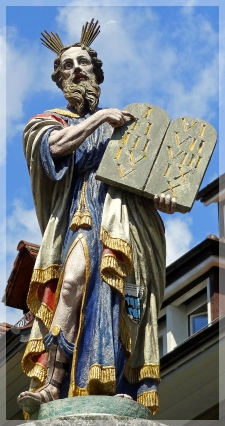
Moses Fountain - Bern - SwitzerlandOur Colorado church had a large worship center with excellent acoustics so, when the local Jewish congregation wanted to present a concert of Jewish music by a well-known Jewish performer, we were happy to offer our venue to them. The Christians in attendance never expected the evening to end with Jews and Christians joining hands and dancing the hora around the church while singing “Hava Nagilah” (Let Us Rejoice). What the Jews hadn’t expected were the Bibles on the back of every chair. Before the concert began, many intently looked through them and, after the concert, they expressed their surprise at finding their Hebrew Scriptures in our Christian Bibles!
While we call it the Old Testament, it isn’t called that by a Jew. When “testament” appears in the New Testament, it is a rendering of the Greek word diatheke, meaning covenant. While Christians recognize the old covenant God made with the Israelites, we also believe He made a new covenant (or testament) with the followers of Jesus. For a Jew, however, there’s nothing “old” about that covenant because there hasn’t been a new one. As a result, they much prefer the term Hebrew Bible or Hebrew Scriptures. The other term used for the Hebrew Bible is Tanakh—an acronym for its three categories: Torah (Law), Nevi’im (Prophets), and Ketuvim (Writings).

Even though the Hebrew Bible has 24 books divided into those three categories and our Old Testament has 39 books and four categories (Law, History, Wisdom and Poetry, and Prophecy), they both tell the same story, but in a different order. The number of books differs because the Hebrew Bible combines the first and second books of Samuel, Kings, and Chronicles, the books of Ezra and Nehemiah, and the 12 books of the minor prophets. Instead of ending with the Prophets as does our Old Testament, the Hebrew Bible ends with the Writings and the book of Chronicles.

The 1st century Jewish historian Flavius Josephus (37/38 – 100 AD) reported that there was an authoritative list of the twenty-two books Jews called “holy scriptures” that was determined by the time of Artaxerxes (464-424 BC). The book number differs because Ruth was attached to Judges and Lamentations to Jeremiah at that time. We know that the Scripture our Lord read, studied, and memorized as a boy in Galilee is the same Scripture we have today.

Jesus made frequent references to the Scriptures throughout His ministry and his enemies soon learned that they couldn’t argue the Word of God with the One who breathed that word! He defeated Satan’s temptations with words from Deuteronomy and, during his frequent confrontations with the Jewish rulers, Pharisees, and Sadducees, He made specific references to verses in Genesis, Leviticus, Deuteronomy, Exodus, Samuel, Isaiah, Hosea, and Psalms. He quoted from Malachi when speaking of John the Baptist and frequently quoted from Scripture to show how He would fulfill prophecies. He explained the writings of Moses and the prophets to Cleopas on the road to Emmaus. According to Liberty University’s Harold Willmington, of the 1,800 verses reporting Jesus’ words in the gospels, 180 verses are Old Testament quotes or allusions.

While I can understand a Jew’s unfamiliarity with a Christian Bible and surprise at finding the Hebrew Scriptures in it, I can’t understand why those of us who claim to follow Jesus are so unfamiliar with the words our Lord read, studied, quoted, and believed while He walked the earth! If it was important to Him, shouldn’t it be important to us?

Then he said, “When I was with you before, I told you that everything written about me in the law of Moses and the prophets and in the Psalms must be fulfilled.” Then he opened their minds to understand the Scriptures. [Luke 24:44-45 (NLT)]

Copyright ©2023 jsjdevotions. All rights reserved.

HIS SANCTUARY

Don’t you realize that your body is the temple of the Holy Spirit, who lives in you and was given to you by God? You do not belong to yourself, for God bought you with a high price. So you must honor God with your body. [1 Corinthians 6:19-20 (NLT)]

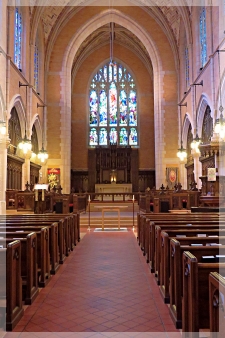
St. Paul's Cathedral - MNSince we both attended liturgical churches as girls, my friend and I were trying to recall the terms for the various parts of a traditional church building. We knew the foyer is called the narthex and the congregation sits the church’s nave. We also knew the altar rail usually separated the nave from the chancel in the front. It’s from the chancel that the service is conducted and where the altar, pulpit, and lectern are located. We even recalled that the sacristy was the room holding Communion supplies and linens. Since we were worshipping in a park that morning, my friend asked the location of our sanctuary. In historic usage, sanctuary and chancel were synonymous but, in modern usage, a sanctuary consists of the entire worship space of a church. With no building, we had no narthex, nave, or chancel but we did have a worship space; our sanctuary was a gazebo in a county park.

As God would have it, my next morning’s reading took me to today’s verse from 1 Corinthians. The Greek word usually translated as “temple” was naós, meaning a sanctuary, a divine dwelling-place, a temple, or place of divine manifestation. In Paul’s day, naós referred to the Temple proper, from the inner courts to the Holy Place with the seven-branched candlestick, golden incense altar, and showbread table all the way to the innermost area called the Holy of Holies—a place so sacred that it could be entered only by the High Priest once a year, on the Day of Atonement.

Having recently written about the lack of respect and reverence now common in a church sanctuary, Paul’s words gave me pause. The Temple and all its utensils—from the Ark, altars, and lamps to the snuffers, basins, oil, incense, and priest’s garments—were considered holy. Dedicated solely to serving God, they were not to be used for common or profane uses. If we are God’s sanctuary, a place of worship and the divine dwelling place of the Holy Spirit, do we treat ourselves with the reverence and respect due God’s temple? Are we solely dedicated to serving God? Are we ever used for vulgar, disrespectful, or profane purposes?

Do we ever desecrate our sanctuary by not treating our bodies properly? Do we treat them with the same care and regard we would Communion wafers, altar linens, or a Baptismal font? God’s sanctuary, however, is more than our physical bodies; it’s our entire being, our hearts and minds. Do we speak, read, look at, find humor in, think about, or do things we wouldn’t if we were in church? Do we always serve as a worship space of our amazing Triune God or just during prayers or worship service? Do we reflect the dignity, sanctity, and holiness that comes with being the house of God?

A great deal of responsibility comes with being God’s dwelling place. Just as the Temple was defiled in 168 BC when Antiochus Epiphanes sacrificed a pig on the altar of incense, our sins defile us. They are like obscene graffiti on a church walls, vandalism of the altar, defacement of the Bible, or leaving excrement on the pews. Preacher Harry Ironside reminds us, “How careful you and I ought to be that we grieve not that blessed One who dwells within, that we do not bring dishonor upon the name of the Savior who has sent His Spirit to live in our body.”

The Jews were so zealous about maintaining the purity of God’s sanctuary that a low fence  separated the court of the Gentiles from the rest of the Temple mount complex. Gentiles and ritually unclean Israelites were forbidden, on pain of death, from passing through its gates to the interior areas—the sanctuary of the Temple. Are we that zealous about keeping His dwelling place within us—His sanctuary—pure and undefiled?

For that matter, our brothers and sisters in Christ also serve as a dwelling place of God. Do we treat them with the same reverence and respect due God’s sanctuary? We should!

Don’t you realize that all of you together are the temple of God and that the Spirit of God lives in you?… All of you together are Christ’s body, and each of you is a part of it. [1 Corinthians 3:16,12:27 (NLT)]

Copyright ©2023 jsjdevotions. All rights reserved.

PUT AWAY YOUR CALCULATORS AND CALENDARS! (Revelation – Part 3)

blood moon - lunar eclipse

Photo Courtesy Dennis Johnson


However, no one knows the day or hour when these things will happen, not even the angels in heaven or the Son himself. Only the Father knows. [Matthew 24:36 (NLT)]

I couldn’t finish writing about Revelation without a caution to beware of end times predictions. If someone claims to have secret knowledge or frightens you with their teaching—abandon them ASAP! If Jesus didn’t know when the end would occur, I can guarantee that no mortal will!

Nevertheless, in 1994, radio evangelist Harold Camping predicted the world would end on September 6. When it didn’t, explaining his mistake was a mathematical error, Camping got out his calculator again and predicted the apocalypse would begin precisely at 5:59 PM, May 21, 2011. At that time, those chosen by God would ascend to heaven in the Rapture and cataclysmic earthquakes would rock the earth. After finding himself still here May 22, Camping admitted his understanding of God’s plan was slightly off but continued predicting the world’s end on October 21. When October 22 dawned, the evangelist confessed such predictions were “incorrect and sinful” and finally conceded that God might not tell people the date of Christ’s return. Camping’s apology, however, was little comfort to his followers who’d given up jobs and families to warn people of God’s coming judgment!

Because Joel 2:31 and Revelation 6:12 describe the sun growing dark and the moon turning red as blood before the great day the Lord arrives, we frequently read of “blood moon” predictions! A “blood moon” is a total lunar eclipse during which we see the moon slowly darken and change color from bright white to an orange-red coppery color. Not a rare event, one occurred last November and another will in 2025. On September 28, 2015, however, the fourth such lunar eclipse occurred within two years (a “tetrad event”) and coincided with the Jewish celebration of Sukkot. The concurrence isn’t surprising since Sukkot always occurs on the first full moon following the autumn equinox. Nevertheless, this caused some Christian evangelists to warn of imminent world-shaking events or that the Four Horsemen of the Apocalypse would reveal their missions. They didn’t! Nevertheless, we’ll probably hear more tribulation prophecies in 2033 when the last full moon in the tetrad occurs on October 8—the first day of Sukkot!

Because Revelation calls “666” the number of the Beast, people try to use 666 to predict the end. Although Revelation’s message shouldn’t frighten believers, many Christians in 17th-century Europe feared the world’s end in 1666. When the Great London Fire that year destroyed much of the city, they thought it the end of the world but, since it lasted only four days and left only ten dead, that wasn’t much of an end!

To determine the Beast’s name, some people use gematria (a system of assigning numeric values to letters or words in the Hebrew language). Although originally limited to Hebrew, they also use Greek, Latin, English, or whatever suits them. Depending on the language, whether first and/or last name is used, and the number of mathematical applications employed, just about any name can be made to total 666 (including Nero Caesar, Julius Caesar, Domitian, Vespasian, Caligula, Mohammed, Pope Benedict IX, Luther, Ronald Reagan, and Mikhail Gorbachev). Don’t fret about 666 or its meaning. We aren’t going to know the Beast’s identity until it appears but we’ll recognize the Beast by the mark!

Last week I wrote about the Episcopal priest Jeopardy contestant and his easy dismissal of Revelation. His dismissal is understandable. False prophecies, outlandish predictions, and farfetched interpretations of Revelation bring shame and ridicule to John’s vision and, by extension, to Jesus. False rapture and end-of-the-world predictions do more than embarrass and discredit the false prophet, they dishonor the Lord and the Christian doctrine of Christ’s return!

It is only by studying Revelation that we can maintain both our hope in the return of Jesus and dispel the doomsday delusions of today’s false prophets. Let us remember that God doesn’t want us to speculate about the timing of His return; He wants us to remain faithful, righteous, watchful, and ready. In the meantime, rather than being sign watchers, we should be disciple makers!

So when the apostles were with Jesus, they kept asking him, “Lord, has the time come for you to free Israel and restore our kingdom?” He replied, “The Father alone has the authority to set those dates and times, and they are not for you to know. But you will receive power when the Holy Spirit comes upon you. And you will be my witnesses, telling people about me everywhere—in Jerusalem, throughout Judea, in Samaria, and to the ends of the earth.” [Acts 1:6-8 (NLT)]

Copyright ©2023 jsjdevotions. All rights reserved.

NOT TO BE IGNORED (Revelation – Part 1)

Behold, I am telling you a mystery; we will not all sleep, but we will all be changed, in a moment, in the twinkling of an eye, at the last trumpet; for the trumpet will sound, and the dead will be raised imperishable, and we will be changed. [1 Corinthians 15:51-52 (NASB)]

little blue heronWhen researching another devotion, I learned that a Jeopardy contestant missed this $1,000 clue: “It’s the ascension heavenward by true Christians both living & dead at Christ’s second coming.” Although the answer was the Rapture, the contestant, an Episcopal priest, remained silent. He later explained that he didn’t believe in the Rapture or hold to a literal reading of Revelation, adding that the literal reading of Revelation is a “a product of the modern era.” His words gave me pause.

In the decades I attended denominational churches, I never heard any reference to the Rapture and can’t recall ever hearing a sermon about the tribulation or Christ’s return. While I’d read bits and pieces of Revelation, it seemed so bizarre after the first three chapters that I thought the Apostle John might have imbibed in the 1st century version of LSD. It was not until I began attending more evangelical and Bible-based churches that I became familiar with both the Rapture and Revelation.

Although not found in Scripture, the word “rapture” comes from the Latin rapiõ meaning “to seize, snatch away,” which is equivalent to the Greek word harpazõ or “caught up” that is found in 1 Thessalonians 4:13-18 and 1 Corinthians 15:50-52. In the Rapture, dead and living believers will be caught up together to meet Jesus in the clouds to make way for God’s judgment and wrath that will be poured out on the earth during the Tribulation. Because Scripture is unclear about how and when this will occur, Paul called it a mystērion—something that only can be known through God’s revelation. Being a mystery, however, doesn’t mean something like it won’t happen.

While there is general agreement throughout the Church about the resurrection of the dead and Christ’s return, there is a diversity of thoughts about the particulars. Unlike essential doctrine in which Christians have unity (e.g. the forgiveness of sins and Christ’s deity, death, and resurrection), there’s plenty of liberty about the specifics of the end times and Christ’s return. That Episcopal priest is just one of many Christians who don’t believe in the Rapture.

My issue is with the priest’s easy dismissal of Revelation. Perhaps he’s like a mainstream pastor friend who questions whether Revelation belongs in the Bible. Even though the New Testament canon was not firmly established until 397, the book of Revelation was considered part of the Church’s holy Scriptures in the early stages of Christianity. It was listed as part of the canon around 180 AD in both Irenaeus’ Against Heresies and on the Muratorian Fragment. Church fathers like Irenaeus (bishop of Lyons), Papias (bishop of Hierapolis), Theophilus (bishop of Antioch), Justin Martyr, Tertullian, and Clement of Alexandria all accepted the Apocalypse as revealed in John’s vision.

While a renewed interest in Revelation may be “a product of the modern era,” the earliest church fathers like Irenaeus and Justin Martyr took a literal view of the thousand-year reign with Christ. It was only after Constantine awarded full legal recognition and favor to the Christian church in 313 and Christianity became the official religion of the Roman Empire in 380 that the focus of the church changed. No longer being persecuted for their faith, Christians went from looking for their ultimate comfort in the world beyond the grave to seeking comfort in this world. As believers became more content in the here and now, they became less eager for the Apocalypse, God’s future judgment, and Jesus’ return.

While we don’t know whether the end is near or in another 2,000 years, we should look to Christ’s promised return. As the final chapter of our salvation, Revelation never should be ignored, scorned, or forgotten. It can be confusing, intimidating, and mind-boggling at times, and we’ll probably never fully understand it. Nevertheless, Revelation is worth reading; after all, it’s the only book in the Bible promising a blessing to those who read its words and do what it says!

Blessed is the one who reads, and those who hear the words of the prophecy and keep the things which are written in it; for the time is near. [Revelation 1:3 (NASB)]

Copyright ©2023 jsjdevotions. All rights reserved.