NO WORDS OF COMFORT

Don’t let your hearts be troubled. Trust in God, and trust also in me. There is more than enough room in my Father’s home. If this were not so, would I have told you that I am going to prepare a place for you? When everything is ready, I will come and get you, so that you will always be with me where I am. [John 14:1-3 (NLT)]

water lilyThe next day would have been Sally’s wedding anniversary but, because it marked the six-month anniversary of her husband’s death, there would be no celebration. Instead of flowers, dinner, and romance, there would be tears. That morning, Sally called her step-mother, Sue, to share her dread of the following day. When telling us this, Sue admitted to being at a loss for words of consolation. A woman of faith and an ordained pastor, Sue’s difficulty in finding comforting words was because her step-daughter is Jewish. When Sue married Sally’s Jewish father, she respected her new family’s faith just as they respected hers. They knew her beliefs and what she did for a living and Sue gladly answers their questions. Nevertheless, she chooses her words carefully when speaking of the Lord and neither evangelizes nor condemns. Although her words that morning were as reassuring as they could be without speaking of Jesus, Sue knew they were nowhere near as comforting as they could have been.

In the Hebrew Bible, Sheol is mentioned as the place of the dead and the idea of a resurrection appears in Daniel and Isaiah. The Talmud contains references to heaven (Gan Eden), hell (Gehinnom), and the World to Come. Unfortunately, the who, when, what, how, and where details are missing and Judaism is ambiguous (and often contradictory) about what actually happens when one dies. Sue said she listened carefully during her son-in-law’s funeral and interment for words of comfort but heard none. After reading the Jewish funeral prayer El Maleh Rachamin and their Mourner’s Kaddish, I had to agree.

Had Sally been a believer, Sue might have told her daughter-in-law that she was not alone in distress and reminded her of the time Jesus walked on water and stilled the storm. We have a God who knows when we’re in trouble, is willing to walk on water to reach us, and will bring us peace in the middle of the tempest! Sue would have told Sally how much God loves her—so much so that He gave His one and only son so that all who believe would not perish but have eternal life. She would have comforted her with the story of Lazarus and Jesus’ words to Martha that He was the resurrection and the life and that anyone who believed in Him would live even after dying. Then again, maybe the widow would have found Revelation’s promise that He will wipe every tear and there will be no more tears, mourning, or death comforting. Sadly, those words are of little cheer to one who refuses to believe.

No words can take away the sorrow of a young woman suddenly losing her beloved husband, the father of her three small children, but there is much in our faith that can ease that pain. No Christian is left to face sorrow alone; we have a Savior, a Comforter, and the reassuring and powerful promises of Scripture. Thank you, Jesus.

Death to the Christian is the funeral of all his sorrows and evils and the resurrection of all his joys. [James H. Aughey]

I am leaving you with a gift—peace of mind and heart. And the peace I give is a gift the world cannot give. So don’t be troubled or afraid. [John 14:27 (NLT)]

Copyright ©2025 jsjdevotions. All rights reserved.


SWIMMING WITH HOPE

Blessed be the God and Father of our Lord Jesus Christ. Because of his great mercy he has given us new birth into a living hope through the resurrection of Jesus Christ from the dead and into an inheritance that is imperishable, undefiled, and unfading, kept in heaven for you. [1 Peter 1:3-4 (CSB)]

Back in 1957 (long before PETA existed), Curt Richter, a professor at Johns Hopkins, conducted a series of cruel and inhumane experiments to demonstrate the power of hope and resilience in overcoming difficult situations. In this case, the difficult situation was rats being put in a bucket of water with no means of escape and timing how long it took them to drown. After two preliminary experiments, Richter hypothesized that introducing hope to the rats would increase their survival times.
In his third experiment, after being dropped into the water, the rats were observed as they progressed towards drowning but were rescued just before they gave up and died. After being dried and given time to recover, they were then re-immersed and the experiment repeated. Once the rats realized intervention and rescue was possible, they had hope of being rescued again. That glimmer of hope in their tiny rodent brains was a motivating factor for their perseverance and resilience and, instead of giving up and drowning within 15 minutes as they earlier did, they managed to swim 60 to 80 hours before finally giving up and drowning in exhaustion. (I said the experiment was cruel!)

In theory, Richter’s study applies to people as well as rats—if we have hope, we can survive (or at least survive longer) but, without hope, we will surely give up and drown. In 1 Peter, we find the Apostle writing to early Christians scattered throughout Asia Minor. Probably written around 64 AD, these new believers were encountering hostility and, before the year ended, they would experience wholesale persecution after Rome burned. Peter, however, wrote of hope, joy, and a priceless inheritance during their many trials. His message applies to Christians today, as well. Although our hope is eternal life, we don’t have to wait until the future to receive it; it is in the here and now! We have an inheritance that never will fade or decay!

Like all believers throughout time, we will encounter trouble and trials in this world but we can be confident in God’s plan and presence, put fear aside, have resilience in trials, and persevere as we tread water in our challenges! As Christians, we have good reason to keep swimming amid our trials and difficulties. Even if we’re not rescued from our problems in this life, we still have hope. Whether we continue to swim or sink, we’ve already been saved and have another, far better life, yet to come!

It’s been said, “Where there’s life, there’s hope!” The fact of life, however, isn’t what determines hope; it’s the faith of our life that does! As Christians, we have a living hope—a confident expectation that our God is present, faithful, and will do as He says. Unlike Richter and his rats, we know that God is not toying with us nor are we subjects of a cruel experiment. He doesn’t give us hope only to snatch it away; the hope He gives us is both living and lasting. We may not be rats but, like Richter’s subjects, we all need a reason to keep swimming! As Christ’s followers, we have it!

A Christian will part with anything rather than his hope; he knows that hope will keep the heart both from aching and breaking, from fainting and sinking; he knows that hope is a beam of God, a spark of glory, and that nothing shall extinguish it till the soul be filled with glory. [Thomas Brooks]

You rejoice in this, even though now for a short time, if necessary, you suffer grief in various trials so that the proven character of your faith—more valuable than gold which, though perishable, is refined by fire—may result in praise, glory, and honor at the revelation of Jesus Christ.…Through him you believe in God, who raised him from the dead and gave him glory, so that your faith and hope are in God. [1 Peter 1:6-7,21 (CSB)]

Copyright ©2025 jsjdevotions. All rights reserved.

IMAGE BEARERS

Then God said, “Let us make human beings in our image, to be like us.” … So God created human beings in his own image. In the image of God he created them; male and female he created them. [Genesis 1:26,27 (NLT)]

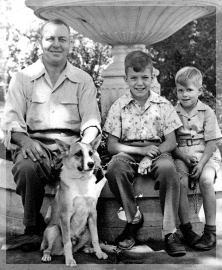
father and sonsIt’s often said, “Like father, like son,” and that was true of my father-in-law and his sons. Although they weren’t carbon copies of their dad, the boys shared several characteristics with the man who fathered them. In the same way, because God created us in His image, we share some of His characteristics. Of course, there are many important ways we are not like our Creator—He is all-knowing, eternal, all-powerful, and ever-present. Without a physical body, we don’t have things like God’s nose, hair color, or smile. Nevertheless, we do resemble Him in the spiritual, moral, and intellectual attributes of our nature that distinguish us from the rest of the animal world.

Although we share some of God’s attributes, we share them only to a limited extent. I can be a good person, be good-natured, be good at something, look good, feel good, do good, and even smell good. Nevertheless, I am not wholly good. Although I can be in love, love someone or something, act loving, profess my love, and be loved, I cannot be love. While my family claim that my recipes for barbecue sauce, California dream bars, and buttermilk pancakes are perfect, I am not (and never will be) perfect. I can distinguish righteousness from wickedness, have righteous indignation, act righteously, and feel both righteous and self-righteous, but I still sin. I can recognize wisdom, act wisely, and, on occasion, even give wise counsel, but I am not wisdom and, while I can know the truth, discern between truth and falsehood, and speak the truth, I am not truth.

On the other hand, God doesn’t stop at doing good, loving wholly, performing flawlessly, acting righteously, advising wisely, and speaking the truth—He is goodness, love, perfection, righteousness, wisdom, and truth personified! Nevertheless, imperfect as we mortals are, we should resemble our Creator in our words and actions. I’m not sure we always do.

God doesn’t play favorites. Every human being, regardless of race, nationality, ethnicity, politics, language, wealth, education, religion, social status, power, or gender has been created in the image of God. Do we treat our fellow image bearers with the respect, love, and compassion due to all of God’s children?

Since all people are in the image of God, all deserve to be treated with the dignity the image affords. [John H. Walton]

Every human life is a reflection of divinity, and…every act of injustice mars and defaces the image of God in man. [Martin Luther King, Jr.]

So all of us who have had that veil removed can see and reflect the glory of the Lord. And the Lord—who is the Spirit—makes us more and more like him as we are changed into his glorious image. [2 Corinthians 3:18 (NLT)]

Since you have heard about Jesus and have learned the truth that comes from him, throw off your old sinful nature and your former way of life, which is corrupted by lust and deception. Instead, let the Spirit renew your thoughts and attitudes. Put on your new nature, created to be like God—truly righteous and holy. [Ephesians 4:21-24 NLT]

Copyright ©2025 jsjdevotions. All rights reserved.

A FRIEND PRAYS

Then they sat on the ground with him for seven days and nights. No one said a word to Job, for they saw that his suffering was too great for words. [Job 2:13 (NLT)]

When his life turned from riches to rags and all he loved and possessed (along with his health) was taken from him, Job’s friends came and silently sat with him on the ground for seven days. While this seems odd to us, it was perfectly normal in Job’s day. Seven days was the traditional mourning period and tradition held that those visiting a mourner weren’t to speak until the mourner spoke first. As it turned out, his friends’ compassionate silence was the kindest thing they did for Job. Things rapidly went downhill as soon as the three men opened their mouths!

Reflecting a sort of retribution theology—that good things happen to good people and bad things to bad people—Job’s friends were sure that his troubles were divine retribution for his sins. Ignoring their knowledge of Job, a man Scripture described as “the finest man on earth…blameless…a man of integrity” who “fears God and stays away from evil,” they wanted him to repent of his unnamed sins so that God would stop punishing him. While Job’s friends were quick to accuse him of being an unrepentant sinner, there is no mention of them praying for or with him. In fact, in the end, it is Job who prays for them.

If Job were a friend of mine, his name would be on my prayer list; he’d fit right in with the rest of the names on it. There are people with depression, addictions, cancer, MS, Parkinson’s, heart disease, and dementia. There are caregivers, sick babies, parents of troubled children and children with troubled parents. Some are mourning the loss of loved ones while others are in recovery, hospice, or dire financial straits. There are people who have no faith and others who are struggling to keep their faith. Unlike Job’s friends, however, I don’t blame them for their troubles but, like Job’s friends, I do want their lives to improve. I want every one of them to be happy, healed, and whole. I want their issues resolved, their problems solved, their health restored, and their goals achieved.

Unfortunately, it is not my will that will be done—if it were, there would be “happily ever after” endings to all their stories. In the end, it is God’s plan that will prevail, not mine. Just as I don’t know the cause of my friends’ problems, I don’t know the solutions to their difficulties. Nevertheless, I do know the One who has the solutions to their trials and the answers to their questions. As believers, rather than trying to figure out what God should do, we must trust Him in the suffering, tragedies, and uncertainties of this life. God alone is the source of all wisdom. As we offer our intercessions, let us take comfort in Paul’s words that the Holy Spirit knows for what we should pray. While we may be at a loss for the right words, the Holy Spirit never is.

Heavenly Father, give us compassionate and understanding hearts for our hurting friends. Let us know when supportive silence is better than anything we could ever say to them. Help us focus our prayers on your will rather than our desires. Reassure those for whom we pray of your loving-kindness and strengthen their weary spirits. May they have peace in their circumstances, discover joy in their troubles, hear your voice clearly, follow your directions willingly, and be filled with hope for the future.

Beware in your prayer, above everything, of limiting God, not only by unbelief, but by fancying that you know what he can do. [Andrew Murray]

I urge you, first of all, to pray for all people. Ask God to help them; intercede on their behalf, and give thanks for them. [1 Timothy 2:1 (NLT)]

And the Holy Spirit helps us in our weakness. For example, we don’t know what God wants us to pray for. But the Holy Spirit prays for us with groanings that cannot be expressed in words. And the Father who knows all hearts knows what the Spirit is saying, for the Spirit pleads for us believers in harmony with God’s own will. And we know that God causes everything to work together for the good of those who love God and are called according to his purpose for them. [Romans 8:26-28 (NLT)]

Copyright ©2025 jsjdevotions. All rights reserved.

UNBEATABLE ODDS AND INVINCIBLE ADVERSARIES

Only by your power can we push back our enemies; only in your name can we trample our foes. I do not trust in my bow; I do not count on my sword to save me. You are the one who gives us victory over our enemies; you disgrace those who hate us. O God, we give glory to you all day long and constantly praise your name.[Psalm 44:5-8 (NLT)]

Some of the lesser-known heroes of the Bible are found in the lists of David’s mightiest men. Among his warriors, David’s mighty Three had the most authority, influence, and leadership. Their leader was Jashobeam, a man who once used his spear to kill 800 warriors in a single battle. Next in rank was Eleazar who remained with David in battle when the rest of the troops fled. He killed Philistines until he no longer could lift his sword. The third of the Three was Shammah. After being attacked in a field by the Philistines, the troops fled. Shammah alone remained to defend it and bring victory to Israel. These three were so devoted to David that, when he expressed a desire for fresh water from Bethlehem, they risked their lives to break through enemy lines to get some for him. David’s Three were among the best of the best when it came to valor, courage, and allegiance.

David also had an elite group of about thirty warriors. The mighty men of the Thirty helped David establish his kingdom and served as commanders for the rest of his troops. As famous as the Three was Abishai. Leader of the Thirty, he once killed 300 of the enemy in a single battle!

Described by Samuel as being more honored than any of the Thirty was Benaiah (son of Jehoiada). Among his feats was the killing of two ariels from Moab. The meaning of ariels is unclear and, while it could mean two lion-like oversize warriors like Goliath, it also could be a description of the lion-like ferociousness and strength of his opponents. In either case, alone and outnumbered two to one, the odds were against Benaiah, but he bravely defied the odds, and killed those lion-like warriors. Another time, upon encountering a lion, Benaiah accessed the situation and spotted a pit. Instead of turning tail and fleeing, the warrior turned toward the lion, chased it down into the pit, and killed it. Later, armed only with a club, he killed an impressive-looking Egyptian warrior bearing a spear. At a disadvantage since his clumsy club was useful only in close-up battle and the Egyptian’s spear was long, Benaiah ran toward his enemy, wrenched the spear from his hands, and killed him with his own weapon (much as David did with Goliath)!

Although we’re not likely to face great warriors or lions, we often encounter a number of what often seem to be unbeatable odds or invincible adversaries. Our first reaction to overwhelming challenges easily can be to abandon the cause and accept defeat without even trying. That’s what the troops did when they left David, Eleazar, and Shammah to fight the Philistines alone!

Warriors like David, Jashobeam, Eleazar, Shammah, Abishai, and Benaiah knew how to face both danger and adversaries. Instead of being paralyzed by fear or fleeing, these men faced each challenge head-on. What made these warriors so mighty? It wasn’t their bravery, strength, and prowess on the battlefield that made them that way; their might came from their knowledge of and faith in the Lord! They had courage, power, and steadfastness because they knew they weren’t fighting their battles alone; God was with them!

Could we be missing God-ordained opportunities because we only see insurmountable obstacles, invincible opponents, or fierce lions? It’s easy to let fear discourage and even paralyze us. Doing nothing, however, gets us nowhere. When the odds are against us, let’s think of these mighty men, trust in God, and give chase to the lions in our life!

Stand up to your obstacles and do something about them. You will find that they haven’t half the strength you think they have. [Norman Vincent Peale]

So be strong and courageous, all you who put your hope in the Lord! [Psalm 31:24 (NLT)]

Don’t be afraid, for I am with you. Don’t be discouraged, for I am your God. I will strengthen you and help you. I will hold you up with my victorious right hand. [Isaiah 41:10 (NLT)]

 Copyright ©2025 jsjdevotions. All rights reserved.

RETALIATE OR FORGIVE – FORGIVENESS (3)

But I say to you who hear, Love your enemies, do good to those who hate you, bless those who curse you, pray for those who abuse you. …. Be merciful, even as your Father is merciful. [Luke 6:27-28,36 (ESV)]

black vultureWhen writing about forgiveness these last few days, I wondered why we find it so difficult to forgive. Perhaps it’s because, in our troubled hearts, we want to even the score before doing so. Wanting to retaliate in some way, bitterness and resentment grow and eat at us until we can extract our pound of flesh.

For one woman, the opportunity for retaliation didn’t arise until her father died and she wrote his blistering obituary. Contemptuous of the man, she said he lived “29 years longer than expected and much longer than he deserved!” and called him a “horse’s ass!” After naming his “relieved children,” she said he left behind ”countless other victims including an ex-wife, relatives, friends, neighbors, doctors, nurses and random strangers.” Calling the man, “a model example of bad parenting combined with…a complete commitment to drinking, drugs, womanizing and being generally offensive,” she added that he joined the Navy as part of a plea deal to avoid criminal charges. Along with being described as reckless, wasteful, and having no redeeming qualities, he was accused of abusing his family, squandering their money, and being cruel to animals.

Explaining “there will be no prayers for eternal peace and no apologizes to the family he tortured,” she added that the man’s cremains would be kept in the barn until the “donkey’s wood shavings run out.” The obituary closed with the words that his passing “proves that evil does in fact die and hopefully marks a time of healing and safety for all.” The angry words in this scathing obituary were the family’s way of extracting their pound of flesh from the man.

Reading those words saddened me when I read them in 2017 and they continue to trouble me today. Perhaps the man’s family found the spiteful obituary cathartic, but publicly cataloguing the dead man’s wrongs accomplished nothing. Even though their contemptuous words remain on the funeral home’s website today, the man they hated will never read them! I suspect the sweet taste of revenge his family may have felt when the obituary was posted left them with a bitter aftertaste.

When harmed, it’s natural to want payback. Natural, however, isn’t necessarily right and justice and vengeance are God’s department and His alone. Rather than meeting evil with more evil, Jesus tells us we are to meet evil with grace and to do all we can to live in peace with everyone. As Christ’s followers, we are expected to extend grace and forgiveness.

I can only pray that this man’s passing has provided healing for those whose lives he touched. That healing, however, won’t come until they finally forgive him and let go of the past. Like their anger, forgiveness can’t change their past but, unlike anger, forgiveness can change their future! Unlike the bitter aftertaste of anger and revenge, forgiveness always tastes sweet!

 To forgive is to set a prisoner free and discover that the prisoner was you. [Lewis B. Smedes]

If possible, so far as it depends on you, live peaceably with all. Beloved, never avenge yourselves, but leave it to the wrath of God, for it is written, “Vengeance is mine, I will repay, says the Lord.” To the contrary, “if your enemy is hungry, feed him; if he is thirsty, give him something to drink; for by so doing you will heap burning coals on his head.” [Romans 12:18-20 (ESV)]

Copyright ©2025 jsjdevotions. All rights reserved.