
For wicked men are found among my people; they lurk like fowlers lying in wait. They set a trap; they catch men. [Jeremiah 5:26 (ESV)]
 Fowlers are professional bird catchers. In ancient Israel, they supplied the market with wild pigeons and doves destined for sacrifice, small birds (like quail) for food, and doves and other birds for caged pets. Since most of us get our poultry at the grocery, we’re probably unfamiliar with the fowler and his methods. To capture birds, fowlers spread nets or set traps and snares on the ground, camouflage them with natural materials, and cover them with grain. Tempted by the food, the birds leave the safety of the sky and come down to the ground where they are caught.
The fowler studies his prey’s behavior to find the best way to trap it. He wouldn’t hunt for a heron in the middle of a forest as he would for a dove, bait an eagle’s snare with seeds as he would for a sparrow, or use ground level noose traps for swifts as he might for quail. Sometimes the fowler used decoys by taking young birds from their nest and raising them by hand. Once tame, they were confined in hidden cages so that their voices would call others of their kind to the spot where they’d be trapped or killed. Knowing this about the fowler and his snares or traps, we can see why they frequently were used metaphorically in Scripture and likened to Satan. The enemy was the fowler, his schemes were the fowler’s methods and snares, and people were the silly birds with neither sense nor strength enough to escape the fowler’s snare.
When the prophet Amos asked, “Does a bird land in a trap on the ground if there is no bait for it?” [3:5] he wasn’t speaking of sunflower seeds and sparrows; he was speaking of the bait Satan uses in his snares. Each of us is tempted by different things—it could be pride and resentment for one person and gambling and anger for another. Whether it’s selfishness, wealth, hypocrisy, appetite, indolence, lust, envy, or something else, Satan knows what appeals to each of us and his traps will be placed and baited accordingly. Like the fowler’s bait, the lure Satan uses promises pleasure but delivers disaster! After all, a few bits of millet is all the trapped quail gets before it ends up as someone’s dinner!
Just as the fowler knows, “It is useless to spread a net where any bird can see it,” [Prov. 1:17], Satan’s snares don’t look like the traps they are! Few of us would deliberately step into a “den of iniquity” but things aren’t always what they seem. Like the fowler, Satan uses decoys to bring others into his snare. The influence of the pagans remaining in Canaan became a “snare and a trap” for Israel just as bad examples, friends, acquaintances, influencers, or associates can lure us into Satan’s snare.
The fowler doesn’t stand by his traps and shout out his plans and neither does Satan. Like the fowler, he uses trickery, deceit, distraction, and disguise to keep his prey from realizing the danger. We, however, are far smarter than little birds and God has not left us defenseless. Satan may be laying traps, but we don’t have to be his prey. Along with God’s word to light our way, we have God’s protection and the power of His Holy Spirit—when we’re dwelling in the “shelter of the Most High,” our “Maker’s care” will keep us “from the fowler’s snare.”
He that hath made his refuge God Shall find a most secure abode,
Shall walk all day beneath his shade, And there at night shall rest his head.
Then will I say, “My God, thy power Shall be my fortress and my tower;
I, that am formed of feeble dust, Make thine almighty arm my trust.”
Thrice happy man! thy Maker’s care Shall keep thee from the fowler’s snare;
Satan, the fowler, who betrays Unguarded souls a thousand ways. [Isaac Watts]
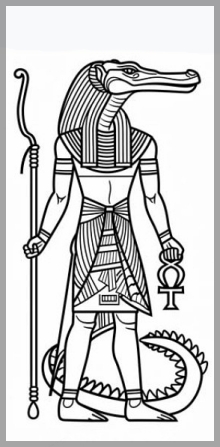 Over a period of 3,000 years, ancient Egypt’s pantheon of gods numbered between 1,400 and 2,000. During that time, some faded in prominence and new gods appeared. Often depicted as part human and part animal, Egypt’s gods had names, unique back-stories, and their own domain and expertise. Each god/goddess was responsible for a certain part of daily life, from motherhood to music, record keeping to funerals, and cosmic order to hunting. While the ten plagues God sent Egypt through Moses and Aaron may seem somewhat arbitrary to us in the 21st century, every one of them was a direct attack on one or more Egyptian god. They were the ultimate “smack-down” between God Almighty and Egypt’s deities.
 We’re two weeks into the season of Lent. While we typically associate this time before Easter with giving up something, it is more than simply abstaining or fasting from some thing or things. Fasting without prayer is nothing more than a diet and abstaining from some pleasure without prayer is more like dry January than a Lenten discipline! Without prayer, fasting and abstinence are physical acts but not spiritual ones! When we give up something for Lent, we need to deliberately and intentionally seek the Lord in prayer at the same time!
 In 1986, holocaust survivor and Nobel Laureate Elie Wiesel said, “The opposite of love is not hate, it’s indifference.” That thought, however, has a longer history. In 1897, in George Bernard Shaw’s The Devil’s Disciple, these words were spoken: “The worst sin towards our fellow creatures is not to hate them, but to be indifferent to them: that’s the essence of inhumanity.” The evil of indifference can be found as far back as 474 BC (during Judah’s exile) in the story of Esther and as recently as today’s news.
 Once upon a time, a little boy was busy digging in the sand at the beach. Like other youngsters through the years, he thought he even might be able to dig all the way to China. His steadfast excavations got so deep that he encountered a large rock. With great determination, he dug and dug with his plastic shovel in an attempt to free it from the ground. Unfortunately, the little boy and his small shovel were no match for the rock. When the shovel broke in two, the boy let out a howl and burst into tears. Hearing the child’s cries, his father immediately went to comfort him. Through his sobs, the boy told how he’d tried and tried to free the rock but was too weak, his arm was too short, and he’d broken his only shovel. His father gently asked why he hadn’t used all of his strength. “But I did, Daddy, I really did!” exclaimed the boy. “No, son, you didn’t,” explained the man as he reached into the hole, grabbed the rock with his large hands, and pulled it from the ground. “You should have called me!”
 Evil is anything that contradicts the nature of God and it’s easy to see Satan’s presence in malevolent acts like terrorism, genocide, slavery, torture, and human trafficking. The enemy, however, is usually far more subtle. Evil also includes things like anger, pride, fretfulness, immorality, pettiness, selfishness, deceit, envy, spite, unforgiveness, hatred, hypocrisy, envy, jealousy, greed, and unkindness. Although we’re more likely to find them in our hearts than genocide or murder, they’re not as easy to recognize. Because it’s easier to see the evil done by others than it is to face the evil in our hearts, we don’t spot Satan when he comes slithering into our lives.
