
But when Jesus saw it, he was indignant and said to them, “Let the children come to me; do not hinder them, for to such belongs the kingdom of God. Truly, I say to you, whoever does not receive the kingdom of God like a child shall not enter it.” [Mark 10:14-15 (ESV)]
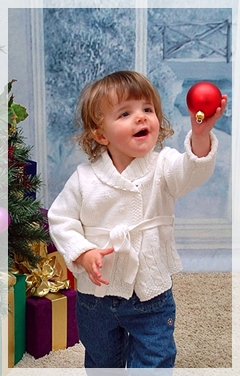 One day, the disciples scolded some parents for bringing their children to Jesus for a blessing. After telling them the Kingdom belonged to those who received it like a child, He called the children to Him. Unlike adults, children accept their humble position and live by faith and trust. Without self-consciousness and knowing they are in complete dependence on the giver, they receive gifts with humility and enthusiasm. Like explorers, children have a sense of wonder on their quest to learn about the world around them. They are filled with excitement and awe at every new thing they experience because life hasn’t become routine, predictable, or run-of-the mill to them.
Thinking of a child’s sense of wonder, I recalled my grand’s reaction to the small nativity I purchased for her more than twenty years ago. While her parents were away for the weekend in late November, she stayed with us. Although the tyke knew all about Santa, she didn’t know the Christmas story so I gave her a nativity set in a small wooden box. It had a handle on top so it could be carried like a purse and a latch in front that, when opened, revealed a stable and about a dozen wooden figures. As we opened the box, I told her the beautiful story that went along with those figures. Her eyes were big as saucers as she heard about the baby Jesus, angels, shepherds, wise men with gifts, and a star that led them to the baby. Filled with wonder at the amazing story, she had me tell it several times. When her parents came to pick her up, she immediately sat them down in our living room. After carefully opening her nativity box, she enthusiastically identified each character and explained the Christmas story to them.
How many Christmas pageants have we attended? How many Christmas Eves have we heard the words from Luke 2 or sung “Silent Night” in candlelight? How many times have we heard about the angelic chorus and the shepherds’ astonishment? Are we as astonished by the nativity as were they? Unlike a child, I suspect that we’ve lost our sense of awe and wonder at the incarnation—our astonishment that Jesus clothed Himself in a human body so that He could live a sinless life only to suffer a sinner’s death.
We’ve probably lost count of the Palm Sunday, Maundy Thursday, or Tenebrae/Good Friday services we attended. How many times have we heard about Jesus washing the disciple’s feet or the women discovering the empty tomb on Easter morning? For that matter, how many times have we read or heard about the feeding of the multitude, the miraculous provision of wine at Cana, blind Bartimaeus receiving sight, or the parable of the Prodigal Son? While familiarity doesn’t necessarily breed contempt, it can breed boredom.
In theater, the actors are expected to deliver a well-rehearsed performance in a fresh and new way every time. Called the “illusion of the first time,” they endeavor to make the audience feel like they are witnessing something happening for the very first time. What if we, as readers and hearers of the word, tried to create the “illusion of the first time”? What if we put on the eyes and ears of a child who’s hearing or reading it for the first time—someone who doesn’t know that Abraham won’t have to sacrifice Isaac, Lazarus will walk out of the tomb, only one leper will return to thank Jesus, the Red Sea will part, the walls of Jericho will collapse, or that young David will defeat the gigantic Goliath? What if we were hearing or reading those familiar narratives for the first time? Even though we know the stories, shouldn’t we be as filled with wonder as was my grand when she learned the Christmas story? Shouldn’t we be as amazed as were the shepherds when they heard an angelic chorus on the night of Christ’s birth, as astonished as were the mourners when Lazarus walked out of that tomb, as distressed as were the women at the foot of the cross, and as stunned as were the disciples when Jesus appeared Easter morning!?
While we may have the knowledge of decades-long believers, let us come to Scripture with a child’s awe and sense of wonder. Let us react to the words as if it were the first time we’ve read or heard them—as if we don’t know how the story ends. Let us recreate the “illusion of the first time” and have the wonder of a child!
A child’s world is fresh and new and beautiful, full of wonder and excitement. [Rachel Carson]
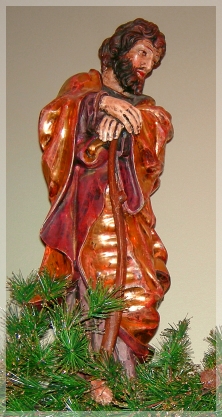 While putting away our nativity, I looked at the figure of Joseph. For the man who played a pivotal role in the Christmas story, once Christmas is packed away, Mary’s husband rarely gets a second thought until the next December. Neither Mark nor John mention the man who served as step-father to Jesus and the author of Hebrews didn’t even list him in its “Hall of Faith.”
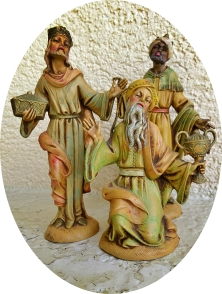 For centuries, access to the written Word of God was limited to just a few. The printing press wasn’t invented until 1439 and, at the time, only about 20% of the population could read. As a result, churches were decorated with paintings, stained glass windows, statues, carvings, and mosaics depicting biblical stories or illustrating theological concepts. For people who couldn’t read the book, religious art told the story. Consider how the Stations of the Cross in Roman Catholic churches illustrate the events of Good Friday. Sometimes, a picture really is worth a thousand words! While most nativity scenes are inaccurate, our depictions of the nativity don’t have to be historically exact to be meaningful.
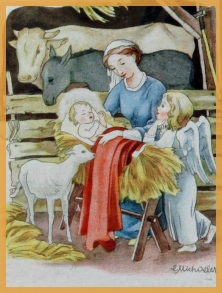 The earliest known portrayal of Jesus’ birth is a bas relief on a Roman sarcophagus from around 385. It depicts the swaddled Christ child in the manger flanked by an ox at His head and an ass at His feet. Why are they present instead of Joseph and Mary? In 1223, Francis of Assisi brought some hay and a manger to a cave and celebrated Mass there on Christmas Eve. Even though Mary and Joseph weren’t present, an ass and an ox were! In 1291, Pope Nicholas IV commissioned Arnolfo di Cambio to create a permanent nativity. While there are statues of Mary and Jesus, Joseph, and three Magi, the sixth statue shows the heads of an ox and an ass rather than shepherd or angel. Besides the baby Jesus, the ass and the ox are the most ancient and consistent elements in depictions of the nativity. Why do these two animals, neither of which is mentioned in the gospels, have such a prominent place in our nativity scenes, Christmas cards, and carols?
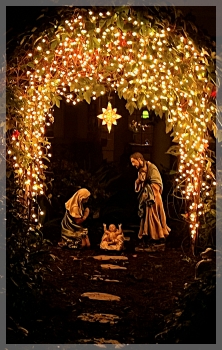 Unfortunately, much of our Advent season is not spent joyfully looking forward to celebrating the birth of the Christ child. In hope of finding the perfect gift for everyone on our list, we pore over catalogues and search for sales and coupons. Either we fight for parking spots at the mall and spend hours standing in line or spend those hours sitting at the computer while shopping on line! We then fret and fuss over wrapping those gifts, mailing packages and Christmas cards, hosting and attending parties, baking cookies, making travel arrangements, decorating the house, preparing holiday dinners, and paying the ever-mounting bills. When we say, “Merry Christmas!” we might find ourselves mumbling a Scrooge-like “Bah! Humbug” under our breath! Instead of looking forward to Christmas with anticipation, there are times we can’t wait until it’s all over and done.
 A certain amount of discontent seems to be built into us, which isn’t all bad since discontent can be the incentive to make improvements. Dissatisfaction with the harpsichord’s inability to vary the intensity of its sound led Bartolomeo Cristofori to invent the piano around 1708. Benjamin Franklin’s annoyance at having to switch between two pairs of glasses led to his invention of bifocals and it probably was his discontent with a cold house that led to his invention of the metal-lined Franklin stove. The invention of the “ballbarrow,” with its rust-proof plastic bin and ball-shaped wheel that won’t sink into soft soil, is the result of James Dyson’s discontent with the traditional wheelbarrow. As Thomas Edison said, “Discontent is the first necessity of progress.”
 Devotions of the Heart