RED LIGHTS

Rejoice in our confident hope. Be patient in trouble, and keep on praying. [Romans 12:12 (NLT)]

tasslefloiwerBack in his college days, my husband and several friends were on a lonely stretch of road in what seemed the middle of nowhere when they stopped for a red light. Although the average red light lasts from 90 to 120 seconds, that seemed like an eternity to the impatient driver. After looking around and seeing no other cars, he proceeded through the intersection. There was, however, one other vehicle nearby—and it was a police car! Although that driver’s impatience cost him time and money, other drivers’ impatience can take lives! A typical commuter train, for example, usually passes through an intersection in two to three minutes. But, when we lived in Illinois, at least one or two impatient drivers tried (and failed) to beat the local commuter train across the tracks every year.

Patience has been described as the quality we admire in the driver behind us but can’t stand in the driver ahead! As impatient as we are while waiting for a red light to turn green or a train to get through the crossing, I wonder at our patience when waiting for God. When we bring our concerns to Him, do we expect His answer in a New York minute (said to be the interval between a Manhattan traffic light turning green and the guy behind you honking his horn)? Encountering God’s version of red lights and crossing gates doesn’t mean we can’t make progress; they simply mean that it’s time to wait.

Rather than trusting God enough to wait for His timing, we frequently barge ahead only to face the consequences. Sarah’s impatience while waiting for Abraham’s promised heir led to an enduring hostility between the descendants of Ishmael and Isaac. Esau was so impatient for dinner that he traded his birthright for a bowl of stew. The Israelites’ impatience when waiting for Moses to return from Mt. Sinai led to the golden calf and a plague while their impatience with the long journey around Moab resulted in an infestation of poisonous snakes. Moses’ impatience with them at Meribah Kadesh barred him from entering the Promised Land and Saul’s impatience while waiting for Samuel’s arrival caused him to lose his kingdom. The prodigal son was so impatient that he asked for his inheritance early and he ended up squandering it all. Impatience is costly in more ways than one and the consequences can be long lasting. Let us remember that it is God’s timetable we are to fulfill, not ours!

Waiting on the Lord is the opposite of running ahead of the Lord, and it’s the opposite of bailing out on the Lord. It’s staying at your appointed place while he says stay, or it’s going at his appointed pace while he says go. It’s not impetuous, and it’s not despairing. [John Piper]
Wait patiently for the Lord. Be brave and courageous. Yes, wait patiently for the Lord. [Psalm 27:14 (NLT)]

I waited patiently for the Lord to help me, and he turned to me and heard my cry. [Psalm 40:1 (NLT)]

Copyright ©2021 jsjdevotions. All rights reserved.

STAYING AFLOAT

Don’t copy the behavior and customs of this world, but let God transform you into a new person by changing the way you think. Then you will learn to know God’s will for you, which is good and pleasing and perfect. [Romans 12:2 (NLT)]

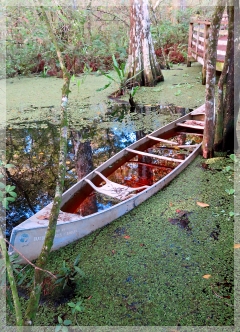
canoe - corkscrew swampWhenever I saw the swamped canoe at the swamp/bird sanctuary, I remembered the old aluminum canoe we had at our cottage. Because it remained down at the lakefront all year long, the canoe served as winter home to the chipmunks and mice. After decades of rodents taking refuge there, the critters eventually chewed up all the foam flotation blocks in both ends of the craft. Since a boat will float only as long as it weighs less than the maximum amount of water it displaces, those empty chambers didn’t affect the canoe if it remained upright and relatively dry. But, if the craft capsized, its empty chambers would rapidly fill with water and, with the extra weight, sink. Knowing how easily the canoe could sink made us extra cautious—it was used only when the water was calm, no one deliberately tipped it, and lifejackets were required.

Sometimes, however, we’re closer to sinking than we know. Several years ago, we were camping by a small lake when my son, husband, and father-in-law decided to rent a small row boat and go fishing. At noon, they pulled the boat ashore and returned to our campsite to eat. After lunch, the fellows returned to their boat and rowed out onto the lake. When their feet got wet, they realized the boat was taking on water and started bailing. The water poured in faster than they could empty it, the boat sunk lower into the water, and they quickly rowed back and pulled the boat ashore. While gathering their fishing gear, my husband discovered that the boat’s drain plug was missing. My father-in-law, who’d been hesitant to leave the boat unattended during lunch, had decided to outsmart any would-be thieves by removing its plug and sticking it in his pocket. Unfortunately, he’d forgotten to reinstall the plug after lunch. Rather than any would-be thieves, they were the ones who got wet!

Boats don’t sink because of the water around them—they sink because of the water that gets into them. In the same way, Christians are meant to live in this sinful world without any of the world’s sins seeping into us. When the world finds its way into our lives, things like fear, anxiety, immorality, deceit, anger, pride, envy, selfishness, and greed do their very best pull us down and drown us. Like the boat’s plug, God’s word can keep the world from getting into our lives and affecting us. Like the buoyancy blocks in a canoe, our faith in Jesus will keep us from sinking even when our lives turn upside down. And, like a life jacket, the Holy Spirit will keep us afloat until we safely reach shore.

Let us always remember that Simon Peter only began to sink when he took his eyes off the Lord!

But when he saw the strong wind and the waves, he was terrified and began to sink. “Save me, Lord!” he shouted. [Matthew 14:30 (NLT)]

Copyright ©2021 jsjdevotions. All rights reserved.

VOLUNTEER OR SERVANT?

Jacobs ladderWhen a servant comes in from plowing or taking care of sheep, does his master say, “Come in and eat with me”? No, he says, “Prepare my meal, put on your apron, and serve me while I eat. Then you can eat later.” And does the master thank the servant for doing what he was told to do? Of course not. In the same way, when you obey me you should say, “We are unworthy servants who have simply done our duty.” [Luke 17:7-10 (NLT)]
Even though we no longer live in Illinois, we still receive our northern church’s newsletter. The latest edition mentioned the need for substitute Sunday School teachers and people to participate in “a crazy afternoon of ‘Do-Gooding’” called “Rake and Run” in which church members go from yard to yard raking leaves for those unable to do so for themselves. It also included an image of a newspaper “help wanted” ad that read:

SERVANTS WANTED: We have unlimited openings for motivated servants to meet the needs of God’s people. Start immediately. Responsibilities include performing random acts of kindness, serving and pleasing God, and doing what He calls you to do. No skills needed. God will equip you with on-the-job training. Benefits will include growth opportunities leading to one incredible “raise” at the end of your service. To apply: Contact God.

Notably absent in the newsletter was the word “volunteer.” Volunteers are an essential part of clubs, homeowner associations, service groups, and non-profits, and groups like these couldn’t function without them. The Church, however, doesn’t need volunteers; it needs servants! Jesus never told parables about volunteers because He wasn’t enlisting volunteers. Instead, He told parables about servants because that’s what He was calling us to be!

The word often translated in our Bibles as servant or bond servant, however, had nothing to do with being a servant like the chamber maid, butler, or valet in Downton Abbey. The word used was doulos, meaning slave, and it literally meant a person owned by another for his or her lifetime. While the word “volunteer” occurs eight times in the Old Testament, it never appears in the New. Doulos, however, occurs there 127 times in 119 verses. When Jesus freed us from slavery to sin, He freed us to become slaves to God. While our bondage to sin meant death, our bondage to God means eternal life—the “raise” at the end of our service!

For a follower of Jesus, there is big difference between being a volunteer at the church and a doulos or servant to Christ. Since they’re under no obligation, volunteers never need to leave their comfort zones; they can choose their task and are free to decline any or all requests. Serving at will, volunteers use leftover time to work and can quit and walk away at any time. It’s an entirely different matter for a doulos or servant of Christ. Instead of choosing the task we are willing to do, we do the task that needs to be done—the one God call us to do—even  when it means leaving our comfort zone. While volunteers use their free time at their convenience, Jesus’ servants sacrifice their time (often at their inconvenience) to serve Him. A volunteer’s commitment is temporary but, as servants of Christ, we have a lifetime commitment to serving our Master whenever and wherever He calls us. We volunteer only when we want to but we serve God because we need to do so. It is what we are called to do because faith and works are inextricably linked!

When Jesus told His disciples that the harvest was plentiful but the workers were few, could it have been because those workers viewed themselves as volunteers rather than His servants? Jesus is calling us to serve Him, will we answer His call?

It is a greater glory to us that we are allowed to serve God, than it is to him that we offer him that service. He is not rendered happy by us; but we are made happy by him. He can do without such earthly servants; but we cannot do without such a heavenly Master. [William Secker]

When you were slaves to sin, you were free from the obligation to do right. And what was the result? You are now ashamed of the things you used to do, things that end in eternal doom. But now you are free from the power of sin and have become slaves of God. Now you do those things that lead to holiness and result in eternal life. For the wages of sin is death, but the free gift of God is eternal life through Christ Jesus our Lord. Romans 6:20-23 (NLT)]

Copyright ©2021 jsjdevotions. All rights reserved.

WITHIN OUR LIMITS

The apostles returned to Jesus from their ministry tour and told him all they had done and taught. Then Jesus said, “Let’s go off by ourselves to a quiet place and rest awhile.” [Mark 6:30-31a (NLT)]

Whenever we were with my mother-in-law, she would say, “Come, sit down, and rest for a bit.” Since I usually was busy preparing a meal or doing some task for her, I’d say, “Not now, Grandma, maybe later!” Now that she’s gone, I wish I’d spent a few more minutes sitting and resting with her. I thought of her this morning when reading Jesus’ words urging the disciples to find a quiet place to rest awhile.

Having just returned from their first mission trip of preaching, healing the sick, and casting out demons, the disciples were tired and hungry. In an attempt to get away from the crowd gathered around them, Jesus and the men left by boat to find an out-of-the-way place where they could rest and talk. We know the rest of the story—the people followed on foot and were waiting for Jesus when He came ashore. Seeing the throng as “sheep without a shepherd,” Jesus had compassion and taught them throughout the day. When evening came, He ended up feeding over 5,000 with five loaves and two fish. The miraculous feeding of this multitude overshadows the way the story began—with Jesus’ suggestion that they find “a quiet place and rest awhile.” Nevertheless, it’s as important as the rest of the story.

My physical issues the last several months made it clear that not taking regular breaks from the computer and failing to get a decent night’s sleep take a toll on our bodies. I’ve also come to understand that it’s not just our bodies that suffer when life gets out of balance. Retreat and rest are as important spiritually as they are physically; that’s why, as busy as Jesus was, He often withdrew to the wilderness for prayer.

According to the Talmud, Jews are supposed to pray three times a day and Scripture tells us that both David and Daniel did so. Muslims also take daily spiritual retreats in their obligatory five-times-a-day prayer ritual called salah. The Arabic word salah literally means “connection” and this practice is intended to link the one who prays with the creator. Other than Paul telling us to never cease praying, we Christians don’t have a similar “requirement.” If we did, I suspect some of us would try to lump together the five prayers into one or two so we wouldn’t have to interrupt our day (which would defeat its purpose). Muslims, however, have specific times (dawn, noon, afternoon, sunset, and evening) specified so that believers continue to maintain their connection with God throughout the day. Perhaps we should consider adopting their practice in some way.

In her book about discerning God’s will, author Ruth Haley Barton said, “Disciplines of rest and retreat teach us to live within our limits.” She pointed out that when we fail to do so, we compromise the quality of our relationships both with God and the people around us. My mother-in-law knew how to live within her limits. Granted, as a centenarian, she had fairly narrow limits and did a lot of resting, but she had a point! We need to find a balance between work and retreat, activity and rest, doing and being, in all areas of life.

Even though we know better, when it comes to spiritual matters, many of us emulate Martha by being busy doing for the Lord rather than model her sister Mary, who retreated from her activities to be with the Lord! When God instituted the work-free Sabbath, the Israelites had to trust God’s provision enough for tomorrow to retreat and rest on the Sabbath. Observing the Sabbath kept them from idolizing work. When we won’t stop working to be with the Lord, we’ve created a false idol. When we pause for Him, as did the Israelites on the Sabbath, we begin living within our limits by conceding that God is God and we are not! Only He can do it all.

Living within our limits doesn’t mean we have to go off on vacation or spend a week in a monastery and it shouldn’t be confined to just one day a week. Living within our limits could begin with our own Christian version of selah by taking regular mini-retreats from our daily activities to connect with God through prayer. Scripture tells us that Jesus frequently withdrew from the world to pray; let us not be afraid to do the same.

But Jesus often withdrew to the wilderness for prayer. [Luke 5:16 (NLT)]

Copyright ©2021 jsjdevotions. All rights reserved.

WHO’S THE PILOT?

key west expressI trust you, O Lord. I said, “You are my God.” My future is in your hands. [Psalm 31:14-15a (GW)]

By the time our son was seventeen, he had his pilot’s license. To log solo flight time, he’d often fly from his school in another state to a small airport near our home. We’d meet him there and enjoy lunch together before he returned. Sometimes, he’d take one of us up for a short flight over the scenic countryside before he flew back to school. I don’t even like commercial flights on a jumbo jet with a seasoned pilot so getting on a single-engine Cessna with a teenager at the controls was a leap of faith for me. Nevertheless, when I’m on a plane, I have to leave the flying to those far more skilled than I—even when it’s a seventeen-year-old! Reassuring myself that there was less my son could hit in the air (while trying to forget that safely landing a plane was probably more difficult than parallel parking), I surrendered control to him and trusted that he knew what he was doing.

God is my Co-Pilot is the title of a 1945 film based on the World War II exploits of Robert Lee Scott, Jr. That title eventually became a Christianese catch-phrase and still can be found on bumper stickers today. While a charming sentiment, it is theologically incorrect. If God is our co-pilot, we’re in the wrong plane! There are no dual controls in God’s plane and He doesn’t want us touching the yoke or messing with the rudder pedals. God is neither our assistant nor are we His. He’s not the passenger on our plane; we’re the passengers on His. We don’t belong anywhere in the cockpit; we belong back in the cabin. He has a flight plan specifically designed for each of us and we have to trust that plan to Him.

While it’s easy to trust in God’s sovereignty and cede the controls to Him when the journey is smooth, it’s much harder when turbulence occurs or it begins to storm. I’ve had some bumpy (and frightening) flights, especially over the mountains in summer, but I never barged into the cockpit to take charge nor did I don a parachute and bail out. Trusting the captain, I surrendered control to him, buckled up, prayed, and let him do his job.

Unfortunately, it’s difficult for me to admit that I’m no better at running my life than I am at piloting a plane. While I’m willing to trust a complete stranger to pilot me safely home in the midst of a storm, I often bail out or push into the cockpit of life and try to seize the controls from God at the first sign of turbulence in life. The end result is that I crash and burn and God ends up being rescue squad, fire department, clean-up crew, and salvage expert. Trust and obey is really all God asks of us, and yet we often try to do His job for Him.

Heavenly Father, forgive us for the many times we try to wrest control of our lives to go in another direction than the one you planned for us. As Creator of the Universe, we concede that you are far more skilled at plotting the best route, keeping us on course, and handling all the storms, unruly fellow travelers, engine problems, and fuel shortages that trouble our days. Secure in your love for us, we know that you want us to have a safe landing. You are the captain—the pilot of our plane. Trusting in you, we are your passengers awaiting your orders.

When a train goes through a tunnel and it gets dark, you don’t throw away the ticket and jump off. You sit still and trust the engineer. [Corrie Ten Boom]

I know the plans that I have for you, declares the Lord. They are plans for peace and not disaster, plans to give you a future filled with hope. [Jeremiah 29:11 (GW)]

Copyright ©2021 jsjdevotions. All rights reserved.

SNAP IN OUR CELERY

Now that I am old and gray, do not abandon me, O God. Let me proclaim your power to this new generation, your mighty miracles to all who come after me. [Psalm 71:18 (NLT)]

pansyEvery year, Britain’s The Oldie magazine celebrates the achievements of the “older generation’ by granting their “Oldie of the Year Awards.” According to the magazine’s founder, Richard Ingrams, it’s not enough for someone simply to be an “elderly achiever”—you also must show that you still have “snap in your celery.” This year, wanting to recognize Queen Elizabeth II for her leadership during the pandemic, the magazine offered her the honor of being their “Oldie of the Year.” The 95-year-old monarch, however, politely declined saying, “Her Majesty believes you are as old as you feel, as such The Queen does not believe she meets the relevant criteria to be able to accept, and hopes you will find a more worthy recipient.” What a great attitude; there’s a woman who still has snap in her celery!

What defines “old?” Is it a matter of years or mind? When we spent our winters in Colorado, we often saw Banana George (aka George Blair) in his signature yellow jumpsuit shredding the slopes on his yellow snowboard. In his eighties and early nineties at the time, George didn’t even learn to snowboard until he was 75. This stunt water skier and star of the Cypress Gardens water show was 40 before he even learned how to water ski! At 46, George started barefoot water skiing and became famous for skiing on one foot while holding the tow rope between his teeth (a feat he continued doing until he was 79)! George continued water skiing and snowboarding until he was 92 when, suffering from the devastating effects associated with Lewy Body Dementia, he reluctantly put away his water skis and snowboard. When speaking of George, his wife said, “He wanted to make people happy, so he did all these things and made everybody happy.” Banana George certainly had “snap in his celery!”

It’s easy for us “seniors” to consider youth a prerequisite for serving God and even easier for the younger generation to think of us as “over the hill.” After all, David was about seventeen when he defeated Goliath and Daniel and his three friends were in their mid-teens when they boldly refused to eat the king’s food. Shadrach, Meshach and Abednego were no more than thirty when they bravely chose a fiery furnace over worshiping Nebuchadnezzar’s statue. Samuel was just a lad when he readily answered God’s call, Jeremiah was only 17 when he became a prophet, Esther was barely out of her teens when she saved a nation, and Mary was barely in her teens when she chose to become mother to the Messiah. It’s believed that Timothy was around 20 when he joined Silas and Paul on the Apostle’s second tour through Asia Minor and less than 40 when he took charge of the church at Ephesus.

Youth, however, is not a requirement for doing God’s work. Abraham was 75 when he left Haran and headed for Canaan. 80 when he led the Israelites out of Egypt, Moses guided them for another 40 years. When they led the Israelites across the Jordan, we know that Caleb was 79 and Joshua was about the same age. Moreover, contrary to popular belief (and most Sunday school coloring pages), Daniel was not a young man when he faced those lions. 66 years had passed since his arrival in Babylon and, by the time he was thrown to the lions, Daniel was around 82! At that age, we’d expect a stroke or heart attack to finish him off before the hungry beasts could. Nevertheless, Daniel survived and continued to record his prophetic visions for at least three more years. Along with their faith in God, these men had snap in their celery!

We probably won’t be nominated as the “Oldie of the Year” or water ski and snowboard until our nineties but, like Queen Elizabeth and “Banana” George, we can continue to have a passion for life. Moreover, like those Biblical “oldies” we can have a passion for serving the Lord. Since none of us are old by God’s standards (after all, He’s older than time itself), our age should be determined by attitude rather than years. As Author Erma Bombeck once said, “When I stand before God at the end of my life, I would hope that I would not have a single bit of talent left and could say, ‘I used everything you gave me.’” May we all endeavor to keep the snap in our celery!

Here is the test to find whether your mission on earth is finished: If you’re alive, it isn’t. [Richard Bach]

Though our bodies are dying, our spirits are being renewed every day. For our present troubles are small and won’t last very long. Yet they produce for us a glory that vastly outweighs them and will last forever! [2 Corinthians 4:16b-17 (NLT)]

Copyright ©2021 jsjdevotions. All rights reserved.