
Yet Jerusalem says, “The Lord has deserted us; the Lord has forgotten us.” “Never! Can a mother forget her nursing child? Can she feel no love for the child she has borne? But even if that were possible, I would not forget you! See, I have written your name on the palms of my hands.” [Isaiah 49:14-16a (NLT)]
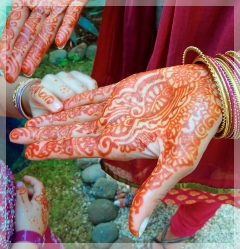 To the delight of the girls who attended the party, my daughter-in-law hired a Mehndi artist for my grand-daughter’s birthday celebration. Using a red-orange paste made from the dried leaves of the henna plant, the artist adorned the girls’ hands or arms with assorted intricate floral motifs. Since all of the family on her mother’s side is from India, this ancient form of body art is familiar to my grand. Although she’s attended several Mehndi parties, most of her guests have not. A Mehndi party for close friends and family is an important pre-wedding tradition in any Indian wedding. Along with plenty of food and music, there are henna artists. While they take only a few minutes painting designs on the guests, they spend several hours painting intricate geometric shapes and floral and paisley motifs on the bride’s hands, arms and feet. Hidden somewhere among the elaborate patterns on her body is the groom’s name.
Tradition holds that finding the hidden name is a game the newlyweds play on the wedding night. If the groom manages to find his name hidden among all of the designs, he will be the boss of the marriage; if he doesn’t, his wife rules the roost! Determining the boss in the relationship, however, isn’t why God says He’s written Israel’s name on the palms of His hands. Nevertheless, having the name of the bride’s beloved written on her hands always reminds me of God’s words in Isaiah 49.
At the time of Isaiah’s prophecies, Israel was facing hard times and captivity. Although they were the ones who abandoned God, they thought God had forgotten them and no longer cared whether or not they existed. In these verses, God reassures Israel that He will never forget them and, as a sign of His commitment, He’s even written Israel’s name on the palms of his hands.
Assuring Israel that He loves them like a mother, God compares forgetting them to the impossibility of a nursing mother forgetting her suckling child. Having nursed my children, I guarantee a nursing mother can’t forget her infant. If her hungry baby doesn’t make his presence known with howling, her uncomfortably full breasts will remind her that it’s time to feed him. Nursing mothers aren’t likely to forget their babies but, even if they could, God says He won’t because Israel’s name is inscribed on His hand.
The Hebrew word used was chaqaq and meant far more than just applying dye to someone’s skin; it meant to cut in, carve, or engrave. Unlike Mehndi which fades in two to three weeks, Israel’s name was permanently cut into God’s hands. Used figuratively, these two analogies symbolized God’s eternal commitment to His people and His covenant promises.
As Christians, what do promises made to Israel mean to us? In the Old Testament, Israel is used in several ways: Israel is a person (Jacob), a people (the descendants of Jacob’s twelve sons), the “promised land” (a mass about the size of Rhode Island), the northern kingdom after the kingdom divided, and sometimes even the southern kingdom of Judah. In the New Testament, however, Israel takes on a new meaning. Rather than a person, people, land mass, or political nation, Israel is a spiritual kingdom. Before Jesus, it was one’s bloodline that defined an Israelite; it’s different now. As the Apostle Paul explains, a true Israelite now is someone who believes in the Messiah Jesus Christ. It is faith, rather than things like circumcision and descending from Abraham’s bloodline, that makes us “sons of Abraham.” God’s promises to Israel are promises made to us because they’ve been received by faith rather than bloodline.
Fear not, no matter how dark the days, God will never forget us—our names are etched into the palms of His hands!
 Let’s go back to the sixties—a time of “turn on, tune in, drop out”—a counter-culture of “flower power,” anti-war sentiment, and discontented disillusioned youth. When Chuck Smith saw these “hippies” on the California beaches, he said they needed a bath but, when his wife Kay saw them, she said they needed the Lord! Moving their message onto the streets and beach, they opened the doors of their church to those kids and anyone else who wanted to come in. Regardless of faith, background, attire, length of hair, addictions, political views, cleanliness, or finances, the church unconditionally welcomed everyone. While still preaching the uncompromising truth of the Gospel, what began as a congregation of 25, within eight years had to conduct three Sunday services in a 2,200-seat auditorium!
 In four of Paul’s epistles, he instructs his readers to greet one another with a sacred kiss. The word he used was philéma which meant a kiss of respect or affection between friends rather than one of romance. It seems odd to us today but, when greeting or saying farewell in the ancient world, people frequently kissed one another on the cheek, forehead, beard or hands. In the Old Testament, for example, both Laban and Esau kissed Jacob, Joseph kissed his brothers, Moses kissed Aaron and Jethro, Samuel kissed Saul, David kissed Barzillai and Jonathon, and Absalom curried favor by kissing just about everyone who approached him!
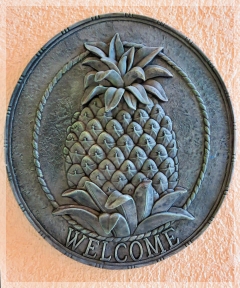 For a Christian, being hospitable should be second nature but, for many, the thought of entertaining is terrifying. Entertaining, however, has nothing to do with hospitality. One has to do with cuisine, attire, atmosphere, and possessions, and says “Look what I have,” while the other has to do with love, respect, sharing, refreshment, and comfort and says, “What I have is yours!” One is meant to impress and the other is meant to bless.
 In the ancient world, travel was dangerous and the nomadic people of Israel took hospitality seriously. It was the way to transform an unknown person (who might pose a future threat) into a guest and a friend. Hospitality was an integral part to many of the Old Testament’s stories. Both Abraham and Lot welcomed strangers into their home. Rebekah gave water to Abraham’s servant, watered his camels, and then offered food for the animals and rooms for the night. Rahab gave lodging and protection to the Israelite spies, Manoah and his wife fed the stranger who visited them, the widow of Zarephath gave her last morsel of food to Elijah, and the Shunammite woman provided food and a room for the prophet Elisha whenever he passed through Shunem. Abigail generously provided food for David and his band of men and David welcomed Jonathon’s crippled son Mephibosheth at his table as a way of showing God’s kindness.
 This is the Lord’s doing, and it is wonderful to see. This is the day the Lord has made. We will rejoice and be glad in it. [Psalm 118:23-24 (NLT)]
 Devotions of the Heart