
Post this at all the intersections, dear friends: Lead with your ears, follow up with your tongue, and let anger straggle along in the rear. God’s righteousness doesn’t grow from human anger. So throw all spoiled virtue and cancerous evil in the garbage. In simple humility, let our gardener, God, landscape you with the Word, making a salvation-garden of your life. [James 1:19-21 (MSG)]
Some days, doing “the best we can” may still fall short of what we would like to be able to do, but life isn’t perfect – on any front – and doing what we can with what we have is the most we should expect of ourselves or anyone else. [Fred Rogers]
 As a teen and young adult, it was easy to be critical of my parents and their parenting. Vowing I’d never say or do some of the things they did, I was sure I’d never make any of their mistakes. Once I became a mother, however, I became far more forgiving and much less judgmental. Turns out, I made some of the same mistakes my parents did (and plenty more of my own).
Parents want to keep their children from heartbreak, disappointment, and harm; they want more and better for their children than they had. As a result, despite their best intentions, they can be over-protective, judgmental, enabling, dictatorial, or stubborn. All things considered, I now realize my parents did the best they could. While they didn’t always make the right decisions, they thought they were the correct ones at the time. It’s only in hindsight that we get twenty-twenty vision!
Most people don’t wake each morning intending to be unforgiving, unsympathetic, intractable, or indifferent. Rather than planning on being selfish, temperamental, hypercritical, or rude, we probably wake up hoping to be kind, patient, and loving. Unfortunately, we’re not always good at doing that! I certainly never begin the day intending to be impatient, inconsiderate, or negative, but that has been known to happen—far more frequently than I’d like. None of us are perfect; being human, we all make plenty of mistakes. My prayer each morning is simple: to be a better person that day than the one I was the day before. Through the power of the Holy Spirit, that is gradually happening.
When we remember that sometimes our best efforts are not nearly good enough, it becomes much easier to forgive others for their failings. Forgiveness doesn’t mean those actions were right or good and it doesn’t mean we approve or accept them. It simply means we forgive them. While we’re forgiving others, we should forgive ourselves for our shortcomings as well. Let’s start the new year by releasing our regrets and resentments and granting grace both to others and ourselves. Every one of us made mistakes and we all could have done better; nevertheless, what’s done is done. If God can forgive us, we ought to be able to do so, too.
Father, replace any hidden resentment, anger, and regret from our hearts with compassion, love, and forgiveness. Help us accept that flaws, both ours and those of others, are part of being human. Show us how to learn from our mistakes and the mistakes of others. Fill us with your Holy Spirit so that we can be better people today than we were yesterday, and even better ones tomorrow.
Forgive, forget. Bear with the faults of others as you would have them bear with yours. Be patient and understanding. Life is too short to be vengeful or malicious. [Phillips Brooks]
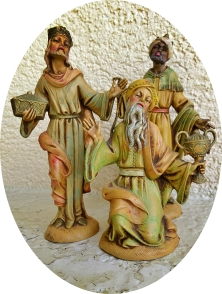 For centuries, access to the written Word of God was limited to just a few. The printing press wasn’t invented until 1439 and, at the time, only about 20% of the population could read. As a result, churches were decorated with paintings, stained glass windows, statues, carvings, and mosaics depicting biblical stories or illustrating theological concepts. For people who couldn’t read the book, religious art told the story. Consider how the Stations of the Cross in Roman Catholic churches illustrate the events of Good Friday. Sometimes, a picture really is worth a thousand words! While most nativity scenes are inaccurate, our depictions of the nativity don’t have to be historically exact to be meaningful.
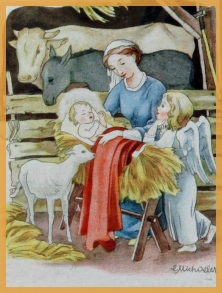 The earliest known portrayal of Jesus’ birth is a bas relief on a Roman sarcophagus from around 385. It depicts the swaddled Christ child in the manger flanked by an ox at His head and an ass at His feet. Why are they present instead of Joseph and Mary? In 1223, Francis of Assisi brought some hay and a manger to a cave and celebrated Mass there on Christmas Eve. Even though Mary and Joseph weren’t present, an ass and an ox were! In 1291, Pope Nicholas IV commissioned Arnolfo di Cambio to create a permanent nativity. While there are statues of Mary and Jesus, Joseph, and three Magi, the sixth statue shows the heads of an ox and an ass rather than shepherd or angel. Besides the baby Jesus, the ass and the ox are the most ancient and consistent elements in depictions of the nativity. Why do these two animals, neither of which is mentioned in the gospels, have such a prominent place in our nativity scenes, Christmas cards, and carols?
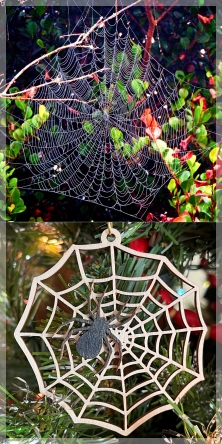 It was a web day at the park and I don’t mean the world-wide kind. It was one of those days when the morning dew, mist, and light cooperated in such a way that we saw beautiful intricate spider webs hanging everywhere. Looking as if they were made of strands of silver rather than proteinaceous silk extruded from a spider’s spinnerets, it seemed like the spiders had decorated all the trees in celebration of Christmas.
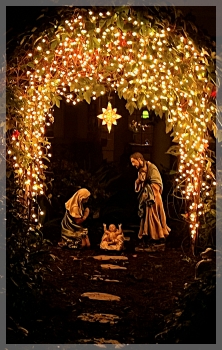 Unfortunately, much of our Advent season is not spent joyfully looking forward to celebrating the birth of the Christ child. In hope of finding the perfect gift for everyone on our list, we pore over catalogues and search for sales and coupons. Either we fight for parking spots at the mall and spend hours standing in line or spend those hours sitting at the computer while shopping on line! We then fret and fuss over wrapping those gifts, mailing packages and Christmas cards, hosting and attending parties, baking cookies, making travel arrangements, decorating the house, preparing holiday dinners, and paying the ever-mounting bills. When we say, “Merry Christmas!” we might find ourselves mumbling a Scrooge-like “Bah! Humbug” under our breath! Instead of looking forward to Christmas with anticipation, there are times we can’t wait until it’s all over and done.
 Devotions of the Heart