
And he said to them, “The kings of the Gentiles exercise lordship over them, and those in authority over them are called benefactors. But not so with you. Rather, let the greatest among you become as the youngest, and the leader as one who serves. For who is the greater, one who reclines at table or one who serves? Is it not the one who reclines at table? But I am among you as the one who serves. [Luke 22:25-27 (ESV)]
 While researching 1st century dining habits, I learned how guests traditionally were seated. Although da Vinci’s famous mural places Jesus in the middle of the group at a long rectangular table, the position of Jesus (as the host) would have been second from the left on the left side of a U-shaped table. Customarily, a trusted friend was seated to the host’s immediate right and the guest of honor to the host’s immediate left. The rest of the diners were seated to the left starting with the highest-ranking person and proceeding on down to the least important. If a servant were present during the meal, the last seat was his since it was closest to the door. With no servant, it was given to the youngest or lowest ranking guest.
Based on references in Scripture, it is believed that John (who was described as “lying close to the breast of Jesus”) was the trusted friend to the Lord’s right and Judas (who “dipped his hand in the dish” with Jesus) was in the honored position to His left. Since Peter had to signal John to ask the identity of the betrayer, scholars think he probably was directly across from John in the least important position at the far end of the right side of the table. As the host, Jesus would have determined this seating arrangement—and it seems to have been as much about role reversal in God’s kingdom as was Jesus washing the feet of the disciples. Normally, one would expect Peter, the rock upon whom Jesus would build His church, to have the place of valued friend to Jesus’ immediate right and John, the youngest of the men, to have the last place at the table. Jesus, however, seated the least in the first place and the soon-to-be leader in the servant’s spot. Was this yet another way to impress upon His followers the importance of the servant leadership?
But what of Judas? Not only did Jesus wash His betrayer’s feet, but He also gave him the guest of honor’s place immediately to His left. Judas didn’t just eat from the same bowl as did Jesus, John reports that Jesus actually dipped bread into a bowl and gave it to Judas, an action that openly honored the man. How could Jesus do that and why? As Jesus’ head rested close to Judas’ chest, was this a way of giving Judas one last chance or a way of assuring the man of His love? Was this a lesson for the disciples about God’s love for even the worst of sinners? Was it a lesson for all of us about the undeserved, unconditional, unselfish, and never-ending love of Jesus? Can we love and serve the way our Lord did?
 When picturing the Last Supper, we probably visualize it much like Leonardo da Vinci’s famous mural with the men seated on chairs at one long table. While visually appealing, the picture is inaccurate. Instead of sitting on chairs with their feet concealed under the dinner table, Jews and Romans in Jesus’ day lounged on low sofas or cushions surrounding a low three-sided table called a triclinium. The cushions or couches were placed on the outside of the three sides which left the inside open for serving and entertainment. Diners would recline on their left sides, lean into the bosom of the person on their left, support their heads with their left arms, eat and drink with their right hands, and stretch their legs out to the right.
 While we’re busy decorating our homes, planning holiday menus, finding the perfect gift for everyone on our list, and stressed about supply chain issues and shipping delays affecting the receipt of those gifts, let’s not forget that we’re in the season of Advent. This is a time for us to prepare for the second coming of Christ and to ponder the gifts of hope, love, peace, and joy we received with His first coming.
 In the early church, it was common for believers to gather together for prayer and, when Peter was imprisoned, they gathered to pray for his release at the home of Mary, the mother of John Mark. For a people who believed in prayer, it’s ironic that Peter thought the angel that freed him to be a mere vision until he found himself free on the city streets and that the church was astonished when he showed up at Mary’s house! Amazing things can happen when the church prays for its leaders. Prayers broke Peter’s chains, imagine what they can do for our pastors!
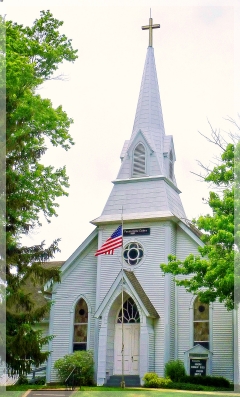 The story is told about a pastor who was shaking hands with his congregation after church one Sunday morning when a little boy handed him a dollar. After thanking him, the pastor asked what it was for. The youngster replied, “It’s for you, because I heard my daddy say that you were the poorest preacher that we ever had.” How easy it is to criticize our pastors when, instead, we should be praying for them.
 Friends recently watched their young grandson while his parents enjoyed a much needed “adults only” vacation. Accustomed to the permissive parenting of today, the youngster wasn’t overly familiar with obedience. One of the first things he learned during his visit was that, “Grandpa doesn’t count.” Apparently, his parents give him a count of three (or more) to decide whether or not to obey them; Grandpa, however, did not!
