WITH WONDER

But when Jesus saw it, he was indignant and said to them, “Let the children come to me; do not hinder them, for to such belongs the kingdom of God. Truly, I say to you, whoever does not receive the kingdom of God like a child shall not enter it.” [Mark 10:14-15 (ESV)]
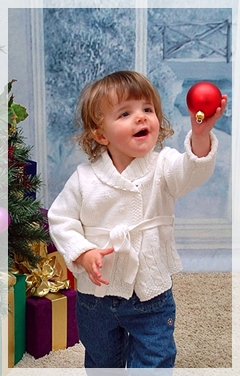
One day, the disciples scolded some parents for bringing their children to Jesus for a blessing. After telling them the Kingdom belonged to those who received it like a child, He called the children to Him. Unlike adults, children accept their humble position and live by faith and trust. Without self-consciousness and knowing they are in complete dependence on the giver, they receive gifts with humility and enthusiasm. Like explorers, children have a sense of wonder on their quest to learn about the world around them. They are filled with excitement and awe at every new thing they experience because life hasn’t become routine, predictable, or run-of-the mill to them.

Thinking of a child’s sense of wonder, I recalled my grand’s reaction to the small nativity I purchased for her more than twenty years ago. While her parents were away for the weekend in late November, she stayed with us. Although the tyke knew all about Santa, she didn’t know the Christmas story so I gave her a nativity set in a small wooden box. It had a handle on top so it could be carried like a purse and a latch in front that, when opened, revealed a stable and about a dozen wooden figures. As we opened the box, I told her the beautiful story that went along with those figures. Her eyes were big as saucers as she heard about the baby Jesus, angels, shepherds, wise men with gifts, and a star that led them to the baby. Filled with wonder at the amazing story, she had me tell it several times. When her parents came to pick her up, she immediately sat them down in our living room. After carefully opening her nativity box, she enthusiastically identified each character and explained the Christmas story to them.

How many Christmas pageants have we attended? How many Christmas Eves have we heard the words from Luke 2 or sung “Silent Night” in candlelight? How many times have we heard about the angelic chorus and the shepherds’ astonishment? Are we as astonished by the nativity as were they? Unlike a child, I suspect that we’ve lost our sense of awe and wonder at the incarnation—our astonishment that Jesus clothed Himself in a human body so that He could live a sinless life only to suffer a sinner’s death.

We’ve probably lost count of the Palm Sunday, Maundy Thursday, or Tenebrae/Good Friday services we attended. How many times have we heard about Jesus washing the disciple’s feet or the women discovering the empty tomb on Easter morning? For that matter, how many times have we read or heard about the feeding of the multitude, the miraculous provision of wine at Cana, blind Bartimaeus receiving sight, or the parable of the Prodigal Son? While familiarity doesn’t necessarily breed contempt, it can breed boredom.

In theater, the actors are expected to deliver a well-rehearsed performance in a fresh and new way every time. Called the “illusion of the first time,” they endeavor to make the audience feel like they are witnessing something happening for the very first time. What if we, as readers and hearers of the word, tried to create the “illusion of the first time”? What if we put on the eyes and ears of a child who’s hearing or reading it for the first time—someone who doesn’t know that Abraham won’t have to sacrifice Isaac, Lazarus will walk out of the tomb, only one leper will return to thank Jesus, the Red Sea will part, the walls of Jericho will collapse, or that young David will defeat the gigantic Goliath? What if we were hearing or reading those familiar narratives for the first time? Even though we know the stories, shouldn’t we be as filled with wonder as was my grand when she learned the Christmas story? Shouldn’t we be as amazed as were the shepherds when they heard an angelic chorus on the night of Christ’s birth, as astonished as were the mourners when Lazarus walked out of that tomb, as distressed as were the women at the foot of the cross, and as stunned as were the disciples when Jesus appeared Easter morning!?

While we may have the knowledge of decades-long believers, let us come to Scripture with a child’s awe and sense of wonder. Let us react to the words as if it were the first time we’ve read or heard them—as if we don’t know how the story ends. Let us recreate the “illusion of the first time” and have the wonder of a child!

A child’s world is fresh and new and beautiful, full of wonder and excitement. [Rachel Carson]
And great crowds came to him, bringing with them the lame, the blind, the crippled, the mute, and many others, and they put them at his feet, and he healed them, so that the crowd wondered, when they saw the mute speaking, the crippled healthy, the lame walking, and the blind seeing. And they glorified the God of Israel. [Matthew 15:30-31 (ESV)]

Copyright ©2025 jsjdevotions. All rights reserved.

MARY’S HUSBAND

And her husband Joseph, being a just man and unwilling to put her to shame, resolved to divorce her quietly. But as he considered these things, behold, an angel of the Lord appeared to him in a dream, saying, “Joseph, son of David, do not fear to take Mary as your wife, for that which is conceived in her is from the Holy Spirit.” [Matthew 1:19-20 (ESV)]

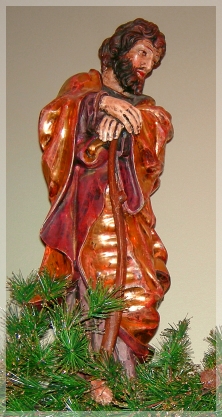
JosephWhile putting away our nativity, I looked at the figure of Joseph. For the man who played a pivotal role in the Christmas story, once Christmas is packed away, Mary’s husband rarely gets a second thought until the next December. Neither Mark nor John mention the man who served as step-father to Jesus and the author of Hebrews didn’t even list him in its “Hall of Faith.”

Unfamiliar with 1st century Jewish marriage customs, we probably take Joseph’s presence at the nativity too lightly. Rather than an agreement between two people, marriage at the time was an agreement between two families. Before the prospective bride was consulted, the groom (or his father) approached her father and the men would negotiate the price [mohar] to be paid for the girl. Once the mohar had been paid, the first of two ceremonies, the betrothal, was held and the couple were legally married. Following the betrothal, the bride remained in her father’s house, gathered her trousseau, and prepared for married life while the groom prepared living accommodations for his wife and arranged for the wedding feast. Although married, the couple were prohibited from having sex. It wasn’t until about a year after the betrothal that a colorful procession led the woman to the house of her groom, more vows were made, and the marriage finally was consummated.

During her betrothal, the bride could not belong to another man. Should the groom learn that she lied about her virginity, he could dissolve the marriage contract through a certificate of divorce and, if caught in the act of adultery, she could be killed.

Matthew tells us Joseph was dikaios, meaning righteous and just. Expressing a righteousness rooted in a covenant relationship with God, dikaios emphasizes moral integrity and obedience to the Law. Can you imagine this honorable man’s reaction to his bride’s pregnancy? Remember, within days of Gabriel’s visit to her, Mary hurried to the home of Zechariah and Elizabeth where she stayed for three months. When she told Joseph of her pregnancy, did he wonder what his bride had been up to while away in the hill country? Consider his distress at what seemed a betrayal. Imagine his disappointment at Mary’s preposterous explanation that probably seemed like an outlandish lie. Knowing he wasn’t the father, Joseph had every legal right to divorce her and demand the mohar’s return; in fact, Mary’s infidelity could cause her to be stoned!

Although an angel appeared to Joseph in a dream to reassure him that Mary’s baby was, indeed, conceived by the Holy Spirit, Joseph was an ordinary builder—not a priest like Zachariah or a prominent rabbi like Shammai. I suspect this was his first angelic visit and he must have questioned the validity of his dream. Imagine his confusion and consider his torment as he struggled with his choice. If he divorced Mary, Joseph could deny responsibility for her shameful pregnancy and maintain his good reputation but, if he stayed with Mary, he assumed responsibility for the pregnancy and took on her disgrace. His choice regarding Mary’s scandalous pregnancy affected both of their families, as well.

Nevertheless, Joseph valued God’s call over his reputation and remained betrothed to Mary. Moreover, despite everyone else assuming they had sex, both Matthew and Luke tell us that Joseph refrained from intercourse with Mary before Jesus’ birth. The young man honored God’s plan over his own wants and needs. It was not until after Jesus’ birth that their marriage finally was consummated.

Right after the Magi’s departure, the new father had a second visit from an angel. Told to flee to Egypt because the child’s life was in danger from Herod, Joseph immediately obeyed. Although he must have had misgivings about leaving his homeland, Joseph kept Mary and Jesus safe and they became refugees in a pagan country. They only returned when, once again, an angel of the Lord directed his way.

While Joseph seems to disappear after the second chapters of both Matthew and Luke, his role in Jesus’ life certainly didn’t stop. It was in his home that “Jesus increased in wisdom and in stature and in favor with God and man.” [Luke 2:52]

Can you imagine what it was like for this righteous (but ordinary) man to be tasked by God with the responsibility of being guardian to the Messiah—the one who would “save his people from their sins”? What was it like to hold the Son of God in his calloused hands or to teach Him to walk, handle tools, and read the Torah? Consider the weight of responsibility upon Joseph’s shoulders. The last we hear of him is when he and Mary temporarily “lost” the twelve-year-old Jesus on their return from celebrating the Passover in Jerusalem. I can’t imagine his panic at having lost the Messiah! Although Joseph almost certainly died before the Lord’s crucifixion, we don’t know when, where, or how. What we do know is that Joseph was, indeed, a dikaios man—a man who was willing to follow God’s guidance and do His will regardless of the consequences.

Joseph reminds us that those who appear hidden or in the shadows can play an incomparable role in the history of salvation. [Pope Francis]

An angel of the Lord appeared to Joseph in a dream and said, “Rise, take the child and his mother, and flee to Egypt, and remain there until I tell you, for Herod is about to search for the child, to destroy him.” And he rose and took the child and his mother by night and departed to Egypt and remained there until the death of Herod. [Matthew 2:13-15 (ESV)]

Copyright ©2025 jsjdevotions. All rights reserved.

RESOLUTIONS

Search me, O God, and know my heart; test me and know my anxious thoughts. Point out anything in me that offends you, and lead me along the path of everlasting life. [Psalm 139:23-24 (NLT)]

The tradition of New Year’s resolutions goes back over 4,000 years to the ancient Babylonians (whose new year began in mid-March with the spring equinox). During their 12-day celebration called Akitu, they either crowned a new king or reaffirmed their loyalty to the old one. To ensure the gods’ favor, they promised to return borrowed items and pledged the repayment of all their debts.

Around 46 BC, Julius Caesar altered the calendar and began the year in January to honor the two-faced Janus—the Roman god who could look back into the past and forward into the future at the same time. Romans believed that the rest of the year would go pleasantly if that was how they spent its first day. Trying to spend January 1st as happily as possible, there were games, feasts, gifts, sweet treats, and plenty of wine while complaint, gossip, and quarrels were avoided. By making sacrifices to Janus and promising to live a better life, Romans believed the year ahead would bring prosperity and success.

Did you spend yesterday as pleasantly as possible—with no spats or spite? Did you start the new year with a resolution or two? While pledging to become a better person in the coming year or promising to return borrowed items and pay one’s debts are good goals for 2025, the majority of our New Year’s resolutions usually have something to do with health, exercise, or diet.

Before resolving to floss, eat more vegetables, or run a 5K, we should pray and ask God what He would like to see us change. “Search me, O God,” is what could be called a dangerous prayer because, when we ask God to search, we should be ready for what He finds. Chances are that it will have nothing to do with developing better dental or nutrition habits.

Asking God to examine our innermost being is like asking Him to perform exploratory surgery in search of sin. While a surgeon may not find a malignancy, God is sure to find plenty of areas in our lives that need excising or change. In medicine, a surgeon usually removes a malignancy if it is found. In God’s hospital, it’s a little different. If He finds disease or malignancy in our hearts, after pointing it out, He expects us to repent and turn away from it.

According to Drive Research, only 9% of those who make New Year’s resolutions successfully keep them all year. Sadly, our spiritual goals can fail as readily as the non-spiritual ones. For 20 years, one Christ-following friend has resolved to read the Bible, cover-to-cover; so far, she’s not gotten past Leviticus! Perhaps we’d do better if we remember that we can’t change by ourselves. While will-power alone might keep us away from Dunkin’ Donuts or Krispy Kreme (at least for a while), it’s not enough when we’re combating spiritual enemies. Fortunately, we are empowered by the Holy Spirit and, through Him, all things are possible—even reading the Bible.

Let us remember that Jesus is in the business of transformation. He transformed water into wine, the blind into the sighted, the lame into the strong, and the diseased into the healthy. He changed the churning sea into calm water, a few morsels of food into a feast, and the dead into the living. Jesus’ miracles of transformation continue today. He turns darkness into light, anger into peace, fear into hope, animosity into love, selfishness into generosity, mourning into joy, shame into honor, and sinners into saints. If you’re still not sure what your resolution should be, you can always borrow Jonathon Edward’s: “Resolution One: I will live for God. Resolution Two: If no one else does, I still will”

May you have a blessed new year.

The object of a new year is not that we should have a new year. It is that we should have a new soul. [G. K. Chesterton]

And I will give you a new heart, and I will put a new spirit in you. I will take out your stony, stubborn heart and give you a tender, responsive heart. And I will put my Spirit in you so that you will follow my decrees and be careful to obey my regulations. [Ezekiel 36:26-27 (NLT)]

 Copyright ©2025 jsjdevotions. All rights reserved.