FREE TO BE

So God created human beings in his own image. In the image of God he created them; male and female he created them. [Genesis 1: 27 (NLT)]

But the Lord God warned him, “You may freely eat the fruit of every tree in the garden—except the tree of the knowledge of good and evil. If you eat its fruit, you are sure to die.” [Genesis 2:16-17 (NLT)] 
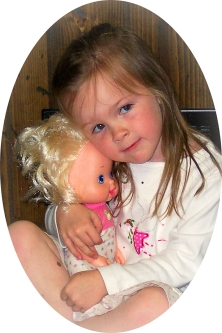
When my grandchildren were little, our guest bedroom was their playroom. Whenever they played house or school, the dolls and stuffed animals were the “children” in their imaginary world. For the most part, the dolls were well-behaved and helped in the play kitchen, sat attentively in their chairs, and were nice to the other children. But, sometimes, those pretend children misbehaved and needed to be put in “time-out.” In their world of make-believe, why did my grands choose to have children who sometimes disobeyed? I suspect they enjoyed the opportunity to do the disciplining instead of always being the one getting disciplined! Then again, without benefit of theological discussion, perhaps they simply understood the concept of free will and gave their dolls the ability to choose.

The grands gave their dolls free will just as God did with mankind. If He hadn’t given us free will, God wouldn’t have needed to tell Adam not to eat from the tree and we’d still be in Eden. Knowing Adam and Eve would disobey, why did He put that tree in the garden in the first place? How could a loving God design a world in which man could and would make bad choices? While Genesis tells us what God did, it never really tells us why.

Genesis, however, tells us that, of all of God’s creatures, mankind is the one made in His image. God has the ability to make choices and, being made in His image, so do we. He gave us the ability to reason and make decisions. Without free will, we’d be more like mindless puppets than distinctive individuals. What kind of god would create intelligent beings who had no willpower—who had no choice but to serve him without question? Certainly not our God of love. He wanted a relationship with mankind, not some version of animatronic “Stepford” people or robots. If we could do nothing but love and obey, it wouldn’t be real love or obedience; the love would be obligatory and the obedience meaningless. God wanted man to choose to love and trust Him not because he has to, but because he wants to. So, why the tree? A choice can’t be made without having at least two options—something had to be prohibited. The problem was not in God’s faulty design of the garden; it was in man’s failure to make the right choice. Mankind abused the gift of free will.

Our good God designed a good world. In fact, He saw everything in the garden and said it was good, including that tree. The tree itself was not wicked; it was the knowledge of good and evil that was bad. By partaking of the tree, mankind knew what evil was. It wasn’t the tree that introduced death – it was our disobedience.

If we could only make right turns, we’d go in a circle, but God gave us the ability to take our own individual journey and turn both left and right. Loving and obeying Him was not the only choice in that garden and it’s not the only option now. It is, however, the only option that will give us joy and an abundant life, both now and forever.

If a thing is free to be good it is also free to be bad. And free will is what has made evil possible. Why, then, did God give them free will? Because free will, though it makes evil possible, is also the only thing that makes possible any love or goodness or joy worth having. [C.S. Lewis]

Today I have given you the choice between life and death, between blessings and curses. Now I call on heaven and earth to witness the choice you make. Oh, that you would choose life, so that you and your descendants might live! [Deuteronomy 30:19 (NLT)]

Don’t you realize that you become the slave of whatever you choose to obey? You can be a slave to sin, which leads to death, or you can choose to obey God, which leads to righteous living. [Romans 6:16 (NLT)]

Copyright ©2026 jsjdevotions. All rights reserved.

CONFIRMATION

So Balak…sent messengers to Balaam the son of Beor at Pethor, which is near the River in the land of the people of Amaw, to call him, saying, “Behold, a people has come out of Egypt. They cover the face of the earth, and they are dwelling opposite me. Come now, curse this people for me.” [Numbers 22:4b-6a (ESV)]

BalaamWhen reading the narratives of the Old Testament, it’s tempting to think that some of the stories are more legend than history. Take the story of Balaam, the pagan prophet hired by King Balak to curse the Israelites, who ended up blessing the Israel and pronouncing disaster on its enemies. Since this took place around 1407 BC, it’s easy to question the story’s accuracy. Balaam’s existence, however, has extra-biblical non-Israelite confirmation.
Over 2,800 years ago, the story of Balaam, “a divine seer,” who pronounced doom to his own people, was written in red and black ink on the plaster wall of a building in the ancient city of Deir ‘Alla in present day Jordan (about 25 miles from where the incident recorded in Numbers 21 took place). The building collapsed as the result of an earthquake around 760 BC (an event referenced in the books of Amos and Zechariah). In 1967, 119 fragments of Balaam’s story were found in the building’s rubble. Probably written about 800 BC, the text begins with the title, “Warnings from the Book of Balaam the son of Beor. He was a seer of the gods.” It continues with, “The misfortunes of the book of Balaam son of Beor. A divine seer was he.” Two more times in the first four lines, the prophet is referred to as “the son of Beor” just as he is in the Hebrew Bible. Referencing “the Book of Balaam” indicates that the wall’s words were copied from an earlier text and that the original material was older than the writing on the wall. While the Deir ‘Alla story mentions pagan gods, the God whose visit caused the prophet to weep bitterly is referred to as “El Shaddai,” which is how the God of Israel was referenced during this time.

The wall’s text tells us that Balaam was well known as a “cursing prophet” and much of the Deir ‘Alla text is given to the prophet’s many curses. These ancient wall fragments help explain why King Balak’s representatives traveled 400 miles to hire Balaam to curse the Israelites. Although the story on the wall, with its mention of other gods and goddesses, doesn’t exactly match the version in Numbers, one would expect a pagan people to put their slant on it and, with only a portion of the wall existing, we have only part of the story. Nevertheless, we know Balaam did exist.

When archeologists wondered why Balaam’s book would be written on the wall of a building in Deir ‘Alla, their answer was found in eleven clay tablets found in the same area. Dating from 1200 BC or earlier (the time of Balaam), they identify Deir ‘Alla as Pethor (Balaam’s home in the Hebrew Scriptures) and speak of the “smiters of Pethor.” If this “divine seer” lived in what is now Deir ‘Alla, it is not surprising that his story would be preserved in his hometown. While these fragments of wall and tablets don’t prove Balaam’s story in Numbers, they certainly back it up. However, there is no doubt that Balaam existed; he was a real prophet, well-known for casting curses, who lived on the east side of the Jordan, and was revered for centuries after his death.

While more ancient artifacts are being discovered every year, archeology is based on what’s been left behind, discovered, and deciphered. Many pieces are missing in the puzzle and the fragmentary nature of archeological evidence makes it impossible to recreate the Middle East’s complete history. Fortunately, we don’t need every biblical event to be confirmed by archeology because we accept the Bible as the Word of God. Scripture doesn’t need proof because it comes with the authority of God; saying archeology proves the Bible gives it more authority than that given to Scripture. Let us remember that, long before there were archeologists, Jesus accepted Scripture’s authority, cited it frequently, and attributed its words directly to God. If it was good enough for Jesus, it should be good enough for us!

Nevertheless, as time goes on and bits and pieces of ancient history are discovered and analyzed, we find that archeology continues to support the Bible. Extra-biblical evidence for Scripture’s people, places, and events continue to be found and verified. Archeological findings like those at Deir ‘Alla pose a problem for skeptics who’d prefer to think of the exodus, Israel’s wilderness wanderings, and the conquest of Canaan as things of legend. Since there is extra-biblical verification that Balaam was real, they should be cautious of dismissing other people like Balak, Moses, Aaron, Joshua, and the Israelites! Who knows what archeological treasures are hidden under the feet of those who walk in the Holy Land today?

Every word of God proves true; he is a shield to those who take refuge in him. [Proverbs 30:5 (ESV)]

Copyright ©2026 jsjdevotions. All rights reserved.

OUR WORST ENEMY

Temptation comes from our own desires, which entice us and drag us away. These desires give birth to sinful actions. And when sin is allowed to grow, it gives birth to death. [James 1:14-15 (NLT)]

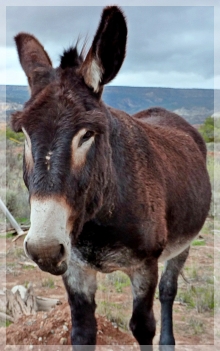
donkeyAs the Israelites journeyed toward Canaan, they turned south to the plains of Moab. Fearful of so many Israelites in Moab and Midian, King Balak of Moab sent the elders of Moab and Midian to hire Balaam, a sorcerer and prophet, to curse the Israelites. Although Balaam tried to do just that, the Lord intervened by speaking through the mouth of a donkey, opening the prophet’s eyes to see an angel of the Lord, and being told he could speak only the message the Lord put in his mouth. Rather than cursing the Israelites, Balaam ended up blessing them and cursing Moab! Needless to say, the prophet did not receive the rich reward promised him. Although God prevented Balaam from cursing Israel, the unscrupulous prophet found another way to get his reward from Balak—he got Israel to bring a curse upon themselves!
Any reading the Hebrew Scriptures tells us that Israel’s biggest threat wasn’t from pagan curses or foreign armies. The danger lay in their continual failure to remember and obey their God—the God who delivered them from Egyptian slavery, brought them safely through the wilderness, and even protected them from Balaam’s curse. Sacred prostitution was a common practice among the Canaanite religions and, while camped at Shittim, Israel’s men began to have sex with the local women. Encouraged by these women, they then began attending their local feasts, pagan sacrifices, and worshipping Baal of Peor (one of the main gods of the Moabites, Midianites, and Ammonites). The Lord grew angry with Israel for their debauchery and idolatry and commanded the deaths of all who defiled themselves by participating in the sacrilege. 24,000 men died in the violent plague of judgment. It turns out that the same Balaam who blessed Israel instead of cursing it was the one who instigated the women’s invitation to fornication and idolatry. Even though Balaam set the stage for the seduction of the Israelite men, no one forced them to respond; that responsibility fell squarely on each man’s shoulders.

Moab’s King Balak didn’t need a curse to kill any Israelites; they did a fine job of doing that on their own! But, the story didn’t end well for Balaam and the Midianites, as well. The Lord commanded Moses to take vengeance on them for their seduction of His people. A brutal massacre of the nation followed and the prophet Balaam died in the carnage. Nevertheless, the Israelites’ fall to temptation reminds us that our greatest battles are not against enemy armies or pagan prophets but against Satan and our own sinful natures. God, however, has not left us defenseless. While our worst enemy is self, our strongest ally is Jesus and the power of the Holy Spirit.

Beware of no man more than of yourself; we carry our worst enemies within us. [Charles H. Spurgeon]

So I say, let the Holy Spirit guide your lives. Then you won’t be doing what your sinful nature craves. [Galatians 5:16 (NLT)]

A final word: Be strong in the Lord and in his mighty power. Put on all of God’s armor so that you will be able to stand firm against all strategies of the devil. [Ephesians 6:10-11 (NLT)]

Copyright ©2026 jsjdevotions. All rights reserved.

JUDGMENT DAY WILL COME

Then I saw a great white throne and him who was seated on it. From his presence earth and sky fled away, and no place was found for them. And I saw the dead, great and small, standing before the throne, and books were opened. Then another book was opened, which is the book of life. And the dead were judged by what was written in the books, according to what they had done. … And if anyone’s name was not found written in the book of life, he was thrown into the lake of fire.[Revelation 20:11-12,15 (ESV)]

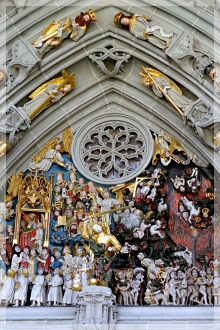
Before stepping inside of the Bern Münster Cathedral, you’ll probably stop and stare at the archway above the main entrance. There you’ll see 294 carved sandstone figures in a graphic illustration of God’s final judgment when the wicked are separated from the righteous. To your right are the naked damned souls in the midst of flames while, on your left, the righteous stand clothed in white and marked with the seal of God on their foreheads. Lady Justice with her scales and the Archangel Michael with his sword stand in the center. The entire scene is surrounded by larger statues of various saints and martyrs as well as the five wise virgins and the five foolish ones who weren’t ready for the bridegroom’s return!

Crafted in the late 1400s, this powerful visual sermon brings to life the biblical scene from Revelation of Christ’s return to judge humanity. While we’re not likely to find anything like that in our modern churches, the last judgment was a common theme for church doorways in the Middle Ages. Most people were illiterate and depictions like this one instilled both devotion and a healthy dose of fear into the hearts of the faithful as they entered God’s house. Nevertheless, to us in the 21st century, Judgment Day seems an odd way to welcome people into church!

For the people of the Middle Ages, however, death was waiting just around the corner. Unpredictable, it took the young as easily as the old. Between 1347 and 1353, for example, the Black (bubonic) Plague wiped out as much as half of Europe’s population. Disease, poor nutrition, famine, lack of medical care, inadequate housing, and violent warfare meant the average life expectancy was as low as 30 years. Leprosy, influenza, tuberculosis, small pox, and dysentery ran rampant, maternal and infant mortality rates were high, and, with no vaccines, antiseptics, antibiotics, anesthesia, or proper sanitation, death was an everyday event. Surrounded by the dead daily, death simply was an unavoidable part of life and one expected sooner rather than later.

Along with Revelation’s joyful news of Christ’s return and the world set right, is the prophecy that there will be a final judgment which, depending on the person, can be good news or bad. For those who put their faith in Christ while alive, there is nothing to fear; Jesus is forever. But, for those who ignored previous warnings and failed to put their faith in Christ while living, there are no second chances; eternal hell awaits. That frightening scene over the doorway was a vivid reminder that the day was coming when Jesus would return—a day when He’ll send His followers to everlasting life and the others to everlasting torment. With stakes like that and death within sight, the cathedral’s entry reminded people to be prepared for the day of judgment. Perhaps it caused them to ponder where they would be standing when that day happened.

Here in the 21st century U.S., we live in a safer more sanitized world than medieval Europe—one far removed from the daily threat of death. Although we know we have an expiration date, unless we have a terminal diagnosis, that date seems far removed. Nevertheless, death is an inescapable part of life. Regardless of how rich, famous, or beautiful we might be, death awaits us all just as it did for the people of the Middle Ages.

Whether our last day on earth is accompanied by the coroner or the sound of trumpets at Jesus’ triumphant return, that doorway in Bern remains a powerful reminder that the day of reckoning will come. On Judgment Day, anyone who has lived will appear before the throne of God and be judged, but only those whose names are in the book of life will enter the new heaven and earth. The stakes are as high today as they were more than 600 years ago and death’s arrival remains unavoidable. It’s been said that many who plan to seek Christ at the 11th hour die at 10:30! Where will you stand when Judgment Day comes? Where will those we love be standing?

When the Son of Man comes in his glory, and all the angels with him, then he will sit on his glorious throne. Before him will be gathered all the nations, and he will separate people one from another as a shepherd separates the sheep from the goats. And he will place the sheep on his right, but the goats on the left. Then the King will say to those on his right, “Come, you who are blessed by my Father, inherit the kingdom prepared for you from the foundation of the world.” … Then he will say to those on his left, “Depart from me, you cursed, into the eternal fire prepared for the devil and his angels.” [Matthew 25:31-34,41 (ESV)]

Copyright ©2026 jsjdevotions. All rights reserved.

STAY ALERT!

When the devil had finished tempting Jesus, he left him until the next opportunity came. [Luke 4:13 (NLT)]

bearWhile I expected bear sightings when we lived in the mountains of Colorado, I never expected a bear to find its way into our Florida community and scavenge in a neighbor’s trash bin on her driveway! While bears generally prefer natural foods like berries and nuts, as civilization encroaches on their habitat, those foods are becoming less abundant. Driven by their need to eat, bears will go where they can find any food. With a sense of smell that is seven times greater than a bloodhound’s, it’s estimated they can smell a food source from as far away as 20 miles. Opportunistic creatures, they take advantage of whatever is easily available, whether bird seed, pet food, barbecue grills, or garbage.

Tenacious and intelligent animals, bears will spend hours solving a problem if food is involved but, since they lack opposable thumbs, bears couldn’t open the lock on our community’s “bear-proof” dumpster in Colorado. At the time, however, the doors on Subarus didn’t require thumbs to open and the hungry bears in our Colorado town eventually learned how to open the doors of unlocked Subarus. After that, no unlocked Subaru in town was safe from a bear! Once a bear gets inside a car, the door often closes and traps it. By the time the imprisoned angry animal manages to make an exit, the car’s interior is wrecked and the bear has done what it usually does in the woods! Nevertheless, just as people often forgot to latch our dumpster, some people still left their cars unlocked!

Satan is as opportunistic and tenacious as any black bear and, if we let him, he can leave our lives even more messed up than a bear does a Subaru. Rather than sniffing out the aroma of a garbage can or a candy bar on the dash, he has an uncanny way of sniffing out our vulnerabilities and spotting our weaknesses. Think of the story of Job. When Satan couldn’t get him to curse God by taking his wealth and livestock, servants, herdsmen, workers, and children, he came back and took the man’s health. Although Job never cursed God, he lost perspective and cursed the day he was born. As determined and unwilling to admit defeat as a black bear, Satan probably was behind the words of condemnation spoken by Job’s wife and friends. Like a hungry bear, the enemy does not give up easily. When the devil failed to tempt Jesus in the wilderness, he departed “until the next opportunity.” Like the Terminator and hungry bears, Satan will be back.

Just as storing garbage inside, latching bear-proof dumpsters, and locking car doors is a way to prevent bear problems, being aware of our vulnerabilities is a way of protecting us from Satan’s attacks. Recovery programs often use the acronym H-A-L-T as a reminder. Standing for Hungry, Angry, Lonely, and Tired, these feelings make us susceptible to Satan. While we often think of hunger as that grumble in our tummies, it is more. Hunger is dissatisfaction, frustration, a desire for something more or different and often has nothing to do with food. Anger isn’t just being mad at someone. Anger is holding on to unforgiveness, hostility, and resentment, and often includes casting blame. While lonely seems self-explanatory, we don’t have to be alone to be lonely. Even when surrounded by people, we can feel isolated, unappreciated, deserted, and desolate. Being tired can be physical exhaustion, but it’s also apathy, feeling drained by circumstances (or people), or wanting to abandon both hope and effort.

Being aware of these feelings when they arise helps us take extra precautions to protect ourselves. Instead of locking our dumpsters and cars, we redouble our efforts to study God’s Word, pray, worship with praise, offer thanks, gather in Christian fellowship, or even seek Christian counseling. When we leave ourselves vulnerable with hunger, anger, loneliness, or tiredness, we’re little safer from the enemy’s attack than people who keep their food in their tents when camping, store their garbage outside, don’t lock their Subarus, or fail to latch bear-proof dumpsters. Whether from bears or Satan, we’re just asking for trouble.

Satan loves to fish in the troubled waters of a discontented heart. [Thomas Watson]

Stay alert! Watch out for your great enemy, the devil. He prowls around like a roaring lion, looking for someone to devour. Stand firm against him, and be strong in your faith. [1 Peter 5:8-9 (NLT)]

But the Lord is faithful; he will strengthen you and guard you from the evil one. [2 Thessalonians 3:3 (NLT)]

Copyright ©2026 jsjdevotions. All rights reserved.

HE’S ALWAYS READY

Listen closely to my prayer, O Lord; hear my urgent cry. I will call to you whenever I’m in trouble, and you will answer me. [Psalm 86:6-7 (NLT)]

God is our refuge and strength, always ready to help in times of trouble. [Psalm 46:1 (NLT)]

Once upon a time, a little boy was busy digging in the sand at the beach. Like other youngsters through the years, he thought he even might be able to dig all the way to China. His steadfast excavations got so deep that he encountered a large rock. With great determination, he dug and dug with his plastic shovel in an attempt to free it from the ground. Unfortunately, the little boy and his small shovel were no match for the rock. When the shovel broke in two, the boy let out a howl and burst into tears. Hearing the child’s cries, his father immediately went to comfort him. Through his sobs, the boy told how he’d tried and tried to free the rock but was too weak, his arm was too short, and he’d broken his only shovel. His father gently asked why he hadn’t used all of his strength. “But I did, Daddy, I really did!” exclaimed the boy. “No, son, you didn’t,” explained the man as he reached into the hole, grabbed the rock with his large hands, and pulled it from the ground. “You should have called me!”

While the circumstances and challenges are different, we’re really not much different than that little boy. Determined to be self-sufficient and strong, we often fail to call on our Heavenly Father to help with the heavy lifting. I’ve never sobbed at the beach while holding a broken shovel but I’ve sat in despair, hopelessness, and tears in plenty of other places because I thought I was at the end of all my resources. It’s usually after complaining to God with a variety of whys—why this, why now, why here, and (my personal favorite) why me—that I finally resort to asking Him for help! Perhaps our trials exist to drive us to God—to trust in Him and call on Him in faith. While God rarely offers an answer to the whys, He does respond and, if it’s something He wants done, He helps me find a way to get it done.

True confessions here! When I was away over the holidays, I had a glitch in my website. While two devotions were posted on the site, they failed to be sent out to my subscribers. Upon returning home, after spending over two hours with the site’s AI assistant, I was no further along in finding the cause or solution. After AI finally conceded defeat, I was turned over to a real person for a live chat. The site’s “Happiness Engineer” was stumped but promised to get back to me later in the day. It was not until I was awaiting the response that I finally used all the strength available by going to the true “Happiness Engineer” in Heaven. Shortly after praying, I received the very simple solution to my problem! Why did I wait and when will I learn?

Famine in Israel, an agricultural society, was a grave matter. After Israel suffered from a three-year famine, David prayed to God about it. Why did he wait? What was David doing during the three years of food scarcity before he finally fell to his knees and consulted God? Why didn’t he pray at the first sign of trouble rather than waiting until the people were starving? Could pride have made David think that he and his advisors could solve a food crisis on their own? If so, that pride caused his people to suffer for three years simply because he didn’t use all the strength available to him by calling on his Father! It was only after his prayer that the Lord told David the famine’s cause and David did what needed to be done to end it. [2 Samuel 21]

Ours is not a God of Last Resort! He is not where we go when all else fails: when the shovel breaks or the grain bins are empty. Rather than a back-up plan, God is our first and best option! Ours is a first-responder God! He’s the first call we should make when the rock seems immovable, we discover insects infesting our fields, a drought threatens the harvest, the website isn’t working, or we see challenges looming on the horizon. With His power, we can do things we could never accomplish by ourselves. Let us be strong in the Lord!

We tend to use prayer as a last resort, but God wants it to be our first line of defense. We pray when there’s nothing else we can do, but God wants us to pray before we do anything at all. Most of us would prefer, however, to spend our time doing something that will get immediate results. We don’t want to wait for God to resolve matters in His good time because His idea of ‘good time’ is seldom in sync with ours. [Oswald Chambers]

A final word: Be strong in the Lord and in his mighty power. [Ephesians 6:10 (NLT)]

He gives power to the weak and strength to the powerless. … Those who trust in the Lord will find new strength. They will soar high on wings like eagles. They will run and not grow weary. They will walk and not faint. [Isaiah 40:29,31 (NLT)]

Copyright ©2026 jsjdevotions. All rights reserved.