THE LAW – JUST TWO (Part 2)

And you must love the Lord your God with all your heart, all your soul, and all your strength. [Deuteronomy 6:5 (NLT)]

Do not seek revenge or bear a grudge against a fellow Israelite, but love your neighbor as yourself. I am the Lord. [Leviticus 19:18 (NLT)]

New England asterYesterday I told about a friend who was reading her Bible in a coffee shop when a young Jewish man belittled her belief in God. Admitting that he once believed, he explained he no longer did because the Torah had too many laws. My friend was pleased when the Holy Spirit provided her with this simple response: “Try the New Testament; there are only two laws in it!”

As Christians, we adhere to some laws found in the Old Testament but not all. For example, while abiding by the commandments regarding adultery and idolatry, we ignore the ones requiring ritual baths or prohibiting pork and shellfish. Because of this, non-believers sometimes accuse us of being inconsistent or hypocritical. The law God gave in the Old Testament was given specifically to the nation of Israel. Setting them apart from the pagan nations surrounding them, the covenant He made was with them and not anyone else.

God gave the new nation of Israel a set of civil laws dealing with such things as their relationship with one another, conducting business, and settling disputes. He gave them ceremonial laws dealing with things like worship, temple practices, sacrifice, ritual cleanliness, and priestly duties and attire. God also gave Israel moral laws: laws telling them what was right and wrong, like those found in the Ten Commandments. Because Israel’s nationality and religion were one in the same, their civil, ceremonial, and moral laws often were interconnected.

The civil laws governing the nation of Israel don’t apply to us any more than Colorado’s laws regarding ski resorts apply to Florida’s beaches or New Jersey’s speed limit of 65 applies to a driver going 80 down a rural freeway in Texas. Like the civil laws, Israel’s ritual laws also were specific for them. Jesus finished the work of their priests and no more sacrifices or days of atonement are necessary.

What then of the moral laws? Based on the character of God, they transcend Mosaic Law and the principles behind them remain valid. With the exception of keeping holy the Sabbath day, the Ten Commandments are repeated throughout the New Testament. Sometimes, they are repeated in much stronger terms, as when Jesus equated anger with murder and lust with adultery! [Mathew 5:21-23,28]

Under the Old Covenant, the Israelites were given a choice: obey and reap God’s blessings or disobey and reap His curses. Having to justify themselves, Israel struggled and failed time and time again. The New Covenant, however, is based on grace rather than obedience—Jesus did for us what we couldn’t do for ourselves. With the New Covenant, God’s grace wasn’t limited to one nation but was made available to all people and for all time.

So what laws are we Christians to obey? Jesus made it simple with just two laws: wholly love God and love others as ourselves. Those two simple laws cover every conceivable situation far better than splitting hairs over who qualifies as a neighbor or how many times we are to forgive. We don’t need specific laws telling us to pay wages in a timely manner, use honest weights and measures, be charitable, honor our promises, do no wrong in buying or selling, and not to afflict widows and orphans. Found in both the Old and New Testaments, we have two all-purpose laws that cover all of those situations and much more. If we can fulfill these two, we’ve fulfilled them all!

Jesus replied, “‘You must love the Lord your God with all your heart, all your soul, and all your mind.’ This is the first and greatest commandment. A second is equally important: ‘Love your neighbor as yourself.’ The entire law and all the demands of the prophets are based on these two commandments.” [Matthew 22:37-40 (NLT)]

Copyright ©2020 jsjdevotions. All rights reserved.

 

THE LAW – MORE THAN 613  (Part 1 of 2)

Adonai said to Moshe, “Come up to me on the mountain, and stay there. I will give you the stone tablets with the Torah and the mitzvot I have written on them, so that you can teach them.” [Exodus 24:12 (CJB)]

black-eyed susansA friend told of reading her Bible in a coffee shop when a stranger came up and made a disparaging comment about her belief in God and Scripture. Identifying himself as Jewish, he said he no longer believed the Bible, adding “There are just too many laws in the Torah.” Observant Jews have even more than the 613 laws found in Scripture. The words of Exodus 24:12 were construed to mean that, along with the written commands in Exodus, Leviticus, Numbers and Deuteronomy, God gave Moses additional explanations and examples that he was to teach. Believing these oral explanations were passed from Moses to Joshua and on down to the following generations, Deuteronomy 17:8-11 was understood to mean that, along with declaring verdicts in disputes, the priests or sages could further clarify and interpret the law.

The sages often used this oral tradition to “put a fence around the Torah” and prevent transgressions. For example, beginning at midday on the 14th day of Nissan, leaven was prohibited during Passover. If clouds covered the sun, the sages were concerned that leaven might accidentally be eaten so they extended the law by two hours. While Scripture alluded to prohibited labor on the Sabbath, such as kindling a fire or doing business, it never listed every prohibited act. In great detail, the oral tradition specified kinds of work and explicitly prohibited anything even resembling labor such as braiding hair (weaving) or applying makeup (dyeing).

The work of compiling these oral traditions began around 200 BC and continued until what’s known as the Mishnah was completed around 220 AD. Divided into six sections, it deals with agricultural laws, prayers, festivals and fasts, family life, both civil and criminal jurisprudence, and the regulations defining what is “clean” and “unclean.” Since some earlier oral material had not been included in it, rabbis continued to interpret and clarify the law and their findings were gathered into the Gemara. Around 540, the Gemara and Mishnah were collected into the Talmud. Consisting of 63 tractates (treatises) divided into 523 chapters, the Talmud represents the labor of many generations over a period of approximately 800 years. Today, the Torah consists both of the written law, Torah Shebichtav, found in the first five books of the Old Testament, and the oral law, Torah Sheba’al Peh, found in the Talmud.

While the law was God’s gift to His people and a guide to life in Israel’s new land, human traditions ended up supplanting and complicating God’s word. With all of the Torah’s rules, regulations, and interpretations, it’s easy to see why the young man became discouraged. It’s not that the Torah is bad, it’s that his religion had become more about rules and obedience than relationship and faith.

Only take great care to obey the mitzvah and the Torah which Moshe the servant of Adonai gave you — to love Adonai your God, follow all his ways, observe his mitzvot, cling to him, and serve him with all your heart and being.” [Joshua 22:5 (CJB)]

Copyright ©2020 jsjdevotions. All rights reserved.

SOLA SCRIPTURA

All Scripture is breathed out by God and profitable for teaching, for reproof, for correction, and for training in righteousness, that the man of God may be complete, equipped for every good work. [2 Timothy 3:16-17 (ESV)]

snowy egretProtestant reformers summarized the essentials of the Christian faith in five short statements, the first of which is “Scripture alone” (Sola Scriptura) which means the Bible (both Old and New Testaments) is the sole, definitive, dependable, and essential authority for our faith and practice. While the Bible is not the only place we’ll find truth, the concept of “Scripture alone” means that everything else we learn about God must be interpreted in light of Scripture. When it comes to theology, if an idea doesn’t stand up to the Bible it hasn’t passed the acid test of truth.

Jesus warned of false prophets who would come in “sheep’s clothing,” [Matthew 7:17] Peter warned of false teachers in the community of believers who would slander the truth [2 Peter 2:1-2], and the Apostle Paul continually warned churches of the dangers of those “who deliberately twist the truth concerning Christ.” [Galatians 1:6-9] The danger of false doctrine has not lessened in this day and age of influencers and mass media where anyone can create a platform to spread his or her version of God. People are looking for a ray of hope in our divisive and often angry world and false prophets often appeal to what we’d like to hear rather than what God said. Subtle in the way they can spin truth into untruth, false teachers are hard to recognize, especially since so few Christians actually have read the Bible!

Scripture doesn’t explain metamorphosis, photosynthesis, or Boyle’s law or tell us the value of pi, how to find a square root, make a perfect soufflé, or write a computer program. While it doesn’t tell us everything we need to know, Scripture does tell us all we need to know to become a Christian, live as a Christian, and mature as a Christian. The Bible may have been penned by human authors but the words they wrote are the words of God and the Bible is the supreme source of truth for what we believe and how we live.

Sola Scriptura, however, doesn’t mean the Bible is the only place where we’ll find truth. People like Charles Spurgeon, C.S. Lewis, Augustine, Aquinas, Luther, Dietrich Bonhoeffer, Lee Strobel, John Bunyan, N.T. Wright, A.W. Tozer, and Francis Chan are all valuable resources and I’m sure God inspired many of their words. Nevertheless, unlike the words of Scripture, their words are not infallible and, if they don’t agree with Scripture, they’re the ones who are wrong!

It’s good practice to complement our Scripture reading with Bible commentaries, theology books, Christian blogs, devotionals, Bible studies, and sermons, but we must remember those sources are supplements, not substitutes, for the real thing. Let us continually use discernment and be wary of theology that isn’t firmly based in God’s Word. Consider how different it would have been if Eve had stuck with God’s word instead of believing Satan’s explanation of God’s motives! Sola Scriptura: let Scripture alone be the final authority!

For concerning the divine and holy mysteries of the Faith, not even a casual statement must be delivered without the Holy Scriptures; nor must we be drawn aside by mere plausibility and artifices of speech. Even to me, who tell thee these things, give not absolute credence, unless thou proof of the things which I announce from the Divine Scriptures. For this salvation which we believe depends not on ingenious reasoning, but on demonstration of the Holy Scriptures. [Cyril of Jerusalem (Catechetical Lectures)]

But I fear that somehow your pure and undivided devotion to Christ will be corrupted, just as Eve was deceived by the cunning ways of the serpent. You happily put up with whatever anyone tells you, even if they preach a different Jesus than the one we preach, or a different kind of Spirit than the one you received, or a different kind of gospel than the one you believed. [2 Corinthians 11:3-4 (NLT)]

Copyright ©2020 jsjdevotions. All rights reserved.

USING A MIX

When you pray, don’t babble on and on as people of other religions do. They think their prayers are answered merely by repeating their words again and again. Don’t be like them, for your Father knows exactly what you need even before you ask him! [Matthew 6:7-8 (NLT)]

tri-colored heron

While I enjoy cooking from scratch, I’ve never found recipes that produce better results than those from certain boxed mixes. Conceding that someone else has created better and easier recipes than mine for cornbread and brownies, I occasionally resort to using them. Nevertheless, I usually add chopped green chilies to the cornbread and chocolate chips or crushed Oreos to the brownies to make the finished product uniquely my own.

Like a boxed mix, there are times when we want to use a ready-made prayers when talking with God. Ready-made prayers are well written and, like Kraft mac ‘n cheese, comforting in their familiarity. They help us to convey thoughts we just can’t seem to find the words to express, clarify our concerns, or guide our prayers in God’s direction instead of in our own. Believing they kept him in touch with “sound doctrine” rather than his version of “religion” and fixed his focus on the long-range rather than the immediate, C.S. Lewis often used prayers from The Book of Common Prayer.

Just as I occasionally resort to a baking mix, like Lewis, there are times I use ready-made prayers like the ones found in the Psalms, The Book of Common Prayer, John Baillie’s A Diary of Private Prayer, or The Valley of Vision, a collection of Puritan prayers and devotions. Sometimes other people’s way with words—their passion, vulnerability, repentance or joy—are more expressive than anything I could articulate. Reinhold Niebuhr’s words, “God grant me the serenity to accept the things I cannot change; courage to change the things I can; and wisdom to know the difference,” say it better than I ever could.

Nevertheless, much as having the same recipe prepared the same way over and over again can get boring, saying the same prayers over and over again can get humdrum. The disciples were warned about the mindless repetition of prayers. Our prayers should never be dull and routine and we should be cautious of reciting words that are overly familiar or insincere. It helps if we’re sure to add a little something of our own thoughts to ready-made prayers just as we might do with a boxed mix of cornbread or brownies!

Bend down, O Lord, and hear my prayer; answer me, for I need your help. Protect me, for I am devoted to you. Save me, for I serve you and trust you. You are my God. Be merciful to me, O Lord, for I am calling on you constantly. Give me happiness, O Lord, for I give myself to you. O Lord, you are so good, so ready to forgive, so full of unfailing love for all who ask for your help. Listen closely to my prayer, O Lord; hear my urgent cry. I will call to you whenever I’m in trouble, and you will answer me. [Psalm 86:1-7 (NLT)]

Copyright ©2020 jsjdevotions. All rights reserved.

LEAD US NOT

And do not lead us into temptation, but deliver us from evil. [Matthew 6:13 (NASB)]

Let no one say when he is tempted, “I am being tempted by God”; for God cannot be tempted by evil, and He Himself does not tempt anyone. But each one is tempted when he is carried away and enticed by his own lust. Then when lust has conceived, it gives birth to sin; and when in is accomplished, it brings forth death. [James 1:13-15 (NASB)]

wrong wayWhen I was a little girl, I had a beautifully illustrated picture book of the Lord’s Prayer. I clearly remember the illustration accompanying these words: “Lead us not into temptation, but deliver us from evil.” A beautiful angel stood at a crossroads in front of two children and blocked their way down the wrong path.
While we ask God to guide us away from tempting circumstances and situations, we also know that an angel doesn’t always block the way. Sometimes God allows or even leads us into temptation and trials. The Holy Spirit led Jesus into the wilderness for the express purpose of being tempted by Satan [Matthew 4:1] and God tested the Israelites during their forty years in the desert to know whether or not they would keep His commandments. [Deut. 8:2] In the book of Job, God allowed Satan to tempt the man by mercilessly attacking him.

While God may allow us to be tempted, Scripture affirms that He never tempts us and He never will be the author or originator of evil. God can’t put evil desires into our hearts because there is no evil in Him. Nevertheless, God may bring us into situations that will sorely tempt us. When He does that, however, His plan always is for our good. Satan tempts in the hope of ruining us but God allows temptation to strengthen or test us. He doesn’t lead us into temptation to see us fail; he leads us into battle with evil so that we may be victorious.

We pray, “Lead us not into temptation,” because we know we are weak. Charles Spurgeon pointed out that a man who carries gunpowder on him wisely asks not to be led where sparks are flying. We may not be carrying gunpowder in our pockets, but things like pride, anger, fear, worry, despair, vanity, greed, and even lust are deep in our hearts and so we ask God not to lead us into situations where they might explode. But, in spite of our request, there are times that’s exactly where He leads us. That’s why, admitting our powerlessness to overcome evil on our own, we continue the prayer with, “deliver us from evil.” Life is a series of temptations and we ask God to give us the power and strength to withstand every temptation we face.

When Jesus was led into the wilderness to be tempted, the Holy Spirit was with Him the entire time. When we find ourselves in that same wilderness, we have the Holy Spirit, as well. Rather than an angel blocking the way, the Spirit will deliver us from evil!

Temptation is the best school into which the Christian can enter; yet, in itself, apart from the grace of God, it is so doubly hazardous, that this prayer should be offered every day, “Lead us not into temptation;”’ or if we must enter into it, “Lord, deliver us from evil.” [Martin Luther]

No temptation has overtaken you but such as is common to man; and God is faithful, who will not allow you to be tempted beyond what you are able, but with the temptation will provide the way of escape also, so that you will be able to endure it. [1 Corinthians 10:13 (NASB)]

Copyright ©2020 jsjdevotions. All rights reserved.

HANDS

Lift up your hands in the sanctuary and praise the Lord. [Psalm 134:2 (NIV)]

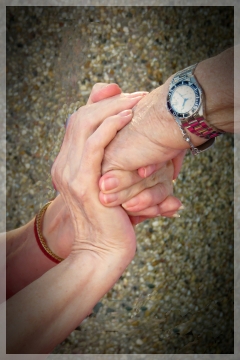
handsWhile social distancing has put an end to breaking bread with friends and holding hands while sharing a table blessing, I recall a dinner several years ago when I held the hand of our pastor’s wife during grace. For a small woman, her hands were larger and stronger than I expected. After grace, I looked at them and, comparing her youthful hands with mine, admit to feeling a twinge of envy. Like her, I played the piano but, unlike her, I could barely span an octave. Her sturdy hands had incredible reach and, unhampered by arthritis, there was power in her touch on the keyboard. I was overwhelmed by the strength of her hands and the beautiful way she uses them to praise the Lord as the worship leader at our mountain church.

As I pondered hands, I thought of a friend who used her hands to sign for the hearing impaired, the men whose hands set up chairs for Bible study, people who use their hands to pack meals for the food bank, and the ones serving soup at the homeless shelter. Some people’s hands warmly greet people as they enter church, bake cookies for Bible study (and lonely neighbors), fold programs or pass out communion. I thought of the preschoolers’ hands acting out “Zacchaeus” or “This Little Light of Mine” and the adult hands making a joyful noise in the bell choir and band. I thought of the calloused hands that mow the lawn and shovel the snow at our northern church, the patient hands that help the church’s children create sheep from cotton balls and tongue depressors, and the little hands that make those crafts. I thought of the hands that comfort the sick and hospitalized, baptize new believers, are raised in praise during worship, or enthusiastically clap during a spirited song. I considered the hands that prepare meals for families in need, hold babies in the church nursery so their mothers can have a few quiet minutes during worship, and fold in intercessory prayer for their church family. I thought of the hands that knit or crochet for the prayer shawl ministry and those that went from sewing colorful pillowcases for hospitalized children to making masks during the pandemic. What of the hands that so freely drop money into the offering baskets and those that carefully count the money and keep the books? They may not be leading worship while playing a keyboard or strumming a guitar but those hands are doing God’s work in their own unique way.

Today I looked at my wrinkled hands with their short fingers and knobby knuckles—hands that ache at night, are stiff in the morning, struggle to open jars and no longer fly over the piano’s keys. Nevertheless, they are hands that still can serve God. Mother Teresa often defined herself as “a little pencil” in the hand of the Lord. Indeed, we all are pencils in God’s hands and leave his mark on those we touch.

Thank you, God, for our hands; show us what you want us to do with them so they bring glory to your name. While this pandemic means we can’t hold hands with one another, show us how we can use our hands and hearts to reach out to your children. Bless our hands, O Lord, to do your holy work.

I don’t claim anything of the work. I am like a little pencil in His hand. That is all. He does the thinking. He does the writing. The pencil has nothing to do with it. The pencil has only to be allowed to be used. [Mother Teresa] 

May the favor of the Lord our God rest on us; establish the work of our hands for us – yes, establish the work of our hands. [Psalm 90:17 (NIV)]

Copyright ©2020 jsjdevotions. All rights reserved.