ALL CREATURES GREAT AND SMALL

Then God blessed them and said, “Be fruitful and multiply. Fill the earth and govern it. Reign over the fish in the sea, the birds in the sky, and all the animals that scurry along the ground.” [Genesis 1:28 (NLT)]

All creatures great and small, All things wise and wonderful, The Lord God made them all. [Cecil Frances Alexander]

AFRICAN PENGUIN

A giant Pacific octopus named Marcellus is the narrator in Shelby Van Pelt’s delightful novel Remarkably Bright Creatures. While the animal’s ability to verbalize is pure fiction, Marcellus’ curmudgeonly personality and ability to plan are quite possible. Said to have the intelligence of a Labrador retriever or a 3-year-old child, octopuses are the most intelligent of the invertebrates. They can use tools, recognize people, hold grudges, escape aquariums, untie knots, and solve mazes.

Scientists have identified distinctive behavioral traits in animals as diverse as elk, fish, ferrets, spotted hyenas, spiders, sea anemones, rodents, lizards, and birds. Naturally, the same characteristic presents differently in different species. An introverted octopus, for example, will stay in its den while feeding and try to hide by changing color, but an introverted human might stand alone at a party or skip the party entirely. As for a shy African penguin named Tubbs who once wintered at our local zoo—the introverted bird took his food into the back corner of his den to eat it, usually stood with his back to the other penguins and zoo visitors, and, like many timid fellows, wasn’t successful with the females.

Several years ago, we became acquainted with Tubbs and his penguin friends Missy, Squirt, and Sal when we had the opportunity to meet their keepers and go behind their exhibit to feed them. Initially, the penguins all looked alike but, when we looked more closely, we realized their black chest spots were as unique as are human fingerprints. Like zebras, jaguars, monarch butterflies, and the rest of God’s creatures, no two are exactly alike. God never repeats himself.

As we fed those fascinating birds, their distinctive personalities began to emerge. Along with the socially awkward Tubbs, we met the outgoing Missy who, unfortunately for Tubbs, clearly had a crush on her human keeper. The “hen-pecked” Sal followed his domineering mate Squirt wherever she went. Although the other penguins preferred eating their fish “headfirst,” Squirt insisted on getting her dinner presented sideways. While it was penguin instinct that made Tubbs gorge himself in preparation for molting, it was his timid personality that caused the curious penguin to peek around a corner at us rather than stand at the gate with the others.

Scientists have found intelligence, personalities, and emotions in everything from limpets and crabs to coyotes and water striders. Nevertheless, until meeting those penguins, I’d thought of personalities only in domesticated animals and attributed them to training and environment. I hadn’t considered the possibility of undomesticated animals having distinctive personalities and the ability to feel and express emotions, but scientists have found that even honey bees can exhibit optimism and pessimism!

The fictional Marcellus was a gentle reminder of the lessons I learned from my time with the penguins. While animals may not be able to speak in a way that we can understand or exhibit emotions in a way we recognize, there is nothing dumb or unfeeling about any of God’s creatures. Their complexity and diversity point to our unlimited Creator and His intelligent, imaginative, and loving design. God created every living thing and none of His creation happened by accident.

God commanded us to keep and care for His creation, not to exploit or abuse it. As title holder to the earth, He will hold us responsible for the way we care for it and for the creatures with whom we share it. Wednesday is Earth Day, a day dedicated to honoring the environmental movement, raising awareness about pollution, and promoting global sustainability. Saving the environment depends on each and every one of us. For the sake of penguins, octopuses, and the rest of God’s creatures who are unable to speak for themselves, let us be better stewards of God’s beautiful earth.

The earth is the Lord’s and the fullness thereof. O God, enlarge within us the sense of fellowship with all living things, our brothers the animals to whom Thou gavest the earth as their home in common with us. We remember with shame that in the past we have exercised the high dominion of man with ruthless cruelty so that the voice of the earth, which should have gone up to Thee in song has been a groan of travail. May we realize that they live not for us alone, but for themselves and for Thee and that they love the sweetness of life. [Attributed to St. Basil the Great]

You gave them charge of everything you made, putting all things under their authority—the flocks and the herds and all the wild animals, the birds in the sky, the fish in the sea, and everything that swims the ocean currents. [Psalm 8:6-8 (NLT)]

Copyright ©2026 jsjdevotions. All rights reserved.

THE FOWLER

For wicked men are found among my people; they lurk like fowlers lying in wait. They set a trap; they catch men. [Jeremiah 5:26 (ESV)]

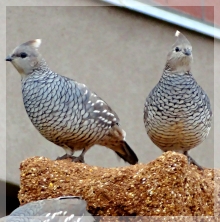
quailFowlers are professional bird catchers. In ancient Israel, they supplied the market with wild pigeons and doves destined for sacrifice, small birds (like quail) for food, and doves and other birds for caged pets. Since most of us get our poultry at the grocery, we’re probably unfamiliar with the fowler and his methods. To capture birds, fowlers spread nets or set traps and snares on the ground, camouflage them with natural materials, and cover them with grain. Tempted by the food, the birds leave the safety of the sky and come down to the ground where they are caught.

The fowler studies his prey’s behavior to find the best way to trap it. He wouldn’t hunt for a heron in the middle of a forest as he would for a dove, bait an eagle’s snare with seeds as he would for a sparrow, or use ground level noose traps for swifts as he might for quail. Sometimes the fowler used decoys by taking young birds from their nest and raising them by hand. Once tame, they were confined in hidden cages so that their voices would call others of their kind to the spot where they’d be trapped or killed. Knowing this about the fowler and his snares or traps, we can see why they frequently were used metaphorically in Scripture and likened to Satan. The enemy was the fowler, his schemes were the fowler’s methods and snares, and people were the silly birds with neither sense nor strength enough to escape the fowler’s snare.

When the prophet Amos asked, “Does a bird land in a trap on the ground if there is no bait for it?” [3:5] he wasn’t speaking of sunflower seeds and sparrows; he was speaking of the bait Satan uses in his snares. Each of us is tempted by different things—it could be pride and resentment for one person and gambling and anger for another. Whether it’s selfishness, wealth, hypocrisy, appetite, indolence, lust, envy, or something else, Satan knows what appeals to each of us and his traps will be placed and baited accordingly. Like the fowler’s bait, the lure Satan uses promises pleasure but delivers disaster! After all, a few bits of millet is all the trapped quail gets before it ends up as someone’s dinner!

Just as the fowler knows, “It is useless to spread a net where any bird can see it,” [Prov. 1:17], Satan’s snares don’t look like the traps they are! Few of us would deliberately step into a “den of iniquity” but things aren’t always what they seem. Like the fowler, Satan uses decoys to bring others into his snare. The influence of the pagans remaining in Canaan became a “snare and a trap” for Israel just as bad examples, friends, acquaintances, influencers, or associates can lure us into Satan’s snare.

The fowler doesn’t stand by his traps and shout out his plans and neither does Satan. Like the fowler, he uses trickery, deceit, distraction, and disguise to keep his prey from realizing the danger. We, however, are far smarter than little birds and God has not left us defenseless. Satan may be laying traps, but we don’t have to be his prey. Along with God’s word to light our way, we have God’s protection and the power of His Holy Spirit—when we’re dwelling in the “shelter of the Most High,” our “Maker’s care” will keep us “from the fowler’s snare.”

He that hath made his refuge God Shall find a most secure abode,
Shall walk all day beneath his shade, And there at night shall rest his head.
Then will I say, “My God, thy power Shall be my fortress and my tower;
I, that am formed of feeble dust, Make thine almighty arm my trust.”
Thrice happy man! thy Maker’s care Shall keep thee from the fowler’s snare;
Satan, the fowler, who betrays Unguarded souls a thousand ways. [Isaac Watts]

He who dwells in the shelter of the Most High will abide in the shadow of the Almighty. I will say to the Lord, “My refuge and my fortress, my God, in whom I trust.” For he will deliver you from the snare of the fowler and from the deadly pestilence. He will cover you with his pinions, and under his wings you will find refuge; his faithfulness is a shield and buckler. [Psalm 91:1-4 (ESV)]

Copyright ©2026 jsjdevotions. All rights reserved.

FALSE GODS

By now I could have lifted my hand and struck you and your people with a plague to wipe you off the face of the earth. But I have spared you for a purpose—to show you my power and to spread my fame throughout the earth. [Exodus 9:15-16 (NLT)]

SobeckOver a period of 3,000 years, ancient Egypt’s pantheon of gods numbered between 1,400 and 2,000. During that time, some faded in prominence and new gods appeared. Often depicted as part human and part animal, Egypt’s gods had names, unique back-stories, and their own domain and expertise. Each god/goddess was responsible for a certain part of daily life, from motherhood to music, record keeping to funerals, and cosmic order to hunting. While the ten plagues God sent Egypt through Moses and Aaron may seem somewhat arbitrary to us in the 21st century, every one of them was a direct attack on one or more Egyptian god. They were the ultimate “smack-down” between God Almighty and Egypt’s deities.

When Moses struck the water of the Nile and turned it into blood for seven days, it was a direct attack on the crocodile-headed Sobeck, whose job was to be the Nile’s protector, as well as Khnum, the god of water and life, who was to guard the river’s source. The fouled river also was an affront to Osiris whose bloodstream was said to be the Nile. The plague of frogs who came up from the Nile and into people’s homes challenged the frog-headed goddess Heget who was in charge of regeneration, rebirth, and fertility. Aaron striking the dust of the earth to make gnats/fleas/lice immediately appear that covered both man and beast was a direct attack on Geb/Seb/Keb, the god of the earth and soil. The fourth plague, teems of flies or biting insects filling the air, challenged the power of Shu, the Egyptian god of air, and brought shame to any insect-headed god like Khepri whose head was that of a scarab beetle. With this affliction and the ones that followed, God distinguished between Egypt and the people of Israel. Remaining unaffected by the plagues, the people of Israel did not suffer these annoyances and hardships! While the God of Israel protected His people from the flies, Shu and Khepri couldn’t protect theirs!

The plagues intensified with the fifth plague, a deadly disease affecting cattle and livestock. The deaths of Egypt’s cattle was an insult to Apsis, the god of fertility (often represented as a bull) and the cow-headed Hathor, the goddess of love and protection. The punishment continued when ashes tossed by Moses became festering boils on both man and beast. This was the first direct strike on Egypt’s people and skin diseases and boils were seen as a sign of divine displeasure or judgment. Both Sekhmet, the goddess with power over disease, and Isis, goddess of healing, were helpless in the face of this challenge. The punishments increased with a devastating hail storm and continuous lightning, an attack on Seth/Set (god of wind and storms), Nut (goddess of the sky), and Osiris, the crop fertility god. The assault on those deities continued with the eighth plague, an east wind that blew in swarms of locusts. The false gods couldn’t prevent the locusts from consuming any vegetation that survived the hail storm.

The ninth punishment brought three days of complete darkness to the Egyptians. The most worshipped god in Egypt was the sun god Ra/Re, but both he and Kepri, the god of the dawn, were powerless in the face of Israel’s God. The final plague was death to the firstborn of both man and beast. Even Pharaoh’s son, believed to be a divine birth, died. These deaths challenged the power and authority of Isis and Osiris, the protectors of life, as well as Pharaoh, the god-king believed to be the son of Ra.

Revealing them as the powerless worthless idols they were, each of the plagues challenged, defeated, and shamed the false gods of Egypt. The God of Israel proved Himself to be the one true God—sovereign and superior in all aspects. While directed at Egypt, this message of Jehovah’s supremacy also was meant for the people of Israel as well as the rest of the world.

There is no need to go to heathen lands to find false gods. We can find them right here in our own country (and possibly in our own homes). Anything that gets between us and God is a false god and no more worthy of our devotion and worship than were Ra, Osiris, or Sekhmet. That we don’t depend on Seth to protect us from storms or bow down before statues of the bull-headed Apsis doesn’t mean we’re not guilty of idolatry! Nowadays, we worship the far more subtle false gods of the 21st century—things like wealth, power, influence, property, fame, pleasure, beauty, popularity, education, comfort, science, sex, money, and self. Never forget that our false gods will fail to serve and save us just as easily as Egypt’s false gods failed them!

What each one honors before all else, what before all things he admires and loves, this for him is God. [Origen]

Think about the things of heaven, not the things of earth. For you died to this life, and your real life is hidden with Christ in God. And when Christ, who is your life, is revealed to the whole world, you will share in all his glory. So put to death the sinful, earthly things lurking within you. Have nothing to do with sexual immorality, impurity, lust, and evil desires. Don’t be greedy, for a greedy person is an idolater, worshiping the things of this world. [Colossians 3:2-5 (NLT)]

Copyright ©2026 jsjdevotions. All rights reserved.

CONFIRMATION

So Balak…sent messengers to Balaam the son of Beor at Pethor, which is near the River in the land of the people of Amaw, to call him, saying, “Behold, a people has come out of Egypt. They cover the face of the earth, and they are dwelling opposite me. Come now, curse this people for me.” [Numbers 22:4b-6a (ESV)]

BalaamWhen reading the narratives of the Old Testament, it’s tempting to think that some of the stories are more legend than history. Take the story of Balaam, the pagan prophet hired by King Balak to curse the Israelites, who ended up blessing the Israel and pronouncing disaster on its enemies. Since this took place around 1407 BC, it’s easy to question the story’s accuracy. Balaam’s existence, however, has extra-biblical non-Israelite confirmation.

Over 2,800 years ago, the story of Balaam, “a divine seer,” who pronounced doom to his own people, was written in red and black ink on the plaster wall of a building in the ancient city of Deir ‘Alla in present day Jordan (about 25 miles from where the incident recorded in Numbers 21 took place). The building collapsed as the result of an earthquake around 760 BC (an event referenced in the books of Amos and Zechariah). In 1967, 119 fragments of Balaam’s story were found in the building’s rubble. Probably written about 800 BC, the text begins with the title, “Warnings from the Book of Balaam the son of Beor. He was a seer of the gods.” It continues with, “The misfortunes of the book of Balaam son of Beor. A divine seer was he.” Two more times in the first four lines, the prophet is referred to as “the son of Beor” just as he is in the Hebrew Bible. Referencing “the Book of Balaam” indicates that the wall’s words were copied from an earlier text and that the original material was older than the writing on the wall. While the Deir ‘Alla story mentions pagan gods, the God whose visit caused the prophet to weep bitterly is referred to as “El Shaddai,” which is how the God of Israel was referenced during this time.

The wall’s text tells us that Balaam was well known as a “cursing prophet” and much of the Deir ‘Alla text is given to the prophet’s many curses. These ancient wall fragments help explain why King Balak’s representatives traveled 400 miles to hire Balaam to curse the Israelites. Although the story on the wall, with its mention of other gods and goddesses, doesn’t exactly match the version in Numbers, one would expect a pagan people to put their slant on it and, with only a portion of the wall existing, we have only part of the story. Nevertheless, we know Balaam did exist.

When archeologists wondered why Balaam’s book would be written on the wall of a building in Deir ‘Alla, their answer was found in eleven clay tablets found in the same area. Dating from 1200 BC or earlier (the time of Balaam), they identify Deir ‘Alla as Pethor (Balaam’s home in the Hebrew Scriptures) and speak of the “smiters of Pethor.” If this “divine seer” lived in what is now Deir ‘Alla, it is not surprising that his story would be preserved in his hometown. While these fragments of wall and tablets don’t prove Balaam’s story in Numbers, they certainly back it up. However, there is no doubt that Balaam existed; he was a real prophet, well-known for casting curses, who lived on the east side of the Jordan, and was revered for centuries after his death.

While more ancient artifacts are being discovered every year, archeology is based on what’s been left behind, discovered, and deciphered. Many pieces are missing in the puzzle and the fragmentary nature of archeological evidence makes it impossible to recreate the Middle East’s complete history. Fortunately, we don’t need every biblical event to be confirmed by archeology because we accept the Bible as the Word of God. Scripture doesn’t need proof because it comes with the authority of God; saying archeology proves the Bible gives it more authority than that given to Scripture. Let us remember that, long before there were archeologists, Jesus accepted Scripture’s authority, cited it frequently, and attributed its words directly to God. If it was good enough for Jesus, it should be good enough for us!

Nevertheless, as time goes on and bits and pieces of ancient history are discovered and analyzed, we find that archeology continues to support the Bible. Extra-biblical evidence for Scripture’s people, places, and events continue to be found and verified. Archeological findings like those at Deir ‘Alla pose a problem for skeptics who’d prefer to think of the exodus, Israel’s wilderness wanderings, and the conquest of Canaan as things of legend. Since there is extra-biblical verification that Balaam was real, they should be cautious of dismissing other people like Balak, Moses, Aaron, Joshua, and the Israelites! Who knows what archeological treasures are hidden under the feet of those who walk in the Holy Land today?

Every word of God proves true; he is a shield to those who take refuge in him. [Proverbs 30:5 (ESV)]

Copyright ©2026 jsjdevotions. All rights reserved.

STAY ALERT!

When the devil had finished tempting Jesus, he left him until the next opportunity came. [Luke 4:13 (NLT)]

bearWhile I expected bear sightings when we lived in the mountains of Colorado, I never expected a bear to find its way into our Florida community and scavenge in a neighbor’s trash bin on her driveway! While bears generally prefer natural foods like berries and nuts, as civilization encroaches on their habitat, those foods are becoming less abundant. Driven by their need to eat, bears will go where they can find any food. With a sense of smell that is seven times greater than a bloodhound’s, it’s estimated they can smell a food source from as far away as 20 miles. Opportunistic creatures, they take advantage of whatever is easily available, whether bird seed, pet food, barbecue grills, or garbage.

Tenacious and intelligent animals, bears will spend hours solving a problem if food is involved but, since they lack opposable thumbs, bears couldn’t open the lock on our community’s “bear-proof” dumpster in Colorado. At the time, however, the doors on Subarus didn’t require thumbs to open and the hungry bears in our Colorado town eventually learned how to open the doors of unlocked Subarus. After that, no unlocked Subaru in town was safe from a bear! Once a bear gets inside a car, the door often closes and traps it. By the time the imprisoned angry animal manages to make an exit, the car’s interior is wrecked and the bear has done what it usually does in the woods! Nevertheless, just as people often forgot to latch our dumpster, some people still left their cars unlocked!

Satan is as opportunistic and tenacious as any black bear and, if we let him, he can leave our lives even more messed up than a bear does a Subaru. Rather than sniffing out the aroma of a garbage can or a candy bar on the dash, he has an uncanny way of sniffing out our vulnerabilities and spotting our weaknesses. Think of the story of Job. When Satan couldn’t get him to curse God by taking his wealth and livestock, servants, herdsmen, workers, and children, he came back and took the man’s health. Although Job never cursed God, he lost perspective and cursed the day he was born. As determined and unwilling to admit defeat as a black bear, Satan probably was behind the words of condemnation spoken by Job’s wife and friends. Like a hungry bear, the enemy does not give up easily. When the devil failed to tempt Jesus in the wilderness, he departed “until the next opportunity.” Like the Terminator and hungry bears, Satan will be back.

Just as storing garbage inside, latching bear-proof dumpsters, and locking car doors is a way to prevent bear problems, being aware of our vulnerabilities is a way of protecting us from Satan’s attacks. Recovery programs often use the acronym H-A-L-T as a reminder. Standing for Hungry, Angry, Lonely, and Tired, these feelings make us susceptible to Satan. While we often think of hunger as that grumble in our tummies, it is more. Hunger is dissatisfaction, frustration, a desire for something more or different and often has nothing to do with food. Anger isn’t just being mad at someone. Anger is holding on to unforgiveness, hostility, and resentment, and often includes casting blame. While lonely seems self-explanatory, we don’t have to be alone to be lonely. Even when surrounded by people, we can feel isolated, unappreciated, deserted, and desolate. Being tired can be physical exhaustion, but it’s also apathy, feeling drained by circumstances (or people), or wanting to abandon both hope and effort.

Being aware of these feelings when they arise helps us take extra precautions to protect ourselves. Instead of locking our dumpsters and cars, we redouble our efforts to study God’s Word, pray, worship with praise, offer thanks, gather in Christian fellowship, or even seek Christian counseling. When we leave ourselves vulnerable with hunger, anger, loneliness, or tiredness, we’re little safer from the enemy’s attack than people who keep their food in their tents when camping, store their garbage outside, don’t lock their Subarus, or fail to latch bear-proof dumpsters. Whether from bears or Satan, we’re just asking for trouble.

Satan loves to fish in the troubled waters of a discontented heart. [Thomas Watson]

Stay alert! Watch out for your great enemy, the devil. He prowls around like a roaring lion, looking for someone to devour. Stand firm against him, and be strong in your faith. [1 Peter 5:8-9 (NLT)]

But the Lord is faithful; he will strengthen you and guard you from the evil one. [2 Thessalonians 3:3 (NLT)]

Copyright ©2026 jsjdevotions. All rights reserved.

THE PUPPET KING (Part 2)

Joash did what was pleasing in the Lord’s sight throughout the lifetime of Jehoiada the priest. … But after Jehoiada’s death, the leaders of Judah came and bowed before King Joash and persuaded him to listen to their advice. [2 Chronicles 24: 2,17 (NLT)]

binding hempvineEarlier this week, I wrote of the Levites’ failure to protect Judah from idolatry but one Levite stands out in his loyalty to God and commitment to the temple: Jehoiada the priest. When Judah’s King Ahaziah died, his mother, Queen Athaliah seized Judah’s throne. The daughter of Ahab and Jezebel, she was as evil as her parents and tried to kill all of her son’s heirs. Unknown to her, Ahaziah’s infant son Joash was hidden by his aunt and survived. Raised by the high priest Jehoiada, the boy’s existence was kept secret while the priest plotted to put him on the throne. When the boy was seven, Jehoiada made a pact with five army commanders who covertly travelled throughout Judah to summon the Levites and leaders to a meeting at the Temple.

At that meeting, Jehoiada declared that the king’s son should reign. Once he introduced Joash, the rightful heir, the men planned to depose his wicked Athaliah. As they guarded the child, he was anointed and the crown placed on his head. After presenting him with a copy of the law, Joash was proclaimed king, Queen Athaliah was slain, the temple of Baal demolished, and its pagan priests killed.

With this successful rebellion, Jehoiada led the people and the new king in rededicating themselves to the Lord. The temple was restored, the priests and Levites again followed David’s instructions, and the gatekeepers returned to the temple. Unfortunately, after Jehoiada’s death, Joash made the same mistake his ancestor Rehoboam did—the young king listened to the wrong people and followed bad advice. The nation returned to idolatry, the temple fell into disrepair, and the temple’s treasures were used to pay tribute to the King of Aram. As the Chronicler wrote: “Because of this sin, divine anger fell on Judah and Jerusalem.” [24:18] The Lord’s judgment took the form of an invasion by the Arameans.

Sadly, even though the Judeans cleaned the temple of idols, they never scoured the idolatry from their hearts and the story only gets worse. The Lord sent prophets advising Judah to repent but they wouldn’t listen. Then, when Jehoiada’s son, Zechariah, prophesized that they were headed for destruction, Joash added murder and desecration of the temple to his sins. He had the son of the priest who saved his life stoned to death in the temple courtyard. Later, during battle with the Arameans, Joash was wounded, but his wounds were not what killed him. He died at the hands of his servants in retaliation for the murder of Jehoiada’s son, Zechariah.

Joash was a puppet king and only as good as his advisors. He may have held the book of law in his hands but he never placed it in his heart. As a result, Joash was dependent on man’s word rather than God’s. Let us learn from this story and take our advice from God rather than man.

Oh, the joys of those who do not follow the advice of the wicked, or stand around with sinners, or join in with mockers. But they delight in the law of the Lord, meditating on it day and night. They are like trees planted along the riverbank, bearing fruit each season. Their leaves never wither, and they prosper in all they do. [Psalm 1:1-3 (NLT)]

But the wisdom from above is first of all pure. It is also peace loving, gentle at all times, and willing to yield to others. It is full of mercy and the fruit of good deeds. It shows no favoritism and is always sincere. [James 3:17 (NLT)]

Copyright ©2025 jsjdevotions. All rights reserved.