GOING “ALL-IN”

My dear family, I don’t reckon that I have yet overtaken it. But this is my one aim: to forget everything that’s behind, and to strain every nerve to go after what’s ahead. I mean to chase on towards the finishing post, where the prize waiting for me is the upward call of God in King Jesus. [Philippians 3:13-14 (NTE)]

dolphinJeopardy contestant James Holzhauer became known for his 32-game winning streak, massive winnings, and his “all-in” hand gesture while putting all of his winnings on the line when answering a Daily Double. A new champion is in the making with Ph.D. student Matt Amodio. Like Holzhauer, he plays an aggressive game and is not timid when it comes to the Daily Double. Last Wednesday, after saying “all-in,” he wagered his entire holdings of $8,000 and lost it all; undeterred by the previous night’s Daily Double loss, he again went “all-in” with a $10,400 wager the next day. His willingness to go “all-in” has paid off handsomely and, by the end of the week, he’d won 28 games and amassed $1,004,001.

Seeing both Holzhauer and Amodio fearlessly go “all-in” when it comes to game show winnings, I wondered if we’re as fearless when it comes to going “all-in” when it comes to God. Showing tremendous confidence in their intelligence and knowledge of trivia, neither contestant allowed previous set-backs to keep them from their purpose. Granted, their goal was to amass as much money as possible yet I question whether we’re as confident in God and as determined in our purpose to serve him faithfully. Are we “all-in” when it comes to following Jesus?

Scripture’s heroes are people who went “all-in” – not with their money but with their lives. Noah was “all-in” when he built the ark on dry land, Jochebed was all-in when she placed the infant Moses in a basket and placed him on the bank of the Nile, and Abraham went “all-in” when he left his homeland, packed up his possessions, and set off to parts unknown. The unmarried Mary wasn’t so naïve that she didn’t know the risks of her choice, but she went “all-in” when she chose to become pregnant through the Holy Spirit. Think of John and James who went “all-in” when they left their father and fishing boat or Matthew who left his lucrative tax collector job. Peter went “all-in” when he stepped out of the boat to walk on water, the woman with the bleeding disorder was “all-in” when she ventured into the crowd to touch Jesus, and the unnamed woman was “all-in” when she anointed Jesus’ feet and hair with her tears and costly jar of fragrant oil. The poor widow was “all-in” when she dropped two small coins in the collection box, Stephen was “all-in” when he continued to preach the gospel as stones rained down on him, Barnabas went “all-in” when he sold his land and gave the proceeds to the church, and Peter and John were “all-in” when they defied the authorities and continued to boldly proclaim the gospel. Like Holzhauer and Amodio, they took risks with no guarantee of success but, unlike those game show contestants, they didn’t do it for themselves; they did it for God. It wasn’t an earthly prize they sought; it was a heavenly one!

Think of the rich young ruler who, although he wanted to know Jesus, was reluctant to surrender to Him. Unwilling to go “all-in,” he walked away from the Lord and missed an eternal relationship with God! What about us? Are we “all-in” when it comes to Jesus? With His words that we are to “Love the Lord your God with all your heart, all your soul, and all your mind,” Jesus is telling us that we are to go “all-in” all of the time. Do we?

He then spoke to them all. “If any of you want to come after me,” he said, “you must say No to yourselves, and pick up your cross every day, and follow me. If you want to save your life, you’ll lose it; but if you lose your life because of me, you’ll save it. What good will it do you if you win the entire world, but lose or forfeit your own self? … “Nobody,” replied Jesus, “who begins to plough and then looks over his shoulder is fit for God’s kingdom.”  [Luke 9:23-25,62 (NTE)]

Copyright ©2021 jsjdevotions. All rights reserved.

 

FARMA – Part 3

The kingdom of heaven may be compared to a man who sowed good seed in his field, but while his men were sleeping, his enemy came and sowed weeds among the wheat and went away. So when the plants came up and bore grain, then the weeds appeared also. And the servants of the master of the house came and said to him, “Master, did you not sow good seed in your field? How then does it have weeds?” He said to them, “An enemy has done this.” [Matthew 13:24-28 (ESV)]

sunflowerWhile we usually reap what we sow, we also can receive unexpected and undeserved harvests! When we lived in the north, courtesy of God and nature, wildflower seeds took root in the field next to our house and Spiderwort, Sunflowers, Dame’s Rocket, and Wild Bergamot grew there without any effort on my part. Although I hadn’t sowed them, I never protested those beautiful wildflowers; I just thanked God for them. None of us are likely to complain to God about the many undeserved blessings He regularly bestows on us!
While we certainly don’t object when we get a harvest of blossoms, we’re sure to protest when we receive an unexpected (and seemingly undeserved) harvest of life’s thistles. Like the farmer who sowed high-quality seeds only to discover weeds growing in his field, we were distressed the year we discovered our beautiful field of wildflowers had been invaded by thistles. Although we hadn’t planted the invasive weeds, the unwelcome thistles were there!

Shortly before his eviction from Eden, Adam was told that the ground would yield thistles and thorns along with grain. That warning was both literal and figurative. Satan will spread his seeds wherever and whenever the opportunity arises and the enemy’s seeds of evil can invade people’s lives no matter how many good seeds they’ve sown. We can sow the seeds of love and fidelity but still be betrayed by an unfaithful spouse, we can work carefully and industriously but get downsized, we can drive cautiously and courteously but get hit by a drunk driver, and, even though we pray for and love our enemy, he may continue to hate us!

While we should expect more of the same when we sow thistle seeds, we’re perplexed when we’ve sown seeds of righteousness and get things like misfortune, difficulty, suffering, or loss. That’s the enemy assaulting us and we can’t allow his seeds of hatred, anger, resentment, doubt, or violence to take root in our hearts. Rather than wonder why, our job is simply to faithfully tend our fields and keep sowing seeds of righteousness. When the time is right, God will take care of the weeds and we’ll be part of a wonderful harvest.

If I ask, “Why me?” about my troubles, I would have to ask, “Why me?” about my blessings. … I take the good with the bad, and I try to face them both with as much calm and dignity as I can muster. [Arthur Ashe]

Therefore, my beloved brothers, be steadfast, immovable, always abounding in the work of the Lord, knowing that in the Lord your labor is not in vain. [1 Corinthians 15:58 (ESV)]

Copyright ©2021 jsjdevotions. All rights reserved.

BUYING A FIELD

See how the siege ramps have been built against the city walls! Through war, famine, and disease, the city will be handed over to the Babylonians, who will conquer it. Everything has happened just as you said.  And yet O Sovereign LORD, you have told me to buy the field—paying good money for it before these witnesses—even though the city will soon be handed over to the Babylonians. Then this message came to Jeremiah from the Lord: “I am the Lord, the God of all the peoples of the world. Is anything too hard for me? [Jeremiah 32:24-27 (NLT)]

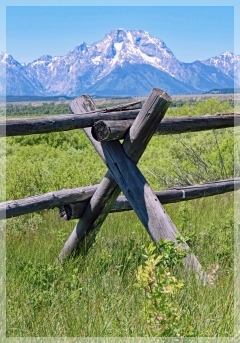
grand tetons - jackson holeUnder siege for nearly a year, Jerusalem was surrounded by the Babylonians, and Judah’s future looked grim. Whether it was poverty or the desire to get rid of property that soon would be worthless once Babylon invaded, Hanamel decided to sell his land in Anathoth, about three miles from Jerusalem. Under Israelite law, property was supposed to stay within a family and so Hanamel offered it to his cousin, the prophet Jeremiah.

Since Anathoth already was under Babylonian control, Hanamel’s real estate deal would be like being offered property in Kabul, Afghanistan. While real estate often is considered a good investment, purchasing property in an active war zone or occupied territory is not. Nevertheless, even though Jeremiah was imprisoned in the palace courtyard and the nation’s defeat was inevitable, God instructed him to become the property’s redeemer by purchasing his cousin’s land.

Having prophesied the fall of Judah, the destruction of Jerusalem, Zedekiah’s imprisonment, and the Jews’ captivity, Jeremiah knew how worthless the land was. Although he lawfully could refuse to purchase it, the prophet paid his cousin 17 shekels (about 18-months’ wages) for the land which, considering the circumstances, seems a sizeable sum for land he’d never live to enjoy. Assuring his scribe Baruch that the worthless land again would have value, he told him to take the deeds, place them in a clay jar (the ancient version of a safety deposit box), and preserve them in a safe place, The prophet then passed along God’s hopeful words to all those who witnessed the transaction in the courtyard: “Someday people will again own property here in this land and will buy and sell houses and vineyards and fields.”

Along with his prophecies of Jerusalem’s ruin, Judah’s defeat, and the people’s captivity, Jeremiah had prophesied God’s eventual restoration of the people to their land. He didn’t buy the land because Judah wouldn’t be conquered; he purchased it because it would! The prophet was putting his money where his mouth was. His purchase of a worthless piece of acreage was an act of faith. It was a sign of hope for the future by the man who’d prophesied doom and gloom—a powerful demonstration of his belief in God’s promise that the land would again have value and belong to the Jews.

If we want to see the fulfillment of God’s promises to us, like Jeremiah, we must be obedient to God’s commands, no matter how difficult, confusing, or absurd they seem to be. In the face of obstacles, hardship, or overwhelming odds, we must demonstrate our faith and hope in God because faith and obedience go hand in hand. If we say we believe His promises, we must act as if we truly do! May we always remember that nothing is too hard for the Lord!

I will certainly bring my people back again from all the countries where I will scatter them in my fury. I will bring them back to this very city and let them live in peace and safety. They will be my people, and I will be their God. And I will give them one heart and one purpose: to worship me forever, for their own good and for the good of all their descendants. And I will make an everlasting covenant with them: I will never stop doing good for them. I will put a desire in their hearts to worship me, and they will never leave me. I will find joy doing good for them and will faithfully and wholeheartedly replant them in this land. [Jeremiah 32:37-41 (NLT)]

Copyright ©2021 jsjdevotions. All rights reserved.

LOVE CASTS OUT FEAR

dragonflyWhen all the people in the synagogue heard these things, they became very angry. They got up, forced Jesus out of town, and took him to the edge of the cliff on which the town was built. They planned to throw him off the edge, but Jesus walked through the crowd and went on his way. [Luke 4:28-30 (NCV)]

For love to be real, for it to grow deep inside, it must not give in to fear. It is not afraid to give, to risk, to chance, even if it hurts. Love believes. It is faith moving forward. Fear holds us back. It makes us stop or turn and run. [Chris Fabry]

While writing yesterday’s devotion about selfishness being the opposite of love, I found several authors who suggested that fear is the opposite of love. This gave me pause; can something be the opposite of more than one thing?

From day one, when Mary and Joseph fled with Him to Egypt, Jesus had plenty of reasons to be fearful and yet fear never prevented Him from speaking, healing, pointing out hypocrisy and evil, or going to the cross. He didn’t give in to fear when, after speaking of God’s grace to Gentiles, the people of His own hometown tried to force him off a cliff. Angry mobs, religious leaders, and Rome never intimidated Jesus or kept Him from challenging the corrupt political and religious system of His day. He knew a warrant was issued for His arrest and that the cross awaited Him in Jerusalem but fear didn’t stop Jesus from boldly riding into the city while being hailed as a king. He knew Judas would betray Him and yet the Lord shared His last meal with him. Jesus didn’t plead for mercy or justice at his trial and His last words weren’t ones of fear or selfishness; they were words of loving forgiveness. Nothing Jesus said or did speaks of fear but everything He said and did speaks of love.

Afraid of commitment, rejection, manipulation, the opinions of others, insufficiency, injury, ineptitude, failure, or that there won’t be enough left over for us, we don’t love. Afraid of being vulnerable, we protect ourselves by not getting involved, not going all-out, not sharing, and not caring. So, like the priest and Levite in the Good Samaritan parable, we walk away, keep to ourselves and our interests, pretend we don’t notice, or make excuses.

Fear happens when we look at ourselves rather than trust in God. Perhaps fear and selfishness are two sides of the same coin. When we’re fearful, we become selfish and, when we’re selfish, it’s likely we’re afraid of something or someone. Love, however, is the antidote to both afflictions. God is love and where God’s love is, there is neither selfishness nor fear.

The call of Jesus is a call to take heart, to have courage, to stand tall in the name of love. The daily invitation that the risen Christ extends to us is to be a people who refuse, in love, to step to the tune of fear. [Bishop Robert O’Neill]

Where God’s love is, there is no fear, because God’s perfect love drives out fear. It is punishment that makes a person fear, so love is not made perfect in the person who fears. [1 John 4:18 (NCV)]

God did not give us a spirit that makes us afraid but a spirit of power and love and self-control. [2 Timothy 1:7 (NCV)]

Copyright ©2021 jsjdevotions. All rights reserved.

TOO HEAVY

My thoughts are nothing like your thoughts,” says the Lord. “And my ways are far beyond anything you could imagine. For just as the heavens are higher than the earth, so my ways are higher than your ways and my thoughts higher than your thoughts. [Isaiah 55:8-9 (NLT)]

mockingbirdAfter Jane Marczweski’s stunning performance on America’s Got Talent last June, I posted a devotion (It’s Okay) about her. Known as Nightbirde, the 30-year-old vocalist (and three-time cancer survivor) sang an original song called “It’s Okay” and received the “golden buzzer” from judge Simon Cowell. Last week, the brave young woman had to withdraw from the competition because her health has taken a turn for the worse. In an interview on CNN with Chris Cuomo, she shared that her metastatic breast cancer has now invaded both lungs and liver and her fight with cancer is demanding all of her energy and attention.

When we see a young person like Nightbirde, a beautiful person both inside and out who seems so deserving of good future, it’s easy to ask the age-old question of “Why?” Why do some of the best people, the ones with the most to offer, seem to suffer the most or have their futures cut short when many of the worst and worthless seem to breeze along without a problem? Why, when life begins to look up does God so often pull out the rug? “Life doesn’t always give breaks to those that deserve it,” said the singer while adding, “but we knew that already.” Indeed, we did; nevertheless, we don’t like it!

When Cuomo asked Nightbirde if she ever wonders, “Why?” the young woman replied, “I try not to occupy myself with questions that are too big for myself to answer. It’s a waste of time. You know, just because it’s a mystery doesn’t mean it’s the absence of meaning. Sometimes, the mystery means there is more meaning there than we can even understand and so I accept that and I let go of the question because it’s too heavy.”

Indeed, much in our lives seems inexplicable and far beyond our comprehension. But, as the young singer pointed out, incomprehensible or unknowable doesn’t mean meaningless or pointless. It’s a mystery why Nightbirde’s promising future probably will be cut short; then again, it’s a mystery why my mother died when I was fifteen, why my brother was struck with inoperable cancer at the moment his life finally took an upturn after years of trouble, and why the God-fearing believers on my prayer list have been burdened with things like mesothelioma, Alzheimer’s, Parkinson’s, MS, schizophrenia, and chronic pain. This young woman’s words remind us all that our lack of understanding of God’s purpose doesn’t mean that what happens is without meaning.

I can’t understand quantum physics any more than I can understand the ways of God. The difference between the two is that, given enough time, effort, and tutoring, I eventually could understand quantum physics but I will never be able to fully understand God. While we can come to know and love Him, we never will be able to comprehend His mysterious ways. Indeed, some questions are so weighty that we’d never make sense of God’s answer even if He explained it to us!

This optimistic young woman says she’s planning for her future rather than her legacy and says, “I want to be the bird that sings in anticipation of the good things that I trust are coming.” As a Christian, Nightbirde doesn’t need to ask God “Why?” because she knows good things are coming, whether in this world or the next!

Oh, how great are God’s riches and wisdom and knowledge! How impossible it is for us to understand his decisions and his ways! For who can know the Lord’s thoughts? Who knows enough to give him advice? And who has given him so much that he needs to pay it back? For everything comes from him and exists by his power and is intended for his glory. All glory to him forever! Amen. [Romans 11:33-36 (NLT)]

Copyright ©2021 jsjdevotions. All rights reserved.

FAITHFUL AND ABLE

God is not a man, so he does not lie. He is not human, so he does not change his mind. Has he ever spoken and failed to act? Has he ever promised and not carried it through? [Numbers 23:19 (NLT)]

 I will look up for there is none above you;
I will bow down to tell you that I need you.
Jesus, Lord of all; Jesus, Lord of all!
I will look back and see that you are faithful;
I look ahead believing you are able.
Jesus, Lord of all; Jesus, Lord of All!
[I Will Look Up (Redman, Ingram, Joye, Brown, Brock)]

columbineIn our family, the car’s driver controls the music. Since my husband usually drives, that tends to be ‘50s and ‘60s rock. My thrice weekly chiropractor appointments, however, have given me the opportunity to listen to worship music rather than golden oldies. Last week, while alone in the car, I joined with Elevation Worship as they sang of laying the worries of the world, the needs of their loved ones, their hopes and dreams, and every anxious thought at God’s feet. “I will look back and see that you are faithful; I look ahead believing you are able!” Those words are so true and yet I frequently forget to look back to God’s past provision or ahead with trust that He is able to provide exactly what is needed.

Singing, “All my life is in your hands,” I wondered if we truly believe that. After laying our worries at His feet, do we ever doubt His faithfulness and ability, pick them up, and take them back again? Do we have reservations about our incredibly faithful and overwhelmingly able God because we know how fallible and incompetent we often are? My life is filled with a series of mishaps, misunderstandings, and failures and I suspect yours is, too. We misplace our phones and have to call ourselves to find them. We read the words “dry clean only” but toss the sweater into the washer. We proof-read a dozen times only to find mistakes in the finished product and write grocery lists but leave them at home. We miss appointments, arrive late, and don’t return calls. We mean to do a task but forget and often claim to know what we’re doing when we haven’t a clue. We promise but disappoint, plan but fail to carry out, and our repairs frequently make the problem worse. We say we’ll pray for someone and don’t, intend to write a letter but never get around to it, or get exasperated when we mean to be calm. That’s not even mentioning the other assorted betrayals, deceit, debacles, and transgressions of which we’re all capable. Knowing how incredibly unreliable and faithless we can be, we often doubt God. God, however, is perfect—we, most certainly, are not!

Hearing the words, “I will look back and see He is faithful,” I did just that. I looked back and saw God’s faithfulness to me in every crisis and dark valley I’ve encountered. From Genesis through Revelation, we see God’s faithfulness to His children and, in the life, death, and resurrection of Jesus we see His promises fulfilled. Flawed beings that we are, we’re often unfaithful to our promises or unable to fulfill them but our perfect God is both faithful to His promises and more than able to fulfill every one! Although I’ve failed the ones I love and, at times, they’ve failed me, God never has and never will!

Understand, therefore, that the Lord your God is indeed God. He is the faithful God who keeps his covenant for a thousand generations and lavishes his unfailing love on those who love him and obey his commands. [Deuteronomy 7:9 (NLT)]

Your eternal word, O Lord, stands firm in heaven. Your faithfulness extends to every generation, as enduring as the earth you created. [Psalm 119:89-90 (NLT)]

Copyright ©2021 jsjdevotions. All rights reserved.