
…for the Lord God had not made it rain on the land, and there was no man to work the ground. But mist would come up from the earth and water all the ground. Then the Lord God formed the man out of the dust from the ground and breathed the breath of life into his nostrils, and the man became a living being. [Genesis 2:5-7 (CSB)]
 Earlier this week, I compared a fictional 21st century Noah with the original ark builder. Although I was told there had been no rain on earth before the Flood, since I hadn’t read it myself, I wanted to make sure before writing it. As it turns out, there is no clear decisive answer to whether or not there was rain before Noah’s day so I didn’t mention it at all.
Those who claim it never rained before the Flood occurred cite verses from Genesis and Hebrews to support their position. Genesis 2:5-7 tells us a mist covering the land watered the ground before the advent of mankind. Since rain isn’t mentioned again until Genesis 7:4 when God tells Noah He will make it rain, they assume the mist covered the earth until that time.
On the other hand, mist watering the earth prior to Adam doesn’t necessarily mean this canopy of water continued when Adam and Eve were banished from Eden. After the fall, things on earth changed radically—pain and death were introduced, the ground was cursed, and man had to toil to have food to eat. That neither rain nor drought are mentioned doesn’t necessarily mean they didn’t exist after the fall. It’s quite possible that the physical processes of water evaporation, cloud formation, and precipitation that recycle the world’s water supply today existed at the time of Noah, but we don’t know.
In Hebrews 11:7, we are told that God warned Noah “about what was not yet seen.” While that which hadn’t yet been seen could have been rain, it also could have been the phenomenon of a global catastrophe that started with a 40-day rainstorm flooding the entire earth and destroying every living thing on the earth. The event was so extraordinary that it would be one year and ten days after the rain began that Noah, his family, and the animals emerged from the ark onto dry land.
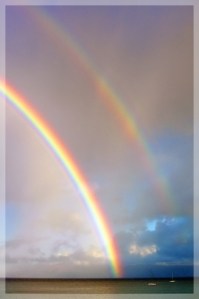
Once the waters receded, God promised that never again would floodwaters destroy all life; He confirmed His covenant with a rainbow. The timing of this post-flood rainbow is given as additional evidence that rain was a new phenomenon on earth since a rainbow requires the existence of rain. But, when God said, “I have placed my bow in the clouds,” He never said it was the first rainbow. God merely told Noah that it would serve as a reminder of His promise never to flood the earth again.
There is no way to know for sure whether there was rain prior to the flood and a case can be made for both sides of the question. Fortunately, whether or not it rained before the flood is a moot point because it doesn’t matter. Nevertheless, two valuable lessons were learned while I tried to answer that question. The first was simply to get our Bible knowledge first-hand!
The second lesson is that we should be cautious of reading more into a few Bible verses than what is there. There is a vast difference between speculation and Gospel truth and much of what occurred from the beginning of time through the 1st century AD is not mentioned in the Bible. After all, 400 years are missing between Malachi’s words and the birth of John the Baptist! Just because something isn’t stated in Scripture doesn’t necessarily mean it didn’t exist or happen! For example, Exodus mentions only two midwives by name but that doesn’t mean they were the only midwives serving several thousand Hebrew women! While we may find portions of Scripture ambiguous about peripheral issues (like rain or midwives), the Bible is quite clear about the essentials of Christian doctrine! Where Scripture is clear, we must be inflexible about the fundamentals of our faith. Let us be wary, however, of being unbending when Scripture is unclear and the issue is minor.
On the essentials, unity. On the nonessentials, liberty. In everything, charity. [Jack Hyles]
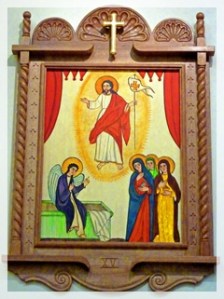 Found in almost every Roman Catholic church (and some Protestant and Orthodox ones), are the Stations of the Cross—a series of fourteen icons or carvings on the walls—each of which depict a moment in the Passion of Christ. Created to help people contemplate the events leading up to Christ’s crucifixion, they start with His death sentence from Pilate and end with His dead and battered body being laid in the tomb. Because Good Friday and Jesus’ death aren’t the end of the story, some churches have begun adding the resurrected Christ as a 15th station.
 We know Jesus prayed all night before choosing His Apostles. What made Him select those twelve men for His inner circle? Perhaps Andrew and John, having previously been disciples of John the Baptizer, were primed for the arrival of the Messiah but why did Jesus choose Andrew’s brother Simon/Peter and John’s brother James? Jesus called John and James the “Sons of Thunder,” implying they were bold, rash, and quick to anger. Why would Jesus choose them rather than men more even-tempered and less impetuous? For that matter, why four fishermen instead of students of the Torah? You don’t have to know how to cast a net to go fishing for people!
 Jeremiah told the exiles to work and pray for their captors. He explained that it was the shalom (well-being, peace, health, success, safety, and welfare) of their captors that they would ensure Judah’s shalom. For a people who’d been torn from their homeland and Temple, I expect it was difficult to understand how seeking Babylon’s prosperity would help them; but, it did!
 In C.S. Lewis’ children’s fantasy novel The Lion, the Witch and the Wardrobe, the youngest child, Lucy Pevensie, happens upon an enchanted armoire and steps into the magical world of Narnia. Upon returning, she rushes to tell her siblings of her astonishing adventure. Hearing such a tall tale and finding no concrete proof of its truth, her older siblings assume the story to be a figment of her imagination. They take their concern over her falsehood to their wise elderly uncle. He cautions them to use logic and consider Lucy’s story carefully. He points out there are only three possibilities: either she’s lying, crazy, or telling the truth. After pointing out that lies usually are more plausible than Lucy’s inexplicable tale, he asks if she’s lied before. The children admit she’s always been truthful. After pointing out that none of Lucy’s behavior indicates mental illness, they all agree she can’t have gone mad. He then suggests that since she’s neither a liar nor crazy, they could consider the possibility that Lucy’s story is true.
 The attackers march like warriors and scale city walls like soldiers. Straight forward they march, never breaking rank. They never jostle each other; each moves in exactly the right position. They break through defenses without missing a step. [Joel 2:7-8 (NLT)]
 Devotions of the Heart