
…be filled with the Spirit, addressing one another in psalms and hymns and spiritual songs, singing and making melody to the Lord with your heart, giving thanks always and for everything to God the Father in the name of our Lord Jesus Christ…. [Ephesians 5:18-20 (ESV)]
About midnight Paul and Silas were praying and singing hymns to God, and the prisoners were listening to them, [Acts 16:25 (ESV)]
 In the ruins of Oxyrhynchus, Egypt, a scrap of parchment known as P.Oxy. 1786 was discovered in 1918. Only 11-inches long and 2-inches wide, it consists of four lines of text along with musical notations on the back of a grain contract. Found in an ancient garbage dump, it was just one of 500,000 parchments dating from the 1st century BC to the 7th AD. Along with grocery lists, official records, and business contracts, the rubbish heap yielded a play by Sophocles, poetry by Sappho, portions of the Old Testament, fragments of both Matthew’s and Mark’s gospels, and an arrest warrant for a Christian.
While scholars call it P.Oxy. 1786, after hearing the version adapted by Chris Tomlin and Ben Fielding, you probably will know it as “The First Hymn.” Indeed, in a way, it is! Granted, the song sung by Miriam after crossing the Red Sea predates Christ by 1,400 years, the Hebrew Psalms were sung at Temple worship, and Biblical scholars believe passages like Colossians 1:15-20 and 1 Timothy 3:16 were hymns sung by early Christians. Nevertheless, none of those psalms or hymns include musical notations as does P.Oxy. 1786. To date, this scrap of parchment dating from around 260 AD is the oldest piece of Christian music in existence.
Although musicologists and historians have known about P.Oxy. 1786 for over a century, it remained in a sort of academic “no man’s land,” until historian John Dickson took an interest in it. Hoping to bring this obscure little hymn back to life, he reached out to musicians Ben Fielding and Christ Tomlin. The result is a new worship song, “The First Hymn.” Bringing the words of this ancient hymn back to life as a contemporary worship song seems almost sacrilegious until we understand the original music. Musicologists say the hymn used the same melodic structure used in taverns and on the stage at pagan theaters at the time. Musically, it was a 3rd century version of a Broadway, pop, or contemporary worship song! While the resurrected version doesn’t sound like the original, it has remained true to its purpose—a Christian worship song in the musical style of the day!
This hymn was sung at a time when the Church was confronted both by the pagan gods of the Roman Empire and various heresies regarding the divinity of Jesus and the Trinity. Yet, in its 35 words, it is a bold declaration of Christian faith. Combatting heresies of the day, it clarifies both the divinity of Jesus and the three separate but equal persons of the one triune God. It also makes a not too subtle dig at the Roman god Zeus. While pagans referred to him as the “giver of good gifts,” this hymn calls God the “only giver of all good gifts.” Moreover, by calling the heavens to be silent and the rivers to be still, the hymn showed the power of the one true God!
The 3rd century was a dangerous time for followers of Christ. In 201, Rome made conversion to Christianity a capital offense and, by mid-century, every citizen was required to make a sacrifice to the gods or face death. Found in that same ancient rubbish dump was a formal certificate proving that one local citizen had offered pagan sacrifice in public. Christians who refused were martyred in gruesome ways; if they weren’t crucified or beheaded, they may have been tossed into cauldrons of boiling oil or cast into an arena to be devoured by lions. Nevertheless, this hymn speaks of a God who gives good gifts—not suffering and persecution! This defiant hymn resounds with joy with its words, “Might, praise, and glory forever to our God. The only giver of all good gifts.”
The singing of hymns has a long history in the Christian church. Psalms, a book of songs, is the longest book in the Bible and Scripture makes over four hundred references to singing and fifty direct commands to sing. The last thing Jesus and the disciples did in the upper room His last night was sing a hymn. While in prison, Paul and Silas prayed and sang hymns to God which led to their jailer’s conversion! We find instructions to sing in Psalms, Ephesians, Colossians, and James. In the early second century, the Roman governor Pliny the Younger described the worship practices of Christians who “were in the habit of meeting on a certain fixed day before it was light, when they sang in alternate verses a hymn to Christ, as to a god.” Let us continue to sing the song of the redeemed as boldly as did the persecuted Christians of the early Church. Amen and amen.
Let all be silent: The shining stars not sound forth,
All rushing rivers stilled, As we sing our hymn
To the Father, Son, and Holy Spirit,
As all Powers cry out in answer, “Amen, amen.”
Might, praise, and glory forever to our God.
The only giver of all good gifts. Amen. Amen.
[P.Oxy. 1786 (The First Hymn)]
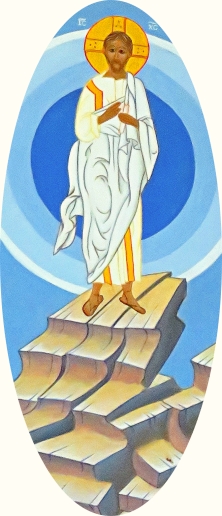 The Resurrection story didn’t end on Easter with Jesus’ appearance to ten disciples, Mary Magdalene, Mary the mother of James and John, Salome, and Joanna, along with Cleopas and another believer who broke bread with Him in Emmaus. Appearing and disappearing at will, Jesus remained on earth for forty days. While He probably appeared other times, Scripture tells us He later appeared to Thomas and the ten others, to seven of the disciples beside the Sea of Galilee, to His half-brother James, to over 500 believers at one time, and to the disciples on his last day with them.
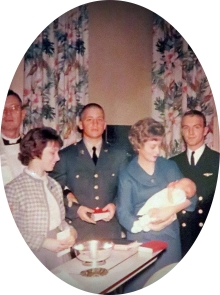 Earlier this week, I wrote about my nephew Johnny’s baptism in my mother’s hospital room. Because she was at death’s door, my brother took emergency leave and he and I served as the baby’s sponsors in Baptism (or Godparents).
 We once had neighbors who left our church for what I’ll call the “church of what’s happening now.” Its members have a variety of beliefs about God and, while they acknowledge a “higher power,” they do not share a concept of it. It could be God, a sacred force, or the spirit of life and there is no right or wrong way to understand Him, Her, or It. While some may regard Jesus as a great moral and spiritual leader or prophet (and possibly even supernatural), they don’t believe He was God and reject the Trinity. Theirs is an eclectic mix of beliefs with each person having his or her own personal truth. Embracing uncertainty, some believe there may be an afterlife and/or reincarnation but, for others, this life is all there is. Although they look to the Bible for wisdom, they also find spiritual inspiration in texts like the Bhagavad Gita, Dhammapada, and Tao Te-Ching. Our neighbors were loving caring people who believed in good things like justice, compassion, peace, protecting the environment, and the dignity of the individual. Nevertheless, while some of their thinking was correct, their conclusion was very wrong.
 Earlier this week, I compared a fictional 21st century Noah with the original ark builder. Although I was told there had been no rain on earth before the Flood, since I hadn’t read it myself, I wanted to make sure before writing it. As it turns out, there is no clear decisive answer to whether or not there was rain before Noah’s day so I didn’t mention it at all.
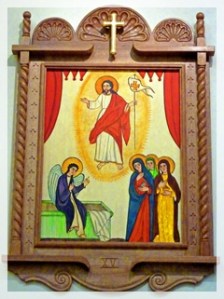 Found in almost every Roman Catholic church (and some Protestant and Orthodox ones), are the Stations of the Cross—a series of fourteen icons or carvings on the walls—each of which depict a moment in the Passion of Christ. Created to help people contemplate the events leading up to Christ’s crucifixion, they start with His death sentence from Pilate and end with His dead and battered body being laid in the tomb. Because Good Friday and Jesus’ death aren’t the end of the story, some churches have begun adding the resurrected Christ as a 15th station.
 Devotions of the Heart