
Cast your cares on the Lord and he will sustain you; he will never let the righteous be shaken. [Psalm 55:22 (NIV)]
Cast all your anxiety on him because he cares for you. [1 Peter 5:7 (NIV)]
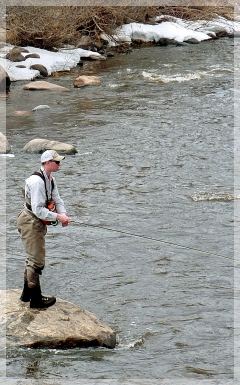 Even though I’m not an angler, whenever I read about casting my cares, I picture using a fly rod and casting my concerns out into the river so the fast moving water can carry them away to God. When we lived in the mountains, one of our favorite walking trails ran alongside the Yampa River and we often paused to watch as the fishermen (and women) cast their lines into the water. Fly fishing is all about the art of casting and a bit like poetry in motion. It was fascinating to watch an angler flick the rod back and forth, gradually increasing the speed of the motion, before finally casting the line forward so the fly would land in the perfect spot. Masquerading as a water insect, the fly is made of things like fur, feathers, fabric and tinsel and secured to a hook. Rather than purchasing flies, many fishermen spend hours tying their own flies. Not wanting to lose either fly or fish in the river, anglers use at least five different knots to securely connect the reel to the backing, fly line, leader, and tippet before finally tying on the fly.
There is an art to fly casting and fly fishermen spend years perfecting their technique, especially since no one cast is ideal for every situation. Christians, however, aren’t casting flies—they’re casting things like fear, problems, anxiety, and worry—the cares every believer faces in this fallen world. While there’s no special technique to casting those cares, like fly fishing, it’s often easier said than done. Just as a fly fisherman may labor over tying his flies and fret about choosing the perfect ones for the day’s conditions, we often spend a great deal of time focusing on our worries rather than casting them into God’s river. Just as the fisherman ties those five knots to keep from losing his fly, we tie ourselves up in knots when we’re reluctant to give up our cares to God!
The anglers casting their lines in the river want to catch and land a fish but, when we cast our cares, we want to bring in an empty line. They catch, we release! Our cares are not for God to take away from us but for us to release to Him. Because the flies on the end of a fishing line are nearly weightless and our cares often seem as heavy as boulders, casting cares seems harder than casting a fly in the river. Nevertheless, it can be done and is far more rewarding than a trophy-sized trout.
Fishermen go to the river with an empty creel and hope to return home with a full one but we go to God with a creel full of cares so we’ll end up with an empty one. Our creels may be empty but we’ll be filled with the peace of God!
He that takes his cares on himself loads himself in vain with an uneasy burden. I will cast my cares on God; he has bidden me; they cannot burden him. [Joseph Hall]
 Many years ago, I was facing a difficult decision about a project. In spite of praying, pondering, searching Scripture for direction, and consulting with wise advisors, I was still in a quandary. Nothing brought me closer to a clear answer to my dilemma. Although it seemed like a good idea (at least in theory) and I felt like I should want to be part of it, doubts kept nagging at me. Wanting God to make known His will, I prayed the words of Psalm 143:10: “Teach me to do your will, for you are my God. May your gracious spirit lead me forward on a firm footing.”
 My father had what’s often described as a Type-A personality. An impatient workaholic, he always took on more than he could handle. Life, for him, was one crucial task after another, none of which anyone else could do, at least not correctly. Always in a hurry, he never wanted to stop for anything, even when his gas gauge read precariously close to empty. Something more pressing always took precedence over a brief stop for gas. As a result, his car was often left on the roadside while he trudged off with a gas can to find the nearest service station. Instead of saving time, his refusal to stop cost him time. Living that way actually cost him his life; he died of a massive coronary at the age of fifty-six. It’s often been said that your in-box still will be full when you die and, indeed, his was. None of us can accomplish everything on our to-do list and we may well destroy both our relationships and ourselves while trying.
 Yesterday, I wrote about Job’s lamentation. 19th century bible scholar George Granville Bradley said this about Job 3: “Where in the world will you find a sadder strain of more hopeless, uncontrolled, and unbroken lamentation and mourning? … Filled to the brim, they run over with pain.” I have to agree.
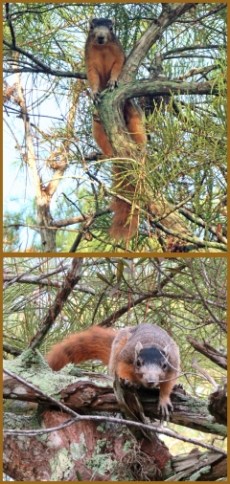 Saturday mornings we usually walk through a nearby park that is home to a unique subspecies of squirrel found here in southwest Florida: the Big Cypress fox squirrel (or BCFS for short). Larger than a common gray squirrel, the BCFS has a black head and back, buff sides and belly, white ears and nose, and a long bushy tail.
 When we spent winters in the mountains, our early morning walk took us by a gourmet restaurant. Occasionally, we’d get a whiff of a delectable mouth-watering aroma as we passed. What we smelled was a large pot of roasted beef and veal bones that had simmered on the back burner overnight. In this day and age of microwaves, Instant Pots, mixes and prepared foods, it’s difficult to understand a chef simmering stock for over 12 hours to concentrate it into a rich demi-glace. That, however, is how the restaurant’s chef gets the flavorful base she uses in her delicious sauces.
 Devotions of the Heart