These days would be remembered and kept from generation to generation and celebrated by every family throughout the provinces and cities of the empire. This Festival of Purim would never cease to be celebrated among the Jews, nor would the memory of what happened ever die out among their descendants. [Esther 9:28 (NLT)]
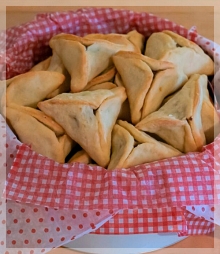 Sunset tonight begins the 14th day of Adar in the Hebrew year 5783 and the Jewish celebration of Purim (or the Festival of Lots). Lasting until sunset tomorrow night, Purim commemorates the saving of the Jewish people from annihilation in the ancient Persian Empire. Purim means “lots” in Persian and this holy day gets its name from the way the diabolical Haman determined the date to “destroy, kill, and annihilate all the Jewish people—young and old, women and children—and plunder their possessions.”
I first learned about this holiday in college when my Jewish roommate received boxes of delicious hamantaschen cookies she graciously shared with me. Hidden inside the sweet flaky triangular-shaped pastries was a sweet filling of either poppy seeds, prunes, or apricots. My roomie said the cookies represented Haman’s three-cornered hat but other sources say they represent his ears or the villain’s pockets filled with money. But, I’m getting ahead of myself without telling you the whole megillah.
“The whole megillah” is an idiom taken from Yiddish that means a long convoluted story, but the Megillah (with a capital M) is a scroll of the book of Esther (which truly is a complicated story filled with plot twists). It will be read during a synagogue service tonight and again tomorrow. The Megillah is read twice to emphasize that everything is orchestrated by God! Rather than the solemnity you’d expect in a place of worship on a holy day, it’s read very dramatically. Each of the 54 times the evil Haman’s name is mentioned, the congregation raucously stomp their feet, boo, hiss, and swing greggers (ratchet noisemakers).
The mitzvoth (religious duties) of Purim are outlined in Esther 9, the first of which is the reading of the Megillah. The second duty is that of feasting and joy. Families and friends feast on hamantaschen and kreplach. Children (and sometimes adults) dress in costume as Esther, Mordecai, or silly characters. Emphasizing the importance of friendship and community, the third mitzvah is to send portions of food to one another (which explains the hamantaschen sent to my roommate). The final mitzvah is that of giving gifts to the poor. To ensure that all Jews can experience the joy of Purim, every Jew is supposed to give money or food to at least two needy people.
Whether or not you’re familiar with the story of Esther, I urge you to read it. Unique about this short book is that God’s name is never mentioned. Nevertheless, His divine attention, direction, and power are evident on every page. His fingerprints are all over every coincidence in the story—from Mordecai overhearing a plot against the king and saving the king’s life to the king’s sleepless night that caused him to learn of Mordecai’s part in his rescue; from Queen Vashti’s banishment to Esther being drafted into the king’s harem; from Esther finding favor with the harem eunuch to being chosen queen; and from the massacre’s date being determined by the throwing of lots to Haman appearing to molest Esther just as Xerxes entered the room.
The miracles in this story were disguised as natural events and, like the sweet filling in the hamantaschen cookies and the savory ground beef or chicken inside the kreplach, God’s intervention was hidden. While God’s name isn’t found in the book of Esther, His activity is! He overruled history, overturned the plans of the wicked, and saved His people. Not every miracle involves something as dramatic as the parting of the sea. Sometimes, God’s miracles can be found in an unlikely friendship, overheard words, a bout of insomnia, the page of a king’s history book, or a roll of the dice!
Although Christians don’t observe Purim, perhaps we should. Let us never forget that Haman’s decree of death to the Jews extended to all Jews in the Persian empire, which would have included those Jews who had begun returning to Judah. Had Haman succeeded in his genocide, the Davidic line would have ended and disrupted God’s plan to send His son to be born a Jew in Bethlehem. The message we find in Esther is a simple one: God’s plans cannot be thwarted.
 Lent begins on Wednesday. Beginning with the solemn reminder that we are but dust and to dust we shall return and concluding with Christ’s victory over death on Easter Sunday, the season’s forty days represent the time the Lord spent alone in the wilderness, fasting in preparation for his ministry, and undergoing Satan’s temptations. A period of self-discipline and repentance, Lent often is observed by such things as contemplation, confession, prayer, fasting, moderation, service, and giving
 Remember the Sabbath day, to keep it holy. Six days you shall labor, and do all your work, but the seventh day is a Sabbath to the Lord your God. On it you shall not do any work, you, or your son, or your daughter, your male servant, or your female servant, or your livestock, or the sojourner who is within your gates. [Exodus 20:8-10 (ESV)]
 Every year a friend sends me a bayberry candle to burn on New Year’s Eve. Legend has it that lighting a bayberry candle when the first star appears, burning it past midnight into the new year, and letting it burn all the way down will bring good luck, wealth, and prosperity to a home. We can’t stay awake past midnight and allowing an unattended candle to burn down to its socket seems more a guarantee of fire and disaster than good luck. Nevertheless, in honor of our friend, we light our candle every New Year’s Eve and extinguish it shortly after the new year begins in Greenland (three time zones east).