SHALOM

Shalom I leave you, My shalom I give to you; but not as the world gives! Do not let your heart be troubled or afraid. [John 14:27 (TLV)]

zebra swallowtailToday’s verses are from the Tree of Life Version (TLV) that was produced by a diverse team of Christian and Messianic Jewish scholars. With the possible exception of the book of Job, all the Bible’s writers were Jews and Jesus was a Hebrew-speaking Jewish rabbi. No matter how good the translation, there are times English doesn’t capture the fullness of the original words used and this translation embraces the rich Hebrew roots of Christianity. To help the reader better understand the intent of the original manuscripts, some original Hebrew names, like Adonai  (Lord) and Elohim (God), Ruach ha-Kodesh (Holy Spirit), and Messiah Yeshua (Jesus Christ) were used and some Hebrew terms, like shalom, amen, hineni, matzah, and mikveh (ritual bath), were restored. Fortunately, this translation offers a glossary for its Gentile readers.
Shalom is one of those beautiful Hebrew words that loses its full meaning when translated into English. Usually translated as peace, shalom is more than a sense of calm, serenity, or the absence of hostilities or war. Meaning wholeness, soundness, health, safety, harmony, tranquility, and prosperity, shalom conveys an inward sense of fullness and completeness in mind, body, and circumstance. With its implication of permanence, a connection to God is necessary for shalom. As Jefferson Bethke says, “Shalom is when you are dancing to the rhythm of God’s voice.”

Rather than Hebrew or Aramaic, the language of the people, the New Testament’s writers wrote in Greek, the language of scholars. They weren’t in error in their reporting nor did the Bible’s translators err in their renditions; they simply were limited by the language they used. Neither Greek nor English have a word that fully captures the spiritual depth of shalom.

On the night of Jesus’ birth, when the multitude of angels announced “Peace on earth!” they wouldn’t have used the Greek word eiréné used by Luke. [2:14] Those shepherds were Jewish and the word would have been shalom. When Jesus told the woman with the blood to go in peace and be healed, it was to go in shalom not eiréné, the word Mark used. [5:34] Eiréné, defined as peace, quietness, national tranquility, or absence of conflict, doesn’t fully apprehend shalom’s meaning.

Addressing people with “Hello” or “Good Morning” is simply a greeting but, when “Shalom” is used as a greeting or farewell, it is a blessing of peace. The Jews of Jesus’ day regularly greeted one another with shalom or shalom aleichem (peace be upon you). The person then returned the blessing with aleichem shalom (unto you peace). Since a connection with God is essential to shalom, both greeting and response were a way of bringing godliness into their encounter and the physical world with their words.

When the angel Gabriel visited Mary, he didn’t greet her with chaire, the Greek word translated as “hail” or “greetings.” [Luke 1:28] He would have blessed her with the word shalom. When Jesus greeted the women Easter morning, He would have said “Shalom” and, when He appeared to the disciples later that day, He probably said “Shalom aleichem!”  Considering their shock at seeing the risen Christ, it’s understandable why both women and disciples failed to properly return His greeting with “Aleichem shalom!”

Shalom is a blessing of peace—peace throughout the world and in one’s personal life—and it is one of the greatest blessings one can give or receive. The peacemakers to whom Jesus referred in the Beatitudes weren’t mediators or political negotiators. They were people whose connection with God gave them shalom. They became peacemakers by transferring their inner sense of fullness, harmony, and well-being (their shalom), to the world around them.

The full meaning of shalom reminds us that true peace is not the absence of conflict or trouble; it is the presence of God. Shalom, my friends; shalom!

In the Bible, shalom means universal flourishing, wholeness, and delight—a rich state of affairs in which natural needs are satisfied and natural gifts fruitfully employed, a state of affairs that inspires joyful wonder as its Creator and Savior opens doors and welcomes the creatures in whom he delights. Shalom, in other words, is the way things ought to be. [Cornelius Plantinga]

So Messiah’s community throughout all Judea and Galilee and Samaria had shalom and was built up. Walking in the fear of the Lord and in the comfort of the Ruach ha-Kodesh, it kept multiplying. [Acts 9:31 (TLV)]

Copyright ©2024 jsjdevotions. All rights reserved.

WHY THE DIFFERENCE?

Moses remained there on the mountain with the Lord forty days and forty nights. In all that time he ate no bread and drank no water. And the Lord wrote the terms of the covenant—the Ten Commandments—on the stone tablets. [Exodus 34:28 (NLT)]

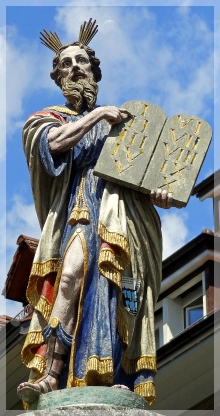
Moses Fountain - Bern  Although three places in Scripture tell us that the Lord proclaimed ten commandments and wrote them on stone tablets, those tablets weren’t numbered (especially not with Roman numerals)! The original languages of the Bible (Hebrew, Aramaic, and Greek) didn’t contain punctuation and the earliest manuscripts didn’t even have spaces between the words. While the words in Scripture are God-breathed, the punctuation was at the discretion of later copyists and translators. Without numbering, punctuation, or paragraphs, we can’t know for sure where one commandment ends and the other begins. As a result, while Jews, Roman Catholics, Protestants, and Orthodox Christians all observe the Ten Commandments, their commandments are not all the same!

For a Jew, rather than ten commandments, there are 613 throughout the Hebrew Scriptures. The first ten are called the Decalogue. While most Christians consider Exodus 20:2, “I am the Lord your God, who rescued you from the land of Egypt, the place of your slavery,” a preface to the Ten Commandments, it is the first one for a Jew and considered the most important because it establishes God’s authority for all that follows. Until that first commandment is accepted—that Adonai is one’s God—the rest wouldn’t be obeyed. The Jewish second commandment spans Exodus 20:3-6 and combines three prohibitions regarding idolatry: (1) no other gods, (2) no making of idols, and (3) no worship of idols. Commandments three through ten are the same as those recognized by most Protestants and Orthodox Christians.

Around 220 AD, the Christian Biblical scholar Origen of Alexandria numbered the commandments in the way familiar to most Protestant and Orthodox Christians. Skipping Exodus 20:2, He began with the prohibition of false gods “You shall have no other gods before me,” and continued with the second commandment prohibiting idols. The 10th commandment prohibited all coveting.

In the fifth century, however, Saint Augustine re-numbered the commandments so that the prohibitions about other gods and idols were combined into the first commandment. Making him short one commandment, Augustine then split Exodus 20:17 into two with coveting a neighbor’s wife the 9th commandment and coveting anything else of the neighbor’s the 10th. Although this required rearranging Scripture’s words, perhaps he reasoned that coveting your neighbor’s wife was vastly different than coveting his house or team of oxen. In any case, Augustine’s system was adopted by the church.

In 1054, the Christian church split into the Eastern Orthodox and the Roman. Orthodox Christians follow Origen’s numbering but include Exodus 20:2, “I am the Lord your God who rescued you from Egypt….,” in the first commandment. The Protestant Reformation of the 16th century further divided the church. Except for Lutherans, the Protestant church returned to Origen’s original numbering system. Perhaps because Luther was an Augustine monk for fourteen years, his version of the Commandments follows that of the Roman Catholic church with one notable exception. Returning to the original order found in Scripture, Luther’s 9th commandment prohibits coveting your neighbor’s house and the 10th prohibits coveting his wife, servant, animals, or anything else. In this way, Luther distinguished coveting the inanimate (house) from coveting the animate (wife, servant, etc.).

Who’s right? Only God know! Far more important than how the commandments are numbered, however, is what those commandments meant to the Israelites and what they mean to us today. The first three or four (depending on your denomination) have to do with mankind’s relationship to God and lay out our obligation to honor our Creator. The next seven or six (again depending on your denomination) have to do with the obligations we have to one another in family and society and lay out the foundation for building a community. Rather than disagreeing about how to number the Ten Commandments, we should make a greater effort to live the two spoken by Jesus!

Jesus replied, “‘You must love the Lord your God with all your heart, all your soul, and all your mind.’ This is the first and greatest commandment. A second is equally important: ‘Love your neighbor as yourself.’ The entire law and all the demands of the prophets are based on these two commandments.” [Matthew 22:37-40 (NLT)]

Copyright ©2024 jsjdevotions. All rights reserved.

POSTING THE COMMANDMENTS

Then God gave the people all these instructions: “I am the Lord your God, who rescued you from the land of Egypt, the place of your slavery. You must not have any other god but me.” Exodus 20:2-3 (NLT)]

Moses - Meiringen - MichaelskircheOn June 19, Louisiana’s Governor Jeff Landry signed legislation requiring all public K-12 classrooms and state-funded universities to display a poster-sized version of the Ten Commandments in “large, easily readable font” in every classroom next year. As expected, a lawsuit has been filed to block what some say is an unconstitutional requirement. I’ll leave the arguments about civil liberties and constitutional law to the lawyers and courts; Louisiana’s law is troubling for other reasons.

For the poster’s required wording, Louisiana’s legislators didn’t look to the original Hebrew or any of the more than 60 accepted Christian Bible translations. Instead, they canonized their own version of the commandments by using the same words placed on a Texas monument the U.S. Supreme Court found to be “on the permissible side of the constitutional line.”

Although the “approved” commandments appear to be from the King James, they are more like a Reader’s Digest version than the real thing. While the prohibition about graven images (Ex. 20:4) is included, verses 5 and 6 with the rest of that commandment along with its warning for disobedience are omitted. The 3rd commandment’s warning of punishment if the Lord’s name is taken in vain also is omitted. Although the commandment to remember the sabbath and keep it holy is included, its prohibitions of work and the reason for the commandment (Ex. 20:9-11) are not. Governments are designed for writing laws, not re-writing Scripture, and God made it clear that His words were not to be edited or abridged in any way!

While Jews, Roman Catholics, Protestants, and Orthodox Christians observe the Ten Commandments, their commandments are not all the same! Disregarding the 16% of their population who are not Christian and the 26% of Louisiana Christians who are Roman Catholic, the required poster uses the Protestant version of the commandments.

In the Texas case, because the monument in question was one of 38 monuments or historical markers on 22-acres of the Texas Capitol grounds and had been there for more than 40 years without objection, the court considered it “historical.” Latching onto the word “historical,” Louisiana’s law doesn’t put the commandments in the Biblical context of who gave them, when and why they were given, and where they are written. Instead, they put the commandments in the context of an historical document. The poster must be accompanied by a four-paragraph “context statement” describing how the Ten Commandments “were a prominent part of American public education for almost three centuries.” Along with the Ten Commandments’ poster, the law also requires the posting of the Mayflower Compact, the Declaration of Independence, and the Northwest Ordinance.

The Ten Commandments do not get their authority because they’ve been printed in schoolbooks since the 17th century nor do they get their significance because they were written thousands of years ago! While they have existed longer than the New England Primer  or the Mayflower Compact, Scripture is no more an “historical document” than the Declaration of Independence or Webster’s The American Spelling Book are sacred ones! Treating the God-breathed Ten Commandments as an historical document diminishes them by placing them on equal footing with McGuffey’s Readers  and a 1787 ordinance laying the basis for the government of the Northwest Territory. As well-written as they may be, theirs are secular words written by men; the words of the Ten Commandments, however, are sacred words spoken by God! Moreover, placing God’s law alongside the teacher’s rules about raising your hand or working quietly further diminishes them.

We could post the Ten Commandments on the walls of every building but that would make no difference in our world today because we can’t legislate God. We can, however, display Him. If we’re to make the world a better place, we won’t do it by posting the Ten Commandments in schools, courtrooms, billboards, or anyplace else. We will do it by posting God’s commandments in our hearts and obediently living God’s way every day!

No one lights a lamp and then puts it under a basket. Instead, a lamp is placed on a stand, where it gives light to everyone in the house. In the same way, let your good deeds shine out for all to see, so that everyone will praise your heavenly Father. [Matthew 5:15-16 (NLT)]

Imitate God, therefore, in everything you do, because you are his dear children. Live a life filled with love, following the example of Christ. [Ephesians 5:1-2a (NLT)]

Copyright ©2024 jsjdevotions. All rights reserved.

LAST WORDS

When Jesus had received the sour wine, he said, “It is finished,” and he bowed his head and gave up his spirit. [John 19:30 (ESV)]

It’s been said that Leonardo da Vinci’s last words were, “I have offended God and mankind because my work did not reach the quality it should have.” A scientist, painter, architect, mathematician, musician, sculptor, geologist, botanist, historian, cartographer, and inventor, da Vinci was a true Renaissance man and it’s difficult to understand how he could feel he failed God or anyone else.
I hope my last words won’t be as depressing as da Vinci’s or as foolish as those of Major General John Sedgwick who, just moments before he was shot and killed during the Civil War, said, “They couldn’t hit an elephant at this distance!” I’d like to think my last words will be as faith-filled as those of blues singer Bessie Smith’s, “I’m going, but I’m going in the name of the Lord!” or Harriet Tubman’s, “Give my love to the churches. Tell the women to stand firm. I go to prepare a place for you.”  Nevertheless, my words probably will be as mundane Elvis Presley’s, “I’m going to the bathroom to read.”

While Nostradamus correctly predicted his death when he said, “Tomorrow, at sunrise, I shall no longer be here,” most of us won’t know when the words we speak will be our last ones. Jesus, however, knew his earthly life was ending when He spoke from the cross. He’d been hanging there for several hours and the weight of his body pulling down on his arms meant he could barely breathe. John tells us Jesus said, “It is finished!” and then died. After hearing those words, can you imagine the heartbreak of His followers? This was Jesus, the man who calmed storms, fed thousands, and healed lepers! This was the promised Messiah! How could it be finished? Everything His disciples believed and hoped for was gone! Was this how their story would end?

Last words, however, aren’t always what they seem. Jesus’ words and the crucifixion were only the end of the first act. What the disciples didn’t understand on that dark Friday afternoon was that the story was just getting started. Three days later, the resurrection opened the second act. Forty days after His resurrection, the second act closed with Jesus’ ascension into heaven. Although He spoke to the disciples and blessed them before His departure, Matthew, Mark, Luke, and John included different portions of Jesus’ final words. Nevertheless, His message was the same: our sins are forgiven, we are to go out into the world and make disciples, and the power of the Holy Spirit is promised. When Jesus physically left the disciples with His ascension into heaven, the second act ended, but the words He spoke were not His final ones. Because He promised both His presence and His return, we know there’s more to come!

The third act began with the Spirit’s presence on Pentecost and continued when Jesus spoke to Saul on the road to Damascus and revealed Himself to John on Patmos. While probably less dramatic than Paul’s encounter and less graphic than John’s, the Lord continues to speak to us today through His living word (the Bible), prayer, and in the Holy Spirit’s beautiful whisper. The only last words to be spoken in the third act will be ours when we depart the stage—whether they are as mundane as those of Elvis or as memorable as da Vinci’s. Nevertheless, when the curtain closes for us, the story still is not over!

The glorious fourth act begins when we come home to Jesus and hear His voice again. This final act has no ending and there will be no last words spoken. It never is finished and the curtain never will fall!

Let not your hearts be troubled. Believe in God; believe also in me. In my Father’s house are many rooms. If it were not so, would I have told you that I go to prepare a place for you? And if I go and prepare a place for you, I will come again and will take you to myself, that where I am you may be also. [John 14:1-3 (ESV)]

Truly, truly, I say to you, an hour is coming, and is now here, when the dead will hear the voice of the Son of God, and those who hear will live. [John 5:25 (ESV)]

Copyright ©2024 jsjdevotions. All rights reserved.


UNICORNS

God brought him forth out of Egypt; he hath as it were the strength of an unicorn: he shall eat up the nations his enemies, and shall break their bones, and pierce them through with his arrows. [Numbers 24:8 (KJV)]

ancient mosaic of aurochSome believers insist that unicorns actually existed because they are mentioned nine times in the Old Testament. Claiming the Bible is completely without error, they insist that you must believe the same thing—including the unicorns! On the other hand, some people disparage believers and discount all of Scripture because of those same unicorns! Do we blindly believe or do we “throw out the baby with the bathwater” because of one word?

While the Bible is infallible, that’s not always true of translators. The Hebrew word used for this wild animal was re’em and seemed to mean a beast with a horn (but not necessarily only one horn). It’s found in Numbers 23:22, 24:8; Deuteronomy 33:17; Job 39:9,10; Psalm 22:21, 29:6, 92:10; and Isaiah 34:7. When looking at the context, re’em always refers to someone or something with great power. In Numbers, we find God comparing His strength to that of the re’em and, in Psalm 22:21, David refers to his formidable enemies as re’em.

By the third century BC, the language and culture of Greece had spread throughout the world and the Jewish knowledge of Hebrew was declining. The Jewish community in Egypt (along with the Hellenic Egyptian ruler Ptolemy II) initiated the translation of the Torah into Greek. During the next two centuries, the entirety of the Hebrew Scriptures were translated into Greek in what is called the Septuagint. At that time, the Hebrew re’em (wild beast with a horn) was inaccurately translated into the Greek monokeros (one horn). When citing the Hebrew Scriptures, the epistle writers quoted from the Septuagint and, since Gentile Christians knew nothing of Hebrew, the Greek Septuagint became the Bible of the early church.

Fast forward to the fourth century when Latin began replacing Greek as the language of the people. In 382 AD, Pope Damasus I commissioned his secretary, Jerome, to produce a new Scripture translation in Latin. Written in the Latin of the day, St. Jerome’s translation is known as the Vulgate. It is from this translation that we get English words like scripture, salvation, justification, and regeneration. In Jerome’s translation, the Greek monokeros became the Latin unicornis (a one-horned beast).

Fast forward again to the 16th century and the first English translations of Scripture—William Tyndale’s and the Geneva Bibles followed by the King James version in 1611. Although unicornis was rendered as unicorn in these Bibles, it’s unlikely the translators believed it to be the mythological unicorn. Not knowing what it was, they simply transliterated the Latin word into the English “unicorn.” Closely associated with chivalry, by the 1600s the unicorn was a symbol of purity and grace that could be captured only by a virgin. The horse-with-a-horn of myths and fairy tales doesn’t sound much like the untamable, ferocious, and powerful wild re’em of the Old Testament!

Nowadays, only a few Bible translations continue to use unicorn. I found only six (out of 62) and all of those are based on the Wycliff, Geneva, or King James translations. While most other versions translate re’em, monokeros, or unicornis as wild ox, a few use wild bull, rhinoceros, or buffalo. Since no one knows absolutely for sure, Young’s Literal translation returns to the original with reem! The Orthodox Jewish Bible uses wild bull, wild ox, and “re’eim (wild ox).”

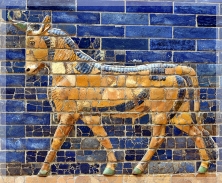
So, what was the re’em? While it could refer to rhinoceros, buffalo, or antelope, it probably refers to aurochs, large cattle which once roamed Europe, Africa, and Asia. Ancient Assyrian and other Middle Eastern texts refer to this this wild ox-like animal with a similar word. Because ancient art usually depicted the auroch from a profile view (as does the ancient mosaic pictured), it appeared to have just one horn. Ancestors of domestic cattle, aurochs stood over six-feet tall and weighed over 2,200 pounds. Julius Caesar described them as “a little below the elephant in size,” having the shape and appearance of a horned bull, possessing “extraordinary” strength and speed, and being untamable, even when taken as calves. The auroch became extinct in Poland in 1627.

While we now have an answer to skeptics who mock us for believing in a book attesting to the existence of unicorns (when it doesn’t), we must be cautious in our response. Although Scripture doesn’t speak of a unicorn, that doesn’t mean some creature with just one horn never existed. After all, God created the one-horned narwal and rhinoceros, so who are we to say He never created something like the mythical unicorn? Although we’ve never seen them, we know animals like the wooly mammoth, dodo, saber-toothed tiger, and auroch existed. Having already seen strange creatures like jelly fish, giant anteaters, and the wildebeest, I know better than to deny God’s ability to create any creature He desires. What we can know for sure, however, is that the Bible can be trusted!

There’s no better book with which to defend the Bible than the Bible itself. [D.L. Moody]

God brings him out of Egypt, He is for him like the horns of the wild ox. He will devour the nations who are his adversaries, And will crush their bones, And smash them with his arrows. [Numbers 24:8 (NASB)]

Copyright ©2024 jsjdevotions. All rights reserved.

YOUR ACHILLES’ HEEL (Armor of God – 3)

Let no one say when he is tempted, “I am being tempted by God,” for God cannot be tempted with evil, and he himself tempts no one. But each person is tempted when he is lured and enticed by his own desire. [James 1:13-14 (ESV)]

armor - Castle of SpiezBack in in 1586, during the Eighty Years’ War, Sir Philip Sidney was fighting for the Protestant cause against the Spanish when he noticed another soldier was without leg armor. Believing that he shouldn’t be better protected than his men, Sidney gave the man his cuisses (armor that covered the thigh). During the Battle of Zutphen, Sidney was fatally wounded in his thigh during the final charge and, three weeks later, he died of gangrene from the injury. While heroic, his death was avoidable if the man had worn his complete set of armor!

In Greek mythology, Achilles was the son of Thetis, a powerful sea goddess. When a seer told her that Achilles would be a great warrior but would die young, Thetis dipped her infant son in the river Styx to make him invincible. The boy became invulnerable everywhere but at his heel where his mother held him. Although Achilles was a great warrior, the god Apollo was angry with him. Knowing of his unprotected heel, Apollo directed a soldier’s arrow to the warrior’s one vulnerable spot and Achilles was killed in battle by that well-aimed arrow. Because of this myth, an “Achilles’ heel” has come to mean a person’s only weakness.

I tell these stories because both Sir Philip Sidney and Achilles were missing part of their protective covering and the Apostle Paul made it clear that the full armor of God is necessary if we are to defeat Satan. Let’s not fool ourselves, just as Apollo knew about Achilles’ unprotected heel, Satan knows exactly where to attack us! The area we leave unprotected is the place where Satan will strike.

While he doesn’t use arrows, canon balls, or bullets, Satan has an arsenal of weapons at his disposal. After bombarding Job with loss of family, finances, status, and health, he continued the attack with intense pain, depression, and doubts about God’s goodness. Satan mistakenly thought God was protecting Job with a fence of prosperity but the man remained impervious to Satan’s arrows because he was wearing God’s spiritual armor.

Satan may have failed with Job but he was successful with others. Finding a chink of pride and self-reliance in David’s armor, Satan tempted him to take a census. Knowing that David’s Achilles’ heel was his eye for the ladies, Satan tempted him with the beautiful but married Bathsheba. Whether it was Judas’ lust for money or a Zealot’s disappointment in the Messiah’s role, Satan knew where his weakness lay and entered Judas through that missing piece of armor.

We all have a weak spot (or spots). After all, even Superman’s Achilles’ heel was kryptonite! For some of us, it is doubts about God’s goodness, pride, fear, unforgiveness, or a wandering eye. For others, it is love of money, a quick temper, a critical tongue, or chronic impatience. What is your Achilles’ heel? Be alert; Satan knows exactly what and where it is and will do his best to take you out of action with what he hopes to be a fatal shot.

Although God’s armor is tailor-made for us, it does us no good if we fail to put all of it on. Are you missing a piece of God’s armor?

He [the devil] will attack you sometimes by force and sometimes by fraud. By might or by sleight he will seek to overcome you, and no unarmed man can stand against him. Never go out without all your armor on, for you can never tell where you may meet the devil. He is not omnipresent, but nobody can tell where he is not, for he and his troops of devils appear to be found everywhere on this earth. [Charles Spurgeon]

Be sober-minded; be watchful. Your adversary the devil prowls around like a roaring lion, seeking someone to devour. [1 Peter 5:8 (ESV)]

Copyright ©2024 jsjdevotions. All rights reserved.