
On the way, Jesus told them, “All of you will desert me. For the Scriptures say, ‘God will strike the Shepherd, and the sheep will be scattered.’ But after I am raised from the dead, I will go ahead of you to Galilee and meet you there.” [Mark 14:27-28 (NLT)]

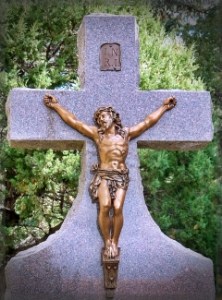
In the days leading up to his crucifixion, the people who claimed to love Jesus the most failed him in many ways. We know about Judas—the disciple trusted enough to carry the money bag who betrayed Jesus for thirty pieces of silver. That last night, the deceitful man had the audacity to have his feet washed by the Lord and to drink from His cup! But what of the other disciples? During that same meal, Peter vowed he’d never deny Jesus, even if it meant his death and the rest of the disciples echoed his pledge. Yet, within a matter of hours, those brave disciples would desert Jesus and Peter would deny Him three times. Even though Jesus asked Peter, James, and John to pray and keep watch with him in the Garden of Gethsemane, they fell asleep, not once but twice!
Where were the disciples when the mob shouted for Barabbas to be freed? For that matter, where were all of those people who had been healed or fed by Jesus? Just a few days earlier, a crowd had shouted, “Hosanna! Blessed is he who comes in the name of the Lord!” Where were they? Why were they silent? Instead of calling for Jesus’ freedom, the mob called, “Crucify him! Crucify him!”
The disciples weren’t even there to carry the cross for Jesus; that task fell to Simon, a stranger from Cyrene. Only John, Mary the mother of Jesus, Mary Magdalene, and some other women followers were at the foot of the cross when Jesus was crucified. Disillusioned and fearful for their lives, the other disciples were absent in His dying hours.
Rather than a disciple, it was a dying criminal who attested Jesus’ innocence, showed his faith, and asked the Lord, “Remember me when you come into your Kingdom.” When Jesus took His last breath and died, it was a Roman soldier and not a disciple who declared, “This man truly was the son of God!” The eleven remaining disciples didn’t even help bury their beloved rabbi. That responsibility was taken by Joseph of Arimathea and Nicodemus, members of the Jewish high council and secret followers of Jesus.
The disciples, confused and frightened, failed Jesus both as disciples and as friends. Nevertheless, despite the way they failed Him, Jesus didn’t fail them. Instead, after His resurrection, Jesus greeted them with words of peace and forgiveness. He then opened their minds to understand the Scriptures and charged these men—the same men who once failed Him—with the task of spreading the good news of His resurrection. Jesus knew it is better to be a believer who sometimes fails than not to believe at all.
Be assured, if you walk with Him and look to Him, and expect help from Him, He will never fail you. [George Mueller]
 Unlike Lazarus, we haven’t had a four-day encounter with death. Our family didn’t wash us with warm water, anoint us with myrrh and aloe, wrap us in a shroud with herbs and spices, lay us in a tomb, and mourn our passing. Most of us haven’t even endured a months-long coma, flatlined, or been brought back to life with an AED. How does such an experience affect someone? Without a doubt, the man who emerged from the tomb differed from the man who died four days earlier. Did Lazarus return to life with the 1st century equivalent of a “bucket list” of things to accomplish, places to go, things to do, and adventures to have?
 At first, it seems that the “Parable of the Unforgiving Servant” should be called the “Parable of the Forgiven Servant.” After all, the king forgave his servant’s debt of 10,000 talents—the equivalent of billions of dollars. While the first part of the parable illustrates the value and extravagance of God’s forgiveness, it takes a dark turn in the second part when illustrating the reciprocal nature of His forgiveness—something the servant learned the hard way!
 Jesus told several parables about the Kingdom of Heaven and, in Matthew 18, He compared it to a king who wanted to bring his accounts up to date with the servants who owed him money. The parable is pretty straight-forward; the king symbolizes God, the servant each one of us, and the debt our sins. One servant owed the king ten thousand talents but was unable to pay. There were serious consequences for not paying debts so the king ordered that the servant’s home and possessions be sold off and that the man and his family be sold into slavery until the debt was paid.
 When the woman joined our group at the table in the school gym, she said, “I got a late start so I was speeding to get here. If a cop stopped me, I was going to tell him I was doing the Lord’s work and, since God will forgive me, he should too.” She insisted that speeding for a godly purpose was a justifiable offense and, since God offers forgiveness, so should the police. Granted, we were doing God’s work by packing meals for the needy but, as the Blues brothers learned when they saved the orphanage, a mission from God is not a “Get Out of Jail Free” card.
 In a classic Peanuts comic (drawn by Charles Schulz), the meek Linus asked his bossy big sister Lucy, “Why are you always so anxious to criticize me?” She answered, “I just think I have a knack for seeing other peoples’ faults.” When Linus queried, “What about your own faults?” Lucy replied, “I have a knack for overlooking them.” Along with her over-sized ego, Lucy has what psychologists call “fundamental attribution error.”
 Devotions of the Heart