
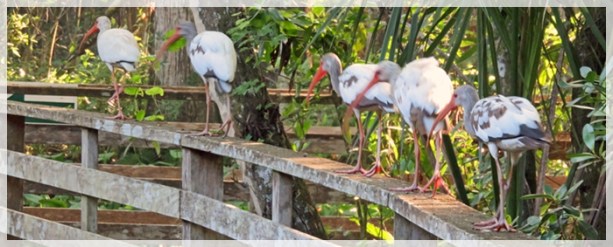
Jesus called out to them, “Come, follow me, and I will show you how to fish for people!” … As Jesus was walking along, he saw a man named Matthew sitting at his tax collector’s booth. “Follow me and be my disciple,” Jesus said to him. So Matthew got up and followed him. … [Matthew 4:19,9:9 (NLT)]
After deciding to explore a park we’d just discovered, I became apprehensive when no map was available on line or posted at the park. It’s not like we were going to get hopelessly lost on asphalt trails and a boardwalk; nevertheless, I was uncomfortable not knowing exactly where the trails would lead. Then again, I’m the sort of person who keeps all sorts of maps in her car, buys guidebooks, Map Quests a location, uses her GPS and never leaves home without a reservation. Admittedly, I’m also a person with a lousy sense of direction so I need all the help I can get!
Simon Peter, Andrew, John and James—they all abandoned their nets, boats, livelihoods, and even the day’s catch to follow Jesus! Later, Jesus called Matthew out of his tax collector’s booth and the taxman immediately followed. That these men responded to Jesus’ call and readily left their old lives behind is remarkable. More astonishing for me is that, after Jesus said, “Follow me,” none of them asked “Where?”
If someone told me to follow him, I’d be sure to inquire, “Where?” Then, I’d probably want to know the route we’d take, whether I’d like it there, when we’d return, where we’d be staying, and what we’d be doing whenever we got to wherever it was we were going. Before they dropped everything to follow Him, those disciples never asked Jesus their destination (or anything else, for that matter). I never even liked playing “Follow the Leader.” Yet, when the disciples blindly followed their leader, they weren’t playing a silly childhood game. The stakes were much higher and their lives were never the same.
When Jesus says, “Follow me!” He expects us to trust Him enough to do just that. Granted, it’s frightening to step into the unknown but the sheep don’t get to ask the shepherd where they’re going and neither do we. Moreover, following Jesus doesn’t mean fitting His plan into our lives; following Jesus means fitting our lives into His plan. Even without a compass, maps or GPS, we can never be lost when we’re following Him because He’ll never lead us astray. Moreover, while we may not know the route He’ll take, we do know we’ll be doing His work along the way. When we think about it, we also know that our final destination is well worth the trip!
 Yesterday, I wrote about unfounded fears. Although I’m a bit of a nervous flyer, I’d rather travel than stay home, so I pray and fly. While I’m a little nervous about heights, I’d rather ride than hike up the mountain, so I pray and ride the lifts. Since my little Ziggy-like guy can easily capture my irrational fears, they rarely plague me. It’s not fear of external things like plane crashes or gondola accidents, however, that disturb me. Instead, it’s the fear that happens when I focus on me instead of God. Will I be wounded, bothered, abandoned or tested? What if I don’t succeed, reach my goal, or make a good impression? Will I be welcome? What if I make a mistake?
 Bad things happen, unforeseen events occur, and every one of us will eventually become a fatality statistic of some kind. A certain amount of fear or caution is wise in our unpredictable world. Most of us, however, are rather selective in our fears. We obsess over things about which we have little or no control and ignore those things over which we do. We don’t want to give up control to the pilot when the odds of dying in a plane crash are 1 in 11 million but trust our driving when the odds of a fatal car crash are 1 in 5 thousand! While we are far more likely to die of heart disease (1 in 6), we tend to obsess about things like dying in a terrorist attack (1 in 20 million). In actuality, we are fourteen times more likely to die in our bathtubs and twenty-five times more likely to die by choking on our food than in a terrorist attack, but we prefer not to think about that while bathing or eating.
 Ralph Waldo Emerson said, “Life is a journey, not a destination;” I thought of that quote when reading an article about a local man who attempted an unsupported solo ski trek from the edge of the Antarctic to the South Pole. This experienced adventurer spent several years preparing for the expedition and rigorously testing his equipment. With extras of nearly everything, he was sure he’d planned for every eventuality. What he hadn’t anticipated was encountering one of the worst summers the Antarctic has experienced, an issue with a ski that caused him constant soreness in his right foot, and a cracked teapot! The teapot (the lone one he had) was the only way he could melt snow and, without it, he’d have no water. Reluctantly, he asked a support plane to airdrop a new pot and, in spite of his best intentions, the trek changed from unsupported to supported. Then, a combination of wind and foot pain took their toll. Although he’d planned on making ten to twelve miles a day, no matter how hard he pushed himself, he averaged only eight and his supplies dwindled. After over 300 miles and thirty-six days alone on the ice, he approached an area where a plane could safely land. If he continued at his pace, he would definitely need more supplies. Moreover, there was an excellent chance that, if and when he arrived at the South Pole, extraction planes would no longer be flying. Although he’d have bragging rights for attaining his goal, penguins could be the only ones who’d ever hear his boasting. Weighing his options, he decided it was time to leave. “For me, turning back is never the wrong decision,” he said.
 Devotions of the Heart