
For I hold you by your right hand—I, the Lord your God. And I say to you, “Don’t be afraid. I am here to help you.” [Isaiah 41:13 (NLT)]
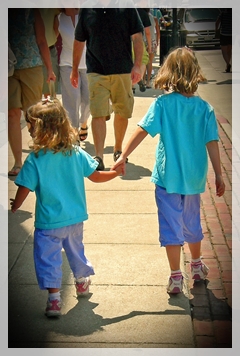 Scientists have found that even a simple hug or the holding of hands can lower both blood pressure and heart rate in stressful situations. Gentle touch also causes a decrease in the stress hormone cortisol and an increase in oxytocin (often called the “cuddling hormone”). Where cortisol might give a “fight or flight” response, oxytocin causes more of a “tend and befriend” one by increasing feelings of trust and connection. Since we were at a funeral and the previous ten days had been a roller coaster of emotion and tension for everyone, the priest’s request to join hands as we stood in prayer benefitted us physically and psychologically as well as spiritually.
While holding hands during prayer wouldn’t be unusual in many evangelical Protestant churches, apparently it is in Roman Catholic ones (especially when done during every prayer) and it has become a point of contention in some dioceses and parishes. Being a rather touchy-feely Protestant, I enjoyed the hand holding and the feeling of solidarity in prayer that came with it. The priest, however, asked us to do more than simply join hands. “Take the hand of the person beside you,” he instructed, “and, fully aware of the soul you are touching, join in prayer.” As I held the hand of the stranger beside me, I thought of those words: “fully aware of the soul you are touching.” I didn’t know the man and will never see him again. From his rosary, I knew we do not attend the same church. Nevertheless, I knew we worshipped the same God and were there for the same reason: to celebrate the life of the man whose body lay in a casket near the altar. As I became more aware of the soul I was touching, my thoughts turned from my own personal sorrow to the sorrow shared by all who were present in the sanctuary. We were one community, united in our thanksgiving for the man we mourned, in our intercessions for his family, in our love for God, and in our belief in the resurrected Christ and the life everlasting.
I appreciate that some people are uncomfortable with the intimacy of holding hands and find doing it during worship an unwelcome innovation. Whether or not we touch one another during prayer is not as important as being fully aware of one another: not just of the people with whom we pray but of all with whom we interact. Fellow travelers through this troubled world, they are struggling as much as we are to navigate the challenges, sorrow, and pain in their paths. Is there some way we can make their journey easier? Sometimes, we find that answer in a simple touch. While we probably won’t bring healing to their bodies, we may bring some healing to their souls.
At the conclusion of the funeral, the deceased’s family followed the casket out of the sanctuary and his sister passed by our pew. My husband stepped into the aisle beside her and they joined hands as they walked out together. Although we hardly know her, fully aware of her mournful soul, he knew her need to be supported during that difficult walk.
Lord, teach us to be fully aware of the souls we encounter each day. Let our words be kind, our actions helpful, and our touch gentle and supportive.
When we honestly ask ourselves which person in our lives means the most to us, we often find that it is those who, instead of giving advice, solutions, or cures, have chosen rather to share our pain and touch our wounds with a warm and tender hand. [Henri Nouwen]
 Now all glory to God, who is able, through his mighty power at work within us, to accomplish infinitely more than we might ask or think. [Ephesians 3:20 (NLT)]
 Jesus said, “Don’t let your hearts be troubled. Trust in God, and trust in me. There are many rooms in my Father’s house; I would not tell you this if it were not true. I am going there to prepare a place for you. After I go and prepare a place for you, I will come back and take you to be with me so that you may be where I am. You know the way to the place where I am going.” [John 14:1-4 (NCV)]
 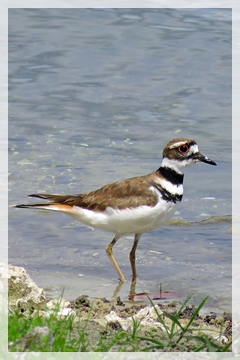 I was singing along with Zach Williams, “Fear, he is a liar,” when I recalled one of my memory verses: “The Lord is my light and my salvation—so why should I be afraid?” [Psalm 27:1] I then realized a commonality in the Bible verses I’ve been memorizing: fear. If asked, I wouldn’t say I’m a fearful person and yet the Bible verses I’ve been memorizing contradict me. I don’t suffer an assortment of phobias nor do I see a threat around every corner. I’m not unduly anxious—I don’t pace, bite my nails, stay awake all night, or binge eat. While I’m cautious when the situation calls for caution, I don’t consider myself irrationally fearful, so why did I choose to memorize so many Bible verses dealing with fear?
 This I declare about the Lord: He alone is my refuge, my place of safety; he is my God, and I trust him. [Psalm 91:2 (NLT)]
 and literally jumped through hoops; all of this took place some twelve to eighty feet above the forest floor.
 He said, “That’s what I mean: Risk your life and get more than you ever dreamed of. Play it safe and end up holding the bag.” [Luke 19:26 (MSG)]
 Devotions of the Heart