WITH WONDER

But when Jesus saw it, he was indignant and said to them, “Let the children come to me; do not hinder them, for to such belongs the kingdom of God. Truly, I say to you, whoever does not receive the kingdom of God like a child shall not enter it.” [Mark 10:14-15 (ESV)]
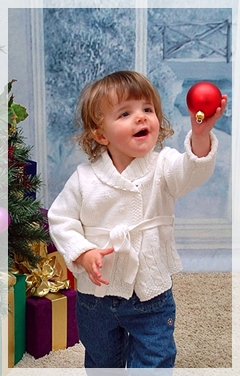
One day, the disciples scolded some parents for bringing their children to Jesus for a blessing. After telling them the Kingdom belonged to those who received it like a child, He called the children to Him. Unlike adults, children accept their humble position and live by faith and trust. Without self-consciousness and knowing they are in complete dependence on the giver, they receive gifts with humility and enthusiasm. Like explorers, children have a sense of wonder on their quest to learn about the world around them. They are filled with excitement and awe at every new thing they experience because life hasn’t become routine, predictable, or run-of-the mill to them.

Thinking of a child’s sense of wonder, I recalled my grand’s reaction to the small nativity I purchased for her more than twenty years ago. While her parents were away for the weekend in late November, she stayed with us. Although the tyke knew all about Santa, she didn’t know the Christmas story so I gave her a nativity set in a small wooden box. It had a handle on top so it could be carried like a purse and a latch in front that, when opened, revealed a stable and about a dozen wooden figures. As we opened the box, I told her the beautiful story that went along with those figures. Her eyes were big as saucers as she heard about the baby Jesus, angels, shepherds, wise men with gifts, and a star that led them to the baby. Filled with wonder at the amazing story, she had me tell it several times. When her parents came to pick her up, she immediately sat them down in our living room. After carefully opening her nativity box, she enthusiastically identified each character and explained the Christmas story to them.

How many Christmas pageants have we attended? How many Christmas Eves have we heard the words from Luke 2 or sung “Silent Night” in candlelight? How many times have we heard about the angelic chorus and the shepherds’ astonishment? Are we as astonished by the nativity as were they? Unlike a child, I suspect that we’ve lost our sense of awe and wonder at the incarnation—our astonishment that Jesus clothed Himself in a human body so that He could live a sinless life only to suffer a sinner’s death.

We’ve probably lost count of the Palm Sunday, Maundy Thursday, or Tenebrae/Good Friday services we attended. How many times have we heard about Jesus washing the disciple’s feet or the women discovering the empty tomb on Easter morning? For that matter, how many times have we read or heard about the feeding of the multitude, the miraculous provision of wine at Cana, blind Bartimaeus receiving sight, or the parable of the Prodigal Son? While familiarity doesn’t necessarily breed contempt, it can breed boredom.

In theater, the actors are expected to deliver a well-rehearsed performance in a fresh and new way every time. Called the “illusion of the first time,” they endeavor to make the audience feel like they are witnessing something happening for the very first time. What if we, as readers and hearers of the word, tried to create the “illusion of the first time”? What if we put on the eyes and ears of a child who’s hearing or reading it for the first time—someone who doesn’t know that Abraham won’t have to sacrifice Isaac, Lazarus will walk out of the tomb, only one leper will return to thank Jesus, the Red Sea will part, the walls of Jericho will collapse, or that young David will defeat the gigantic Goliath? What if we were hearing or reading those familiar narratives for the first time? Even though we know the stories, shouldn’t we be as filled with wonder as was my grand when she learned the Christmas story? Shouldn’t we be as amazed as were the shepherds when they heard an angelic chorus on the night of Christ’s birth, as astonished as were the mourners when Lazarus walked out of that tomb, as distressed as were the women at the foot of the cross, and as stunned as were the disciples when Jesus appeared Easter morning!?

While we may have the knowledge of decades-long believers, let us come to Scripture with a child’s awe and sense of wonder. Let us react to the words as if it were the first time we’ve read or heard them—as if we don’t know how the story ends. Let us recreate the “illusion of the first time” and have the wonder of a child!

A child’s world is fresh and new and beautiful, full of wonder and excitement. [Rachel Carson]
And great crowds came to him, bringing with them the lame, the blind, the crippled, the mute, and many others, and they put them at his feet, and he healed them, so that the crowd wondered, when they saw the mute speaking, the crippled healthy, the lame walking, and the blind seeing. And they glorified the God of Israel. [Matthew 15:30-31 (ESV)]

Copyright ©2025 jsjdevotions. All rights reserved.

THE NATIVITY (2) – LIONS, LAMBS, KINGS, AND SHEPHERDS

The wolf shall dwell with the lamb, and the leopard shall lie down with the young goat, and the calf and the lion and the fattened calf together; and a little child shall lead them. The cow and the bear shall graze; their young shall lie down together; and the lion shall eat straw like the ox. [Isaiah 11:6-7 (ESV)]

And one of the elders said to me, “Weep no more; behold, the Lion of the tribe of Judah, the Root of David, has conquered, so that he can open the scroll and its seven seals.” [Revelation 5:5 (ESV)]

For centuries, access to the written Word of God was limited to just a few. The printing press wasn’t invented until 1439 and, at the time, only about 20% of the population could read. As a result, churches were decorated with paintings, stained glass windows, statues, carvings, and mosaics depicting biblical stories or illustrating theological concepts. For people who couldn’t read the book, religious art told the story. Consider how the Stations of the Cross in Roman Catholic churches illustrate the events of Good Friday. Sometimes, a picture really is worth a thousand words! While most nativity scenes are inaccurate, our depictions of the nativity don’t have to be historically exact to be meaningful.
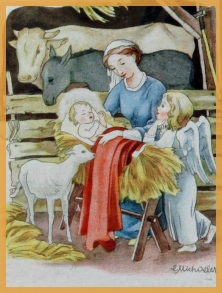
At the Christmas market last week, an artist was painting a nativity scene. Having just written about the ox and ass found in depictions of Jesus’ birth, I was curious if he had them in his. Along with ox and ass, there was a lamb. The presence of this sacrificial animal is a vivid reminder that Jesus was the Lamb of God. It reminds us that His sacrifice on the cross is the reason for that baby in the manger.

But, front and center on the canvas, the artist painted a large lion looking down at the infant Jesus laying in a bed of hay. While not as common as the lamb, ass, and ox, the lion is no stranger to nativities. It points to Jacob’s promise to his son Judah that a conquering victorious king, the lion, would be from his line and suggests the words in Revelation 5:5 referring to Jesus as “the Lion of the tribe of Judah, the Root of David.”  The lion’s presence also illustrates Isaiah’s prophecies of a time when God’s fallen creation will be remade into a place of peace, harmony, and order—a time when Christ will reign over all the earth—when a lion will eat straw rather than babies in a manger!

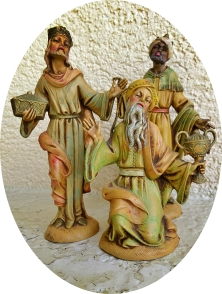
Although they didn’t arrive until Jesus was a toddler, we also find the magi in most nativities. Rather than kings, the magi probably were scholars or priests knowledgeable in astronomy and astrology. It may have been the extravagance of their gifts that caused them to be portrayed as royalty. Moreover, kings presenting gifts to the Messiah echo the prophecies of Isaiah 60 and Psalm 72.

While three gifts were presented, Scripture doesn’t say how many magi there were. Nevertheless, we see three. One king usually is depicted as a Black African, another as Caucasian, and the third as Asian. In Jesus’ day, there were three known continents—Africa, Asia, and Europe. In the 700s, the Venerable Bede (theologian and historian) posited that each of the magi represented one of those parts. As inaccurate as their depictions may be, their different races beautifully illustrate that Jesus came for the people of all nations and races. Seeing the kings of the world bowing in humble worship to the King of Kings, we are reminded that earthly kingdoms may fall but God’s Kingdom will not be destroyed!

In sharp contrast to a nativity’s richly attired kings are the often-barefoot shepherds in their simple attire. While kings were at the top rung of the social ladder, shepherds (along with taxmen and lepers) were at the bottom. The presence of both groups around the manger reinforces the unity that all people (both rich and poor) have in Christ! One shepherd often stands out from the others—a tall shepherd carrying a lamb on his shoulders. His presence is a subtle reference to Jesus as the “good shepherd” who will go to great lengths to save His flock.

Take time this holiday season to look at the various renditions of the nativity around you. Instead of looking for historical accuracy, try to find the scriptural and theological themes hidden within the art. Indeed, sometimes a picture is worth a thousand words!

May the kings of Tarshish and of the coastlands render him tribute; may the kings of Sheba and Seba bring gifts! May all kings fall down before him, all nations serve him!  For he delivers the needy when he calls, the poor and him who has no helper. He has pity on the weak and the needy, and saves the lives of the needy. From oppression and violence he redeems their life, and precious is their blood in his sight. [Psalm 72:10-14 (ESV)]

Copyright ©2024 jsjdevotions. All rights reserved.

THE NATIVITY (1) – THE OX AND ASS

The ox knows its owner, and the donkey its master’s crib, but Israel does not know, my people do not understand. [Isaiah 1:3 (ESV)]

Here betwixt ass and oxen mild, sleep, sleep, sleep, my little child… [13th century French carol]

The earliest known portrayal of Jesus’ birth is a bas relief on a Roman sarcophagus from around 385. It depicts the swaddled Christ child in the manger flanked by an ox at His head and an ass at His feet. Why are they present instead of Joseph and Mary? In 1223, Francis of Assisi brought some hay and a manger to a cave and celebrated Mass there on Christmas Eve. Even though Mary and Joseph weren’t present, an ass and an ox were! In 1291, Pope Nicholas IV commissioned Arnolfo di Cambio to create a permanent nativity. While there are statues of Mary and Jesus, Joseph, and three Magi, the sixth statue shows the heads of an ox and an ass rather than shepherd or angel. Besides the baby Jesus, the ass and the ox are the most ancient and consistent elements in depictions of the nativity. Why do these two animals, neither of which is mentioned in the gospels, have such a prominent place in our nativity scenes, Christmas cards, and carols?
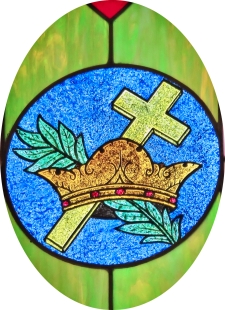
In Scripture, the ox came to represent the people of Israel. As the most important and costly of sacrificial animals, the ox also represented Israel’s prosperity and power. In the temple, figures of twelve oxen (representing Israel’s twelve tribes) supported the huge bronze basin that held water for ritual cleansing. While the ox was considered a ritually “clean” animal, the undivided hoof of the donkey (or ass) made it “unclean” so it came to represent the pagan Gentile nations. Deuteronomy 22:10 specifically prohibited plowing with an ox and an ass yoked together. Jews interpreted this law as being about more than plowing—it was about not mixing the clean with the unclean or the Jew with the Gentile.

In the 8th century BC, Isaiah prophesied, “The ox knows its owner, and the donkey its master’s crib, but Israel does not know, my people do not understand.” At the time, he was bringing God’s charges against Judah and speaking of God’s judgment against them in the immediate future through Assyria and also God’s later judgement with Babylon’s invasion and the fall of Jerusalem. Dumb animals knew to whom they belonged, but God’s chosen people did not!

With the benefit of hindsight, however, the early Church fathers recognized a third prophecy in Isaiah’s words—that of the Messiah’s arrival when Israel failed to recognize Him. Like the donkey, however, the Gentiles knew their master’s crib. Because the ox and ass recognized the Christ when the world did not, they are shown with the Christ. This image illustrates Paul’s words to the Ephesians that Jews and Gentiles are reconciled and have become one in Christ. Their presence at the nativity became a visual way of saying that Jesus came to save the people of all nations!

Because the firstborn male was the Lord’s, Mosaic law demanded the sacrifice to God of every firstborn male of the people’s livestock. As a ritually clean animal, the ox was an acceptable sacrifice. As an unclean animal, however, the ass could not enter the temple or be offered to God. A law unique to the ass gave its owner a choice—rather than killing such a valuable animal, he could redeem it with the sacrifice of a lamb. We sinners, like the ass, are unclean and cannot enter God’s tabernacle but, like the ass, our owner can redeem us with the sacrifice of an innocent lamb, which He did! We are redeemed by the blood of Jesus, the Lamb of God.

While seeing an ox and ass on Christmas cards or in nativity scenes may not be an accurate representation of that first Christmas, let us remember the symbolism behind their presence. While we may be as different as an ox is from an ass, Christ’s church is made up of one united people—people who have been redeemed by the blood of the Lamb!

There were only a few shepherds at the first Bethlehem. The ox and the donkey understood more of the first Christmas than the high priests in Jerusalem. And it is the same today. [Thomas Merton]

You are brought near to God through the blood sacrifice of Christ. Christ is the reason we are now at peace. He made us Jews and you who are not Jews one people. We were separated by a wall of hate that stood between us, but Christ broke down that wall. By giving his own body, Christ ended the law with its many commands and rules. His purpose was to make the two groups become one in him. By doing this he would make peace. [Ephesians 2:13b-15 (ERV)]

Copyright ©2024 jsjdevotions. All rights reserved.

CHRIST THE KING

“My kingdom isn’t the sort that grows in this world,” replied Jesus. “If my kingdom were from this world, my supporters would have fought, to stop me being handed over to the Judaeans. So then, my kingdom is not the sort that comes from here.” [John 18:36 (NTE)]

God’s kingdom, you see, isn’t about food and drink, but about justice, peace, and joy in the holy spirit. [Romans 14:17 (NTE)]

For those of us who attend liturgical churches, yesterday was the last Sunday of the liturgical (or church) year: Christ the King Sunday. A kind of liturgical “New Year’s Eve,” it is the climax and conclusion of the Church’s year.
Starting with Advent, the first half of the church year focuses on the events of Jesus’ life: His incarnation, birth, manifestation, temptation, suffering, death, resurrection, and ascension. The second half of the church year begins on Pentecost (with the outpouring of the Holy Spirit) and, depending on Easter’s date, lasts 23 to 28 Sundays. Sometimes called Ordinary Time, this season focuses on the teachings of Jesus. Next Sunday, we start a new year with the first Sunday in Advent and begin another journey through Scripture to remind us of who we are and to whom we belong.

Like the rest of the liturgical church calendar, Christ the King Sunday is man-made rather than ordained by God. Nevertheless, having attended a liturgical church most of my life, I find comfort in regularly celebrating not just Christmas and Easter but the entire mystery of Jesus—from His incarnation through His death, resurrection, and ascension, to the gifting of the Holy Spirit and the expectation of His glorious return.

When I first saw the words “Christ the King” on the church hymn board years ago, I didn’t know that this observance is a modern addition to the church year. It was instituted in 1925 by Pope Pius XI in response to the growth of communism, fascism, atheism, and secular ultra-nationalism in Europe at that time. Although first observed by the Roman Catholic church, Protestant denominations such as the Lutheran, Anglican, Moravian, Methodist, Nazarene, and Presbyterian churches have joined in observing this day as a reminder that Christ reigns above all earthly rulers.

In the past, cults of personality have formed around leaders like Mussolini, Hitler, Stalin, Mao Zedong, and they continue to form around some world leaders today. Christ the King Sunday is a vivid reminder that our allegiance belongs to our spiritual ruler in heaven as opposed to any earthly political “messiah.” While temporal powers will fade away, Christ’s reign and His kingdom remain eternal. Whether Roman Catholic, Orthodox, or Protestant, observing Christ the King helps to move us from the politics of people to the politics of heaven.

Indeed, Jesus is unlike any other head of state in history. While most leaders are concerned with gaining, increasing, and maintaining power, Jesus gave up His divine power to live as a man among the poor and humble and to die a criminal’s death. While the world’s “kings” strive to amass wealth; King Jesus deliberately left the grandeur of Heaven to be born in a stable and live in a small village as a carpenter’s son. Believing that might makes right, the world’s leaders use economic and military might to enforce their will but Jesus chose to love and forgive his enemies. Jesus’ kingly degrees are unlike those of any earthly ruler: love God, love our neighbors, do unto others as we would have them do to us, pray for our enemies, turn the other cheek, go the extra mile, live in peace with one another, and invite the poor, crippled, lame and blind to our banquets—hardly the typical political platform!

The Kingdom of God is a present reality in our lives and yet, at the same time, the completed Kingdom is yet to come. Theologians describe it as our living in the already—what Christ has done—and the not yet—what He is yet to do when He returns in majesty and glory. Until that day, however, there will be a struggle between the kingdoms of this world and God’s Kingdom. We might want to ask ourselves to which kingdom we owe our allegiance and evaluate whether our actions, attitudes, and words reflect that allegiance. May we always remember that Jesus is our only king; indeed, He is the King of Kings and Lord of Lords!

Then I heard something like the sound of a great crowd, like the sound of many waters, and like the sound of strong thunder, saying, “Alleluia! The Lord our God, the Almighty, has become king! Let us celebrate and rejoice and give him the glory, because the marriage of the lamb has come, and his bride has prepared herself. … On his robe, and on his thigh, is written a name: King of kings, and Lord of lords. [Revelation 19:6-7,19 (NTE)]

Copyright ©2024 jsjdevotions. All rights reserved.

LIKE LOCUSTS

The attackers march like warriors and scale city walls like soldiers. Straight forward they march, never breaking rank. They never jostle each other; each moves in exactly the right position. They break through defenses without missing a step. [Joel 2:7-8 (NLT)]

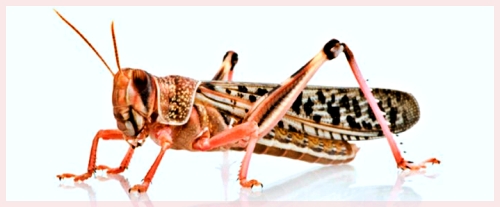
The prophet Joel wrote about God’s coming judgment of Judah but, because there’s disagreement about the date of his prophecy, we aren’t sure if he was describing the approaching Babylonian invasion, God’s final judgment, or both. In any case, the prophet likened the coming army to a swarm of locusts. Like locusts, this invading force would march straight, never break rank or crowd one other, and be unstoppable as they swarmed over the city. Before their arrival, the land would be like the Garden of Eden but, by the time they departed, it would be in utter desolation. Along with Joel, the books of Judges, Jeremiah, Nahum, and Revelation depict enemy hordes as locusts. In Proverbs 30, however, the sage Agur expresses admiration for the “small but wise” locusts because they “march in formation” without a king!

Assuming that Scripture’s words likening locusts to soldiers in a well-organized army were more figurative than scientific, I never gave these grasshopper-like insects much thought. When Charles Spurgeon used them as an example of “how thoroughly the Lord has infused the spirit of order into His universe,” and said, “Locusts always keep their rank, and although their number is legion, they do not crowd upon each other, so as to throw their columns into confusion,” I grew curious.

Normally, locusts are solitary creatures but, when conditions such as flooding or drought cause them to crowd into the same area, physical contact triggers their instinct to become sociable. As they forage for food together, they gather into a swarm of millions. Whether “marching” on land or flying in the air, locusts all go in the same direction and, if the swarm spontaneously changes course, they all switch direction as a group.

Weighing less than a dime, a single locust is hardly worth noticing—an insignificant and unremarkable insect, it’s easily crushed. The locust’s power comes when it joins with others like it. As a swarm, locusts are unstoppable and nearly unbeatable. A single swarm of locusts can number in the trillions, cover hundreds of square miles, move up to 100 miles in a day, and consume over 420 million pounds of vegetation every day!

Sharing a common goal, locusts have learned the best way to achieve it is to act as one. Their singleness of purpose is what makes them unbeatable. They are proof that, when small things come together, they have incredible power. While the cohesiveness of the locusts turns out to be a bad thing for mankind, what if Christ’s church were as unified as these insects? While thinking of the church in terms of locusts isn’t an attractive image, it is a compelling one.

If millions of insects having a brain less than ¼-inch in size can form a united force without having a leader tell them what to do, why can’t Christians? We’re certainly smarter than locusts and we have a king—King Jesus. Under His command, His army of soldiers should be able to gather as one and be a powerful force in this world.

While the locusts’ common enemy is hunger, ours is Satan; one of his favorite strategies is to divide and conquer and he’s done a great job of it! With about 45,000 different Christian denominations worldwide, we’re becoming better known for our scandals, squabbles, splits, and divisions than for our unity, harmony, and cooperation. Christ’s church always will have disagreements but Jesus and the mission He gave us is greater than our disagreements. As part of the same body—the body of Christ—we don’t have to agree on everything to partner with one another. Let us put aside our theological arguments, doctrinal disputes, and cultural biases, along with our different backgrounds, traditions, rituals, and governance to focus on what unites us: our faith in Jesus! Only then will we be able to feed His sheep and “make disciples of all the nations.”

Worldwide evangelism requires the whole church to take the whole gospel to the whole world. [Lausanne Covenant]

“Therefore, go and make disciples of all the nations, baptizing them in the name of the Father and the Son and the Holy Spirit. Teach these new disciples to obey all the commands I have given you. And be sure of this: I am with you always, even to the end of the age.” [Matthew 28:19-20 (NLT)]

Copyright ©2024 jsjdevotions. All rights reserved.

ONCE AND FOR ALL – YOM KIPPUR

He will lay both of his hands on the goat’s head and confess over it all the wickedness, rebellion, and sins of the people of Israel. In this way, he will transfer the people’s sins to the head of the goat. Then a man specially chosen for the task will drive the goat into the wilderness. As the goat goes into the wilderness, it will carry all the people’s sins upon itself into a desolate land. [Leviticus 16:21-22 (NLT)]

While the year is 2024 on most calendars, it is year 5785 on the Hebrew calendar and the tenth day of Tishri begins at sunset tomorrow. For our Jewish brothers and sisters, it will be the Day of Atonement or Yom Kippur. With its themes of atonement and repentance, it the holiest day of the year for a Jew.

The book of Leviticus describes the rituals the Israelites were to perform on this holy day every year. In ancient Israel, this was the only time the high priest could come into the Holy of Holies (the innermost sacred area of the tabernacle or temple) where the Ark of the Covenant was housed. But, before coming into the presence of God and the Ark and beginning the ritual of atonement, he had to ritually cleanse himself from sin by bathing and dressing in spotless plain linen garments. The high priest then atoned for his own sins and those of his family with the sacrifice of a bull.

Two unblemished male goats were taken from the community and lots were cast to determine which goat would be given to the Lord. The first goat was sacrificed and its blood sprinkled on the mercy seat of the Ark. This was the sin offering and made to appease the wrath of God and atone for the sins of the people. Then, having received forgiveness, the second goat was brought before the altar. As a way of transferring the sins of the people to the goat, the priest laid his hands on its head and confessed all the peoples’ sins and transgressions. This goat, the “scapegoat,” was then sent out into the wilderness to carry those sins into the wasteland. In this ancient ritual, the blood of the first goat provided propitiation by appeasing God’s wrath and the second goat provided expiation by atoning for and removing those sins. This atonement ritual was to be repeated year after year.

Without a temple in Jerusalem, there no longer are animal sacrifices or scapegoats. Nevertheless, Jews throughout the world continue to observe this holy day. When a fast day occurs on the Sabbath, it is postponed until Sunday but Yom Kippur is the exception to that rule. Referred to as the Shabbat Shabbaton (the Sabbath of Sabbaths), our observant Jewish friends will fast from all food and drink (including water) from just before sunset Friday until after sunset Saturday. Along with fasting, many Jews will abstain from wearing leather footwear, washing or bathing, applying lotions and creams, or having marital relations. Most of Yom Kippur is spent in the synagogue in intensive prayer, introspection, and the asking of God’s forgiveness for the past year’s sins. The day ends with a single blast of the shofar (ram’s horn trumpet) followed by the proclamation, “Next year in Jerusalem.”

Unlike the yearly sacrifice of goats, the sacrifice of Jesus upon the cross needed to be done only once. Christ was both our sinless high priest and the unblemished sacrifice. When He gave himself up for us, Jesus took God’s wrath upon himself as His blood dripped on the ground beneath Him. When He suffered and died on the cross, Jesus was both the propitiation and expiation of our sins for all time. By dying, this sinless man took on God’s wrath—the wrath we sinners deserved. Rather than take our transgressions into the wilderness, He “removed our sins as far from us as the east is from the west” for all time. [Psalm 103:12] Thank you Jesus!

If you are ready to partake of grace you have not to atone for your sins—you have merely to accept of the atonement. All that you want to do is to cry, “God have mercy upon me,” and you will receive the blessing. [D.L. Moody]

We are made right with God by placing our faith in Jesus Christ. And this is true for everyone who believes, no matter who we are. For everyone has sinned; we all fall short of God’s glorious standard. Yet God, in his grace, freely makes us right in his sight. He did this through Christ Jesus when he freed us from the penalty for our sins. [Romans 3:22-24 (NLT)]

Copyright ©2024 jsjdevotions. All rights reserved.