
 Simon, Simon, Satan has asked to sift each of you like wheat. But I have pleaded in prayer for you, Simon, that your faith should not fail. So when you have repented and turned to me again, strengthen your brothers. [Luke 22:31-32 (NLT)]
I have told you all this so that you may have peace in me. Here on earth you will have many trials and sorrows. But take heart, because I have overcome the world.” [John 16:33 (NLT)]
‘Cause what if Your blessings come through raindrops?
What if Your healing comes through tears?
And what if a thousand sleepless nights are what it takes to know You’re near?
What if my greatest disappointments or the aching of this life
Is the revealing of a greater thirst this world can’t satisfy?
And what if trials of this life-
The rain, the storms, the hardest nights
Are Your mercies in disguise? [Laura Story]
One of the benefits of my thrice weekly PT appointments for the last several months has been the time I spend alone in the car with the radio tuned to the Message on SiriusXM. Sometimes I uninhibitedly sing along with the contemporary Christian praise music and other times I quietly ponder the songs’ words. As I listened to Laura Story’s song “Blessings,” I pondered the many storms, tears, disappointment, and sleepless nights that turned out to be God’s “mercies in disguise.”
In 2006, just two years into her marriage, Laura Story nearly lost her husband to a brain tumor. Although he survived, disabilities remained from his surgery and the future once envisioned by the young couple changed significantly. Among other things, instead of being a stay-at-home mother, Story became breadwinner and caregiver. Her song “Blessings” was written as a reminder that God remains faithful even when things don’t turn out the way we envisioned. “Life is filled with things you don’t expect, but the Bible tells us to respond by trusting God and continuing to worship Him,” said the singer/songwriter. “God has grown us up, deepened our faith, our awareness of our great need for Him as a savior, daily.”
We’ve all experienced those unexpected and uninvited changes—the storms of life—that necessitate changing our expectations and revising our concept of normal. One such event happened in my life fourteen years ago. The details are unimportant but, as I listened to Story’s song, I saw how it was, indeed, a blessing in disguise. At the time, I mourned the end of a dream—the loss of what I envisioned in the future for myself and my family. But, as weeks stretched into months and months into years, the old vision was laid to rest. I wasn’t the only one affected and everyone in that storm lost something as it rained down on us. Nevertheless, just as Jesus was with the disciples in the midst of that storm on the Sea of Galilee, He was with me in that storm, and He will be with us in the storms to come.
When Jesus warned Peter that he’d be run through the sifter, He was telling the disciple that he’d be going through an ordeal and put to the test—a test that would separate the grain from the chaff—the good from the bad. For me, those years were a long season of sifting—sorting out priorities, persevering with what seemed like unanswered prayers, dealing with hardened hearts, accepting what I couldn’t change, learning to step back and allow God to do His work, and trusting the future to Him. It actually was a season of sifting for all involved as resentment and bitterness were separated from forgiveness, animosity from love, doubt from faith, weakness from strength, anger from understanding, excuses from accountability, fear from courage, and deceit from truth.
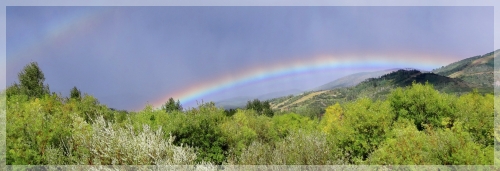
Years later, after plenty of sifting and what Paul would call character strengthening, the storm abated and we finally saw the rainbow at its end. Granted, life is not the same as it was but that doesn’t mean that it isn’t good and probably even better because of that storm.
As it turns out, I now can call one of the darkest times of my life a true blessing and I think the others affected would agree. Of course, the end of one storm doesn’t mean there won’t be others. Nevertheless, we can face them with confidence because, like Laura Story, we’ve learned that the “trials of this life—the rain, the storms, the hardest nights” can be God’s “mercies in disguise.”
 Even though this last year has been one of sorrow and loss for us, I smiled when I recognized the Sorrowless Tree’s bright orange and yellow flowers at the botanical garden. Although its scientific name is Saraca asoca, the Ashoka is commonly called the Sorrowless Tree. Sometimes I wish such a tree actually existed. Even though the tree can’t prevent sorrow, its beautiful foliage and sweet fragrance were just what I needed to lift my spirits as I mourned yet another friend’s death. The flowers reminded me to find joy and gladness in the day God had given me.
 Back in 2008, my husband and I joined others from our church to see Fireproof, a movie by Alex and Stephen Kendrick. It was about Caleb Holt, a firefighter, who’s urged by a friend and his father to hold off on getting the divorce to which he and his wife have agreed. Counseling him to fight for his crumbling marriage, his father gives him a Christian self-help book called The Love Dare and urges him to go on its forty-day challenge. Having nothing to do with the game “Truth or Dare,” the book dares Caleb to improve his marriage, not by changing his wife, but by changing the way he treats her. After completing the forty day challenge, Caleb continues changing his behavior and he and his wife eventually reconcile. As I remember, the movie ends with them renewing their marriage vows. Several months after seeing the movie, I spotted The Love Dare book while browsing through a bookstore. Whether the movie gave birth to the book or the book gave birth to the movie, I don’t know. In any case, I purchased it and, without my husband knowing, took on its 40-day challenge.
 While I’ve been challenged by a scarcity of things like patience, endurance, and wisdom, I confess to never facing a bare cupboard, empty refrigerator, unfilled closet, or depleted bank account and never wondering where I would sleep at night or how I would feed or clothe my children. It’s not that difficult to trust God for His daily provision when we already have more than enough. Trusting Him when the cupboard is bare (or nearly so) is an entirely different story and a new experience for me. It’s not that I’m facing bankruptcy or foreclosure but that my supply of devotions is rapidly diminishing. It seems like I’m publishing faster than I can write and I can’t seem to get ahead. Watching my stockpile diminish, I envision blog bankruptcy and worry threatens my faith in God’s provision.
 Several years ago, author and apologist Lee Strobel commissioned a national survey asking people the one question they would pose to God if they could. As might be expected, the number one response was “Why is there suffering in the world?” Indeed, like Job, we want to know why, especially if the affliction directly affects us or the ones nearest and dearest to us. Why did he get Alzheimer’s? Why did she go into a coma? Why did his child get leukemia or hers have Down’s syndrome? Why was the surgery a failure? Why didn’t the driver stop? Why can’t I have children? Why was he at the wrong place at the wrong time? Why didn’t you stop the shooter from taking those children’s lives? Why couldn’t you save those who perished in that deadly tornado? Why do bad things happen to good people?


