RED LIGHTS

Rejoice in our confident hope. Be patient in trouble, and keep on praying. [Romans 12:12 (NLT)]

tasslefloiwerBack in his college days, my husband and several friends were on a lonely stretch of road in what seemed the middle of nowhere when they stopped for a red light. Although the average red light lasts from 90 to 120 seconds, that seemed like an eternity to the impatient driver. After looking around and seeing no other cars, he proceeded through the intersection. There was, however, one other vehicle nearby—and it was a police car! Although that driver’s impatience cost him time and money, other drivers’ impatience can take lives! A typical commuter train, for example, usually passes through an intersection in two to three minutes. But, when we lived in Illinois, at least one or two impatient drivers tried (and failed) to beat the local commuter train across the tracks every year.

Patience has been described as the quality we admire in the driver behind us but can’t stand in the driver ahead! As impatient as we are while waiting for a red light to turn green or a train to get through the crossing, I wonder at our patience when waiting for God. When we bring our concerns to Him, do we expect His answer in a New York minute (said to be the interval between a Manhattan traffic light turning green and the guy behind you honking his horn)? Encountering God’s version of red lights and crossing gates doesn’t mean we can’t make progress; they simply mean that it’s time to wait.

Rather than trusting God enough to wait for His timing, we frequently barge ahead only to face the consequences. Sarah’s impatience while waiting for Abraham’s promised heir led to an enduring hostility between the descendants of Ishmael and Isaac. Esau was so impatient for dinner that he traded his birthright for a bowl of stew. The Israelites’ impatience when waiting for Moses to return from Mt. Sinai led to the golden calf and a plague while their impatience with the long journey around Moab resulted in an infestation of poisonous snakes. Moses’ impatience with them at Meribah Kadesh barred him from entering the Promised Land and Saul’s impatience while waiting for Samuel’s arrival caused him to lose his kingdom. The prodigal son was so impatient that he asked for his inheritance early and he ended up squandering it all. Impatience is costly in more ways than one and the consequences can be long lasting. Let us remember that it is God’s timetable we are to fulfill, not ours!

Waiting on the Lord is the opposite of running ahead of the Lord, and it’s the opposite of bailing out on the Lord. It’s staying at your appointed place while he says stay, or it’s going at his appointed pace while he says go. It’s not impetuous, and it’s not despairing. [John Piper]
Wait patiently for the Lord. Be brave and courageous. Yes, wait patiently for the Lord. [Psalm 27:14 (NLT)]

I waited patiently for the Lord to help me, and he turned to me and heard my cry. [Psalm 40:1 (NLT)]

Copyright ©2021 jsjdevotions. All rights reserved.

STAYING AFLOAT

Don’t copy the behavior and customs of this world, but let God transform you into a new person by changing the way you think. Then you will learn to know God’s will for you, which is good and pleasing and perfect. [Romans 12:2 (NLT)]

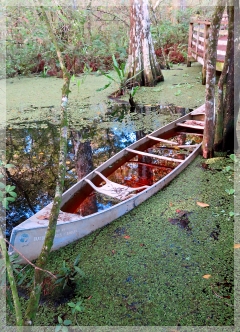
canoe - corkscrew swampWhenever I saw the swamped canoe at the swamp/bird sanctuary, I remembered the old aluminum canoe we had at our cottage. Because it remained down at the lakefront all year long, the canoe served as winter home to the chipmunks and mice. After decades of rodents taking refuge there, the critters eventually chewed up all the foam flotation blocks in both ends of the craft. Since a boat will float only as long as it weighs less than the maximum amount of water it displaces, those empty chambers didn’t affect the canoe if it remained upright and relatively dry. But, if the craft capsized, its empty chambers would rapidly fill with water and, with the extra weight, sink. Knowing how easily the canoe could sink made us extra cautious—it was used only when the water was calm, no one deliberately tipped it, and lifejackets were required.

Sometimes, however, we’re closer to sinking than we know. Several years ago, we were camping by a small lake when my son, husband, and father-in-law decided to rent a small row boat and go fishing. At noon, they pulled the boat ashore and returned to our campsite to eat. After lunch, the fellows returned to their boat and rowed out onto the lake. When their feet got wet, they realized the boat was taking on water and started bailing. The water poured in faster than they could empty it, the boat sunk lower into the water, and they quickly rowed back and pulled the boat ashore. While gathering their fishing gear, my husband discovered that the boat’s drain plug was missing. My father-in-law, who’d been hesitant to leave the boat unattended during lunch, had decided to outsmart any would-be thieves by removing its plug and sticking it in his pocket. Unfortunately, he’d forgotten to reinstall the plug after lunch. Rather than any would-be thieves, they were the ones who got wet!

Boats don’t sink because of the water around them—they sink because of the water that gets into them. In the same way, Christians are meant to live in this sinful world without any of the world’s sins seeping into us. When the world finds its way into our lives, things like fear, anxiety, immorality, deceit, anger, pride, envy, selfishness, and greed do their very best pull us down and drown us. Like the boat’s plug, God’s word can keep the world from getting into our lives and affecting us. Like the buoyancy blocks in a canoe, our faith in Jesus will keep us from sinking even when our lives turn upside down. And, like a life jacket, the Holy Spirit will keep us afloat until we safely reach shore.

Let us always remember that Simon Peter only began to sink when he took his eyes off the Lord!

But when he saw the strong wind and the waves, he was terrified and began to sink. “Save me, Lord!” he shouted. [Matthew 14:30 (NLT)]

Copyright ©2021 jsjdevotions. All rights reserved.

WHO’S THE PILOT?

key west expressI trust you, O Lord. I said, “You are my God.” My future is in your hands. [Psalm 31:14-15a (GW)]
By the time our son was seventeen, he had his pilot’s license. To log solo flight time, he’d often fly from his school in another state to a small airport near our home. We’d meet him there and enjoy lunch together before he returned. Sometimes, he’d take one of us up for a short flight over the scenic countryside before he flew back to school. I don’t even like commercial flights on a jumbo jet with a seasoned pilot so getting on a single-engine Cessna with a teenager at the controls was a leap of faith for me. Nevertheless, when I’m on a plane, I have to leave the flying to those far more skilled than I—even when it’s a seventeen-year-old! Reassuring myself that there was less my son could hit in the air (while trying to forget that safely landing a plane was probably more difficult than parallel parking), I surrendered control to him and trusted that he knew what he was doing.

God is my Co-Pilot is the title of a 1945 film based on the World War II exploits of Robert Lee Scott, Jr. That title eventually became a Christianese catch-phrase and still can be found on bumper stickers today. While a charming sentiment, it is theologically incorrect. If God is our co-pilot, we’re in the wrong plane! There are no dual controls in God’s plane and He doesn’t want us touching the yoke or messing with the rudder pedals. God is neither our assistant nor are we His. He’s not the passenger on our plane; we’re the passengers on His. We don’t belong anywhere in the cockpit; we belong back in the cabin. He has a flight plan specifically designed for each of us and we have to trust that plan to Him.

While it’s easy to trust in God’s sovereignty and cede the controls to Him when the journey is smooth, it’s much harder when turbulence occurs or it begins to storm. I’ve had some bumpy (and frightening) flights, especially over the mountains in summer, but I never barged into the cockpit to take charge nor did I don a parachute and bail out. Trusting the captain, I surrendered control to him, buckled up, prayed, and let him do his job.

Unfortunately, it’s difficult for me to admit that I’m no better at running my life than I am at piloting a plane. While I’m willing to trust a complete stranger to pilot me safely home in the midst of a storm, I often bail out or push into the cockpit of life and try to seize the controls from God at the first sign of turbulence in life. The end result is that I crash and burn and God ends up being rescue squad, fire department, clean-up crew, and salvage expert. Trust and obey is really all God asks of us, and yet we often try to do His job for Him.

Heavenly Father, forgive us for the many times we try to wrest control of our lives to go in another direction than the one you planned for us. As Creator of the Universe, we concede that you are far more skilled at plotting the best route, keeping us on course, and handling all the storms, unruly fellow travelers, engine problems, and fuel shortages that trouble our days. Secure in your love for us, we know that you want us to have a safe landing. You are the captain—the pilot of our plane. Trusting in you, we are your passengers awaiting your orders.

When a train goes through a tunnel and it gets dark, you don’t throw away the ticket and jump off. You sit still and trust the engineer. [Corrie Ten Boom]

I know the plans that I have for you, declares the Lord. They are plans for peace and not disaster, plans to give you a future filled with hope. [Jeremiah 29:11 (GW)]

Copyright ©2021 jsjdevotions. All rights reserved.

THE ESCAPE ROOM

Two people are better off than one, for they can help each other succeed. If one person falls, the other can reach out and help. But someone who falls alone is in real trouble. Likewise, two people lying close together can keep each other warm. But how can one be warm alone? A person standing alone can be attacked and defeated, but two can stand back-to-back and conquer. Three are even better, for a triple-braided cord is not easily broken. [Ecclesiastes 4:9-12 (NLT)]

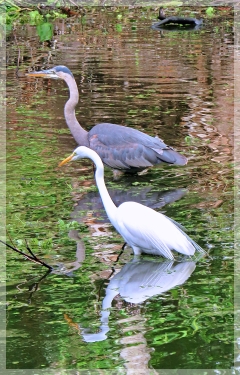
great egret - great blue heronWhen visiting our daughter’s family in New Mexico one October, stormy weather caused us to switch from the pumpkin patch/corn maze outing to an escape room attempt. With just an hour to solve a mystery and “escape,” we entered into a room filled with assorted puzzles, locks, props, and gadgets. Knowing we had to discover clues and complete a series of clever puzzles, we novices decided to divide and conquer. Each person worked on a different task speaking to their individual strengths. I worked on word puzzles while others worked on number challenges, dexterity puzzles, combination locks, or searched for hidden clues.

Silently working on our individual tasks, we missed important clues like the picture of randomly placed fruit. Had we counted the six apples, four lemons, two pineapples, and eight limes, we would have known the four numbers we needed to open a combination lock! Thinking the content of a letter was important, we missed seeing that it was an acrostic with the first letter of each line spelling the clue!

Wanting to prove our stellar problem-solving skills, we hesitated to ask our game guide for help. It wasn’t until we consulted her, talked with one another, and started working as a team that we made any headway. With less than five minutes left, we finally unlocked the kitchen door—only to find that it led into another locked room with even more hidden clues! Our guide is the one who finally released us. Even though we held a up sign saying “epic fail” in our post-game photo, we learned some valuable lessons about life.

Sure that we were as smart as the game master and wanting to get bragging rights for completing it on our own, rather than asking for help, we wasted time spinning our wheels and getting nowhere. Isn’t that what we do with God by only going to Him when all else fails? After all, if we do it by ourselves, we get the glory but, when we ask for God’s help, He gets the glory! Paul, however, tells us that God’s power works best in weakness: “So now I am glad to boast about my weaknesses, so that the power of Christ can work through me. … For when I am weak, then I am strong.” [2 Corinthians 12:9-10]

Ignoring the wise words of Ecclesiastes, rather than help one another, we divided to do our own thing. No one, however, makes it through an escape room alone—it’s a team effort and so is life! Escape rooms require collaboration, cooperation, communication, and listening to one another (even when the idea seems crazy); so does life in Christ.

Although we each had our own particular gift set and abilities—it wasn’t until we appreciated the gifts of others that we made any headway. Being the shortest one in the room, my grand saw a code on the baseboard that we bigger people missed. Even though she wasn’t good with letters or numbers, she spotted what turned out to be the most important clue! No one’s gift is more or less valuable when it’s a team effort. Isn’t that what Paul is telling us in 1 Corinthians 12?

The final lesson we learned was a simple one—don’t be afraid to lose. Failure—even an epic one like ours—is an inevitable part of playing any game so it’s best to embrace the game rather than the outcome. As for our life in Christ—we too will experience failure. With the exception of Jesus, no one else in Scripture did life perfectly. Nevertheless, because we believe in Jesus, we know the eventual outcome is a win. In the meantime, let us find joy in our journey, regardless of its challenges and difficulties.

The human body has many parts, but the many parts make up one whole body. So it is with the body of Christ. … But we have all been baptized into one body by one Spirit, and we all share the same Spirit. Yes, the body has many different parts, not just one part. If the foot says, “I am not a part of the body because I am not a hand,” that does not make it any less a part of the body. And if the ear says, “I am not part of the body because I am not an eye,” would that make it any less a part of the body? If the whole body were an eye, how would you hear? Or if your whole body were an ear, how would you smell anything? But our bodies have many parts, and God has put each part just where he wants it. How strange a body would be if it had only one part! 20 Yes, there are many parts, but only one body. The eye can never say to the hand, “I don’t need you.” The head can’t say to the feet, “I don’t need you.” In fact, some parts of the body that seem weakest and least important are actually the most necessary. [1 Corinthians 12:12-22 (NLT)]

Copyright ©2021 jsjdevotions. All rights reserved.

LOST IN THE MAZE, AGAIN

All of us like sheep, have strayed away. We have left God’s paths to follow our own. [Isaiah 53:6a (NLT)

blue morning gloryIn the years that followed our first maze experience, we continued the pumpkin patch/corn maze tradition but at a farm with a smaller and easier maze. While there were no arrows on stakes to assist the totally confused, there was a larger and better map. Since my daughter and husband have a far better sense of direction than do I, they carried the map and led the rest of us through the maze.

When grazing, sheep like to keep at least four or five other sheep in eyesight and I’m no different. As long as the family remained in view, I paid no attention to where we were. On one outing, after noticing some deep blue morning glories, I stopped to take photos. Spotting a butterfly near the flowers, I briefly turned away from the family to follow it down the trail. When I turned around, my family was nowhere in sight. With no map and in a labyrinth of corn stalks, I was totally lost. Every path seemed to be a dead end and, having left my phone in the car, I couldn’t even make a call! As I wandered in what I hoped was the right direction, I grew anxious. Eventually, I heard someone call my name. Looking up, I saw my family standing on a high viewing platform in the middle of the corn field. From their vantage point, they managed to guide me through the maze until I rejoined them.

Until I got lost in that maze, I’d often wondered about Jesus’ parable of the Good Shepherd. If the shepherd was properly shepherding his flock, how did that one sheep get lost? Now I know! By guiding the flock, the shepherd was doing his job and, by obediently following their shepherd, the rest of the flock were doing theirs. But, that one lost lamb wasn’t paying attention to either shepherd or flock. Perhaps it stopped for some tasty red clover and, after spotting a field of pink vetch, had wandered over for a nibble of it. Maybe, like me, it followed a butterfly and, before the lamb knew what happened, it was all alone. It didn’t mean to stray; it just stopped following the flock and paying attention to the shepherd. Once on its own, the lamb was vulnerable to attack. Fortunately, the good shepherd went looking for it just as my family looked for me.

It’s incredibly easy to lose our way, not just in mazes and pastures, but in the complicated, bewildering, and often perilous world in which we live. Knowing that predators go after the lone sheep that wanders from the herd, our Shepherd has given us His flock—the people of His Church. Unfortunately, instead of morning glories or butterflies, we can get distracted by anything from busyness to boredom, success to defeat, or prosperity to poverty. We don’t mean to stray from the Shepherd’s flock but things like ambition, popularity, self-importance, doubt, worry, discontent, anger, guilt, or disappointment easily can sidetrack us. We start to wander and, before we know it, we’re lost and vulnerable to the enemy’s attack. Fortunately, we don’t need a phone to call our Good Shepherd; a simple prayer is all it takes.

Staying connected with other people of faith—people who follow the Shepherd and will guide us when we’re lost, encourage us when we’re overwhelmed, and correct us when we make a wrong turn—is vital for our survival. As I discovered in the corn maze, it’s best to stay close to the people who have the map and know where they’re going! On the other hand, as members of His flock, it’s important to notice when one of His sheep goes missing.

After he has gathered his own flock, he walks ahead of them, and they follow him because they know his voice. They will listen to my voice, and there will be one flock with one shepherd. … My sheep listen to my voice; I know them, and they follow me.  [John 10:4,16b,27 (NLT)]

Copyright ©2021 jsjdevotions. All rights reserved.

LOST IN THE MAZE

Your word is a lamp to guide my feet and a light for my path. [Psalm 119:105 (NLT)]

scarecrowAlthough we usually visit my daughter’s family in New Mexico in October, my broken ankle canceled our plans. The only bright spot in the cancelation is that I won’t have to participate in the dreaded family tradition of navigating through the corn maze at the pumpkin farm! I say “dreaded” because I’m so directionally challenged that I’d have trouble finding my way out of a box. Actually, after our first outing, I’m surprised any of us ever again ventured into another corn maze.

For our first venture, we chose what was reported to be the best (and largest) maze in the area—a 16-acre corn field that had been transformed into an intricately designed labyrinth. Although we had a small map, we soon became convinced that it was for an entirely different maze. Between the trail’s fiendish twists and turns and its 6-foot walls of corn stalks, we soon were totally lost. We had no idea where we were, let alone where we’d been or where we were going. Hot, thirsty, and tired, the little ones started to whine and complain and we adults weren’t much better. What was supposed to be a fun family outing was turning into a miserable afternoon.

While pausing to finish the last of our water, my husband happened to glance down at the stakes placed along the pathways. Connected by twine, they kept people from taking shortcuts or straying off the convoluted trail into the corn. Seeing that some stakes had a barely noticeable tiny arrow drawn on their  ends, we tried following the markings. Finding that they never led us into dead ends or left us walking in circles, we continued following those arrows all the way to the exit. Even though the solution to our problem was right in front of us, in our frustration, we hadn’t seen it.

While wandering through that maze, we were like a flock of sheep without a shepherd—and a flock without a shepherd is just a herd of lost sheep (maybe even dead ones since they’ve been known to follow one another off cliffs or into deep water)! While we may be smarter than sheep, like them, we need guidance and our Shepherd is the Lord. While it’s easier to follow His lead when all is going well and the path seems straightforward, it grows more difficult when the path He’s laid out for us is a complicated or challenging one. In God’s world, however, there are no shortcuts and sometimes we have to navigate through what seems a hopeless maze. Think of the convoluted routes taken by the Apostle Paul on his four mission trips, the less than straightforward route to Canaan God gave Moses, and the many years and challenges encountered by David before he became king. The paths on which God placed them were filled with twists, turns, and even a few dead ends.

Although our Shepherd will never abandon us, it sometimes seems as if He has. Feeling hopelessly lost, we find ourselves unsure of where to go or what to do as we wander through a maze of difficulties or major decisions. Rather than tiny arrows drawn on wooden stakes, God guides us through our journey with His word. Without it, we can find ourselves as lost as my family was in that corn field. Whether the path God puts us on is a complex maze or a straightforward four-lane freeway, He has provided us with all the guidance we need in Scripture. Far more accurate than our useless map and easier to understand than those arrows, His word can be trusted to lead us through our troubles to hope, safety, sustenance, strength, and peace.

 All Scripture is inspired by God and is useful to teach us what is true and to make us realize what is wrong in our lives. It corrects us when we are wrong and teaches us to do what is right. God uses it to prepare and equip his people to do every good work. [2 Timothy 3:16-17 (NLT)]

Copyright ©2021 jsjdevotions. All rights reserved.