
For the whole law can be summed up in this one command: “Love your neighbor as yourself.” [Galatians 5:14 (NLT)]
The only way to have a friend is to be one. [Ralph Waldo Emerson]
 When the religious scholar asked, “And who is my neighbor?” Jesus answered with the parable of the Good Samaritan in which he made it clear that one’s neighbors can be strangers—even enemies. Sometimes, however, our neighbor really is the guy next door or the couple sitting in the pew behind us at church.
Many of the houses in our Florida community have beautiful front porches and nearly every one of those porches has a lovely set of wicker chairs sitting on it. Yet, in all of our years here, I never have seen anyone sitting in those chairs. There was a time many years ago when people sat on their front porches and chatted with their neighbors after dinner. Now, I guess we’re all inside in front of our computers or televisions. Have we all become so busy with our own interests and activities that we have no interest in anyone else? Have we become so afraid of getting involved that we don’t even want to know our neighbors? How can we love them if we don’t even bother to meet them?
I thought of neighbors last night while driving through a nearby community famed for their over-the-top Christmas lights. With all the Santas, elves, snowmen, gaudy lights, and music, it was incredibly colorful, tacky, and fun, but it had little or nothing to do with Christ or Christmas. It did, however, have a lot to do with neighbors and friendship.
As we drove down the brightly lit streets, residents were outside chatting with one another, driving friends around in golf carts, or gathering around fire pits in front yards. Older children in Santa hats collected money for the Cancer Society and the little ones were toted around in wagons and strollers. With each street having a theme, neighbors had to talk to and work with one another to erect arches across their roads, place giant angels on the mailboxes, put candy canes in every yard on the block, or help one another assemble their elaborate displays. They probably discussed who on the block would play the holiday music and I’m sure several extension cords were shared. The residents had to communicate, cooperate, and assist one another. In fact, they seem to enjoy decorating so much that they also bedeck the neighborhood for Halloween. Their little community isn’t just a group of homes with the same zip code and garbage pick-up day; it is a group of neighbors who share and care—both for the community and for one another.
Taking the Good Samaritan parable seriously, my husband and I care for our neighbors—or at least the ones we don’t know: the nameless faceless ones who benefit from our donations to good causes. While that’s loving our neighbor, it’s the impersonal and easy way to do it. Rather than simply writing checks for the neighbor we’ll never know, we should think a little closer to home and find ways to know the neighbors down the street. Maybe it’s time to meet the woman next door, make an effort to go beyond a quick hello to the couple with the schnauzer, invite the recently widowed man down the street to dinner, or introduce ourselves to that stranger at church. Perhaps, that neighborhood with the extraordinary holiday decorations had more to do with love, Christ, and Christmas than I realized.
I have always wanted to have a neighbor just like you,
I’ve always wanted to live in a neighborhood with you.
So let’s make the most of this beautiful day,
Since we’re together we might as well say,
Would you be mine? Could you be mine?
Won’t you be my neighbor? [Fred Rogers]
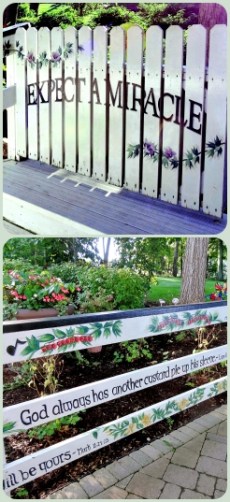 When we lived in the north, we often walked a public path that meandered along the shoreline of a nearby lake. Running through both public and private properties, it crossed the front lawns of historic lakefront estates and stunning homes with beautifully landscaped yards and gardens. One such home placed a lakeside bench for tired walkers that said, “Sit-Pray-Mediate-Enjoy” under a sign that read, “You can trust me. Love, God.” A delightful white fence delineated their private property from the public path. Decorated with whimsey, “Expect a Miracle” was the message on the gate and assorted Bible verses and words of wisdom were painted on the fence’s horizontal slats.
 Even though “Black Friday” sales already have started and stores have been decorated for Christmas since Halloween, the holiday season doesn’t officially start until Thursday with Thanksgiving. Although the angel brought good news of joy to the shepherds and told them not to be afraid, the holiday season brings a sense of dread and anxiety for many of us. “Stress” and “family” are two words that shouldn’t go together but often do. The dynamics of several families and generations gathering together over the holidays can put a strain on everyone as different traditions, expectations, politics, and faiths collide with one another. Couples struggle to keep both in-laws and parents happy while grandparents overindulge their grands. Children get too much sugar and not enough sleep, too much money is spent, and too much alcohol often gets consumed. Add to that the challenges presented by long-distance travel with its almost inevitable lost luggage, delays, or cancellations and trying to maintain peace at a politically divided dinner table and we have the makings of a perfect storm! The joy of the season easily gets lost in the stress of the season.
 Lord, I trust in you. You are my God. My life is in your hands. [Psalm 31:14-15a (ERV)]
 Even though they have their own unique song, northern mockingbirds usually incorporate the songs of other birds into theirs. With their ability to sound like jays, thrashers, hawks, orioles, and robins (along with car alarms and frogs), rather than sounding like themselves, these masters of mimicry can sound like what they’ve heard.
 It wasn’t Hagar’s fault; she really had no choice in the matter. It was the barren Sarah who offered her maidservant Hagar to Abraham like a brood mare to a stallion to provide him with an heir. Having been used by both mistress and master, Scripture tells us that Hagar began to treat Sarah with disdain once she became pregnant. Rather than accept her part in the tense situation, Sarah blamed her husband, grew jealous of her maid, and treated the girl harshly. Sarah wasn’t just unpleasant to her servant. The Hebrew word used was anah, meaning oppressed or afflicted; it is the same word used to describe the way Egypt’s taskmasters treated their Israelite slaves. In short, Sarah wasn’t just stern, she was vindictive and cruel. Since Abraham had washed his hands of the matter, Hagar saw no reprieve. Wanting to escape her merciless mistress and the household turmoil, Hagar did what many of us do when faced with difficult and seemingly impossible circumstances—she fled.
 Devotions of the Heart