COMPLETING THE RACE – Part 1

Therefore, since we are surrounded by such a huge crowd of witnesses to the life of faith, let us strip off every weight that slows us down, especially the sin that so easily trips us up. And let us run with endurance the race God has set before us. [Hebrews 12:1 (NLT)]


Next weekend, my son will be participating in Chicago’s triathlon during which he’ll swim nearly a mile, bike 24.8 miles, and finish up with a 6.2-mile run. Because it’s a grueling race that requires stripping off extraneous equipment twice, it reminds me of Hebrews 12:1. After coming out of the water, my son rushes to the first transition area while stripping off swim cap, goggles, and wet suit. Having worn shorts and shirt under the wet suit, he drops off his swim attire and dons his race bib, socks, shoes, helmet, and sunglasses before mounting his bike. Then, after biking nearly 25 miles, he makes his second transition by changing into running shoes and leaving behind his bike, helmet, and bike shoes. At each transition, he strips off any unnecessary gear that can slow him down. After all, the wet suit would be extra weight when biking as would be the bike and helmet during the run!

Although my son is a seasoned triathlete, he wasn’t when he did his first triathlon a dozen years ago in rural Illinois. Not knowing that seasoned triathletes don’t wear wetsuits designed for water sports, he wore the same wetsuit he used when wake boarding and diving. Wet suits made for triathlons, however, are designed to be taken off quickly for an easy transition and made of thinner lighter neoprene with a slippery outer coating that reduces drag and provides optimal swimming dynamics and speed. He also made the mistake of wearing regular bike shorts under his wetsuit. While bike shorts have the extra padding necessary for long rides, in a triathlon that padding acts like a sponge and holds onto the wetness from the swim along with any sweat from the ride and run. My son ended up biking and running in what felt like a toddler’s very wet and heavy soiled diaper! Instead of conserving energy and swimming, biking, and running faster, he was weighed down by his poor choice of equipment.

The race referred to in Hebrews 12, however, isn’t a triathlon; it is our journey of faith. Nevertheless, it is like a triathlon because it requires strength, determination, and endurance. It’s long and strenuous, often grueling, and comes with a variety of challenges and difficult transitions. The epistle’s writer tells us that we must cast off anything that hinders us in order to complete the journey. Rather than stripping off water-logged bike shorts or leaving behind the bike when we start to run, the believer needs to strip himself of the extra weight found in things like unbelieving friends, questionable activities, greed, fear, anxiety, bitterness, unconfessed sins, or doubt. Those can impede our progress and cause us to stumble as easily as can running a race in bike shoes.

There will be times when even the best prepared Christian will tire, falter, turn the wrong way, or consider quitting. Unlike a triathlon, however, the time it takes to complete the course doesn’t matter; finishing is the only thing that counts. Moreover, there is no winner in the race of faith—staying true to the course, no matter how long it takes, makes anyone a winner!

I have fought the good fight, I have finished the race, and I have remained faithful. And now the prize awaits me—the crown of righteousness, which the Lord, the righteous Judge, will give me on the day of his return. And the prize is not just for me but for all who eagerly look forward to his appearing. [2 Timothy 4:7-8 (NLT)]

Copyright ©2022 jsjdevotions. All rights reserved.

BUTTERFLY KISSES – Part 2

Give thanks to the Lord, for he is good! His faithful love endures forever. [Psalm 107:1 (NLT)]

For I know the plans I have for you,” says the Lord. “They are plans for good and not for disaster, to give you a future and a hope.” [Jeremiah 29:11 (NLT)]

red-spotted purple admiral butterflyAs I began looking for, listing, and thanking God for the little blessings hidden in each day (His “butterfly kisses”), I couldn’t help but wonder about the rest of the day. In a fallen world that all but guarantees loss, pain, misery, and trouble, does God just scatter these special moments of grace willy-nilly? Does He randomly send things like encouraging emails, the perfect worship song at just the right time, the aroma of gardenias wafting through the air, a hummingbird flitting through the garden, a shooting star, or doves nesting outside the window? What about the rest of our moments—the ones when we’re struggling with colicky babies, chronic pain, a severely disabled child, stage-4 cancer, betrayal, or abuse? As I look at my prayer list, I see prodigal children, financial woes, severe depression, food insecurity, parents who’ve lost two infants in less than two years, families dealing with Alzheimer’s, and a newly-wed who, less than an hour after sending her husband off to work with a kiss, learned that he died of an aortic aneurysm while on the train. Hearing children’s laughter while frolicking in the pool, a popsicle on a hot summer day, a rainbow, or seeing the elusive green flash at sunset only go so far in alleviating their anguish or sorrow. Where is God’s grace the rest of the time?



But wait! What do we know of God? Throughout Scripture, we are told that He is good and that He loves us as a parent loves a child. We know we have a loving God who gives us good gifts because, in Matthew 7, Jesus compared God’s provision to that of a loving father who wouldn’t deceive his children by giving them an inedible stone or a poisonous snake instead of bread or fish. Scripture also tells us that this good and loving God has a plan for us. So, if we believe that we are loved by a good God and that this good and loving God has set our lives in motion according to His plan, does it not follow that His entire plan is for our good (even when it includes sleepless nights, loss, hurt, pain, and tears)?

While we grab with gusto all that seems good to us, we’d prefer escaping the rest. While we find joy in the gifts we like, we feel cheated when it’s not the gift we wanted or expected. Nevertheless, every moment, even the ones that seem to break our hearts, are as much a part of God’s grace as are the little blessings of the day. Perhaps, God’s butterfly kisses are simply His way of reminding us of His loving presence in everything and serve as a way for us to see His hand in all things. It is in thanking Him for the little insignificant gifts of our day that we eventually find the ability to gives thanks in all circumstances!

Be filled with the Holy Spirit, singing psalms and hymns and spiritual songs among yourselves, and making music to the Lord in your hearts. And give thanks for everything to God the Father in the name of our Lord Jesus Christ. [Ephesians 5:18b-20 (NLT)]

Copyright ©2022 jsjdevotions. All rights reserved.


BUTTERFLY KISSES

What is the price of two sparrows—one copper coin? But not a single sparrow can fall to the ground without your Father knowing it. And the very hairs on your head are all numbered. So don’t be afraid; you are more valuable to God than a whole flock of sparrows. [Matthew 10:29-31 (NLT)]

dove squabs

In her book One Thousand Gifts, Ann Voskamp writes of being challenged by a friend to write a list of 1,000 things she loved. Interpreting the challenge as making a list of the day’s blessings or gifts, she began recording the seemingly insignificant things that brought bits of joy into her ordinary day. Like a gratitude journal, it included the more obvious things like a child’s escape from serious injury or an unexpected visit from a friend. There was, however, more as Voskamp deliberately set out to find the little gifts hidden in the day—things like jam piled high on toast, toothless smiles, moonlight on pillows, warm cookies, the whistle of the tea kettle on a winter’s day, and the earthy aroma of the woods. As she thanked God for the trivial inconsequential little blessings of the day, she discovered the joy hidden within them. While Ann Voskamp refers to them as gifts, I think of them as God’s “butterfly kisses.” Even though God doesn’t flutter His eyelids on my cheek, these blessings are like the nearly imperceptible kisses mothers have given their children for generations. In the midst of the busyness, trouble, and worries of the day, they are the subtle and easily missed reminders of our Father’s love.

Recognizing my need for an attitude adjustment after spending much of the past year fighting health issues and the glums and gloomies accompanying them, I’ve been reading Voskamp’s book. When what was to be more than a month-long road trip was cut short by half because of my medical issues, I knew I needed to start my own list if I ever hoped to get out of my funk. The first morning home, I looked out and saw that a pair of Mourning Doves had nested in the nearby bougainvillea. The hope that came with the nest’s promise of new life made it the first gift I listed. Several days later, upon finding the nest empty, I thought the chicks had fledged until I looked down at the ground to see their mangled remains. “Oh God, how could you?” I cried. After all, if He sees every sparrow that falls, He certainly saw the doves that brought me such joy. I took it as a personal affront that He allowed the first “gift” I listed to be taken by some predator.

Throughout the morning, I watched as Mr. and Mrs. Dove walked around the bougainvillea and among the shrubbery. By the end of the day, however, they were gone and, most likely, busy building another nest and laying two more eggs. The mortality rate for dove squabs is 69% so I suspect they are accustomed to loss and knew enough to get on with their lives.

Of course, I know that the birds’ unfortunate demise wasn’t directed at me; loss and death have been a part of life since the time Adam and Eve were evicted from Eden. Then again, their loss may have been a lesson for me—to accept that uncertainties, pain, disappointment, and death are an inevitable part of life. Just as the doves moved on with their lives, so should I! While life is gain, it also is loss. As mere players, we don’t get to write the script, rewrite the scenes we don’t like, direct the show, or know how or when the play will end.

Granted, sometimes it feels as if God is nowhere to be found, but maybe it’s simply because we haven’t slowed down and really looked for Him. On that Sunday morning after the crucifixion, two of Jesus’ followers were returning to Emmaus when Jesus joined them. It may have been because of their sadness, disappointment, fear, or even doubt, but they failed to recognize the Lord. It was only when they stopped, invited Jesus into their home, and shared the bread He blessed, that they finally recognized Him. Perhaps, when we do the same—when we are mindful of the moment and thankful for the blessings or bread we have before us (whether focaccia, Wonder Bread, saltines, or a few crumbs)—we will recognize God’s presence. Thankfulness is the soil from which joy sprouts and it is when we are thankful for His gifts (whether large or small) that we will find His joy.

God is the great I AM which means He is present not just in the past or in the future but in the here and now! It’s not always easy to see Him but, when we slow down, open our eyes, and deliberately seek Him, we will find Him in the little seemingly insignificant gifts of each day and feel his butterfly kisses on our cheeks. As Elijah discovered, God is present in the whisper as well as the shout!

Always be joyful. Never stop praying. Be thankful in all circumstances, for this is God’s will for you who belong to Christ Jesus. [1 Thessalonians 5:16-18 (NLT)]

This is the day the Lord has made. We will rejoice and be glad in it. [Psalm 118:24 (NLT)]

Copyright ©2022 jsjdevotions. All rights reserved.

MRS. JOB

He comforts us in all our troubles so that we can comfort others. When they are troubled, we will be able to give them the same comfort God has given us. [2 Corinthians 1:4 (NLT)]


When God gave Satan permission to test Job, He told the fallen angel that he could do anything he wanted to Job except take the man’s life. As a result, Job lost his wealth, possessions, children, and health. The only things left were his home and wife. Some might say that one of Job’s trials was that his wife didn’t die when the rest of his family did. After all, it was his wife who told him, “Curse God and die.”

Let’s not be too harsh with Mrs. Job; don’t forget that, when Satan stole Job’s normal, he also took life as she once knew it from his wife. She may have kept her health, but everything else she held near and dear was taken and she suffered the same emotional, economic, and social devastation as her husband. The ten children to whom she’d given birth, nursed and tended, were gone as were any grandchildren. Her mama’s heart had to be breaking. The family wealth (and status) had vanished in an instant; soon the bill collectors would arrive and, in all probability, the roof over their heads would vanish as well. Her strong and healthy husband, the man who loved and protected her, became an invalid overnight! He was covered with boils from head to toe and itched so badly that he scratched his skin with broken pottery. He had scabs all over his body and maggots and worms in his pus-filled sores. In deep depression, he was an insomniac who had nightmares when he managed to sleep. He was feverish, losing weight, in constant pain, had halitosis, his skin had turned dark, and he was in constant pain. Today’s doctors might diagnose a necrotizing skin fasciitis—think “flesh eating bacteria.” Job’s future was doubtful and his wife had to watch as he suffered. Witnessing her husband’s anguish and being unable to alleviate his pain couldn’t have been easy!

Moreover, there wasn’t much hope for Mrs. Job’s future; a better tomorrow was not on the horizon As far as she knew, she was facing imminent widowhood. A penniless widow with no children, she’d be the poorest of the poor, powerless, and vulnerable. Frightened and distraught, she was understandably angry at a God who allowed this to happen. Unfortunately, the only words of hers recorded are ones in which she took out that anger on her husband. Giving Mrs. Job the benefit of the doubt, those words may have been a combination of anguish and compassion— anguish about a seemingly hopeless situation and a compassionate hope that her husband’s suffering would end with his quick death.

As I thought about Mrs. Job, I thought of other people whose spouses are slowly being stolen by things like strokes, cancer, Parkinson’s, MS, and dementia. It seems that some of them have become rather cold to their afflicted partner and I’ve judged them unfairly (as I originally did Job’s wife). I forgot that they, too, are suffering. Their old normal is gone, their new normal is challenging, and their future is not the one they expected or hoped to have. Their lives have become a struggle as they try to cope with increasing responsibilities, mounting financial burdens, and a spouse who is deteriorating daily. Perhaps, what seems to be a lack of sympathy and understanding for their spouse is their way of preparing themselves for the loss they eventually will face. It’s not easy to summon compassion for people who seem to lack compassion themselves but, if I can muster sympathy for Mrs. Job, I should be able to muster far more sympathy for people I know who are caught in similar situations.

If ever presented with challenges like those of Job’s wife, I pray that I’ll be strong, brave, supportive, hopeful, loving, and trusting of God. As for now, I’ll no longer judge Mrs. Job or her brothers and sisters in similar situations. Whether or not I like their attitude or behavior is not my business. My job is simple—prayers, compassion, and support, not just for the afflicted, but also for their caregivers. The job of caregiver is not an easy one. Father, give them strength, wisdom and compassion in the face of their tremendous challenges.

Since God chose you to be the holy people he loves, you must clothe yourselves with tenderhearted mercy, kindness, humility, gentleness, and patience. Make allowance for each other’s faults, and forgive anyone who offends you. Remember, the Lord forgave you, so you must forgive others. Above all, clothe yourselves with love, which binds us all together in perfect harmony. [Colossians 3:12-14 (NLT)]

Copyright ©2022 jsjdevotions. All rights reserved.

LIFE’S THORNS

So to keep me from becoming proud, I was given a thorn in my flesh, a messenger from Satan to torment me and keep me from becoming proud. [2 Corinthians 12:7 (NLT)]

roseThe prayer from The Valley of Vision read: “I am at a loss to know what thou wouldest have me do, for I feel amazingly deserted by thee, and sense thy presence so little…” In the margin of the book, I’d written “I feel this way sometimes!” while adding “I’m in need of grace!” For much of the past year, I’ve pondered the question of, “Where is God when you desperately need Him?” I’ve often felt abandoned and alone as if my prayers for relief were falling on deaf ears.
It’s easier to write about Paul’s acceptance of the thorn in his flesh, taking pleasure in our troubles, and finding strength in our weakness than actually doing it! While usually translated as “thorn” the Greek word used in 2 Corinthians 12:7 was skolops which meant anything with a sharp point that could produce pain—from a splinter to a stake upon which he could be impaled! We don’t know the exact nature of Paul’s thorn but there’s no doubt it caused him more distress than a mere splinter and, by the time he wrote 2 Corinthians, it had afflicted him for fourteen years! Used figuratively, the thorn could have been his poor eye sight, another physical ailment, depression, persecution, or an enemy. His vagueness is purposeful since the verse is not about the thorn’s identity but its purpose and, at some time or another, we all will have thorns troubling us.

Although Paul knew he could only survive by depending on the Lord, he initially saw only two options. Either the Lord could remove the thorn so he could get on with his ministry or the thorn would remain troubling him and hindering his ministry. God, however, offered Paul a third option. God would leave the thorn but supply him with grace enough to continue—not on Paul’s strength but, by the grace of God, on His.

For more than a year, a series of painful physical issues have plagued me. Although I had some temporary relief, now they’re back and brought some thorny friends with them. For the past year, my prayers were about returning to what I called normal, which simply was the old routine to which I’d grown accustomed and liked. Like Paul, I saw only two options and it felt like my prayers fell on deaf ears as I pled for relief. Thinking of myself as sort of a super woman who, with enough grit, could power through every setback, it was pride that kept me from praying the right prayer. Finally, rather than pleading with God to remove my thorn, my prayer was one of acceptance; I asked God for grace enough to meet each day and to show me how to serve Him in what is my new normal. God hadn’t been deaf to me but my pride had caused me to be deaf to Him. Giving the same answer He gave Paul, He reminded me that His power works best in weakness and His grace is all I need. God told me to accept my thorns and to trust in His future grace.

Depending on God’s power and strength, I will continue in this ministry but, in acceptance of my limitations, rather than Monday through Friday, God willing, I will publish only twice each week: Monday and Thursday. Paul’s thorn didn’t stop him and, while mine will slow me down, it won’t stop me either!

O that all my distressed and apprehensions might prove but Christ’s school to make me fit for greater service by teaching me the great lesson of humility. [The Valley of Vision – A Collection of Puritan Prayers & Devotions (Arthur Bennett, ed.)]

Three different times I begged the Lord to take it away. Each time he said, “My grace is all you need. My power works best in weakness.” So now I am glad to boast about my weaknesses, so that the power of Christ can work through me. That’s why I take pleasure in my weaknesses, and in the insults, hardships, persecutions, and troubles that I suffer for Christ. For when I am weak, then I am strong.  [2 Corinthians 12:8-10 (NLT)]

Copyright ©2022 jsjdevotions. All rights reserved.

UNWELCOME FRIENDS

“I have told you all this so that you may find your peace in me. You will find trouble in the world—but, never lose heart, I have conquered the world!” [John 16:33 (PHILLIPS)]

When all kinds of trials and temptations crowd into your lives my brothers, don’t resent them as intruders, but welcome them as friends! … The man who patiently endures the temptations and trials that come to him is the truly happy man. For once his testing is complete he will receive the crown of life which the Lord has promised to all who love him. [James 1:2,12 (PHILLIPS)]
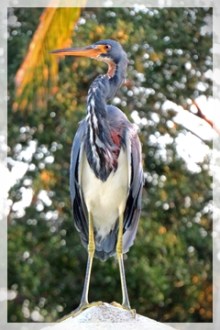
tri-colored heron

Winters in southwest Florida bring sunshine, warmth, ocean breezes, and visitors. Just as guests arriving at your door are unavoidable during winter in Florida, so are troubles (only they arrive all year long)! Jesus tells us troubles are inevitable, James tells us to welcome them as friends, and Paul tells us that we can have joy in the midst of them. I suppose we might as well make the best of them since, like poor relatives when we’ve won the lottery, trouble is sure to find us no matter where we hide. Troubles, like people, come in all shapes and sizes. Some are dead serious while others are merely annoying. Like guests, troubles are unpredictable; when you expect them, they don’t arrive and when it is least convenient, they frequently do! Then, just when you think they’ve packed up and are ready to leave, you discover they’ve cancelled their flight and plan to stay for the season.

It’s been said that fish and house guests start to stink after three days; I’m inclined to think that problems start to stink about that time, as well. Unfortunately, it often is easier to get rid of spoiled fish and unwelcome company than it is to free ourselves from difficulties.

In spite of James’ words, I’m not sure any of us can welcome troubles the way we do friends. Nevertheless, while we don’t have to be thrilled about the arrival of troubles, we can maintain a positive outlook during their stay. Knowing God has a purpose for our trials, we can even find some joy in their presence. While we may not welcome challenges, we can welcome the refining of our faith, the development of our endurance, and the building of our character that accompany them.

When I look back over my lifetime, I realize that I’ve become a better person, not in spite of my troubles, but because of them. In retrospect, I see that good truly came from all the bad that happened. That said, I’m the first to admit that I don’t look forward to any more faith-strengthening or character-building experiences. Thank you, God, but I’d just as soon stop right here. God, however, doesn’t give us a say in that matter and He’s not done with any of us until our last day on earth. While I’m not putting out the welcome mat for misfortune, calamity, trouble, and trials, I won’t fear their arrival.

Trials are medicines which our gracious and wise Physician prescribes because we need them; and he proportions the frequency and weight of them to what the case requires. Let us trust his skill and thank him for his prescription. [Sir Isaac Newton]

This doesn’t mean, of course, that we have only a hope of future joys—we can be full of joy here and now even in our trials and troubles. Taken in the right spirit these very things will give us patient endurance; this in turn will develop a mature character, and a character of this sort produces a steady hope, a hope that will never disappoint us. Already we have some experience of the love of God flooding through our hearts by the Holy Spirit given to us. [Romans 5:3-5 (PHILLIPS)]

Copyright ©2022 jsjdevotions. All rights reserved.