LITERAL OR FIGURATIVE (Revelation – Part 2)

Above all, you must realize that no prophecy in Scripture ever came from the prophet’s own understanding, or from human initiative. No, those prophets were moved by the Holy Spirit, and they spoke from God. [2 Peter 1:20-21 (NLT)]

columbineThe Apostle Peter tells us that true prophecy isn’t a product of the prophet—prophets only speak God’s revelation. Directed by the Spirit, their words communicate the message the Lord wants sent. Sometimes, however, prophecy is difficult to understand and interpretations of Revelation go from one extreme to the other. Some, like that priest in Monday’s devotion, dismiss it as completely symbolic. To them, Revelation is an allegory about the conflict between good and evil with good winning in the end. On the other extreme, we find obscure theories, convoluted correlations, and implausible explanations of every symbol and metaphor along with sensationalism and unchecked speculation connecting Revelation to current events.

A simple rule of thumb in hermeneutics (the interpretation of Scripture) is, when it obviously is literal, we should accept it as such. The key to understanding Revelation is to interpret it as literally (and simply) as possible. Extra meaning shouldn’t be given to words or phrases if they can be understood as written. For instance, we shouldn’t assume 1,000 years means anything else. Moreover, when a description is of something we’ve never seen, such as cherubim or heaven, we shouldn’t immediately dismiss it as totally figurative. Nevertheless, we can’t read Revelation as we might a newspaper. When a passage clearly uses figurative language or obviously is symbolic, we should interpret it as such.

At the same time, we should be careful about finding extra meaning in John’s figurative descriptions. For example, Revelation 4:3 describes the One sitting on the throne “like a jasper stone and a sardius in appearance; and there was a rainbow around the throne, like an emerald in appearance.” Although the word “like” clearly indicates a simile, many commentators ascribe extra meaning to the descriptions, e.g. the stones allude to the high priest’s breast plate, the red sardius signifies God’s righteous anger or Jesus’ blood, the green denotes God’s mercy and grace, or the rainbow means God’s won’t depart from His covenant with Israel. To understand John’s words, we don’t need to get bogged down in possible symbolic meanings when what we’re being told clearly is that there was a spectacular radiance to the One (God) sitting on the throne.

Revelation, like other apocalyptic prophecy, often has bizarre imagery. John describes such things as locusts wearing armor with wings that roared like an army of chariots and horses with heads like lions with fire, smoke, and burning sulfur coming from their mouths. While these horrifying things may have been living demonic creatures, they also could be weaponry like helicopters, drones, missiles, or tanks. Prophecy describes the future and, not knowing what he saw, John may have used metaphors to describe their size, power, and noise. Whatever he saw was unfamiliar, frightening, and capable of mass destruction and his imagery conveys that perfectly.

While meant for all believers, John specifically wrote to the seven churches in Asia and many of his allusions make sense in historical context. When he describes a woman sitting on seven hills, his 1st century readers easily would have known he was referring to Rome (a city built on seven hills). Moreover, because concepts and symbols from the entire Bible echo throughout Revelation, John’s allusions must be put in scriptural context. Without ever making a direct quote, 278 of Revelation’s 404 verses make at least one allusion to the Old Testament. For example, after one of the elders points out “the lion from the tribe of Judah, the Root of David,” John sees a “Lamb, standing as if slaughtered.” John’s original readers easily would have recognized Messianic descriptions found in Isaiah and Genesis.

With events taking place simultaneously in heaven and on earth, Revelation doesn’t follow a strict chronology and can be challenging to follow. With its wars, famine, and disasters, it can be distressing and, with its allusions and figurative language, it can be confusing. But, as God’s word, Revelation can’t be ignored or treated as fictional fantasy.

Because Revelation was written for the servants of Christ (that’s us), it seems unlikely that God expected us to have theology degrees to understand its message. Nevertheless, understanding Revelation is easier with a good study Bible, a commentary or two, and a study guide or group, along with prayers for the Spirit’s guidance.

Revelation shows us God’s amazing patience as He gives mankind opportunity after opportunity to repent and plenty of reasons to do so! For those who choose not to believe, Revelation is a book of dire warning but, for those who believe, it is a beautiful book of hope. Spoiler alert—Jesus wins!

The big picture of Revelation is clear: Jesus returns, people must be ready, evil is defeated…. With the rest of the details, there is room for disagreement. [Scott McConnell]

Then the angel said to me, “Everything you have heard and seen is trustworthy and true. The Lord God, who inspires his prophets, has sent his angel to tell his servants what will happen soon.” [Revelation 22:6 (NLT)]

Copyright ©2023 jsjdevotions. All rights reserved.

WHOSE SIDE?

When Joshua was near the town of Jericho, he looked up and saw a man standing in front of him with sword in hand. Joshua went up to him and demanded, “Are you friend or foe?” “Neither one,” he replied. “I am the commander of the Lord’s army.” [Joshua 5:13-14 (NLT)]

spiderwortThe Israelites had just crossed the Jordan River and were preparing to conquer Canaan when Joshua came upon an armed man. Joshua was a stranger in a foreign land and, as Israel’s general, he may have been scrutinizing Jericho’s defenses to determine his plan of attack. I wonder if Joshua brandished his sword (while shaking in his sandals) as he queried, “Friend or foe?” The man, however, was neither ally nor adversary. Identifying himself as the commander-in-chief of the Lord’s army, his loyalty was to neither side. His allegiance was to God and the only side he was on was God’s! God wasn’t on Israel’s side any more than He was on Canaan’s. Israel, however, was on God’s side because their conquest of Jericho was part of His master plan of redemption. It was because they were on God’s side that the fortified city’s walls collapsed.

Jump ahead some 500 years to King Asa of Judah. In 2 Chronicles, we find the people of Judah under attack by an Ethiopian army of tens of thousands equipped with 300 chariots. Asa turned to God for guidance. Rather than ask God to be on their side, he prayed that Judah’s side was God’s and confirmed that it was in God’s name that they fought. In spite of overwhelming odds, Judah’s army was victorious, not because God was on their side but because they were on God’s. Asa then committed his kingdom to seeking God with all their heart and soul.

Unfortunately, twenty-one years later, the King forgot whose side he was on when Israel invaded Judah. Rather than turning to God, he committed himself to an alliance with the pagan Ben-hadad of Aram. Although the alliance at first appeared to be a success, the prophet Hanani rebuked the king for violating his covenant to seek the Lord’s side. Sadly, Asa’s foolhardiness meant that Judah would continue to be at war for generations.

When addressing a joint session of Congress in 1984, President Ronald Reagan noted that America was founded by men who believed God was their rock of safety. The President then added, “We must be cautious in claiming that God is on our side, but I think it’s all right to keep asking if we’re on His side.” 120 years earlier, in the midst of the Civil War, one of Abraham Lincoln’s advisors said he was grateful God was on their side. Lincoln replied, “Sir, my concern is not whether God is on our side; my greatest concern is to be on God’s side, for God is always right.” Being on God’s side should be our concern, as well. Our all-powerful God does not choose sides; there only is one side and it is His.

Whether the dispute or disagreement is religious, political, familial, among neighbors or nations, we tend to get behind one side or another. Before taking sides, drawing lines in the sand, making threats, burning bridges, creating alliances, waging battle, or championing a cause, we must prayerfully determine which side is God’s. In many of our disputes, there’s a fair chance that neither side is God’s! While we may not be sure where God stands on every question, we do know He’s on the side of things like love, peace, forgiveness, truth, mercy, compassion, salvation, justice, healing, generosity, humility, decency, righteousness, and kindness. Let His Spirit and Word be our guide. Remember, it doesn’t matter whose side we’re on, if it isn’t God’s!

They always win who side with God. [Frederick W. Faber]

The Lord will stay with you as long as you stay with him! Whenever you seek him, you will find him. But if you abandon him, he will abandon you. [2 Chronicles 15:2b (NLT)]

Don’t copy the behavior and customs of this world, but let God transform you into a new person by changing the way you think. Then you will learn to know God’s will for you, which is good and pleasing and perfect. [Romans 12:2 (NLT)]

Copyright ©2023 jsjdevotions. All rights reserved.

DAMAGED GOODS

But when the teachers of religious law who were Pharisees saw him eating with tax collectors and other sinners, they asked his disciples, “Why does he eat with such scum?” When Jesus heard this, he told them, “Healthy people don’t need a doctor—sick people do. I have come to call not those who think they are righteous, but those who know they are sinners.” [Mark 2:16-18 (NLT)]

pipevine swallowtail butterflyWhile editing photos, I came to one of a pipevine swallowtail. Seeing it on my computer rather than the camera’s viewfinder, I realized it had seen far better days. Its once beautiful wings were tattered and torn, only one “tail” remained, an antenna was missing, and, with many of its scales gone, its wings were more translucent than iridescent blue. Perhaps it had a close call with a predator, the wind had tossed it around, or it simply was old. In any case, it was damaged goods and no longer beautiful.
We tend to discard broken things, battered items, and damaged goods without giving them a second thought and I was ready to delete the less than perfect butterfly. What if God tossed us away because of our imperfections, scars, and defects? What if He stopped caring for us because we were scratched, broken, dented, or wearing out? Unlike the butterfly, it’s not birds, hail, or blowing twigs that leave us ragged and torn; its things like illness and injury, betrayal, loss, dysfunctional families, abuse, mental illness, broken relationships, addiction, financial crises, and sin. Even though the resulting damage isn’t always visible, we’re marred with pain, shame, regret, rejection, disappointment, disgrace, anger, apathy, loneliness, and fear. No one gets through life without getting a few bumps and bruises along the way and we all are damaged goods. Our scuff marks, scars, and brokenness may not be as obvious as the butterfly’s; nevertheless, they are there.

Jesus came for the less than perfect. Think of the people he loved, touched, healed, welcomed, and forgave. Sinners all, they included hated Samaritans and disparaged Gentiles, pariahs like lepers and the bleeding woman, the blind and crippled, an adulterous woman, some traitorous taxmen, political zealots, people with sordid pasts, the demon-possessed, a repentant thief, a prostitute, the disciple who denied Him, the one who doubted Him, and even the one He knew would betray Him! Jesus didn’t come for the perfect; He came for the defeated, damaged, disheartened, and sinful. While the butterfly’s wings will never heal, Jesus can heal the brokenness in our hearts and souls.

Originally, I hadn’t detected the butterfly’s damaged state because it flitted about so quickly that I barely had time to focus before it flew off to another flower. While it may have been damaged, that pipevine certainly wasn’t defeated. In God’s wisdom, He made butterflies more resilient than they appear. While the loss of an antenna means they have some trouble navigating, the loss of scales changes their aerodynamics, and the loss of much of their wings makes flight slower and more demanding, butterflies can thrive and survive, as that battered pipevine proved! It never allowed its tattered wings to deter it from making the most of the sunny day or the remaining days God allotted it. Instead of hiding under a leaf feeling sorry for itself and complaining about the unfairness of life, it was dancing in the flowers and sipping sweet nectar! Rather than being deleted, it belonged in a butterfly hall of fame.

Now, whenever I come across a damaged butterfly, I’m reminded that God loves all of His beautiful children, imperfect and broken creatures that we are. No matter how flawed, He will never discard us or toss us in the trash heap! God made us even more resilient than a fragile butterfly. Because of His power, we never need surrender to life’s challenges. We may be battered by this world but, because God’s grace is more than sufficient, we can carry on. If tattered wings can carry a battered butterfly through the flowers, we know that God can carry us through anything.

That is why we never give up. Though our bodies are dying, our spirits are being renewed every day. For our present troubles are small and won’t last very long. Yet they produce for us a glory that vastly outweighs them and will last forever! So we don’t look at the troubles we can see now; rather, we fix our gaze on things that cannot be seen. For the things we see now will soon be gone, but the things we cannot see will last forever. [2 Corinthians 4:16-18 (NLT)]

Copyright ©2023 jsjdevotions. All rights reserved.

UNEXPECTED DESTINATIONS

But I am trusting you, O Lord, saying, “You are my God!” My future is in your hands. [Psalm 31:14-15a (NLT)]

Sometimes God doesn’t give you what you want not because you don’t deserve it but because you deserve better. [Anonymous Internet wisdom]

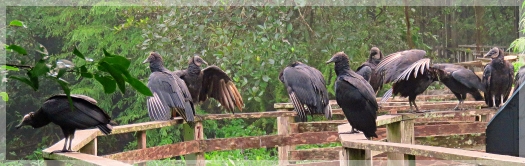
black vultures - corkscrew swampBecause the nearby bird sanctuary/swamp gets its water from rainfall, the size of its lakes fluctuates substantially with the seasons. During the dry seasons of winter and spring, the swamp’s lakes gradually recede until the summer rains begin. When this annual dry-down occurs in springtime, the wading birds congregate in the shallow lakes. With the fish having no place to hide the shallow water, it’s as easy as catching fish in a rain barrel for the birds!
Anticipating a feeding frenzy as the swamp’s wading birds gathered in the receding lakes, we went out to the bird sanctuary. The dry-down happened faster than we expected. Instead of a shallow lake covered with water lettuce, we found only mud. Rather than a plethora of egrets, herons, wood storks, and roseate spoonbills, we encountered dozens of black vultures enjoying the remains of the stinking fish in the muck! What we got certainly wasn’t what we wanted or expected.

Since vultures are known for projectile vomiting if startled or threatened, I admit to some trepidation as I walked between the perched birds on the boardwalk. Nevertheless, seeing all those vultures was an amazing experience. In spite of our initial disappointment, we were thankful for the opportunity to witness nature’s clean-up crew at work.

In spite of our best-laid plans, we don’t always get what we pray for or expect. Emily Perl Kingsley, a mother of a child with a disability, wrote a beautiful essay titled “Welcome to Holland” in which she likens having a child with a disability to someone planning a fabulous trip to Italy. After months of eager expectation, however, she discovers the flight plan unexpectedly changed and she’s landed in Holland. Even though there’s nothing wrong with Holland, it’s not Italy! Admitting the pain in losing her longed-for destination, Kingsley adds, “But, if you spend your life mourning the fact that you didn’t get to Italy, you may never be free to enjoy the very special, the very lovely things….about Holland.”

Unlike Kingsley, I’ve never arrived in Holland after expecting to touch down in Italy. Nevertheless, like her, God has changed my flight plans mid-air and I’ve landed in unplanned-for destinations. Sometimes, God’s plan is even better than we imagined and He takes us to Paris or Madrid when all we prayed for was St. Louis or Minneapolis! On the other hand, sometimes God’s plan takes us places we never wanted to visit—Al-Anon meetings, hospital rooms, nursing homes, grave sites, divorce court, or even Holland. Either way, God’s answer to our prayers is the right one—even though it’s different and unexpected. Trusting in God’s infinite love and wisdom, let us accept God’s plan with joy. Whether it’s vultures instead of roseate spoonbills, Keukenhof Gardens instead of the Colosseum, Edam cheese instead of pizza, or a special needs child instead of an honor student, may we seek to appreciate everything in our present situation and be thankful for our many blessings.

It’s just a different place. It’s slower-paced than Italy, less flashy than Italy. But after you’ve been there for a while and you catch your breath, you look around…. and you begin to notice that Holland has windmills….and Holland has tulips. Holland even has Rembrandts. [Emily Perl Kingsley]

I pray that God, the source of hope, will fill you completely with joy and peace because you trust in him. Then you will overflow with confident hope through the power of the Holy Spirit. [Romans 15:13 (NLT)]

Copyright ©2023 jsjdevotions. All rights reserved.

ASSISTED LIFTING (Rephidim – Part 2)

When Moses’ father-in-law saw all that Moses was doing for the people, he asked, “What are you really accomplishing here? Why are you trying to do all this alone while everyone stands around you from morning till evening?” [Exodus 18:14 (NLT)]

Back when I did weight training, I’d often find myself struggling with my last few reps. When I thought I couldn’t get the dumbbell up another inch and was about to give up, my trainer often gave me a little help so I could finish the rep. Disappointed that I couldn’t do it on my own, he’d remind me, “There’s nothing wrong with a little assisted lifting!”
Earlier this week, when writing about Israel’s victory against the army of Amalek at Rephidim, I didn’t tell the whole story. While Joshua and his men fought in the valley, Moses, Aaron, and Hur observed from a hilltop. Standing tall, Moses raised his arms and extended his staff for all to see. That staff was Israel’s banner and, as long as Moses kept the staff raised high in the air, the Israelites advanced. But, as the day wore on, the eighty-year-old began to tire. His arms grew heavy and, most likely, his back began aching and his legs started cramping. Whenever Moses’ fatigued arms started to fall, the Amalekites began to succeed. As the battle ebbed and flowed, its outcome seemed to depend as much on Moses and that raised staff as it did on the men’s skill with swords. Aaron and Hur, however, found a rock on which Moses could sit. Then the two men stood beside Moses and did some “assisted lifting” of their own by holding up his arms until Israel claimed victory at sunset.

Later, while still camped at Rephidim, Moses got another lesson in assisted lifting. From sunrise to sunset, he dealt with both the spiritual and interpersonal concerns of Israel. Scripture tells us there were 600,000 Israelite men. When we add women, children, and the “mixed multitude” that joined them in their escape from Egypt, more than two million people were traveling together. With those many people (described by Moses as “stiff-necked”), imagine the number of questions, concerns, grievances, and quarrels that came to his attention every day. When Jethro (Moses’ father-in-law) visited the Israelite camp, he observed his son-in-law’s demanding routine. Seeing how overwhelmed Moses was by his enormous responsibilities while others did nothing, Jethro warned Moses that working that way was unsustainable. He sagely advised him to delegate some of his duties among Israel’s leaders.

Jethro suggested that Moses continue to act as the people’s representative before God and as God’s voice to the people. As an intermediary between God and Israel, Moses would intercede for Israel and pass along God’s words to them. But, when it came to mediating people’s everyday (often petty) disputes with one another, Jethro suggested that Moses chose qualified men and subdivide the work of judging among them. Only the most difficult cases would come to Moses. After getting divine approval, Moses heeded his father-in-law’s advice and got some much-needed assisted lifting!

God doesn’t expect us to bear every burden alone. Moses couldn’t do it all by himself and, even though we often think we can, neither can we. Although God will provide assistance, his provision often comes in the advice and help we receive from others. Whether we take that help, however, is entirely up to us. Fortunately, Moses didn’t think himself too strong to be helped with his staff, too wise to be counseled by his father-in-law, or too indispensable to delegate work to others!

Rather than a barbell or even a shepherd’s staff, the heavy weight we’re asked to lift consists of the responsibilities, complications, predicaments, and challenges of life. At some time or another, like Moses, we all will need some assisted lifting. May we never be too proud to accept it.

Thank you, Lord, for the many ways you provide us with the assisted lifting that gives us the strength and ability to succeed.

Two people are better off than one, for they can help each other succeed. If one person falls, the other can reach out and help. But someone who falls alone is in real trouble. Likewise, two people lying close together can keep each other warm. But how can one be warm alone? A person standing alone can be attacked and defeated, but two can stand back-to-back and conquer. Three are even better, for a triple-braided cord is not easily broken. [Ecclesiastes 4:9-12 (NLT)]

Copyright ©2023 jsjdevotions. All rights reserved.

JEHOVAH-NISSI (Rephidim – Part 1)

But you have raised a banner for those who fear you—a rallying point in the face of attack. Now rescue your beloved people. Answer and save us by your power. [Psalm 60:4-5 (NLT)]

May he grant your heart’s desires and make all your plans succeed. May we shout for joy when we hear of your victory and raise a victory banner in the name of our God. [Psalm 20:4-5 (NLT)]

The Amalekites were a warlike nomadic tribe who frequently raided settlements to carry off plundered goods. About six weeks into the Israelites’ exodus from Egypt, these marauders made an unprovoked attack on the weary refugees while they camped at Rephidim. Moses commissioned Joshua to lead an army against their enemies the following morning. Joshua’s army, however, wasn’t made up of soldiers! Facing the veteran warriors of Amalek were men who less than two months earlier had been enslaved brick makers and field laborers! Worse, this unseasoned army was led by a general as inexperienced as were they. Nevertheless, Israel’s men set out to battle while Moses, his brother Aaron, and a man named Hur (who Jewish tradition believes was married to Miriam and brother-in-law to Moses) climbed to the top of a nearby hill to watch. As Israel fought their powerful foes, Moses extended his arms and held out his staff for all to see.

When going into battle, opposing armies would carry banners or standards that served as rallying points before battle, encouraged the warriors as they fought, and announced when the battle was won. Representing their tribe or leader, the banners usually depicted animals, birds, or pagan gods. Made of fabric, wood, or metal, they were fastened onto a long pole or staff so they could be seen from a distance. Marauders like the Amalekites probably had such a banner. The Israelites, however, weren’t an experienced army and had no flag or standard under which to rally.

Moses’ staff was the closest thing Israel had to a banner. Although it looked like an ordinary shepherd’s tool, to the Israelites it symbolized God’s intervention. Through God’s power, it had transformed into a snake, turned water into blood, produced hail, and infested Egypt with frogs, gnats, flies, and locusts. When Moses raised it over the Red Sea, the waters parted and, when Moses struck a rock with it, water gushed out. That staff, associated with God’s miracles, became Israel’s banner. As long it remained in sight, Israel’s novice army believed God was with them and victory was possible. That symbol of God’s faithfulness, presence, and power remained in the men’s sight on the hilltop until Israel was victorious over the army of Amalek.

After their victory, Moses built a memorial altar and called it Yahweh-Nissi (Jehovah-Nissi), which meant “The Lord is Our Banner.” By not calling it “The Staff is Our Banner” or “Our Banner Brought Us Victory,” it was clear that Moses knew it wasn’t the staff, Joshua’s battle strategy, or Israel’s military might that defeated the Amalekites. The name Yahweh-Nissi acknowledged that it was God’s presence and power that gave them their triumph. God, and God alone, was the author of their victory.

Indeed, the Lord is our banner. Unlike the Israelites, we’re not being attacked by an army of marauding warriors but, like them, the enemy attacks us every day with desire, discontent, despair, anger, and guilt. We face our battles under God’s banner—one of encouragement, courage, hope, love, faith, power, and might. If we keep our eyes focused on the Lord, victory is ours. Because of Yahweh-Nissi, we don’t have to fight our battles on our own strength – we have His!

In that day the heir to David’s throne will be a banner of salvation to all the world. The nations will rally to him, and the land where he lives will be a glorious place. [Isaiah 11:10 (NLT)]

Copyright ©2023 jsjdevotions. All rights reserved.