
But you, O Bethlehem Ephrathah, are only a small village among all the people of Judah. Yet a ruler of Israel, whose origins are in the distant past, will come from you on my behalf. [Micah 5:2 (NLT)]
All right then, the Lord himself will give you the sign. Look! The virgin will conceive a child! She will give birth to a son and will call him Immanuel (which means “God is with us”). [Isaiah 7:14 (NLT)]
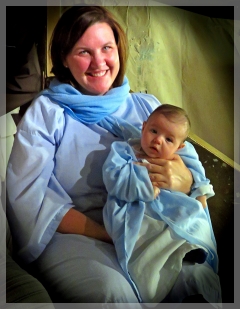 One December evening several years ago, we walked the streets of Bethlehem. Instead of travelling to the Holy Land, however, we traveled back in time at a local church. Our journey began with a stroll through the Christmas story. We walked past Gabriel meeting with Mary, an angel visiting the sleeping Joseph, the shepherds and sheep, Joseph and a very pregnant Mary in a stable, and met the Magi with their camels and gifts. We then went inside the parish hall to the bustling city of Bethlehem. As required by the emperor, we stopped to register for the census and pay our taxes before moving through the crowded marketplace to the shops of the wine merchant, carpenter, leather worker, and oil and spice dealers. After pausing to watch mud bricks being made and fabric being dyed, a young boy took us on a tour through his 1st century Jewish home.
As congested as the area was, we nearly missed our last stop—Joseph, Mary, and their newborn son. Of course, we had an advantage over the people of Bethlehem because we knew the significance of that baby born so many years ago—He was the promised Messiah! Knowing the significance of His birth, we looked for Him.
Although the Hebrew Bible (Old Testament) was written over a period of 1000 years and completed several hundred years before the 1st century, it contained over 300 prophecies of the coming Messiah. The Israelites had centuries to prepare for their savior and all those prophecies to alert them. But, when God Himself took on human flesh over 2,000 years ago, they were too busy in the streets of Bethlehem to notice His arrival. Other than a few shepherds, no one else observed anything special that night. More than a month later, it only was Anna and Simeon who recognized the infant Messiah at Mary’s purification ceremony in Jerusalem. It was almost two years later when some foreign wise men (who’d been following an astronomical phenomenon) brought gifts and worshipped the long-awaited child. With all those prophecies, why weren’t the people of Judah ready and waiting?
Once we walked out the back door of the parish hall, we returned to the 21st century with its Christmas carols, chocolate chip cookies, hot cocoa, and a machine pumping out artificial snow to squeals of delight from the Florida children. Let us never forget, however, that the story isn’t over. There are still many unfulfilled prophecies in the Bible regarding Christ’s second coming. The people of Bethlehem weren’t ready for His first arrival; will we be ready for His second one?
 Apparently speechless when Jesus washed their feet, John records no one objecting to His doing so until Jesus came to Peter. After protesting that Jesus never would never wash his feet, the Lord warned the disciple that unless he allowed Jesus to wash him, Peter wouldn’t belong to Him. Eager to show his devotion to Jesus, Peter then enthusiastically offered the rest of his body for cleansing. Jesus explained that, because Peter already bathed, only his feet needed washing, while adding that not all of those present were clean. Since we know the rest of the story, we know He was referring to Judas. The reference to Judas not being clean, however, tells us that this exchange is about more than washing the filth of Judah’s roads off the disciple’s feet. Since Jesus wasn’t giving a hygiene lesson, what did He mean?
 While researching 1st century dining habits, I learned how guests traditionally were seated. Although da Vinci’s famous mural places Jesus in the middle of the group at a long rectangular table, the position of Jesus (as the host) would have been second from the left on the left side of a U-shaped table. Customarily, a trusted friend was seated to the host’s immediate right and the guest of honor to the host’s immediate left. The rest of the diners were seated to the left starting with the highest-ranking person and proceeding on down to the least important. If a servant were present during the meal, the last seat was his since it was closest to the door. With no servant, it was given to the youngest or lowest ranking guest.
 When picturing the Last Supper, we probably visualize it much like Leonardo da Vinci’s famous mural with the men seated on chairs at one long table. While visually appealing, the picture is inaccurate. Instead of sitting on chairs with their feet concealed under the dinner table, Jews and Romans in Jesus’ day lounged on low sofas or cushions surrounding a low three-sided table called a triclinium. The cushions or couches were placed on the outside of the three sides which left the inside open for serving and entertainment. Diners would recline on their left sides, lean into the bosom of the person on their left, support their heads with their left arms, eat and drink with their right hands, and stretch their legs out to the right.
 Friends recently watched their young grandson while his parents enjoyed a much needed “adults only” vacation. Accustomed to the permissive parenting of today, the youngster wasn’t overly familiar with obedience. One of the first things he learned during his visit was that, “Grandpa doesn’t count.” Apparently, his parents give him a count of three (or more) to decide whether or not to obey them; Grandpa, however, did not!
 Devotions of the Heart