AGE IS ONLY A NUMBER – Part 2

“Don’t be ridiculous!” Saul replied. “There’s no way you can fight this Philistine and possibly win! You’re only a boy, and he’s been a man of war since his youth.”… Goliath walked out toward David with his shield bearer ahead of him, sneering in contempt at this ruddy-faced boy. “Am I a dog,” he roared at David, “that you come at me with a stick?” [1 Samuel 17:33,41-43 (NLT)]

While reading about David and Goliath, I realized that it’s not just our seniors who can be undervalued or overlooked. It’s as wrong to disregard the youth in our midst as it is to discount the old. Likewise, just as some seniors may underestimate their gifts, the same could be said for those who still count the years rather than the decades! Age is just a number to God—He’s more interested in willing hearts than number of years!

As the youngest of his eight sons, Jesse took little notice of David and didn’t even include him in the feast when Samuel visited! God, however, doesn’t judge by appearances (or age) and it was the 10 to 15-year-old David who Samuel anointed king! When he faced Goliath, David was in his teens and Saul ridiculed him for thinking he could slay the giant. Like Saul, Goliath underestimated the young unarmed shepherd boy and the Philistine paid for it with his life!

Samuel was no more than 5 when he started serving Eli, the high priest and judge of Israel. He was about 12 when God tasked the boy with telling Eli that God’s judgment was coming upon him and his family. Most grown men wouldn’t have done that, but Samuel did and he continued serving God for the rest of his life.

Miriam was a young girl when she saved Moses’ life. It was her quick thinking that convinced Pharaoh’s daughter to hire their mother as his wet nurse. Saul’s son Jonathon was 20 when he and his armor bearer bravely attacked the Philistine camp and Jeremiah was less than 20 when God called him to be His prophet. While we picture Solomon as a wise old king, he was about 20 or less when he ascended the throne and sensibly asked God for that wisdom. Although Josiah was only 8 when crowned Judah’s king, Scripture tells us that he sought the Lord in all he did and showed more wisdom than far older kings.

Daniel, Shadrach, Meshach, and Abednego were between 13 and 20 when they courageously refused Nebuchadnezzar’s food so they could observe the dietary laws of the Torah and it was young Daniel who found the creative way of doing it. Having wisdom and understanding beyond their years, all four entered the king’s service in their teens and Daniel became chief of the king’s wise men. God began speaking to Joseph in prophetic dreams when he was 17, it was a young slave girl who directed Naaman to Elisha for healing, and Esther probably was 14 to 16 when she became queen of Persia.

Mary was no more than 16 when she accepted her role as the mother of God and Jesus was about 30 when he began his ministry. While we don’t know the disciples’ ages, we tend to picture them as mature men. Yet, a rabbi’s disciples usually were younger than their teacher so they probably ranged from no more than 30 to as young as 13—the age a boy usually became a rabbi’s disciple. When Christ was crucified three years later, they probably were between 16 and 33! Yet, those young men brought 3,000 to Jesus on Pentecost, formed a Christian community, preached in the Temple, spoke before the High Council, and defiantly continued to teach and preach that Jesus was the Messiah. Tradition holds that Timothy was about 16 when he became a Christ follower, under 20 when he joined Paul and Silas through Asia Minor, and probably in his mid-30s when he led the church in Ephesus. Youth didn’t deter the heroes found in Scripture!

Let us never make the mistake of writing off the young people in our midst just because of their age. Along with their amazing technical skills, they offer enthusiasm, energy, innovative methods, fresh insight, a “can do” attitude, and the ability to quickly learn new things. On the other hand, the younger generation shouldn’t discount their value because of their lack of years. God doesn’t care about age and neither should we! Let us all remember that it was a young boy’s offer of his meager lunch that saved the day and fed over 5,000!
Don’t let anyone think less of you because you are young. Be an example to all believers in what you say, in the way you live, in your love, your faith, and your purity. [1 Timothy 4:12 (NLT)]

“O Sovereign Lord,” I said, “I can’t speak for you! I’m too young!” The Lord replied, “Don’t say, ‘I’m too young,’ for you must go wherever I send you and say whatever I tell you.” [Jeremiah 1:6-7 (NLT)]

Copyright ©2024 jsjdevotions. All rights reserved.

AGE IS ONLY A NUMBER

I will sing to the Lord as long as I live. I will praise my God to my last breath! [Psalm 104:33 (NLT)]

English philosopher Francis Bacon defined “old age” as “always 15 years older than I am.” He would have liked it here in southwest Florida because there always seems to be someone fifteen years older. Nevertheless, having recently celebrated my 77th birthday, it’s getting increasingly hard to find them! While I enjoy being told I look good, I don’t like hearing the “for your age!” ending that sentence! Hearing that qualified compliment, being called “Hon” or “Sweetie” by a waitperson or nurse less than half my age, or people assuming my grey hair means I’m computer inept and/or hard of hearing remind me of the subtle ageism in today’s society.

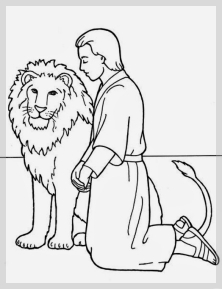
When I first learned about Daniel in the lion’s den in Sunday school, my teacher used a flannel board to tell the story and flannel Daniel had a full head of brown hair. The coloring page that accompanied Daniel’s story when my children attended Sunday school was of a strapping muscular youth. Even the illustrated Bible I gave my grand showed a powerfully built young man sitting amidst the lions. All of those portrayals were wrong! Nebuchadnezzar took only the strongest, healthiest, and best-looking young men for palace training. That however, was 605 BC. It wasn’t until 539 BC (during the reign of Darius the Mede) that Daniel was thrown into the lions’ den. By that time, he’d served as a government official for sixty-six years and probably was into his eighties! He’d lived among Gentiles in a pagan land for over six decades; nevertheless, even though he faced a gruesome death, he defied the king’s edict. Daniel went home, opened the windows, knelt down, and prayed to Jehovah as he’d done every day of his sixty-six-year captivity!

Daniel was an old man; then again, so was Abraham. He was 75 when God called him to leave his home, 86 when Ishmael was born, 99 when circumcised, and 100 when Isaac was born. Moses was 80 and Aaron 83 when they led the Israelites out of Egypt on what became a 40-year trek. Joshua was between 68 and 80 when he led Israel into the Promised Land and Caleb was 85 when he drove the Anakites from Hebron. Jeremiah ministered under Judah’s last five kings and was still prophesying until he was killed in his 70s. When he wrote his gospel and epistles, the Apostle John probably was in his mid to late 70s and, when he wrote Revelation, the man was well into his 80s. Sarah was 90 when pregnant with Isaac and the prophet Anna was over 100 when she recognized Jesus as the Messiah. While we may find ageism in today’s society but there is no such thing as ageism or retirement in God’s Kingdom! The younger ones in Christ’s church never must make the mistake of misjudging or undervaluing the seniors in their midst. I suspect the men who conspired against Daniel underestimated the power of an old man who trusted in God (a fatal mistake since they were the ones eaten by lions that day)!

On the other hand, those of us in our golden (but somewhat rusty) years must stop discounting our value, as well. That we’re facing some limitations or challenges due to age simply means it’s time to reevaluate, not to stop! As seniors, we provide strength, stability, encouragement, and wisdom to our younger brothers and sisters. No matter how old we are, we can always share God’s love and our prayers. God wasn’t finished with Daniel, Abraham, or Moses and He’s not finished with us!

Here is the test to find whether your mission on earth is finished: If you’re alive, it isn’t. [Richard Bach]

Now that I am old and gray, do not abandon me, O God. Let me proclaim your power to this new generation, your mighty miracles to all who come after me. [Psalm 71:18 (NLT)]

Copyright ©2024 jsjdevotions. All rights reserved.

LAST WORDS

When Jesus had received the sour wine, he said, “It is finished,” and he bowed his head and gave up his spirit. [John 19:30 (ESV)]

It’s been said that Leonardo da Vinci’s last words were, “I have offended God and mankind because my work did not reach the quality it should have.” A scientist, painter, architect, mathematician, musician, sculptor, geologist, botanist, historian, cartographer, and inventor, da Vinci was a true Renaissance man and it’s difficult to understand how he could feel he failed God or anyone else.
I hope my last words won’t be as depressing as da Vinci’s or as foolish as those of Major General John Sedgwick who, just moments before he was shot and killed during the Civil War, said, “They couldn’t hit an elephant at this distance!” I’d like to think my last words will be as faith-filled as those of blues singer Bessie Smith’s, “I’m going, but I’m going in the name of the Lord!” or Harriet Tubman’s, “Give my love to the churches. Tell the women to stand firm. I go to prepare a place for you.”  Nevertheless, my words probably will be as mundane Elvis Presley’s, “I’m going to the bathroom to read.”

While Nostradamus correctly predicted his death when he said, “Tomorrow, at sunrise, I shall no longer be here,” most of us won’t know when the words we speak will be our last ones. Jesus, however, knew his earthly life was ending when He spoke from the cross. He’d been hanging there for several hours and the weight of his body pulling down on his arms meant he could barely breathe. John tells us Jesus said, “It is finished!” and then died. After hearing those words, can you imagine the heartbreak of His followers? This was Jesus, the man who calmed storms, fed thousands, and healed lepers! This was the promised Messiah! How could it be finished? Everything His disciples believed and hoped for was gone! Was this how their story would end?

Last words, however, aren’t always what they seem. Jesus’ words and the crucifixion were only the end of the first act. What the disciples didn’t understand on that dark Friday afternoon was that the story was just getting started. Three days later, the resurrection opened the second act. Forty days after His resurrection, the second act closed with Jesus’ ascension into heaven. Although He spoke to the disciples and blessed them before His departure, Matthew, Mark, Luke, and John included different portions of Jesus’ final words. Nevertheless, His message was the same: our sins are forgiven, we are to go out into the world and make disciples, and the power of the Holy Spirit is promised. When Jesus physically left the disciples with His ascension into heaven, the second act ended, but the words He spoke were not His final ones. Because He promised both His presence and His return, we know there’s more to come!

The third act began with the Spirit’s presence on Pentecost and continued when Jesus spoke to Saul on the road to Damascus and revealed Himself to John on Patmos. While probably less dramatic than Paul’s encounter and less graphic than John’s, the Lord continues to speak to us today through His living word (the Bible), prayer, and in the Holy Spirit’s beautiful whisper. The only last words to be spoken in the third act will be ours when we depart the stage—whether they are as mundane as those of Elvis or as memorable as da Vinci’s. Nevertheless, when the curtain closes for us, the story still is not over!

The glorious fourth act begins when we come home to Jesus and hear His voice again. This final act has no ending and there will be no last words spoken. It never is finished and the curtain never will fall!

Let not your hearts be troubled. Believe in God; believe also in me. In my Father’s house are many rooms. If it were not so, would I have told you that I go to prepare a place for you? And if I go and prepare a place for you, I will come again and will take you to myself, that where I am you may be also. [John 14:1-3 (ESV)]

Truly, truly, I say to you, an hour is coming, and is now here, when the dead will hear the voice of the Son of God, and those who hear will live. [John 5:25 (ESV)]

Copyright ©2024 jsjdevotions. All rights reserved.


UNICORNS

God brought him forth out of Egypt; he hath as it were the strength of an unicorn: he shall eat up the nations his enemies, and shall break their bones, and pierce them through with his arrows. [Numbers 24:8 (KJV)]

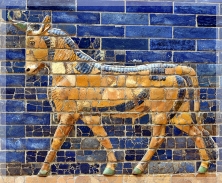
ancient mosaic of aurochSome believers insist that unicorns actually existed because they are mentioned nine times in the Old Testament. Claiming the Bible is completely without error, they insist that you must believe the same thing—including the unicorns! On the other hand, some people disparage believers and discount all of Scripture because of those same unicorns! Do we blindly believe or do we “throw out the baby with the bathwater” because of one word?
While the Bible is infallible, that’s not always true of translators. The Hebrew word used for this wild animal was re’em and seemed to mean a beast with a horn (but not necessarily only one horn). It’s found in Numbers 23:22, 24:8; Deuteronomy 33:17; Job 39:9,10; Psalm 22:21, 29:6, 92:10; and Isaiah 34:7. When looking at the context, re’em always refers to someone or something with great power. In Numbers, we find God comparing His strength to that of the re’em and, in Psalm 22:21, David refers to his formidable enemies as re’em.

By the third century BC, the language and culture of Greece had spread throughout the world and the Jewish knowledge of Hebrew was declining. The Jewish community in Egypt (along with the Hellenic Egyptian ruler Ptolemy II) initiated the translation of the Torah into Greek. During the next two centuries, the entirety of the Hebrew Scriptures were translated into Greek in what is called the Septuagint. At that time, the Hebrew re’em (wild beast with a horn) was inaccurately translated into the Greek monokeros (one horn). When citing the Hebrew Scriptures, the epistle writers quoted from the Septuagint and, since Gentile Christians knew nothing of Hebrew, the Greek Septuagint became the Bible of the early church.

Fast forward to the fourth century when Latin began replacing Greek as the language of the people. In 382 AD, Pope Damasus I commissioned his secretary, Jerome, to produce a new Scripture translation in Latin. Written in the Latin of the day, St. Jerome’s translation is known as the Vulgate. It is from this translation that we get English words like scripture, salvation, justification, and regeneration. In Jerome’s translation, the Greek monokeros became the Latin unicornis (a one-horned beast).

Fast forward again to the 16th century and the first English translations of Scripture—William Tyndale’s and the Geneva Bibles followed by the King James version in 1611. Although unicornis was rendered as unicorn in these Bibles, it’s unlikely the translators believed it to be the mythological unicorn. Not knowing what it was, they simply transliterated the Latin word into the English “unicorn.” Closely associated with chivalry, by the 1600s the unicorn was a symbol of purity and grace that could be captured only by a virgin. The horse-with-a-horn of myths and fairy tales doesn’t sound much like the untamable, ferocious, and powerful wild re’em of the Old Testament!

Nowadays, only a few Bible translations continue to use unicorn. I found only six (out of 62) and all of those are based on the Wycliff, Geneva, or King James translations. While most other versions translate re’em, monokeros, or unicornis as wild ox, a few use wild bull, rhinoceros, or buffalo. Since no one knows absolutely for sure, Young’s Literal translation returns to the original with reem! The Orthodox Jewish Bible uses wild bull, wild ox, and “re’eim (wild ox).”

So, what was the re’em? While it could refer to rhinoceros, buffalo, or antelope, it probably refers to aurochs, large cattle which once roamed Europe, Africa, and Asia. Ancient Assyrian and other Middle Eastern texts refer to this this wild ox-like animal with a similar word. Because ancient art usually depicted the auroch from a profile view (as does the ancient mosaic pictured), it appeared to have just one horn. Ancestors of domestic cattle, aurochs stood over six-feet tall and weighed over 2,200 pounds. Julius Caesar described them as “a little below the elephant in size,” having the shape and appearance of a horned bull, possessing “extraordinary” strength and speed, and being untamable, even when taken as calves. The auroch became extinct in Poland in 1627.

While we now have an answer to skeptics who mock us for believing in a book attesting to the existence of unicorns (when it doesn’t), we must be cautious in our response. Although Scripture doesn’t speak of a unicorn, that doesn’t mean some creature with just one horn never existed. After all, God created the one-horned narwal and rhinoceros, so who are we to say He never created something like the mythical unicorn? Although we’ve never seen them, we know animals like the wooly mammoth, dodo, saber-toothed tiger, and auroch existed. Having already seen strange creatures like jelly fish, giant anteaters, and the wildebeest, I know better than to deny God’s ability to create any creature He desires. What we can know for sure, however, is that the Bible can be trusted!

There’s no better book with which to defend the Bible than the Bible itself. [D.L. Moody]

God brings him out of Egypt, He is for him like the horns of the wild ox. He will devour the nations who are his adversaries, And will crush their bones, And smash them with his arrows. [Numbers 24:8 (NASB)]

Copyright ©2024 jsjdevotions. All rights reserved.

YOUR ACHILLES’ HEEL (Armor of God – 3)

Let no one say when he is tempted, “I am being tempted by God,” for God cannot be tempted with evil, and he himself tempts no one. But each person is tempted when he is lured and enticed by his own desire. [James 1:13-14 (ESV)]

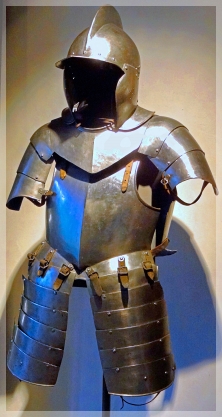
armor - Castle of SpiezBack in in 1586, during the Eighty Years’ War, Sir Philip Sidney was fighting for the Protestant cause against the Spanish when he noticed another soldier was without leg armor. Believing that he shouldn’t be better protected than his men, Sidney gave the man his cuisses (armor that covered the thigh). During the Battle of Zutphen, Sidney was fatally wounded in his thigh during the final charge and, three weeks later, he died of gangrene from the injury. While heroic, his death was avoidable if the man had worn his complete set of armor!

In Greek mythology, Achilles was the son of Thetis, a powerful sea goddess. When a seer told her that Achilles would be a great warrior but would die young, Thetis dipped her infant son in the river Styx to make him invincible. The boy became invulnerable everywhere but at his heel where his mother held him. Although Achilles was a great warrior, the god Apollo was angry with him. Knowing of his unprotected heel, Apollo directed a soldier’s arrow to the warrior’s one vulnerable spot and Achilles was killed in battle by that well-aimed arrow. Because of this myth, an “Achilles’ heel” has come to mean a person’s only weakness.

I tell these stories because both Sir Philip Sidney and Achilles were missing part of their protective covering and the Apostle Paul made it clear that the full armor of God is necessary if we are to defeat Satan. Let’s not fool ourselves, just as Apollo knew about Achilles’ unprotected heel, Satan knows exactly where to attack us! The area we leave unprotected is the place where Satan will strike.

While he doesn’t use arrows, canon balls, or bullets, Satan has an arsenal of weapons at his disposal. After bombarding Job with loss of family, finances, status, and health, he continued the attack with intense pain, depression, and doubts about God’s goodness. Satan mistakenly thought God was protecting Job with a fence of prosperity but the man remained impervious to Satan’s arrows because he was wearing God’s spiritual armor.

Satan may have failed with Job but he was successful with others. Finding a chink of pride and self-reliance in David’s armor, Satan tempted him to take a census. Knowing that David’s Achilles’ heel was his eye for the ladies, Satan tempted him with the beautiful but married Bathsheba. Whether it was Judas’ lust for money or a Zealot’s disappointment in the Messiah’s role, Satan knew where his weakness lay and entered Judas through that missing piece of armor.

We all have a weak spot (or spots). After all, even Superman’s Achilles’ heel was kryptonite! For some of us, it is doubts about God’s goodness, pride, fear, unforgiveness, or a wandering eye. For others, it is love of money, a quick temper, a critical tongue, or chronic impatience. What is your Achilles’ heel? Be alert; Satan knows exactly what and where it is and will do his best to take you out of action with what he hopes to be a fatal shot.

Although God’s armor is tailor-made for us, it does us no good if we fail to put all of it on. Are you missing a piece of God’s armor?

He [the devil] will attack you sometimes by force and sometimes by fraud. By might or by sleight he will seek to overcome you, and no unarmed man can stand against him. Never go out without all your armor on, for you can never tell where you may meet the devil. He is not omnipresent, but nobody can tell where he is not, for he and his troops of devils appear to be found everywhere on this earth. [Charles Spurgeon]

Be sober-minded; be watchful. Your adversary the devil prowls around like a roaring lion, seeking someone to devour. [1 Peter 5:8 (ESV)]

Copyright ©2024 jsjdevotions. All rights reserved.

OUR SWORD (Armor of God – 2)

But he [Jesus] answered, “It is written, “‘Man shall not live by bread alone, but by every word that comes from the mouth of God.’”… Jesus said to him, “Again it is written, ‘You shall not put the Lord your God to the test.’” … Then Jesus said to him, “Be gone, Satan! For it is written, “‘You shall worship the Lord your God and him only shall you serve.’” [Matthew 4:4,7,10 (ESV)]

God’s armor includes the belt of truth, the breastplate of righteousness, the shoes of the gospel of peace, the shield of faith, and the helmet of salvation. No soldier, however, would go into battle without a weapon. While a soldier might go into battle without armor as did David when he met Goliath, he’d never go without a weapon. The young shepherd’s weapon was a handful of stones but the Christian’s weapon is the “sword of the Spirit, which is the word of God.”

The sword Paul describes wasn’t like the nearly six-foot heavy broad sword (rhomphaia) David used to decapitate Goliath or the sword of judgement of Revelation. The sword of the Spirit is a machaira, a small sword, knife, or dagger used in in hand-to-hand combat. While the Christian’s one offensive weapon is small, it is mighty because it can defeat Satan! When Jesus was in the wilderness, He used this powerful sword. The Lord answered each of Satan’s temptations with the words, “It is written…” He needed nothing more than the Word to send Satan packing.

Satan frequently uses his own machaira when tempting people—only his version of the Word is perverted. He’s more than willing to put his words in God’s mouth! When tempting Eve in the garden, the evil one emphasized God’s prohibition rather than His gifts when he asked if God really said she couldn’t eat any of the fruit in the garden. Although Eve corrected him that only one tree was prohibited, she was unsure of God’s words and added that it couldn’t even be touched! When Satan assured Eve that she wouldn’t die if she ate the fruit, the woman was bamboozled; not knowing and trusting God’s word is what brought death into the world!

Long before GPS and cell phones, toward the end of World War II, the allied forces conducted a military campaign to mop up the remaining Nazi resistance in Berlin. When a crucial mission was assigned to one unit, it was essential that each soldier memorize a detailed map of the enemy’s positions in the city. Because each soldier managed to commit the map to memory, the mission was a success. Several years later, the Army conducted an experiment to see if that original feat could be repeated. The participating soldiers were offered an extra week’s furlough as incentive if they could carry out a comparable mission without a glitch. Despite the promise of furlough, this second unit failed to match the success of the first. Could their failure have been because their lives never were in jeopardy? Perhaps one’s survival in battle serves as a greater motivation than a week’s vacation in peacetime.

While I’ve found this story in a variety of sources, I can’t verify its truth. Nevertheless, it makes a great sermon illustration and I found it in a commentary on Ephesians 6:17. As  Christians, we are engaged in spiritual warfare. Rather than holding a map of Berlin and Nazi strongholds in our memory, we need the Bible in our hearts. Paul warned us that Satan “disguises himself as an angel of light.” [2 Cor. 11:14] The only way to spot his falsehoods and perversion of the gospel is to know the truth! The sword of the Spirit—the word of God—is the only offensive weapon in our arsenal. The more we read it, the more we memorize it, and the more thoroughly we know and understand it, the better prepared we are to march into battle. We must study God’s Word as if our lives depended on it—because they do.

The Bible is an armory of heavenly weapons, a laboratory of infallible medicines, a mine of exhaustless wealth. It is a guidebook for every road, a chart for every sea, a medicine for every malady, and a balm for every wound. [Thomas Guthrie]

For the word of God is living and active, sharper than any two-edged sword, piercing to the division of soul and of spirit, of joints and of marrow, and discerning the thoughts and intentions of the heart. [Hebrews 4:12 (ESV)]

Copyright ©2024 jsjdevotions. All rights reserved.