HANDS

Lift up your hands in the sanctuary and praise the Lord. [Psalm 134:2 (NIV)]
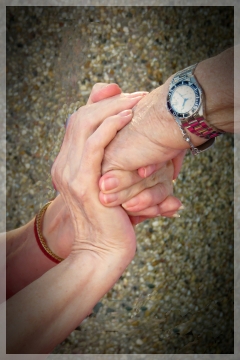
handsWhile social distancing has put an end to breaking bread with friends and holding hands while sharing a table blessing, I recall a dinner several years ago when I held the hand of our pastor’s wife during grace. For a small woman, her hands were larger and stronger than I expected. After grace, I looked at them and, comparing her youthful hands with mine, admit to feeling a twinge of envy. Like her, I played the piano but, unlike her, I could barely span an octave. Her sturdy hands had incredible reach and, unhampered by arthritis, there was power in her touch on the keyboard. I was overwhelmed by the strength of her hands and the beautiful way she uses them to praise the Lord as the worship leader at our mountain church.

As I pondered hands, I thought of a friend who used her hands to sign for the hearing impaired, the men whose hands set up chairs for Bible study, people who use their hands to pack meals for the food bank, and the ones serving soup at the homeless shelter. Some people’s hands warmly greet people as they enter church, bake cookies for Bible study (and lonely neighbors), fold programs or pass out communion. I thought of the preschoolers’ hands acting out “Zacchaeus” or “This Little Light of Mine” and the adult hands making a joyful noise in the bell choir and band. I thought of the calloused hands that mow the lawn and shovel the snow at our northern church, the patient hands that help the church’s children create sheep from cotton balls and tongue depressors, and the little hands that make those crafts. I thought of the hands that comfort the sick and hospitalized, baptize new believers, are raised in praise during worship, or enthusiastically clap during a spirited song. I considered the hands that prepare meals for families in need, hold babies in the church nursery so their mothers can have a few quiet minutes during worship, and fold in intercessory prayer for their church family. I thought of the hands that knit or crochet for the prayer shawl ministry and those that went from sewing colorful pillowcases for hospitalized children to making masks during the pandemic. What of the hands that so freely drop money into the offering baskets and those that carefully count the money and keep the books? They may not be leading worship while playing a keyboard or strumming a guitar but those hands are doing God’s work in their own unique way.

Today I looked at my wrinkled hands with their short fingers and knobby knuckles—hands that ache at night, are stiff in the morning, struggle to open jars and no longer fly over the piano’s keys. Nevertheless, they are hands that still can serve God. Mother Teresa often defined herself as “a little pencil” in the hand of the Lord. Indeed, we all are pencils in God’s hands and leave his mark on those we touch.

Thank you, God, for our hands; show us what you want us to do with them so they bring glory to your name. While this pandemic means we can’t hold hands with one another, show us how we can use our hands and hearts to reach out to your children. Bless our hands, O Lord, to do your holy work.

I don’t claim anything of the work. I am like a little pencil in His hand. That is all. He does the thinking. He does the writing. The pencil has nothing to do with it. The pencil has only to be allowed to be used. [Mother Teresa] 

May the favor of the Lord our God rest on us; establish the work of our hands for us – yes, establish the work of our hands. [Psalm 90:17 (NIV)]

Copyright ©2020 jsjdevotions. All rights reserved.

THE SCARLET CORD

tulip kaufmanniana - fire ball

Faith shows the reality of what we hope for; it is the evidence of things we cannot see. Through their faith, the people in days of old earned a good reputation. [Hebrews 11:1-2 (NLT)]

One of only two women listed in the book of Hebrews’ “Hall of Faith,” Rahab married Salmon, was the mother of Boaz (who married Ruth), a great-great grandmother to David, and one of Jesus’ ancestors. Not an Israelite, she was a prostitute from Jericho who collaborated with her nation’s enemy. Yet, her faith is commended in Hebrews, Matthew makes specific mention of her in Jesus’ genealogy, and James speaks highly of her in his epistle. Why?

Rahab met many travelers in her dubious profession and heard how the Israelites passed through the Red Sea, defeated the Amorite kings Sihon and Og, and slaughtered all of their people. Recognizing the Israelites’ God as supreme, she anticipated Jericho’s defeat and the perceptive woman judiciously aligned herself with the winning side. After protecting two Israelite spies by hiding them from the king’s men, she requested the same loyalty to her that she’d given them and negotiated for the safety of herself and her family. As Rahab lowered the spies to safety on a scarlet cord, they warned that her protection was only ensured if she had that same cord visible on the day of their attack. True to their word, when Jericho fell, Rahab and her family were saved. Was it Rahab’s treason to Jericho that caused her to be mentioned so highly in a gospel and two epistles or was there more?

After leaving Rahab’s house, the spies hid in the hills for three days before returning to camp and reporting to Joshua. After that, the Israelites broke camp and moved to the banks of the Jordan where they stayed another three days before crossing the river. Once across, they erected memorials to commemorate their crossing by God’s power. Four days later, the people celebrated the first night of Passover and, at some point, all of the men were circumcised. While the Israelites observed the eight days of Passover and Feast of Unleavened Bread and the men recovered from their surgery, the invincible city of Jericho closed its gates and readied itself for battle. By then, Rahab had waited at least two weeks for the Israelites and her rescue. Did she begin to doubt the two spies and their God? Had they forgotten about her or did she pick the wrong ally? Did she consider bringing in that scarlet cord and making an alliance with a protector in Jericho? Was she tempted to lose faith in the God of the Israelites?

Eventually, the Israelites set off to conquer Jericho but they didn’t assault the town or lay siege to it. Instead, seven priests blowing rams’ horns followed by 40,000 silent soldiers paraded once around the walled city with the Ark of the Covenant before returning to their camp. For six days, Rahab watched from her window as the Israelites marched once around Jericho and returned to their camp without ever lifting a weapon or shouting a war cry. Was her faith shaken by their strange behavior? Were the Israelites too afraid to attack? What kind of God used such a bizarre battle plan? On the seventh day, when she watched the Israelites parade seven times around the city, did she abandon all hope as she witnessed what appeared to be another day of even more pointless marching? Apparently not; that scarlet cord, the sign of her faith in the God of the Israelites, was still hanging from her window. When the army finally shouted, the walls of the unconquerable city collapsed and Rahab and her family were saved.

The walls of Jericho were leveled by faith in God. Rahab helped two strangers and kept that scarlet cord dangling from her window by that same faith. When God’s plan seems inexplicable or a long time in coming, do we exhibit a similar kind of faith? When things seem at a standstill, when we can’t see His plan, do we despair or do we hang out a scarlet cord of faith in God?

It was by faith that the people of Israel marched around Jericho for seven days, and the walls came crashing down. It was by faith that Rahab the prostitute was not destroyed with the people in her city who refused to obey God. For she had given a friendly welcome to the spies. [Hebrews 11:30-31 (NLT)]

Copyright ©2020 jsjdevotions. All rights reserved.

CARKING CARE

Give your burdens to the Lord, and he will take care of you. He will not permit the godly to slip and fall. [Psalm 55:22 (NLT)]

The Valley of Vision is a collection of Puritan prayers spanning from the sixteenth through the late nineteenth centuries. Having grown up with the King James Bible, its antiquated thees and thous along with verbs forms like wilt, didst, and makest don’t bother me. Their formality actually adds to the beauty and charm of the prayers. Although context usually explained outdated words like nethermost, subserve, and extenuations, I had to look up a few new words like peradventure.

Although I’d never seen the word carking, I immediately knew what the author meant when writing, “Deliver me from carking care…” Sounding like a crow’s unpleasant cry, the phrase “carking care” sounds as disagreeable as what it describes: oppressive worry!

The word cark comes from the Old North French carkier (to load, burden) from the Late Latin carcare (to load a wagon or cart). Carcare is also the source of the word cargo. In English, carking literally means putting on a load or burden and carking cares are concerns that have become burdensome. It’s as if we’ve loaded all of our worries into a wagon and are carting around that troubling cargo. Although we grow weary of the heavy burden, we continue carrying it in our hearts and souls.

Right now, I imagine we all have some major concerns. We fret about children who have missed out on school and family members who must fly, care for the sick, or meet the public in their jobs. We’re in another unpleasant season of politics and the media is filled with incidents of mask rage, protests, civil unrest, and financial woes. If we’re not out of work, we have friends or family who are. Loved ones remain isolated in retirement and nursing homes, bills are piling up, supply chains are broken, businesses are closing, and some people still haven’t gotten their unemployment checks. Vacations, weddings, reunions and even memorial services have been put on indefinite hold, no one knows how schools will function safely, and the COVID dashboards seem to have nothing but bad news. Here in Florida, with hurricane season upon us, we also have the dubious honor of being called the “epicenter” of the latest coronavirus surge. We find ourselves weighing the risks before having a repair man in the house, getting carry-out, or venturing out to the beach or grocery. We’re moving into our fifth month of this pandemic and, with no end in sight, people everywhere are feeling assaulted on all sides. Regardless of their faith, I doubt that anyone feels completely free of cares.

Living in a fallen world, we always will have troubles and concerns. The good news is that they don’t have to be carking ones—we don’t have to carry that cart of cares because God will carry them for us. For that to happen, however, we have to unload our wagon of cares and give them to God through prayer. John Calvin wrote of believers relieving “themselves of their anxieties by pouring them into his bosom…that they may declare that from him alone they hope and expect, both for themselves and for others, all good things.” As we pour our concerns into God’s bosom, let us join with the anonymous writer in his prayer: “Deliver me from carking care, and make me a happy holy person….Teach me to laud, adore, and magnify thee, with the music of heaven, And make me a perfume of praiseful gratitude to thee.”

Perhaps what our Father would have us learn is that worry is not for Him to take away, but for us to give up. [Kathy Herman]

Give all your worries and cares to God, for he cares about you. [1 Peter 5:7 (NLT)]

And I am convinced that nothing can ever separate us from God’s love. Neither death nor life, neither angels nor demons, neither our fears for today nor our worries about tomorrow—not even the powers of hell can separate us from God’s love. [Romans 8:38 (NLT)]

Copyright ©2020 jsjdevotions. All rights reserved.

RATS

Search me, O God, and know my heart; test me and know my anxious thoughts. Point out anything in me that offends you, and lead me along the path of everlasting life. [Psalm 139:23-24 (NLT)]

The human heart is the most deceitful of all things, and desperately wicked. Who really knows how bad it is? [Jeremiah 17:9 (NLT)]

Last week, my foot accidentally made unfortunate contact with an unmovable and incredibly hard piece of furniture. The intense jolt of pain that radiated from my toes through my foot caused words to come spewing out of this church lady’s mouth that had no business being there. While icing my bruised and swollen foot that evening, I recalled C.S. Lewis’ observation that provocation isn’t really what makes us “ill-tempered;” it simply shows us how ill-tempered we really are.

When our immediate response to something or someone is positive—the sort of thing Jesus would do—we’re more than willing to acknowledge our bravery, patience, compassion, or generosity. But, when our instant response to something (or someone) is less than stellar, rather than owning up to our sinfulness, we tend to blame the situation or other person. Justifying ourselves, it was the extenuating circumstance, problematic person, excessive demands (or table leg) that provoked, taxed, perturbed or goaded us into behavior unbecoming of a Christ follower. We, however, can’t have it both ways! Our emotions—our gut reactions, knee jerk responses, and unthinking words—reveal who and what we truly are deep inside.

In Mere Christianity, Lewis likens the sins that are usually revealed only when we’re taken by surprise to “rats in the cellar.” Not seeing the rats when we turn on the light and noisily stomp down the stairs doesn’t mean they’re not there. Most likely, those rats (like our hidden sins), will be seen only when they’re taken by surprise.

It isn’t life’s ambushes—the grueling day, a salesclerk’s rudeness, impossible deadlines, unreturned phone calls, a co-worker’s spitefulness, the vicious tweet, or even broken toes—that cause us to sin; those ambushes just reveal how sinful we actually are. When James and Peter wrote about considering our trials a reason for joy because they help us mature, I thought they were referring only to the significant and often long-lasting challenges of life. Lewis’s words made me consider that those trials include the small, often inconsequential, aggravations and vexations of life that come without warning. They are God’s way of shining a light on the rats in our cellars!

What a man does when he is taken off guard is the best evidence for what sort of man he is. [C.S. Lewis]

Dear brothers and sisters, when troubles of any kind come your way, consider it an opportunity for great joy. For you know that when your faith is tested, your endurance has a chance to grow. So let it grow, for when your endurance is fully developed, you will be perfect and complete, needing nothing. [James 1:2-4 (NLT)]

So be truly glad. There is wonderful joy ahead, even though you must endure many trials for a little while. These trials will show that your faith is genuine. It is being tested as fire tests and purifies gold—though your faith is far more precious than mere gold. [1 Peter 1:6-7a (NLT)]

Copyright ©2020 jsjdevotions. All rights reserved.

EXCUSES

The lazy person claims, “There’s a lion out there! If I go outside, I might be killed!” [Proverbs 22:13 (NLT)]

lions - serengettiAlthough ancient Israel did have lions, they rarely wandered the streets and today’s verse about the sluggard who uses preposterous excuses to avoid work reminded me of more than 45 years ago when I regularly hosted a support group for nursing mothers. Among the chairs in our family room was a large La-Z-Boy rocking recliner. On meeting nights, that chair should have been occupied by the mom with infant twins or the woman within days of giving birth but the women who usually made a bee-line for the comfy rocker were the ones I came to think of as “the excusers.” Although they arrived with a litany of new mother complaints and said they wanted advice, they always had a reason why every suggestion wouldn’t work. While not quite as far-fetched as claiming a stray lion was in the road, some of their excuses came close. Perhaps, operating under the mistaken belief that motherhood was undemanding and trouble-free or that their lives weren’t going to change substantially with a baby’s arrival, these young mothers found it easier to wallow in their misery in a La-Z-Boy than to make an effort to solve their problems and find a way to make their new normal work. Apparently, they weren’t familiar with Proverbs 19:20: “Get all the advice and instruction you can, so you will be wise the rest of your life.”

While pondering excuses, I wondered if mine are as flimsy as claiming a lion is in the street; we all invent excuses to justify both our actions and inaction. The dog may not have eaten our homework but we often try to exonerate ourselves with equally empty excuses. What ones do we use when we’re opposed to trying something new or we want to rationalize not doing something we should have done? What are our excuses when we haven’t prayed, read Scripture, shared our faith, given generously, been patient, made the doctor’s appointment, studied for the test, paid the overdue bill, exercised, attended church, or treated our neighbor with love? Behind every excuse is a real reason; while it can be laziness, it also can be fear, lack of commitment, immaturity, stubbornness, shame, or pride.

Our excuses might be able to fool others and, sometimes, they may even fool us, but they can’t fool God; He’s heard them all! Jesus didn’t offer flimsy excuses and neither should we!

He that is good for making excuses is seldom good for anything else. [Benjamin Franklin]

Nothing in all creation is hidden from God. Everything is naked and exposed before his eyes, and he is the one to whom we are accountable. [Hebrews 4:14 (NLT)]

Search me, O God, and know my heart; test me and know my anxious thoughts. Point out anything in me that offends you, and lead me along the path of everlasting life. [Psalm 139:23-24 (NLT)]

Copyright ©2020 jsjdevotions. All rights reserved.

HIS HAND IN MY GLOVE

This is the explanation: God has made us what we are. God has created us in King Jesus for the good works that he prepared, ahead of time, as the road we must travel. [Ephesians 2:10 (NTE)]

Canadian RockiesLast summer, we moved permanently to our home in Florida. Knowing we’d no longer be spending any time in the cold winters of the Midwest, I packed up our winter attire for the charity resale shop. Along with the many coats, scarves, hats, and boots, I had a pile of winter mittens and gloves. Along with our super warm double ragg mittens, my husband and I had an assortment of wool, fleece, and leather gloves. He had a pair of heavy duty insulated Carhartts and I had some polyester/spandex gloves I often wore while walking. While packing up the rest of the house, I came across work gloves in the furnace room, rubber gloves by the wash tub, gardening gloves in the garage, silicone heat resistant gloves by the grill, fingerless gloves in the gym bag, vinyl gloves in the first aid kit, a pair of oven mitts, and even some chemically treated silver polishing gloves! Each pair had a specific use but, without a hand inside any of them, they were nothing but empty shells.

Thinking about our mittens and gloves, I remembered the words a pastor said many years ago: “Let the hand of God slip into the glove of your life.” When God slipped His hand into Gideon’s life, the fearful man became a warrior. When He slipped His hand in David’s life, the shepherd boy became a giant killer and king. By slipping His hand into Mary’s life, a peasant girl became mother to the Messiah and, when His hand slipped into Peter’s life, a fisherman became a Rock. When God slipped His hand into the glove of Saul’s life, the persecutor of Christians became the builder of Christ’s church.

Those gloves are nothing more than pieces of fabric and leather until they are filled by a hand and put to use. Like a glove without a hand, we are but empty vessels until God’s Holy Spirit fills us. Each glove is designed for a specific function and so are we; each of us has been God-designed for a specific reason. When we let God fill the gloves of our lives, we become His hands and can do the work for which He specially made us. When God fills the voids in our lives, we truly come alive and gain both a sense of purpose and the power to achieve it.

Father Almighty, fill us with your Holy Spirit. Give us loving obedient hearts and servants’ hands so that we joyfully do your holy work.

May not a single moment of my life be spent outside the light, love and joy of God’s presence and not a moment without the entire surrender of myself as a vessel for Him to fill full of His Spirit and His love. [Andrew Murray]

May the God of peace, who led up from the dead our Lord Jesus, the great shepherd of the sheep, through the blood of the eternal covenant, make you complete in every good work so that you may do his will. May he perform, in you, whatever will be pleasing in his sight, through Jesus the Messiah. Glory be to him for ever and ever, Amen! [Hebrews 13:20-21 (NTE)]

Copyright ©2020 jsjdevotions. All rights reserved.