
This is what the Lord says: “Cursed are those who put their trust in mere humans, who rely on human strength and turn their hearts away from the Lord. They are like stunted shrubs in the desert, with no hope for the future. They will live in the barren wilderness, in an uninhabited salty land.” [Jeremiah 17:5-6 (NLT)]
 Our pod is missing! Well, not exactly missing but no one can tell us where it is! We only know that the large box holding our precious possessions is no longer sitting in our driveway back in Illinois nor is it sitting in our driveway here in Florida. While the company promises us that it will arrive by September 29, their responses to our inquiries don’t inspire much confidence. How can they know when it will arrive if they don’t know where it is? Moreover, no one can tell us why it will take four weeks to travel 1,378 miles! Although I keep reminding myself that it’s just stuff, it is our stuff—the stuff we cared about enough to keep and move.
My impatience and frustration at not knowing where the pod is, what condition it is in, and how close it is to arriving make me think of my impatience in prayer, and I don’t think I’m alone in this. Not only do we want to dictate the manner, timing, and outcome of our prayers but also we’d like God to provide us with regular updates as to His progress on our requests. While God is far more trustworthy than any moving company, He usually is as silent about the particulars of our prayers’ outcomes.
It really comes down to trust. Do I trust the movers? Well, I trusted them enough to fill their box with things that were important to me and have them haul it away. At this point, I can trust them to keep their delivery promise or worry about it. Since worry isn’t going to get it here any faster (if at all), I have no choice but to surrender the outcome to them (while praying for its safe and speedy arrival).
It comes down to trust in our prayers, as well—trust in God (and He has a far better track record than any moving company!) Trust has to fill the gap between our heartfelt request and His response. It’s found in that space between our telling God the what, how, where and when of what we want and our ceding the outcome and all of its details to Him. Not everything we ask for will be received; we’re not the customer and God isn’t our celestial vending machine. We don’t get to dictate the terms of our agreement or the end result. We can’t threaten to take our business elsewhere and, unlike the proverbial customer, we are not the ones who are always right. There is only one God and, as the One in charge, He is not at our mercy; we are at His!
When Jeremiah spoke his words of condemnation to the people of Judah, the people had trusted in false gods and military alliances instead of God. In effect, they’d trusted in their own wisdom rather than God’s promises. We may not be erecting Asherah poles, sacrificing to Baal, or making alliances with pagan nations but, when we dictate the outcome of our prayers, we’re little different; we’re trusting in our wisdom and strength rather than God’s.
“The great act of faith is when man decides that he is not God,” said Oliver Wendell Holmes. Indeed, it is. When we turn our concerns Godward, we must trust that our Heavenly Father, the omnipotent creator of the universe, actually knows what He’s doing. Recognizing that God is God (and we are not), we must surrender the outcome and all of the particulars (including the timing) to Him. He is our hope and confidence, our strength and our shield!
 Dorian has departed and we Floridians are taking down hurricane shutters and removing plywood from our windows. Some people avoided that task by having high-impact windows and doors that combine specially glazed impact-resistant glass with heavy duty frames that keep the glass from breaking away from its frame; while the glass may crack from a direct hit, it will not break. In theory, when a home or business has such glass installed, no additional shutters, screens, or plywood are necessary to protect it from the ravages of a hurricane.
 Not so long ago, it was hard to face my computer with any enthusiasm. Every beginning led to a dead end or took me down a rabbit hole of confusion. The paragraphs over which I’d struggled had come to nothing and my hours at the keyboard seemed an exercise in futility. It’s as if I had little scraps of useless fabric but couldn’t find a way to quilt them together. I wondered where God was when I so desperately needed His guidance.
 An early morning rainstorm left a rainbow over the Gulf. “Oh, thank you, Lord,” I said, “That’s just what I needed.” You see, I was suffering from a serious case of the glums and gloomies. Having recently undergone foot surgery, I knew some of my blues had to do with pain, poor sleep, the nuisance of immobility, undone tasks, and “cabin fever.” Nevertheless, that didn’t seem to fully explain my melancholy. Struggling to discern its underlying cause, I’d prayed that God would lead me to the root of the problem. In my darkness, I’d also asked Him to give me a little sign that He heard my pleas. God is big on rainbows—just ask Noah—and it felt like He hung that rainbow out just for me and hope was on the horizon.
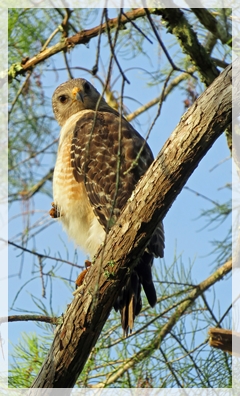 Seeing a red-shouldered hawk perched up in a nearby tree, I focused in on it only to see him suddenly duck his head to avoid being attacked by small bird and then drop again as another tiny bird swept down at him. Those two gnatcatchers boldly harassed the hawk as it kept bobbing and weaving to dodge them. Fiercely territorial, gnatcatchers are unafraid to confront predators and, apparently, the hawk was infringing on their territory. Eventually, the hawk admitted defeat and flew off to another tree. I later asked one of the Audubon docents why the large hawk didn’t fight back against the tiny birds and was told that the hawk knows it can’t win. Being so small, the fast and agile gnatcatcher easily can out maneuver the bigger bird. For the hawk, the energy spent trying to catch the gnatcatcher isn’t worth it; fleeing makes more sense than staying. After settling in another tree not far away, the hawk spotted a crayfish. After sweeping down to catch it, he returned to his new perch and enjoyed a peaceful breakfast (without any annoying gnatcatchers).
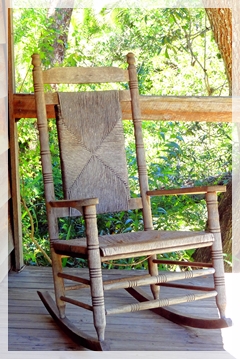 When we’re told to “Be still” in Psalm 46, we tend to think in terms of stopping movement—our busyness, frantic activity, or agitated actions. We associate it with a director yelling, “Cut!” the ref blowing his whistle, or a frustrated parent’s “Cut it out!” Being still can entail all of that, but it is much more. The root of the original Hebrew word used for “still” is the verb rapa which means to be faint, forsake, or sink down. When used as the imperative ra’pha’h, as it is in Psalm 46, it means to drop or release our concerns, to become weak, or surrender. While most Bible versions translate this as “Be still,” some translate as desist, stop fighting, cease striving, be quiet, or be at peace. In short, we’re being told to stop anxiously fighting a situation and leave the matter to God—to relax our grip on things, stop worrying and let it be.

