
I will meditate on your precepts and fix my eyes on your ways. I will delight in your statutes; I will not forget your word. … The law of your mouth is better to me than thousands of gold and silver pieces. … How sweet are your words to my taste, sweeter than honey to my mouth! [Psalm 119: 15-16, 72, 103 (ESV)]
The more you read the Bible; and the more you meditate on it, the more you will be astonished with it. [Charles Spurgeon]
 Psalm 119, the longest of the psalms, is a song in praise of the Word of God. Since we don’t read this psalm in its original Hebrew, we fail to appreciate its intricate construction. Each of its twenty-two sections begin with a letter of the Hebrew alphabet in sequence. Each of the eight verses in those twenty-two sections begin with the letter that introduced it. For example, the first word of the first section begins with alef, as do the next seven verses. In the second section, every line begins with beth. The psalm continues that way up to the 22nd (and last) section where every line begins with the final letter of the Hebrew alphabet, tav.
Using a variety of synonyms (such as words, ways, precepts, testimonies, commandments, path, and law), the psalmist mentions God’s word no less than 183 times! Believed to have been written by David, Jeremiah, Daniel or Ezra, the psalm’s author refers to himself as God’s servant and claims to praise God seven times a day. Whoever it was, penning a 176-line song about delighting in God’s word as an acrostic was a true labor of love.
I thought of this psalm when reading author Ann Voskamp’s description of the joy with which a nomadic tribe in Northern Kenya reacted when Bibles arrived in their village. Packed in cardboard boxes, God’s Word arrived on the back of a camel and was greeted by more than a thousand Rendille tribespeople along with dozens of their distant neighbors. After waiting 30 years for this day, the Rendille finally had Scripture’s words written in their own language. Having written praise songs specifically for the celebration, the women sang, “We give thanks to the Lord. The Word of God is like a pillar in our life. We give thanks to the Lord for this day for it is the first time we have the Bible in our own language.” Voskamp described how several women even slept with their Bibles under their pillows, “because it was treasured. They had nothing more valuable or priceless in their entire lives than God’s Word.” For these followers of Christ, their newly translated Bibles were better than “thousands of gold and silver pieces.”
Unlike the Rendille people, we’ve had God’s word in our own language since William Tyndale’s translation of the New Testament in 1525; ten years later, the entire Bible was available in English. As the best-selling book of all time, Lifeway reports that about 85% of American homes have a Bible and the average household owns between four and five! While I suspect those Rendille tribespeople regularly read their Bibles, the Barna Group found that only about 35% of Americans ever read any of it and 36% of Americans never read at all! Yet, last year, the American Bible Society found that 71% of Americans are curious about the Bible and/or Jesus. There seems to be a disconnect here! If we’ve got questions about cooking, investing, bitcoins, or a medical condition, we research those topics. But, when we’re curious about the Bible or Jesus, those four plus Bibles in our homes remain unopened!
Both the psalmist and Rendille tribespeople celebrated God’s beautiful gift of Scripture. Finding it as “sweet as honey” and better than gold, they treasured this lamp to their feet and light for their path. After witnessing the Rendille’s enthusiastic response to the Bibles’ arrival along with their gratitude and joy in the Word, Voskamp asked herself, “How many Bibles do I have that are on my shelf collecting dust? Do I treasure God’s Word like this?”
Hers is a valid question and one we all should ask ourselves. Do we cherish and appreciate God’s word as did the author of Psalm 119? Do we receive God’s love letter to His people with the enthusiasm of the Rendille people? We should! After all, other than Jesus, it is the best gift God gave to man! Scripture’s words belong in our hearts rather than collecting dust in our bookcases!
I venture to say that the bulk of Christians spend more time in reading the newspaper than they do reading the Word of God. [Charles Spurgeon]
 We enjoy walking in the local Botanical Garden as well as the nearby Corkscrew Swamp. Although both offer plenty of photo ops and pleasant strolls in God’s creation, the Garden offers more color and variety than a swamp any day. Nevertheless, as much as I enjoy the Garden’s beauty and serenity, I feel more at home in the swamp.
 What would you do if you were six and your father said that your mom is in the hospital because she finds it hard to be happy and “did something stupid”? That question is answered in Duncan Macmillan and Jonny Donahoe’s one-act play, Every Brilliant Thing. In their play, that boy, now a grown man, tells the audience that he made of list of everything that was “brilliant” about the world—everything worth living for—and left it on his mother’s pillow. Reflecting a six-year old’s priorities, the list included ice cream, Kung-Fu movies, laughing so hard you shoot milk out your nose, burning things, construction cranes, and “me.” Although she returns the list with its spelling corrected, the boy’s mother never comments on it. Nevertheless, he keeps adding to his list. Although his mother eventually takes her life, the narrator tells how his list took on a life of its own and eventually saved him from his own depression and suicidal thoughts.
 The tradition of New Year’s resolutions goes back over 4,000 years to the ancient Babylonians (whose new year began in mid-March with the spring equinox). During their 12-day celebration called Akitu, they either crowned a new king or reaffirmed their loyalty to the old one. To ensure the gods’ favor, they promised to return borrowed items and pledged the repayment of all their debts.
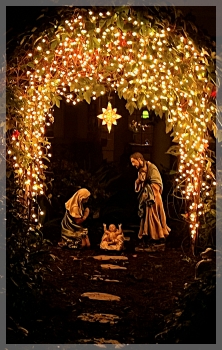 Unfortunately, much of our Advent season is not spent joyfully looking forward to celebrating the birth of the Christ child. In hope of finding the perfect gift for everyone on our list, we pore over catalogues and search for sales and coupons. Either we fight for parking spots at the mall and spend hours standing in line or spend those hours sitting at the computer while shopping on line! We then fret and fuss over wrapping those gifts, mailing packages and Christmas cards, hosting and attending parties, baking cookies, making travel arrangements, decorating the house, preparing holiday dinners, and paying the ever-mounting bills. When we say, “Merry Christmas!” we might find ourselves mumbling a Scrooge-like “Bah! Humbug” under our breath! Instead of looking forward to Christmas with anticipation, there are times we can’t wait until it’s all over and done.
 Devotions of the Heart