
Speak to each other in psalms and hymns and spiritual songs, singing and chanting in your heart to the Lord, always giving thanks for everything to God the father in the name of our Lord Jesus the Messiah. [Ephesians 5:19-20 NTE)]
 Joe Btfsplk was a character in Al Capp’s Lil’ Abner comic strip. With a last name that sounds likes what’s known as a “raspberry” or “Bronx cheer,” the poor man had a dark cloud of perpetual bad luck hanging over his head. Btfsplk no longer appears in the comics but I think his dark cloud of misfortune has settled over the head of a dear friend I’ll call JB (in honor of Capp’s luckless character). Since JB’s retirement, if something could go wrong, it has and, as soon as one challenge resolves, another one appears. When I saw the photos from his most recent mishap, JB looked as if he’d been tossed around in a giant rock tumbler filled with broken glass and boulders.
I later learned that one of his wounds became infected (meaning a hospital stay) and, upon his release, JB fell and suffered a ruptured Achilles tendon! A modern-day Job, the poor guy can’t catch a break!
JB, like Job, could be described as an honorable and upright person who fears God. Fortunately, JB doesn’t have a group of friends (like Job’s) who blame his misfortunes on his unrepented sins. Nevertheless, like Job, JB probably wants to know the why of his continual trials. But, as a Bible-reading Christ follower who’s read the book of Job, JB understands that only our sovereign God knows why life unfolds as it does.
Paul’s words to the Ephesians were to always give “thanks for everything to God the Father” but, when considering JB’s trials, I wonder how it can be done. Were I under the dark cloud that seems to plague him with an unending downpour of challenges, I wonder if I could give thanks for it all. While giving thanks in some or most things is doable, the Greek word Paul used was pas which meant the entirety—every kind of circumstance. Rather than just the good or even tolerable stuff of life, we are to give thanks for the whole shebang (trials and all)!
It’s not as if Paul said those words flippantly. Like JB, his life was filled with trials and adversity. He suffered through more than his share of floggings, beatings, shipwrecks, imprisonment, persecution, physical infirmity, and pain. Giving thanks in such ordeals and trouble seems impossible until we look at Paul’s words leading up to today’s verses in which he said to “be filled with the Spirit!” [5:18] He also called on the power of the Spirit with his closing words to the Ephesians: “Just this: be strong in the Lord, and in the strength of his power.” [6:10] He told Philippians something similar: “I have strength for everything in the one who gives me power.” [4:13]
On our own, we might be able to put on a good front—grit our teeth, “grin and bear it,” or wear a martyr’s face while grumbling inside—but we need the power of the Holy Spirit to have a heart that is thankful to God in all things. It is by the Spirit’s power that we can focus on God, on His love, wisdom, and many blessings so that, knowing that He sees the future while we see only the present, we can submit to His sovereign plan with thanks and even joy.
I don’t think Paul’s words mean we have to be happy every time we end up in the ER, are diagnosed with cancer, or lose a loved one. The many psalms of lament show us that grief, anguish, and pain can coexist with gratitude. Rather than denying our pain, sorrow, or suffering, giving thanks during our trials reminds us that beauty, joy, and good still exist in spite of them. We can move from lament to gratitude because there always is something for which we can be thankful in every situation—even if it’s only that whatever happened wasn’t worse! We know that God is present and that He will strengthen, comfort, protect, and guide us through the dark storms of life and, for that, we can be thankful.
Admittedly, being thankful in all circumstances is not easy. Even famed evangelist Charles Spurgeon struggled. “I have not always found it easy to practice this duty; this I confess to my shame,” said the man known as the ‘Prince of Preachers.’ “When suffering extreme pain some time ago,” continued Spurgeon, “a brother in Christ said to me, ‘Have you thanked God for this?’ I replied that I desired to be patient, and would be thankful to recover. ‘But,’ said he, ‘in everything give thanks, not after it is over, but while you are still in it, and perhaps when you are enabled to give thanks for the severe pain, it will cease.’ I believe that there was much force in that good advice.” Indeed, there is!
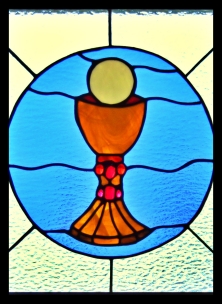 The celebration of the Lord’s Supper/Holy Communion/the Eucharist has been central to Christian worship since the early church. While Protestants think of the Eucharist as the sacrament commemorating the Last Supper with bread and wine, for Roman Catholics and some Orthodox, “Eucharist” specifically refers to the consecrated elements, especially the bread. How ever you define it, the word “eucharist” originally had nothing to do with this beautiful sacrament.
 What would you do if you were six and your father said that your mom is in the hospital because she finds it hard to be happy and “did something stupid”? That question is answered in Duncan Macmillan and Jonny Donahoe’s one-act play, Every Brilliant Thing. In their play, that boy, now a grown man, tells the audience that he made of list of everything that was “brilliant” about the world—everything worth living for—and left it on his mother’s pillow. Reflecting a six-year old’s priorities, the list included ice cream, Kung-Fu movies, laughing so hard you shoot milk out your nose, burning things, construction cranes, and “me.” Although she returns the list with its spelling corrected, the boy’s mother never comments on it. Nevertheless, he keeps adding to his list. Although his mother eventually takes her life, the narrator tells how his list took on a life of its own and eventually saved him from his own depression and suicidal thoughts.
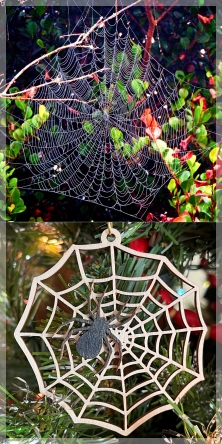 It was a web day at the park and I don’t mean the world-wide kind. It was one of those days when the morning dew, mist, and light cooperated in such a way that we saw beautiful intricate spider webs hanging everywhere. Looking as if they were made of strands of silver rather than proteinaceous silk extruded from a spider’s spinnerets, it seemed like the spiders had decorated all the trees in celebration of Christmas.
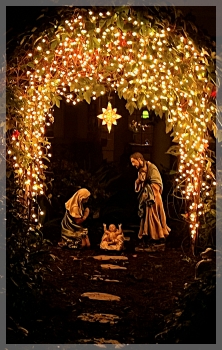 Unfortunately, much of our Advent season is not spent joyfully looking forward to celebrating the birth of the Christ child. In hope of finding the perfect gift for everyone on our list, we pore over catalogues and search for sales and coupons. Either we fight for parking spots at the mall and spend hours standing in line or spend those hours sitting at the computer while shopping on line! We then fret and fuss over wrapping those gifts, mailing packages and Christmas cards, hosting and attending parties, baking cookies, making travel arrangements, decorating the house, preparing holiday dinners, and paying the ever-mounting bills. When we say, “Merry Christmas!” we might find ourselves mumbling a Scrooge-like “Bah! Humbug” under our breath! Instead of looking forward to Christmas with anticipation, there are times we can’t wait until it’s all over and done.
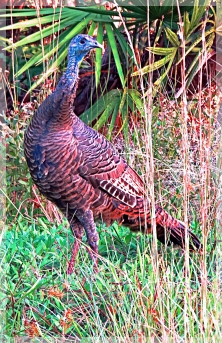 When I was a girl (back in the days of pen, paper, and postage stamps), my mother insisted that I write a “thank you” note for any gifts I received. Whether my birthday or Christmas, I was not allowed to enjoy any gifts until the necessary notes had been written. Moreover, each note had to be personal. I couldn’t just write a quick generic, “Thank you for the nice present.” I had to say something specific about the gift and, if it was money, I had to say how I planned on using it. Even if the present was something I really didn’t like or want (and we’ve all had those kinds of gifts), I had to express gratitude. My mother reminded me that, while I might not value the gift, someone else’s time, thought, love, and money had gone into getting it for me. Therefore, I should take the time to properly acknowledge and show my appreciation for the giver’s generosity. Her “thank you” note rule also applied whenever someone did something special for me. If a family took me to an event or I’d spent the night at a friend’s house, a note of thanks had to be written.
 Devotions of the Heart