PERFECTLY MADE

For it was you who created my inward parts; you knit me together in my mother’s womb. I will praise you because I have been remarkably and wondrously made. Your works are wondrous, and I know this very well. [Psalm 139:13-14 (CSB)]

Today’s socks tell me, “I am perfectly made” and remind me of Psalm 139’s affirmation that, “I have been remarkably and wondrously made.” All of my low-cut athletic socks have pithy affirmations woven into the toes. Depending on what pair I choose, I’m reminded that I have hope or that I’m loved, brave, strong, grateful, kind, powerful, blessed, or thankful. My favorite pair, however, tell me, “I am with you always!” It may seem silly, but there are times, especially during difficult days, when I recall the day’s affirmation on my feet and I stand a little more assuredly.

What we say to others matters, but what we say to ourselves matters even more! The way we speak to ourselves determines how we relate to everything and everyone else! Affirmations replace the negative talk we hear from others as well as the trash talk we say to ourselves! Shifting our minds toward the positive can change the direction we’re taking and lead us to a better destination!

I thought of my socks during church last week when the soloist sang Megan Woods’ lovely song, “The Truth.” The song opened with the sad words, “How many times can you hear the same lie before you start to believe it? The enemy keeps whisperin’ to me… Lord, I don’t wanna listen to the lies anymore.” The negative words we hear our heads are gifts from the enemy—Satan, the Father of lies. He might say that we’re not pretty enough, capable enough, or good enough. He’ll whisper that we’re too young, too old, too fat, too skinny, too tall, or too short. His words tell us we can’t when we can and we shouldn’t when we should. When we pray, he murmurs that God’s not there. Telling us we’re worthless sinners, he claims our past defines us, we don’t deserve happiness, and that we’re unworthy, unlovable, and unforgiveable! The enemy with his lies is camping out rent-free in our heads and his scorn, disparagement, and belittling can make quite a ruckus in there.

Our best defense against the enemy’s lies is keeping God’s truth in our hearts! While my affirmation socks can be found on Amazon, the God’s truth is found in the pages of our Bibles! It is filled with affirmations of who we are in Christ. Instead of socks telling us we are loved or have hope, we have Jeremiah 31:3 telling us that God loves us with an everlasting love and Psalm 62:5 telling us our hope comes from God! While my socks may say I’m strong, Romans 8:37 tells us we’re more than conquerors through Christ! When the enemy tries to take up residence in our minds, let’s remember that Scripture tells us we can stand against his schemes because we’re clothed in the armor of God (Eph 6:11). Our socks don’t need to say, “I am with you always,” because God promised He will never leave nor abandon us (Deut 31:6). God’s word reassures us that we have the peace of God guarding our hearts and minds. (Phil 4:7)

The Bible tells us truth—we are God’s beloved children! He lived and died for us! Never forget that we are God’s workmanship and God doesn’t make junk! Indeed, we are “remarkably and wondrously made.”

The truth is I am my Father’s child
I make Him proud and I make Him smile
I was made in the image of a perfect King
He looks at me and wouldn’t change a thing
The truth is I am truly loved
By a God who’s good when I’m not good enough
I don’t belong to the lies, I belong to You
And that’s the truth!
[Jeff Pardo/Matthew West/Megan Woods]

For we are his workmanship, created in Christ Jesus for good works, which God prepared ahead of time for us to do. [Ephesians 2:10 (CSB)]

Copyright ©2025 jsjdevotions. All rights reserved.

WORDS OF COMFORT

For the sin of this one man, Adam, caused death to rule over many. But even greater is God’s wonderful grace and his gift of righteousness, for all who receive it will live in triumph over sin and death through this one man, Jesus Christ. … So just as sin ruled over all people and brought them to death, now God’s wonderful grace rules instead, giving us right standing with God and resulting in eternal life through Jesus Christ our Lord. [Romans 5:17,21 (NLT)]

Tears are a tribute to our deceased friends. When the body is sown, it must be watered. But we must not sorrow as those that have no hope; for we have a good hope through grace both concerning them and concerning ourselves. [Matthew Henry]

Monday’s devotion (“No Words of Comfort”) originally was published back in 2018. It came to mind because my son-in-law recently died. His death was sudden and unexpected and, when my daughter told me, I was sure I’d misunderstood her words. Not Mike! Still a young man in the prime of his life; it couldn’t be, but it was! Just as we all know we’re going to die someday, we know the people we love will die. It’s just that we expect those deaths to be on our timeline. But they’re not—they’re on God’s. The only guarantee that comes with life on earth is that it will end!

Because we are believers, as was Mike, there was no need for sentimental drivel or faulty theology at Mike’s Celebration of Life. Instead, there were the reassuring words and promises of the New Testament. As Christians, even though we mourned our loss, we could celebrate the life that had been lived and the eternal life that lay ahead. Rather than saying “Good-by” to Mike, it was more like wishing him, “Bon voyage!”

That Mike’s life goes on, however, doesn’t mean we don’t want him back here with us! Being Christ followers doesn’t mean we don’t hurt or mourn nor does it mean we aren’t angry at God for His timing. Like C.S. Lewis, we even questioned if God is a “Cosmic Sadist” who pulls the rug from under us just when life gets really good! We may be people of faith but we’re human and grief, like learning to walk, is a process that involves falls, bumps, and bruises along the way. As David did in the Psalms, we pray honest prayers and freely bring God our pain, queries, anger, and grief. He’s a big God and can handle our questions and lament.

Our anchor in grief is our faith; it keeps us from drifting away in the storm. Hope is where we find our strength. It’s what allows us to face the future—to look to the uncertainty and challenges of the tomorrows ahead and not be afraid. As for love: love comes from God and we are thankful for the years God gave Mike to us—for the love Mike gave us and for the opportunity to know and love him. Death can’t take away our love; Mike remains in our memories and our love endures.

We all grieve for Mike and for the future we expected. Even though an enormous gap now exists in the lives of my daughter and grand, there is a sense of peace surrounding us all. Yes, we mourn our loss and my daughter continues to feel as if a part of her body has been amputated. Nevertheless, we have peace in our heartache because Scripture tells us where Mike is and where we’ll eventually be. Not only do we know how the story ends, but we also know that Jesus, the man who wept at Lazarus’ grave, has not abandoned us. He walks with us in our grief. Our words of comfort are found in Jesus and His promises. They are what enable my daughter to say, “God so graciously gave me Mike. Through His wisdom he took him back home and He will graciously give me healing in my pain. God is faithful.”

And now, dear brothers and sisters, we want you to know what will happen to the believers who have died so you will not grieve like people who have no hope. For since we believe that Jesus died and was raised to life again, we also believe that when Jesus returns, God will bring back with him the believers who have died. [1 Thessalonians 4:13-14 (NLT)]

Copyright ©2025 jsjdevotions. All rights reserved.

IT’S CURTAINS

Teach us to realize the brevity of life, so that we may grow in wisdom. [Psalm 90:12 (NLT)]

Death never takes the wise man by surprise; He is always ready to go. [Jean de La Fontaine]

powderpuffSeveral years ago, two friends joined the ranks of widowhood within a week of one another. Because her husband surrendered to cancer several months earlier by stopping all treatment, one woman was not surprised when she joined the club. The other woman, however, went to bed a wife and awoke the next morning to find herself a widow. Despite his looking the picture of health, her husband, having suffered a fatal stroke while she slept, lay dead on the kitchen floor.
Although Ira Byock is a palliative care physician and a leading advocate for improving end of life care, his book The Four Things That Matter Most is as much about living well as it is about dying. The four things referenced in the book’s title are four simple phrases: Please forgive me. I forgive you. Thank you. I love you. While we may think we’re simply restating what should be evident to those around us, we must never underestimate the power of those words.

We’d like to picture a peaceful ending with family gathered around our bedside and the opportunity to say and hear whatever needs to be said or heard, but that’s probably not the way our last act of life will be staged. Even though I knew my mother’s cancer would defeat her, when I walked out of her hospital room that afternoon, I never suspected that she’d be in a coffin when next I saw her! When I said farewell to my father after a holiday visit, I never expected that, while pheasant hunting in a cornfield, he’d die of a massive heart attack less than three weeks later. My father-in-law was airlifted to a trauma center and died there before any of us even knew he’d been in a car accident. Neither life nor death go according to plan!

In their last moments, did either of those husbands regret having left something unspoken? When their caskets were closed, did their family members weep because of words they’d left unsaid? Because they had warning, I’d like to think the first man and his family expressed their forgiveness, thanks, and love. As for the second husband—while gasping his last breath, did he wish he’d said “I love you!” before his wife went to bed? Do his children regret not apologizing for something or failing to express their love and appreciation for all he did? Does his wife wish she’d told him how much she loved him before going upstairs that night? Does she regret their previous day’s spat or wish she’d thanked him for his incredible patience?

Why should we wait until the curtain is closing before saying the important things? Any forgiveness to request or extend, any thanks to offer, and any words of love to share should not wait for the final act. We may not even know the play is closing, the people to whom we want to speak may not be present, or conversation may not be possible.

Please forgive me. I forgive you. Thank you. I love you. While it may be stating the obvious when we utter those words, being obvious doesn’t mean they don’t need to be said or heard. They’re all things that shouldn’t wait to be expressed until we or the people we love are at death’s door. If Lazarus or his sisters left anything unsaid the first time he died, I imagine they didn’t after his resurrection. Unlike Lazarus, however, we don’t get a second chance at dying and, unlike Martha and Mary, we don’t get a second opportunity to say farewell to our loved ones.

Please forgive me. I forgive you. Thank you. I love you. We don’t know when the curtain will close. Is there anyone to whom we should say those words before it does?

Everyone knows they’re going to die, but nobody believes it…If we did, we would do things differently. … Forgive yourself before you die, then forgive others. [Morrie Schwartz in “Tuesdays with Morrie” by Mitch Albom]

Lord, remind me how brief my time on earth will be. Remind me that my days are numbered—how fleeting my life is. You have made my life no longer than the width of my hand. My entire lifetime is just a moment to you; at best, each of us is but a breath. [Psalm 39:4-5 (NLT)]

Copyright ©2025 jsjdevotions. All rights reserved.

HARD HEARTS

But when they saw him walking on the water, they cried out in terror, thinking he was a ghost. They were all terrified when they saw him. But Jesus spoke to them at once. “Don’t be afraid,” he said. “Take courage! I am here!” Then he climbed into the boat, and the wind stopped. They were totally amazed, for they still didn’t understand the significance of the miracle of the loaves. Their hearts were too hard to take it in. [Mark 6:49-52 (NLT)]

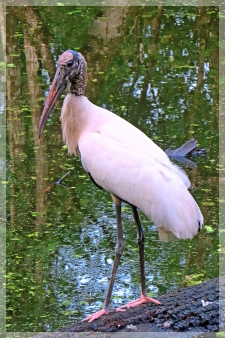
wood stork After feeding a multitude with little more than a handful of food, Jesus sent the disciples across the Sea of Galilee to Bethsaida. He stayed behind to send the people home and then, exhausted, went into the mountains to pray. During the fourth watch (somewhere between 3:00 and 6:00 AM), Jesus looked out at the water and saw that the disciples were struggling against the wind and waves to keep the boat on course. Seeing their distress, he walked on the water toward them. Seeing Him walking on water, they thought Him a ghost and cried out in terror. Phantoms of the night were said to bring disaster and it was thought that the last thing a boatman saw before drowning in Galilee was a ghost on the water! It’s no wonder they were frightened at first.

When Jesus climbed into the disciples’ boat, the wind stopped. He could have calmed the sea any time He wanted, but He chose to wait until the boat was far away, the men had rowed against the fierce wind for hours, and all hope was gone. By walking on the water, Jesus showed the men that the tempestuous sea they feared was nothing more than a path to bring Him to them! Like the feeding of the multitude, Jesus demonstrated His control over the elements—something only God could do!

The disciples failed to recognize Jesus on the water because they weren’t looking for Him. Had they waited in faith, they would have recognized Him, but they waited in fear. By this point in the ministry of Jesus, He had restored a deformed hand, exorcised numerous demons, raised a child from the dead, and healed a paralyzed man, a bleeding woman, lepers, Peter’s mother-in-law, and many others. The disciples just witnessed Jesus feed a multitude with just a few loaves and fish and probably had those twelve baskets of leftovers in the boat with them but they still didn’t get the significance of His provision of food to the multitude. Like so many others, they still were spiritually blind—they saw the miracles but failed to see the one who was God and performed those miracles! They shouldn’t have been surprised by Jesus’ appearance on the water; they should have expected it!

Mark tells us that the hearts of the disciples “were too hard to take it in.” Even knowing all that Jesus had done, they didn’t yet believe. I wonder if the disciples simply were afraid to believe. Just imagine their discussion in the boat that evening as they tried to understand how Jesus managed to feed thousands. They must have wondered what it would mean for them if Jesus really were the Messiah. Would they end up headless as did John the Baptist? Would Jesus’ mission end up as did the failed Messianic movement led by Judas of Galilee with the leader dead and his followers scattered? These men weren’t soldiers; they were common working men and Simon was the only Zealot among them. Did they wonder what Jesus would expect of them? Do we hesitate to accept Jesus because we’re afraid of what He will ask of us?

Almighty God, through the power of your Holy Spirit, open our hearts and minds to your holy truth.

Unbelief is a matter not only of the head but of the heart. The unbeliever’s trouble is that his heart is not right with God. [R. B. Kuiper]

Then he asked them, “Why are you afraid? Do you still have no faith?” [Mark 4:40 (NLT)]

Anyone who believes and is baptized will be saved. But anyone who refuses to believe will be condemned. [Mark 16:16 (NLT)]

Copyright ©2026 jsjdevotions. All rights reserved.

GARDEN OR SWAMP?

For everything there is a season, a time for every activity under heaven. A time to be born and a time to die. A time to plant and a time to harvest. A time to kill and a time to heal. A time to tear down and a time to build up. A time to cry and a time to laugh. A time to grieve and a time to dance. [Ecclesiastes 3:1-4 (NLT)]

We enjoy walking in the local Botanical Garden as well as the nearby Corkscrew Swamp. Although both offer plenty of photo ops and pleasant strolls in God’s creation, the Garden offers more color and variety than a swamp any day. Nevertheless, as much as I enjoy the Garden’s beauty and serenity, I feel more at home in the swamp.

While the Botanical Garden always has an abundance of showy colorful orchids, the swamp’s “super ghost orchid” has blossoms for only a few weeks each year. Even then, you need binoculars or a spotting scope to view its delicate (and not very impressive) flowers. At various times of the year, the swamp has wildflowers like blue flag iris, morning glories, and string lilies but they pale in comparison to the variety of exotic flora found in the Garden all year long. If the swamp’s flowers were in a beauty contest with the Garden’s flamboyant blooms like the passion flower or flaming glory bower, they’d easily lose.

Carefully designed by world-famous landscape architects and impeccably maintained by staff and volunteers, the Botanical Garden speaks of order, design, and perfection; nothing ever seems amiss. The Garden’s plants are beautifully pruned, fertilized, and fussed over. Weeds are quickly pulled and, should a plant wither or die, a lovely new one quickly replaces it.

In contrast, the swamp, with no apparent plan to its layout or plants, is a hodgepodge of flora, fauna, and water that changes almost daily. Completely dependent on rain for its existence, its animals and plants are left to the whims of the weather and Mother Nature. No one pulls the weeds, deadheads the flowers, shapes the trees, or brushes away dead leaves. Lightening and hurricanes take a heavy toll on the swamp’s plant life and, when conditions aren’t favorable, plants wither and die while animals move elsewhere. Dead trees eventually fall and, unless they’re blocking the trail, wherever they land is where they remain.

Try as I might, my life will never have the exquisite perfection of a Botanical Garden. In truth, it resembles the unpredictable and disordered swamp more than any garden. Perhaps, that’s why I enjoy it so much. The swamp is imperfect, changeable, and full of surprises. I never know what flowers will be in bloom, what birds will appear, or if I’ll see alligators, snakes, raccoons, or deer. The only thing I know for sure is that the swamp never disappoints; it always is wonderful and wild in its own unique way!

Life, like the swamp, is chaotic, disorganized, and a little dangerous; nevertheless, it is magnificent! As much as we might prefer it to be as ordered, serene, and pristine as a botanical garden, it isn’t! We’re sure to encounter life’s versions of thistles, mosquitoes, fungus, poison ivy, and animal scat. Nevertheless, along the way, there will be blessings like the swamp’s Roseate Spoonbills, sunflowers, deer, Scarlet Hibiscus, butterflies, and tiny green tree frogs! Like the swamp, we’ll have seasons of abundance and scarcity, downpours and drought, growth and dormancy, health and affliction, blessings and misfortune, beginnings and endings, and even occasional hurricanes. Life comes with its share of muck, weeds, pests, predators, storms, and vulnerability to circumstances beyond our control. The only sure thing is that God is with us during it all!

It’s ironic that our local Botanical Garden is in what used to be a swamp. The 250,000 yards of fill created after two lakes were dug in 2008 sculpted the property into the splendid showplace it is today. Someday, we will trade in our earthly swamp for God’s heavenly garden—a garden far more magnificent than any earthly garden—one with no disease, death, sorrow, pain, or weeds. Until then, we must be satisfied living in the crazy and wonderful swamp we call life. As we walk through it, we brush off the spider webs, avoid the scat on the trail, stay clear of the alligators, and look for the swamp’s gifts. Confident in the swamp’s creator, we find joy and contentment in the unique beauty of our somewhat confusing and chaotic journey. Thank you, God, for this amazing holy mess we call life!

They will never again be hungry or thirsty; they will never be scorched by the heat of the sun. For the Lamb on the throne will be their Shepherd. He will lead them to springs of life-giving water. And God will wipe every tear from their eyes. … He will wipe every tear from their eyes, and there will be no more death or sorrow or crying or pain. All these things are gone forever. [Revelation 7:16-17, 21:4 (NLT)]

Copyright ©2025 jsjdevotions. All rights reserved.

THE BRILLIANT THINGS

This is the day that the Lord has made; let us rejoice and be glad in it. [Psalm 118:24 (ESV)]

What would you do if you were six and your father said that your mom is in the hospital because she finds it hard to be happy and “did something stupid”? That question is answered in Duncan Macmillan and Jonny Donahoe’s one-act play, Every Brilliant Thing. In their play, that boy, now a grown man, tells the audience that he made of list of everything that was “brilliant” about the world—everything worth living for—and left it on his mother’s pillow. Reflecting a six-year old’s priorities, the list included ice cream, Kung-Fu movies, laughing so hard you shoot milk out your nose, burning things, construction cranes, and “me.” Although she returns the list with its spelling corrected, the boy’s mother never comments on it. Nevertheless, he keeps adding to his list. Although his mother eventually takes her life, the narrator tells how his list took on a life of its own and eventually saved him from his own depression and suicidal thoughts.

Throughout the play, the audience learns of additions to the list—everything from peanut butter, water fights, and sunlight to peeing in the sea with nobody knowing, someone lending you a book, cycling downhill, and completing a task. Sort of a theatrical and secular version of Ann Voskamp’s One Thousand Gifts, Every Brilliant Thing is a poignant reminder of the importance of noticing and naming the little “brilliant” things in our lives—to step out of ourselves to take in the small blessings with which God blesses us every day—to pause and feel God’s love in a stranger’s smile, a nurses’ gentle touch, the sound of children’s laughter, the smell of lemon zest, the taste of a fresh-baked warm chocolate chip cookie, a mockingbird’s serenade, a compliment, or the smell of a campfire! No one’s list is the same nor should they be.

Nearly three years ago, Voskamp’s book inspired me to start my own list of “gifts” (what Macmillan and Donahoe called “brilliant” things). But, like the play’s narrator, I put it aside after a while. Although there were moments I thought, “That’s one for the list,” I rarely added them and they were forgotten. It wasn’t until my most recent bout with depression and pain that I resumed adding to it. Of course, I couldn’t add to the list without making a point of opening my eyes to God’s presence in the ordinary stuff of life. Some were big things like taking Communion or learning that my girls are visiting in a few weeks. Most things, however, are pretty mundane—the aroma of night-blooming jasmine, the two standard poodles that sit regally beside their person as he chauffeurs them around the community in his golfcart, Savannah Guthrie’s  book Mostly What God Does, whipped cream on a cup of hot cocoa, and monarch butterflies. There’s nothing extraordinary about these “brilliant” things; nevertheless, they bring a smile to my face and remind me of God’s presence in all things.

Although our cups overflow with God’s blessings, it’s been said that joy comes in sips rather than gulps. May we always remember that it wasn’t in the storm that Elijah heard God—it was in His whisper. Indeed, God whispers to us in the seemingly insignificant but “brilliant” things of life. Let us take note of each and every one!

There is not one little blade of grass, there is no color in this world that is not intended to make men rejoice. [John Calvin]

You serve me a six-course dinner right in front of my enemies. You revive my drooping head; my cup brims with blessing. Your beauty and love chase after me every day of my life. I’m back home in the house of God for the rest of my life. [Psalm 23:5-6 (MSG)]

Copyright ©2025 jsjdevotions. All rights reserved.