
This is what the Lord says: “Cursed are those who put their trust in mere humans, who rely on human strength and turn their hearts away from the Lord. They are like stunted shrubs in the desert, with no hope for the future.” [Jeremiah 17:5-6 (NLT)]
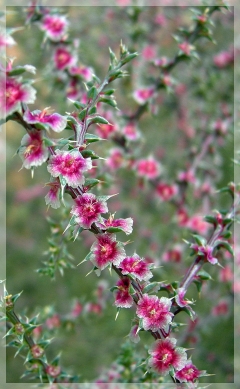
Russian thistle – tumbleweed
Because Judah had trusted in false gods and foreign alliances rather than God, Jeremiah pronounced God’s judgment on the southern kingdom. After saying their sins were as if they’d been etched on their stony hearts with a diamond-pointed iron chisel, he compared them to a stunted shrub. That shrub may have been the tumble thistle, a common plant found in Israel’s grasslands. I’ve never been to Israel but I’ve seen a similar plant in the western states: the Russian thistle, commonly known as tumbleweed or wind witch. Both kinds of weeds begin with flowers on a spiny plant. As their seeds mature, the entire plant dries and breaks from its roots at the soil surface. Shaped like a ball and rootless, the wind blows and rolls these plant “skeletons” across the prairie.
In stark contrast to a stunted shrub, Jeremiah likened those who trust in the Lord to deep-rooted trees planted by the riverbank—trees untroubled by heat or drought. I’m reminded of our hardy American cottonwoods found near rivers, lakes, and irrigation ditches throughout the nation. The fastest growing trees in North America, cottonwoods can grow to over 100-feet tall, with a trunk diameter of 6-feet, and a leaf canopy over 75-feet wide. Instead of being blown by the wind like tumbleweed, the cottonwood’s size makes it an excellent windbreak. When we trust in ourselves and false gods, we’ll be blown every which way like a tumbleweed but, when we trust in God, we can withstand life’s headwinds like a cottonwood.
Growing on the water’s edge, cottonwoods typically survive adverse conditions and prairie fires. Few plants can survive the scorching heat, scant rainfall, relentless winds, blowing sand and poor soil of New Mexico’s White Sands National Monument but the deeply rooted Rio Grande cottonwood thrives there! When we trust in God and sink our roots deep in His word, like the cottonwood, we will flourish and have a full life, even in harsh conditions.
Dubbed “the pioneer tree,” the cottonwood was a welcome sight for settlers crossing the plains because it meant shade from the heat, fuel for a fire, and a source of water. Those same settlers considered tumbleweeds a menace. They leeched nutrients from the soil, crowded out forage grass and, being highly flammable when dry, could become flying fireballs and spread a grass fire. Just as pioneers found refuge in the cottonwood, those who trust in the Lord find refuge in Him. Those who trust only in man are as worthless as a noxious weed and as dangerous as burning tumbleweed.
When we put our trust in man, false gods, or empty ideologies, we’re no different than a tumbleweed: dry and rootless, rolling in whatever direction the wind is blowing, and with no hope for the future. When we trust in the Lord, we’re like the cottonwood: deeply rooted in His word, fed by His living water, and able to survive, even thrive, in the bleakest of situations.
 The anchor, the Christian symbol of hope, is the most prevalent of all the Christian symbols found in the Roman catacombs. In fact, all of the symbols, paintings, mosaics, and reliefs found in the miles of labyrinth-like narrow tunnels and thousands of graves in the catacombs reflect hope in some way. Instead of the dark funereal images you might expect in an underground cemetery, the white walls of the Christian catacombs feature living things like flowers and birds along with Bible stories expressing hope in God’s plan of salvation. Prominent themes from the Old Testament include Daniel emerging untouched from the lions’ den and Shadrach, Meshach, and Abednego exiting unharmed from the fiery furnace. Frequently depicted are the stories of Noah, who escaped from the flood, and Jonah who was delivered from the sea monster. Continuing the theme of deliverance are many images of the good shepherd so frequently mentioned in Psalms. New Testament stories usually showed Jesus raising the dead (with over fifty representations of Lazarus), healing people, and feeding the multitude. The art of the catacombs is all about man’s hope in God’s deliverance, provision, and plan of salvation.
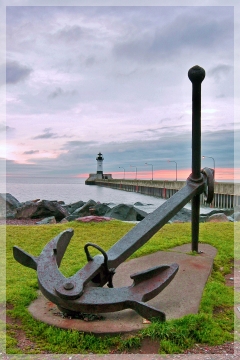 The sign in front of a nearby church read, “Our hope is anchored in the Lord,” which got me thinking about anchors. I’d never given them much thought until we took a Windjammer cruise off the coast of Maine many years ago. Accompanied by four friends and a crew of two, we sailed for a week. At dusk, we’d lower the sails and anchor in a harbor for the night. After breakfast, we’d pull up anchor for another relaxing day of sailing by lighthouses, granite cliffs, fishing villages, and even a few seals. One day, however, gale force winds replaced the gentle breeze and the calm sea turned violent. The sky darkened as rain and hail poured down on us. We immediately pulled into the nearest inlet, lowered the sails, and dropped two anchors to keep from being blown into the rocks! If we’d had two more anchors (as did the sailors in Acts 27), I suspect we would have dropped them, as well. After donning my life jacket and slicker, all I could do was pray and hope those anchors held. You really don’t appreciate the worth of an anchor until you’ve needed one in a storm!
 Yesterday, I wrote about Job’s lamentation. 19th century bible scholar George Granville Bradley said this about Job 3: “Where in the world will you find a sadder strain of more hopeless, uncontrolled, and unbroken lamentation and mourning? … Filled to the brim, they run over with pain.” I have to agree.
 After Satan took Job’s loved ones and wealth, the grieving man remained a pillar of patience and faith. Rather than blaming God, the stoic man acknowledged God’s sovereign authority saying, “The Lord gave me what I had, and the Lord has taken it away. Praise the name of the Lord!” [1:21]
 In a recent Pearls Before Swine comic (drawn by Stephen Pastis), Rat asked Pig if he would be getting out of bed that day. Replying no, the sweet little swine explained, “I fear the big bad world and want no part of it.” When Rat told him he couldn’t stay in bed forever, Pig disagreed. “I have a bed, a bathroom, and a food delivery app that I’ve asked to just throw my food through the window.” In the next frame, we see Rat snug in bed with his friend and asking to borrow a pillow. I understand. There certainly are days in this crazy world of ours that we’d all prefer to just snuggle under the covers and never have to get up to face the challenges of the day, especially if DoorDash would deliver bedside. That, however, is not an option.
 Devotions of the Heart