NO SMALL PARTS 

Here is a simple, rule-of-thumb guide for behavior: Ask yourself what you want people to do for you, then grab the initiative and do it for them. Add up God’s Law and Prophets and this is what you get. [Matthew 7:12 (MSG)]

gardeniaWhen the Academy Awards were held recently, Oscars were presented for things like best director, best lead and supporting actors and actresses, and even best make-up and hair styling. If it’s true (as my theater teachers claimed) that, “There are no small parts, only small actors!” how is it that no awards were given to the best small part players? Regardless of the perfection with which they may have fulfilled their “bit parts”, their screen time was too short to be nominated for anything. To add insult to injury, they may have been known only as Dog Walker or Nurse #2! The small role, however, doesn’t mean the character played an insignificant part in the story. Nevertheless, after moving the story forward, the bit part players just fade into the background. Even so, while their names may be forgotten, the story wouldn’t have been the same had they not played their roles.

When thinking of the people who passed through our lives, we know who the major players are but what of the others, the ones who left a small but indelible mark on us—the people with the bit parts in the scripts of our lives? We may have forgotten their names or never have known them at all. Perhaps it was a neighbor who always waved and smiled when you passed by, the teacher who said you weren’t “dumb,” the trucker who changed your flat tire, or the nurse who let you hold your stillborn baby until you were ready to let him go. It may have been the stranger on the plane who prayed with you as tears rolled down your cheeks, the woman who said “You’re beautiful!” when the scarf slipped off your bald chemo-head, or the stranger who listened when you desperately needed to talk. Whether it was a small kindness, words of encouragement, a little unasked-for (but much needed) help, prayers, a chat over coffee, or just a hug, the bit players in our lives played fleeting but pivotal roles and our interactions, while short-lived, changed us in unexpected ways. They listened, challenged, suggested, assisted, shared, taught, and demonstrated God’s love. They had only a few lines of dialogue in the script but the movie of our lives would be incomplete had their scenes been cut by the film editor.

Granted, there probably are a few unpleasant, painful, or upsetting encounters with bit part players we might prefer having been edited out of our lives, but we don’t need to dwell on those. Let’s remember, however, that we are the small part players in other people’s lives—whether it’s the bagger at the grocery, the receptionist at the doctor’s, the busser at the restaurant, the lonely widow down the street, the kid trying to sell over-priced candy or popcorn for his team, the person giving us technical assistance on the phone, the mom with the crying baby on the plane, or the annoying telemarketer. How will we play our role? Will it be worthy of a heavenly award?

What does love look like? It has the hands to help others. It has the feet to hasten to the poor and needy. It has eyes to see misery and want. It has the ears to hear the sighs and sorrows of men. That is what love looks like. [Augustine]

So let’s not allow ourselves to get fatigued doing good. At the right time we will harvest a good crop if we don’t give up, or quit. Right now, therefore, every time we get the chance, let us work for the benefit of all, starting with the people closest to us in the community of faith. [Galatians 6:9-10 (MSG)]

Copyright ©2022 jsjdevotions. All rights reserved.

THE SACRED KISS (Hospitality – Part 3)

All the brothers and sisters here send greetings to you. Greet each other with a sacred kiss. [1 Corinthians 16:20 (NLT)]

Greet each other with a kiss of love. Peace be with all of you who are in Christ. [1 Peter 5:14 (NLT)]

mallard - american black duckIn four of Paul’s epistles, he instructs his readers to greet one another with a sacred kiss. The word he used was philéma which meant a kiss of respect or affection between friends rather than one of romance. It seems odd to us today but, when greeting or saying farewell in the ancient world, people frequently kissed one another on the cheek, forehead, beard or hands. In the Old Testament, for example, both Laban and Esau kissed Jacob, Joseph kissed his brothers, Moses kissed Aaron and Jethro, Samuel kissed Saul, David kissed Barzillai and Jonathon, and Absalom curried favor by kissing just about everyone who approached him!

Apparently, the Jewish converts in the early church carried on the practice of greeting one another with a kiss and it grew to have a special significance for them. Peter made mention of it in one of his letters and the elders from the church at Ephesus all embraced and kissed Paul before he left for Jerusalem. This “sacred” kiss expressed union and fellowship and signified a spiritual kinship with other followers of Christ. A kiss from a Jewish Christian to a Gentile convert would have indicated the convert’s full acceptance into the church family. This kiss would have been especially meaningful to new Christians who frequently became outcasts from their own families when they converted. The kiss also may have been a sign of mutual forgiveness and reconciliation that was shared before celebrating the Lord’s Supper.

Neither Peter nor Paul were making this kiss mandatory, which is good since greeting one another with a kiss nowadays could lead to a slap, rumors, or a charge of sexual harassment. What they were commanding was that we greet one another warmly and enthusiastically. The word often translated as hospitality in the New Testament was philoxenias which literally meant the love of stranger. Hospitality simply is the generous and friendly treatment of visitors and guests. Sad to say, most flight attendants seem to be better at greeting and saying farewell to strangers than many of today’s churches.

When a friend was visiting a local church, she found an empty pew in which to sit. A few minutes later, she was told to move by a group of women who said she was in “their” pew! We’ve attended church events where none of the empty chairs were available because they were saved for other people’s “friends.” I think of a troubled teen who, after being introduced to Jesus in the church youth group, ventured into the church sanctuary for the first time one Sunday morning. He was immediately greeted by a woman who angrily told him to walk right out and only return once he’d taken off his baseball cap and pulled up his saggy pants! Sadly, these are not isolated events. What happened to the “spiritual kinship” of the early church?

In any church, we all begin as strangers, but we shouldn’t remain that way. As members of God’s large and diverse family, we should become a community of former strangers. Our community, however, must be open to new people and that, sadly, often is where we fail. Christian hospitality begins with acknowledging everyone—not just the people in our own circle—both when they arrive and as they depart. Although most churches have designated greeters, welcoming is everyone’s responsibility. Whether or not we know our fellow worshippers, we should greet them as warmly as we would a guest in our own home. Sometimes, hospitality is as simple as a smile, an introduction, or an extended hand.

I’m the first to admit that, at least for me, speaking to strangers doesn’t come naturally and it isn’t easy. Nevertheless, it is where we must begin. After all, a stranger simply is a friend we haven’t yet met! If Jesus walked into your church, would He be welcomed with Christian hospitality or told to take off his baseball cap and pull up His pants or find another place to sit?

Then the King will say to those on his right, “Come, you who are blessed by my Father, inherit the Kingdom prepared for you from the creation of the world. For I was hungry, and you fed me. I was thirsty, and you gave me a drink. I was a stranger, and you invited me into your home.” [Matthew 25:34-35 (NLT)]

Copyright ©2022 jsjdevotions. All rights reserved

IT’S NOT ENTERTAINING (Hospitality – Part 2)

Cheerfully share your home with those who need a meal or a place to stay. [1 Peter 4:9 (NLT)]

welcomeFor a Christian, being hospitable should be second nature but, for many, the thought of entertaining is terrifying. Entertaining, however, has nothing to do with hospitality. One has to do with cuisine, attire, atmosphere, and possessions, and says “Look what I have,” while the other has to do with love, respect, sharing, refreshment, and comfort and says, “What I have is yours!” One is meant to impress and the other is meant to bless.

The difference between entertaining and hospitality can be seen in a family friend whose Christmas dinners always consisted of a house full of friends and family who ate buckets of fried chicken and the trimmings using paper plates and plastic utensils all of which came from the Kentucky Colonel’s kitchen. While Martha Stewart may not have approved, this woman’s friends and family certainly did because it was about the people not the party! There may not have been Lenox china and linen napkins but there was plenty of love and laughter! We can be entertained lavishly and never feel welcome as happened to Jesus at the Simon the Pharisee’s or, like Elijah at the widow’s, we can be given the smallest morsel from a welcoming host and know faith and love.

Back in 2016, when the east coast of Florida was threatened by Hurricane Matthew, people fled to the Gulf side to escape the storm. Every hotel room here was occupied and the shelters were full. While working over coffee at Starbucks, our new pastor overheard a family of four talking. Evacuees from Miami, they’d arrived at their hotel only to discover that it was overbooked. The pastor tried to continue his work while they anxiously called around in search of a vacancy; there were no rooms anywhere. With all their belongings stuffed tightly in the car and barely enough space to sit (let alone sleep), they wondered what they’d do for lodging. The young pastor was less than a week in town and his small condo still was filled with boxes not yet emptied. He had a sermon to write and a long list of things that needed to get done. Nevertheless, he listened to the Holy Spirit’s voice and introduced himself to the family. Explaining that he and his wife didn’t have much room, he offered what little they did have. The mother’s first response was, “Thank God. Our prayers have been answered!”

God has a delightful sense of humor, proven by the fact that the pastor’s guests turned out to be a rabbi and his family! That family got more than just a carry-out pizza and a place to rest their weary heads—they got an evening filled with Christian hospitality, spirited conversation, and prayer. United by their love of God and a shared belief in what we call the Old Testament and they call the Hebrew Bible, the two families had much in common. When the storm passed and they departed, the Jewish rabbi invited the evangelical Christian minister to visit his family and join him at temple.

Welcoming family, friends, and even strangers in our homes and to our tables is far more important than where they sleep, whatever is put on their plates, or the kind of plates that are used. Anything prepared and shared with love is a worthy gift for all who enter our homes. If an angel comes to the door, we don’t want to turn him or her away just because the house isn’t tidy or we don’t have the makings of a gourmet meal. After all, there’s always the Colonel with his barrel of chicken!

Keep on loving each other as brothers and sisters. Don’t forget to show hospitality to strangers, for some who have done this have entertained angels without realizing it! [Hebrews 13:1-2 (NLT)]

Copyright ©2022 jsjdevotions. All rights reserved

HOSPITALITY – Part 1

When God’s people are in need, be ready to help them. Always be eager to practice hospitality. [Romans 12:13 (NLT)]

As far back as you want to go in the history of God’s people, one of the duties of the righteous was hospitality—by which I mean the willingness to welcome people into your home who don’t ordinarily belong there. [John Piper]                                    

red-bellied-woodpeckerIn the ancient world, travel was dangerous and the nomadic people of Israel took hospitality seriously. It was the way to transform an unknown person (who might pose a future threat) into a guest and a friend. Hospitality was an integral part to many of the Old Testament’s stories. Both Abraham and Lot welcomed strangers into their home. Rebekah gave water to Abraham’s servant, watered his camels, and then offered food for the animals and rooms for the night. Rahab gave lodging and protection to the Israelite spies, Manoah and his wife fed the stranger who visited them, the widow of Zarephath gave her last morsel of food to Elijah, and the Shunammite woman provided food and a room for the prophet Elisha whenever he passed through Shunem. Abigail generously provided food for David and his band of men and David welcomed Jonathon’s crippled son Mephibosheth at his table as a way of showing God’s kindness.
The tradition of hospitality extended into the 1st Century. Matthew welcomed Jesus, the disciples, and his tax collector friends at his table. When Jesus sent out his disciples in Luke 9, he deliberately sent them out with no provisions and told them to depend on the hospitality of others as they travelled from town to town. Jesus probably stayed with Peter’s family when he was in Capernaum, both Zacchaeus and Martha welcomed Jesus into their homes, and a nameless man provided the upper room of his home to Jesus and the disciples for their Passover supper. Christian hospitality continued as the new church expanded. Paul and his companions stayed with Publius in Malta and Lydia in Philippi, Peter stayed with Simon the Tanner in Joppa, and John commended Gaius for his hospitality to Christian teachers.

Simon the Pharisee probably had a nicer home, more servants, richer food, and better wine than any of those other hosts but, when he invited Jesus to dinner, he was anything but hospitable. Although guests traditionally were greeted with a kiss, given a bowl of water with which to wash the dust off their feet, and offered some perfumed oil for their hair, Simon failed to extend any of these customary courtesies to Jesus. He may have addressed Jesus as “Teacher,” but the narrative makes it clear Jesus was there to be questioned rather than welcomed. There may have been a meal but there was no hospitality that night at Simon’s.

Unbeknown to Abraham, Lot, and Manoah, the strangers they welcomed into their homes were angels of the Lord. But, even if we never welcome angels in our homes, we may have men and women whose very presence is a blessing. Who knows? We may even turn a potential enemy into a friend!

We always treat guests as angels…just in case. [Jeremiah of Wallachia (1556 – 1625)]

Don’t forget to show hospitality to strangers, for some who have done this have entertained angels without realizing it! [Hebrews 13:2 (NLT)]

Copyright ©2022 jsjdevotions. All rights reserved

HAPPY HOURS

This is the Lord’s doing, and it is wonderful to see. This is the day the Lord has made. We will rejoice and be glad in it. [Psalm 118:23-24 (NLT)]

My biggest fear is waking up to find what matters
Is miles away from what I spent my life chasing after.
Is my story gonna have the same two words in every chapter?
What if, what if? …
What if today’s the only day I got?
I don’t wanna waste it if it’s my last shot.
No regrets, in the end
I wanna know I got no what ifs! [Matthew West]

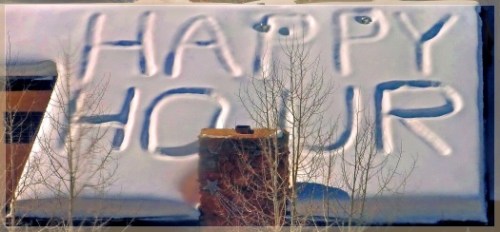
While enjoying discounted drinks and small plates during a local “happy hour” with our old skiing buddies, we reminisced about the many happy hours we spent together in Colorado. One of our favorite lunch (and “happy hour”) spots used to publicize their “happy hour” by spelling out the words in the snow on their rooftop. Since the pub was located right beneath the gondola, skiers couldn’t avoid seeing the message as they rode up the mountain. Tourists would speculate how the words got there and most assumed there were specially placed heat tapes beneath the letters. The letters, however, were carefully stomped out after every major snowfall by a friend who had more enthusiasm than common sense as he jumped from letter to letter on the sloped roof.

For many of us, “happy hour” probably means discounted, beer, wine and cocktails, half-price appetizers, and maybe some entertainment between the hours of 4 and 7. But, is a happy hour really about three hours of discounted drinks and food or a great band?

Today, while listening to Matthew West sing, “What if today’s the only day I got? I don’t wanna waste it if it’s my last shot!” I pondered what makes any of our hours truly happy ones.  It certainly isn’t cheap drinks and food! What kinds of things would an hour of happiness encompass? If you had only a few hours remaining in life, how would you spend them? What would you do to make that hour a happy one? I doubt you would spend them eating and drinking in a bar.

Henry Ward Beecher said, “The art of being happy lies in the power of extracting happiness from common things.” I have to agree. When I think about happiness, my happy hour includes things like God, family, friends, peace, service, generosity, love, hope, faith, worship, salvation, smiles, hugs, laughter, a few silly games with the grands, and maybe a butterfly or two. There are no discounted drinks, chicken wings, peanuts, popcorn, guacamole, salsa, or chips in the scenario because they have nothing to do with true happiness and joy. Also missing from that picture are things like wealth, success, and fame along with quarrels, resentment, conflict, anger, regret, guilt, heartache, disdain, bitterness, fear, hatred, and animosity. In short, a happy hour is one spent in gratitude. It was gratitude for all that God gave us, not the discounted drinks, appies, or sunshine and powdery snow, that made those hours so enjoyable back in Colorado and continue to do so in Florida!

The man who stomped out those letters on the rooftop? When in his mid-forties, his hours were unexpectedly cut short by a freak accident. I’m sure his family would agree that happy hours should never be limited to a few hours at the end of the day. How will we choose to spend whatever is left of our hours to make them happy ones—the kind of hours truly worth having and remembering? After all, today could be our “last shot!”

Do not look back on happiness, or dream of it in the future. You are only sure of today; do not let yourself be cheated out of it. [Henry Ward Beecher]

Now look here, you people who say, “Today, or tomorrow, we will go to such-and-such a town and spend a year there, and trade, and make some money.” You have no idea what the next day will bring. What is your life? You are a mist which appears for a little while and then disappears again. Instead, you ought to say, “If the Lord wills, we shall live, and we shall do this, or that.” [James 4:13-15 (NTE)]

Copyright ©2022 jsjdevotions. All rights reserved

GEORGE AND GRUMPY

A cheerful heart brings a smile to your face; a sad heart makes it hard to get through the day. … A miserable heart means a miserable life; a cheerful heart fills the day with song. [Proverbs 15:13,15 (MSG)]

A cheerful disposition is good for your health; gloom and doom leave you bone-tired. [Proverbs 17:22 (MSG)]

steamboat springs CORecently, long-time friends visited for a few days. They used to live across the street from us when we wintered in Colorado but, like us, their skis are long gone. The memories, however, are still fresh. As happens with old friends, we started reminiscing about blue bird days on the mountain, making first tracks down a slope of fresh powder, our favorite runs (for one person it was the “lunch run”), winter carnivals, and the people who made our mountain town so special.

Nearly every morning, we’d meet our friends at the bus stop for a short ride to the mountain. As we recalled packing like sardines onto the bus so one more skier could fit, we remembered the various bus drivers we had over the years. Without a doubt, our favorite was George. While he could have been the goodwill ambassador for our town, another driver I’ll call Grumpy did his best to make the ride miserable for everyone.

Grumpy never had a smile or a nice word to say to anyone. In fact, other than occasionally telling us to move back, we never heard him say a word. Believe me, we tried and made a point of greeting him by name, commenting on the weather, wishing him a good day, and thanking him when we got off. Determined to get him to respond, we’d ask him how he was doing that day, if he had a good weekend, or managed to get in any skiing. In the several years we were his passengers, we never got an answer or even a smile. The closest we ever got to seeing a grin was when Grumpy would take off from a stop even though he could see skiers running to catch the bus.

Both George and Grumpy were city bus drivers but their similarity ended with their occupation. No matter how crowded the bus, challenging the weather, or difficult his passengers, George always had a friendly greeting and a pleasant word. Whenever possible, he waited for any skiers hurrying to the bus and, when passengers got off the bus, he was sure to offer a cheery farewell and explain which bus to take back and where to board it. He exhibited great patience in a variety of challenging circumstances (and tourists can be very challenging) and showed true concern for his passengers. He wasn’t merely polite; George went out of way to be cordial and accommodating to everyone.

Both men had the same job and did what was required of them. One, however, clearly enjoyed both his job and life and the other, sad to say, just seemed determined to be miserable. From our conversations with George, we knew his life hadn’t been easy. As a single father, he struggled to make ends meet. We also knew that George was a man of faith and, as a man of faith, he was an ambassador for more than our ski town—he was one of Christ’s ambassadors! As for Grumpy—who knows? It’s hard to believe someone so disagreeable and grouchy knew Jesus. Perhaps, it was not knowing how much God loved him that made Grumpy unable to love his fellow travelers on this planet. He certainly couldn’t give away something he didn’t even know he had! Grumpy, however, seemed determined to stay in a desolate dull world of his own making.

One day while chatting with George on our way home, I mentioned the friendly demeanor, good humor, kindness, patience, and joy we saw whenever we rode with him. He responded, “Well, every morning I have a choice. I can rise and whine or rise and shine; I choose to shine!” George had a good point! We each have that same choice every morning with which God blesses us. What will you choose today?

There’s a decision we all have to make, and it seems perfectly captured in the Winnie-the-Pooh characters created by A.A. Milne. Each of us must decide: Am I a fun-loving Tigger or am I a sad-sack Eeyore? Pick a camp. [From “The Last Lecture” by Randy Pausch with Jeffrey Zaslow]

Do everything readily and cheerfully—no bickering, no second-guessing allowed! Go out into the world uncorrupted, a breath of fresh air in this squalid and polluted society. Provide people with a glimpse of good living and of the living God. Carry the light-giving Message into the night so I’ll have good cause to be proud of you on the day that Christ returns. [Philippians 2:14-15 (MSG)]

Copyright ©2022 jsjdevotions. All rights reserved.