CRUTCHES

I heard an unknown voice say, “Now I will take the load from your shoulders; I will free your hands from their heavy tasks. You cried to me in trouble, and I saved you.” [Psalm 81:5b-7a (NLT)]

crutches“He’d always looked at religion as a crutch for people who were too scared to do life by themselves,” is the way author Chris Fabry described a character in his book June Bug. That description made me think of Karl Marx’s frequently paraphrased statement: “Religion is the opium of the people.” Sigmund Freud had an equally low opinion of religion and described it as a form of wish fulfillment. Thinking of religion as little more than a man-made coping mechanism for dealing with the harsh realities of life, Fabray’s character, Marx, and Freud disparaged it along with things like crutches and pain relievers.

As the body’s early warning system, physical pain is what tells us there’s something wrong with our body. But, when excessive pain interferes with our quality of life, it needs to be dealt with. Pain relievers work with our body’s cells, nerve endings, nervous system, and brain to mitigate the pain we feel. While I’ve never taken opium, between assorted broken bones, sprains, torn ligaments, compressed nerves, and surgeries, I’ve used a variety of prescription pain medications to ease my pain and promote the healing process.

As for God being my opiate—while prescription medications help me through my physical pain, it is God who leads me through the dark valleys of grief, fear, loss, betrayal, doubt, pain, and depression that assault us in this earthly life. Like pain meds, God can be habit-forming, but the similarities end there. Unlike pain meds, His long-term use is highly recommended, no prescription is necessary, and He has no dangerous side effects. While I was thrilled to say good-by to pain meds, I never want God out of my life! He has lessened the anguish, sorrow, loneliness, and heartache of my life better than any drug ever could. He is the only prescription for the sin sick soul!

Moreover, many of those ailments and surgeries I’ve experienced required me to use crutches, a knee scooter, or a cane in order to make up for my loss of strength, range of motion, stability, coordination, and endurance. When I’ve been left with only one leg on which to stand, those devices helped me balance and stand steady by broadening my support base.

Just as crutches reduce the weight load on a weak or injured leg, a relationship with God certainly reduces the burdens of life. Like crutches, my faith in God supports me; it gives me strength and stability and keeps me from falling. God holds me steady when I’m unsure, keeps me in balance when I’m over-whelmed, and enables me to walk through the rough patches without stumbling! When I step away from Him and fall, He lifts me up again! God is even better than a crutch because, when I can go no further, He’s been known to pick me up and carry me! I will happily live in God dependence, using God as a crutch rather than live in independence only to trip and fall.

While Marx and Fabry’s character look at pain meds and walking aids with disdain, I look to them with gratitude! I don’t take offense at someone thinking of my faith in God as a crutch or drug. When properly prescribed and used, painkillers and crutches help us cope with the challenges of living with broken bodies. While they are man-made and imperfect, God isn’t! It is His hand that touches me and brings healing to my heart and soul as well as my body! I’m more than willing to admit that I’m too scared to do life by myself. It is because of God that I can cope with the challenges of living in a broken world!

As for Freud’s wish fulfillment—God has given me more than I possibly could have wished for in even my wildest dreams. He’s done more than merely fill my cup with enough; because of God, my cup “runneth over” with peace, purpose, love, and joy!

Now all glory to God, who is able, through his mighty power at work within us, to accomplish infinitely more than we might ask or think. [Ephesians 3:20 (NLT)]

The Lord helps the fallen and lifts those bent beneath their loads. … The Lord is righteous in everything he does; he is filled with kindness. The Lord is close to all who call on him, yes, to all who call on him in truth. [Psalm 145:14,17-18 (NLT)]

 Copyright ©2024 jsjdevotions. All rights reserved.

PLODDING

Have mercy upon me, O God, according to thy lovingkindness: according unto the multitude of thy tender mercies blot out my transgressions. [Psalm 51:1 (KJV)]

snailI suspect we would prefer a eulogy that shines a light on our victories and accomplishments but the man known as “the father of modern missions” chose otherwise. When William Carey [1762-1834] was asked what text he wanted for his funeral sermon, he chose today’s verse. The humble man wanted to shine a light on God’s lovingkindness and great compassion rather than his personal accomplishments.

Convinced that Jesus’ words in the Great Commission were a binding command on every generation of Christ’s followers, Carey contended that 18th century Christians were as called to take the gospel to foreign lands as were the 1st century Apostles. While this may seem obvious to us today, back in 1786 the prevailing view was that God would bring the nations to Christ without human assistance. Told by some that God didn’t need (or want) his help in converting the “heathens,” others argued that distance, barbarism, dangers, supply issues, and unintelligible languages made foreign missions unfeasible. Carey, however, remained determined to spread the gospel abroad. Eventually, what became known as the Baptist Missionary Society was formed and, in 1793, William Carey and John Thomas were appointed missionaries to the East Indies.

When they arrived in colonial Calcutta, the men faced stiff opposition from the East India Company along with poverty, illness, loneliness, domestic issues, and the deaths of friends and family, but Carey never lost heart. Determined to spread the gospel, he wanted more than converts; Carey wanted to develop apostles! To that purpose, in 1818 he and his colleagues founded Serampore College in West Bengal. While the college’s primary goal was to train indigenous ministers, both believers and unbelievers from all castes were welcome. Fierce critics of the caste system, infanticide, and suttee (widows burning themselves upon their late husbands’ funeral pyres), the missionaries labored tirelessly for the welfare of all Indians. Carey’s greatest contribution to Christ was his work as a translator. A cobbler by training, this self-taught man (whose only degree was an honorary one) translated the entire Bible into six Indian languages and portions of Scripture into 29 others! Carey’s approach to missions combined evangelism with translation, education, social reform, and health care. That same holistic approach remains a model for Christian missionaries today.

William Carey served 41 years in India without a furlough but, even before his death, his name was well known and people started collecting mementos of him. Carey’s contemporary, John Newton (evangelist, abolitionist, and author of “Amazing Grace”) said of him, “I look to such a man with reverence. He is more to me than bishop or archbishop; he is an apostle.” Yet, when this man who was a legend before his time lay dying in 1834, he gave a fellow missionary these instructions: “When I am gone, say nothing about Dr. Carey. Speak about Dr. Carey’s Savior.”

Suspecting that someday his biography would be written, Carey gave his nephew this criterion for judging its correctness: “If he give me credit for being a plodder, he will describe me justly. Anything beyond this will be too much. I can plod. I can persevere in any definite pursuit. To this I owe everything.”

Indeed, Carey was a plodder—it took him seven years to get support for his mission and another seven years passed before he baptized his first convert! Nevertheless, he never lost faith in God’s call to him. Twelve years after establishing the Mission Press in Serampore, the print shop and office burnt to the ground. Type sets for fourteen different languages, vast quantities of paper, dictionaries, and Carey’s entire library along with his completed Sanskrit dictionary, part of his Bengal dictionary, two grammar books, and ten translations of the Bible were destroyed. Even that setback did not deter the plodder. “The loss is heavy” he said, “but as traveling a road the second time is usually done with greater ease than the first time, I trust the work will lose nothing of real value. We are not discouraged…. We are cast down but not in despair.” Indeed, within a few months, the resilient man set up shop and started over again!

A plodder, Carey converted one soul at a time, learned new languages one word at a time, translated the Bible one verse at a time, paid the bills one rupee at a time, and walked the road God set before him one step at a time. God doesn’t call us to be fast; He calls us to be faithful! As Charles Spurgeon said, “By perseverance the snail reached the ark.” Can we do any less?

When reading about William Carey, I couldn’t help but wonder at how easily we allow disappointment, disillusionment, and setbacks to intimidate, dishearten, and overwhelm us in our daily walk as believers. But, for William Carey, it never was about him—it always was about Jesus! He kept his eyes on Christ as he plodded along; let us do the same.

I feel it my duty to plod on while daylight last. [William Carey]

Therefore, my beloved brethren, be ye steadfast, unmoveable, always abounding in the work of the Lord, forasmuch as ye know that your labour is not in vain in the Lord. [1 Corinthians 14:58 (KJV)]

And let us not be weary in well doing: for in due season we shall reap, if we faint not. [Galatians 6:9 (KJV)]

Copyright ©2024 jsjdevotions. All rights reserved.


NEW TERRITORY – New Year’s Day 2024

The land that you are going over to possess is a land of hills and valleys, which drinks water by the rain from heaven, a land that the Lord your God cares for. The eyes of the Lord your God are always upon it, from the beginning of the year to the end of the year. [Deuteronomy 11:11-12 (ESV)]

The Israelites were camped on the east side of the Jordan River, in view of Canaan, when Moses addressed them. After spending the last forty years as nomads in the wilderness of the Sinai Peninsula, can you imagine their excitement at the thought of finally having a place to call their own and their eagerness for a new beginning in a new land? There must have been some apprehension, as well. They weren’t naïve; they knew there would be conflict, battles, and even loss before Canaan was conquered.

Moses was not addressing the original generation of adults he brought out of Egypt—they died in the wilderness because of their disobedience the first time Israel approached Canaan. This was the second generation of adults—the ones who had been under twenty when their parents refused to enter the Promised Land. This generation were eye-witnesses to God’s power and provision. As children, they witnessed the plagues God visited on Egypt. They were there when the waters of the Red Sea parted and watched Pharaoh’s soldiers drown. They experienced Israel’s defeat of the Amalekites at Rephidim, enjoyed God’s provision of quail, and observed water pouring out of a rock more than once. They beheld the glory of the Lord fill the Tabernacle and knew that God faithfully provided them with manna for forty years.

At the same time, this generation also knew the consequences of disobedience. They survived the plague God sent because Israel worshiped the golden calf, saw the earth split open and swallow the men (and their families) who rebelled against Moses, and spent most of their lives as nomads because of their parent’s defiance. They had first-hand knowledge of God’s discipline as well as His faithfulness, provision, compassion, and mercy.

As Canaan was for the Israelites, so a new year is for us. Like a new land, the new year means a fresh start but, like the Israelites, we wonder what trouble the year may bring. Will there be more dark valleys than sunny hilltops? Will our journey be challenging or easy, rocky or smooth, crooked or straight? Will obstacles or detours cause us to lose our way? Will we encounter times of plenty or famine, profit or loss? Will there be storms or sunshine, floods or drought, abundance or scarcity? Rather than being attacked by Amorites, Hittites, or Jebusites, will cancer, divorce, or job loss strike? Just as those Israelites knew that both challenges and blessings lay ahead in Canaan, we know that the new year will bring its share of both grief and joy, chaos and calm, hardship and ease, loss and gain.

Moses told the people not to fear the inhabitants of Canaan because God was with Israel. They didn’t go into new territory alone and neither do we. God was with them and He is with us. While we haven’t gathered manna in the morning, seen bitter water become sweet, experienced God’s victory over Midian, or followed a pillar of cloud or fire through the Sinai wilderness, we know God did all that and more for Israel. Moreover, we have firsthand experience of the many ways He has been faithful to us. In previous years, He transformed discord into harmony, heartbreak into joy, chaos into order, defeat into victory, unhappiness into contentment, and scarcity into enough! God’s faithfulness and power in the past tells us there is nothing to fear in the days ahead!

While we don’t know what 2024 holds, we do know the One who holds the new year in His hands. Let us stride confidently into the challenges of the future knowing that, “The eyes of the Lord your God are always upon it, from the beginning of the year to the end of the year.”

New Year’s Day is a good time to fix one’s eyes on the only One who knows what the year is to hold. [Elisabeth Elliot]

Be strong and courageous. Do not fear or be in dread of them, for it is the Lord your God who goes with you. He will not leave you or forsake you. [Deuteronomy 31:6 (ESV)]

Copyright ©2024 jsjdevotions. All rights reserved.

OH COME, IMMANUEL (5) – THE SECOND ADVENT

The Lord of Heaven’s Armies says, “The day of judgment is coming, burning like a furnace. On that day the arrogant and the wicked will be burned up like straw. They will be consumed—roots, branches, and all. But for you who fear my name, the Sun of Righteousness will rise with healing in his wings. And you will go free, leaping with joy like calves let out to pasture. On the day when I act, you will tread upon the wicked as if they were dust under your feet,” says the Lord of Heaven’s Armies. [Malachi 4:1-3 (NLT)]

In the first Advent, Jesus came as a suffering servant in a manger. In His second Advent, Jesus will return in righteousness as the conquering King who makes all things right. His return means the final destruction of sin, injustice, hate, disease, death, decay and evil. Our God, however, is one of both mercy and judgement and Malachi’s promise of the Messiah included a warning about the coming day of judgment.

Jesus spoke of this coming judgment when He likened the division between believers and unbelievers to a shepherd who separates the sheep from the goats. True believers, however, don’t need to cower in fear at the prospect of judgment. Clothed in His righteousness, they will stand before Jesus forgiven of every single sin. As the faithful, they are the righteous sheep and destined for eternal life in the kingdom. The goats, however, are those who refuse to believe and they are destined for eternal punishment.

The early church thought Jesus would return within their lifetimes but 2,000 years have passed and He still hasn’t returned. Peter explained the delay: “A day is like a thousand years to the Lord, and a thousand years is like a day. The Lord isn’t really being slow about his promise, as some people think. No, he is being patient for your sake. He does not want anyone to be destroyed, but wants everyone to repent.” [2 Peter: 8-9]

Nevertheless, the day will come when Jesus returns to judge the living and the dead. He told us that we must be ready for that day. Just as a thief strikes an unsuspecting house by surprise, Jesus will catch an unbelieving world the same way. On that day, Almighty God will assess everyone according to their soul’s status and, when that happens, there will be no opportunity for last-minute repentance or bargaining.

It is in Christ’s return that we see the promises of God fully come to pass – promises to be with His people – promises that all things will be made new – promises of peace and security – promises of the full enjoyment of all that life was meant to be.

“God’s home is now among his people!” prophesied John in Revelation 21. “He will live with them, and they will be his people. God himself will be with them. He will wipe every tear from their eyes, and there will be no more death or sorrow or crying or pain. All these things are gone forever.” [21:3-4]

This season of Advent is more than a time of preparation to celebrate Christmas; it is a time of preparation to focus our hearts, wills, and minds on Christ’s return—not as the end of the world—but as the beginning of the life as God intended it to be lived—a time when peace and justice will prevail and there will be no death, sorrow, or tears.

2,000 years ago, the people of Judah longed for the promised Messiah and, recognizing mankind’s need for a savior, God answered their prayer with Jesus. As Christians in the 21st century, we long for Messiah’s return and, someday, God will make good on that promise, as well.

The question to ask ourselves during this season isn’t whether we’re ready for Christmas. The question we should be asking is whether we’re ready for that glorious day when Jesus returns.

“Men of Galilee,” they said, “why are you standing here staring into heaven? Jesus has been taken from you into heaven, but someday he will return from heaven in the same way you saw him go!” [Acts 1:11 (NLT)]

Don’t let your hearts be troubled. Trust in God, and trust also in me. There is more than enough room in my Father’s home. If this were not so, would I have told you that I am going to prepare a place for you? When everything is ready, I will come and get you, so that you will always be with me where I am. [John 14:1-3 (NLT)]

Copyright ©2023 jsjdevotions. All rights reserved.

OH COME, IMMANUEL (4) – HE WILL RETURN

As my vision continued that night, I saw someone like a son of man coming with the clouds of heaven. He approached the Ancient One and was led into his presence. He was given authority, honor, and sovereignty over all the nations of the world, so that people of every race and nation and language would obey him. His rule is eternal—it will never end. His kingdom will never be destroyed. [Daniel 7:13-14 (NLT)]

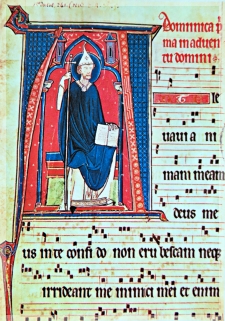
13th-century music manuscript

I began this series by saying that the Jews of the 1st century easily could have sung the words “O come, O come, Immanuel, and ransom captive Israel,” but those words weren’t sung by Jews. They were chanted in Latin over 1,200 years ago by Benedictine monks. In the 1800s, their words were translated into English, the verses rearranged, and the new version set to the melody of a 15th century French requiem mass processional.

The monk’s original version had seven verses and a verse a day was sung in the week before Christmas. Calling for God to come, each verse referred to a Messianic name found in the Hebrew Scriptures: Wisdom, Adonai (the Hebrew word for God), Root of Jesse, Key of David, Dayspring, King of the Gentiles, and Immanuel.

This Gregorian chant, however, was as much about the future as it was about the past. While celebrating our Savior’s birth, it also prepared the monks’ hearts for the day Jesus would return. You see, the first letter of each of the Latin names of God formed an acrostic. When put together in order, they spelled SARCORE but, when put together backwards, they spell Ero cras, which, in Latin, means “I shall be with you tomorrow.” While declaring the first Advent, this hymn is an urgent prayer expressing mankind’s longing for the second Advent when Jesus returns.

Scripture is neither vague nor equivocal on the promise of Christ’s return. His return is a major theme in the prophecy of both Old and New Testaments. 23 of the 27 New Testament books reference His return as do 17 books of the Hebrew Scriptures. According to Bible teacher David Jeremiah, references to Christ’s second coming outnumber references to His first by eight to one!

Jesus Himself promised His return. In Matthew 24:30-31, He spoke of a time people would, “see the Son of Man coming on the clouds of heaven with power and great glory. And he will send out his angels with the mighty blast of a trumpet, and they will gather his chosen ones from all over the world—from the farthest ends of the earth and heaven.”

On the night of His betrayal, Jesus promised His disciples, “I will come back and take you to be with me that you also may be where I am.” [John 14:3] After His ascension into heaven, two angels told the disciples, “This same Jesus, who has been taken from you into heaven, will come back in the same way you have seen him go into heaven.” [Acts 1:11]

Advent is far more than a time to look forward to celebrating Messiah’s birth and prepare for Christmas. It is as much a time to look forward to and prepare for Christ’s return! Many people missed His first coming but no one will miss His second!

And there will be strange signs in the sun, moon, and stars. And here on earth the nations will be in turmoil, perplexed by the roaring seas and strange tides. People will be terrified at what they see coming upon the earth, for the powers in the heavens will be shaken. Then everyone will see the Son of Man coming on a cloud with power and great glory. So when all these things begin to happen, stand and look up, for your salvation is near! [Luke 21:25-28 (NLT)]

Copyright ©2023 jsjdevotions. All rights reserved.

HEALING – Mark 5 (Part 1)

A woman in the crowd had suffered for twelve years with constant bleeding. … She had heard about Jesus, so she came up behind him through the crowd and touched his robe.  For she thought to herself, “If I can just touch his robe, I will be healed.” [Mark 5:25,27-28 (NLT)]

monarch butterflyIn Mark 5, we find three stories of miraculous healings: the demoniac living among the graves in the Gerasenes, the woman who bled for twelve years, and the daughter of Jairus who was brought back to life. These are beautiful stories, but what about all the other people in 2,000 years for whom there has been no healing? Like the woman with the blood disorder, my friend has suffered for more than twelve years, tried every remedy, and gotten no relief. This man of deep faith prays for healing as do all his family and friends. His faith is as strong as that of the nameless woman and yet he’s had no relief.

As the local synagogue’s leader, it’s likely Jairus was one of those in the synagogue who criticized Jesus for healing a man on the Sabbath. He even might have been with the Pharisees when they accused Jesus of being possessed by Satan. He and his daughter certainly weren’t more deserving than a neighbor’s grandson. Along with the child’s parents and countless others, they knelt before Jesus and begged for the boy’s healing. Nevertheless, in spite of their prayers and five-and-a-half years of treatment, healing never came. We didn’t ask God to raise him from the dead; we just wanted Eddie to live more than his brief eight years!

The bleeding woman and Jairus sought out the Lord but Jesus crossed the Sea of Galilee and calmed a storm to reach the Gentile demoniac. My uncle was a good man of deep Christian faith but he descended into the hell of psychosis from which he couldn’t escape and, instead of living among the graves, he lived in a state psychiatric hospital. He desperately sought Jesus but, in spite of countless prayers for release from his demons, release only came when he died. Why was the pagan demoniac healed and not my uncle?

If all we needed for healing was sincere faith and fervent prayers, good Christians would never get sick or die—but, they do. Billy Graham suffered from Parkinson’s disease for 25 years and Martin Luther had 24 years of ill-health. Luther’s pain was so crippling that he frequently prayed for death’s relief. Based on existing records, forensic scientists believe Francis of Assisi suffered from malaria, tuberculosis, peptic ulcer, gastric cancer, brucellosis, blindness from trachoma, and leprosy until his death at 44. Among other ailments, John Calvin suffered from kidney stones, painful gout, heartburn and indigestion, chronic facial pain, roundworms, migraines, and chronic insomnia until his death at 55 (probably from tuberculosis). If anyone had a direct line to God’s ear, it would be men like these and the Apostle Paul. Without a doubt, they all prayed for relief but God chose not to remove their many thorns.

Although Jesus taught us that God will respond to our faithful prayers, He never taught us that faith automatically brings about healing. While there are many instances in Scripture where Jesus links faith and healing, there are many others where the healing seems almost random. When we look at His many miraculous healings, there’s no formula to them. In fact, Jesus’ healing seems unrelated to people’s faith. The man healed by the pool at Bethesda didn’t even know Jesus’ name. The only constant is Jesus rather than faith or prayer!

God can and does heal. Whether or not He does so is His sovereign choice and our physical healing may not be God’s top priority! Of the many sick and suffering people crowded around the pool in Bethesda, Jesus healed just one man. The reasons why God restores health to some and not to others is beyond our understanding. Healing is neither evidence of our faith nor proof of God’s love for us and we can’t allow bitterness or anger to fill our hearts when it doesn’t occur. Even for the most faithful, miraculous healings are the exception not the rule! Someday, all sickness and death will be gone but, until then, we must have faith and trust in God.

He has chosen not to heal me, but to hold me. The more intense the pain, the closer His embrace. [Joni Eareckson Tada]

I was given a thorn in my flesh, a messenger from Satan to torment me and keep me from becoming proud. Three different times I begged the Lord to take it away. Each time he said, “My grace is all you need. My power works best in weakness.” So now I am glad to boast about my weaknesses, so that the power of Christ can work through me. [2 Corinthians 12:7-9 (NLT)]

Copyright ©2023 jsjdevotions. All rights reserved.