
For my thoughts are not your thoughts, neither are your ways my ways, declares the Lord. For as the heavens are higher than the earth, so are my ways higher than your ways and my thoughts than your thoughts. [Isaiah 55:8-9 (ESV)]
 Our old friend Joe recently visited. Along with our friend Ric, he and my husband were partners in a manufacturing business in another state many years ago. Once a year, the three men would meet away from the business (with its phone calls and constant interruptions) to discuss their short-term and long-term business goals. While Ric and my husband were the legal, financial, and sales parts of the business, as a processing engineer, Joe oversaw manufacturing.
Although Joe is a genius when it comes to engineering, electronics, production, and machinery, the innovative thinker had difficulty verbalizing his long-range manufacturing plans to his technology and machinery-challenged partners. Often unable to visualize what Joe had in mind, they sometimes had difficulty understanding his reasoning behind wanting to alter existing equipment, create new machinery, remove or install racks, re-arrange the factory, revise old procedures, or inaugurate new ones. Joe, however, knew exactly what he was doing. Inevitably, a new system would be in place that always resulted in faster and more efficient production, a better-quality product, and a safer work place for their employees. Although my husband and Ric didn’t fully comprehend Joe’s proposals, they knew there always was a method to what sometimes appeared to be madness. Having faith in Joe’s expertise and knowing his concern was for the welfare of their business and employees, they simply had to trust Joe to do his job in the factory while they did theirs in the office!
Just as my husband and Ric rarely understood Joe’s visions, we often have difficulty understanding what God is doing in our lives. We tend to be creatures of habit and prefer doing things the old familiar way rather than learning a new and better way. God, however, is never satisfied with our just being OK; He has great plans for us—to give us “a future and a hope.”
The words of Isaiah 55:8-9 remind us that we must put our complete trust in God; His ways always are better than our own. Because He loves us, we can know that everything in His plans is for our greater good. It’s rarely easy to understand why things (both pleasant and unpleasant) happen the way they do. Nevertheless, it all is part of God’s plan—a plan we cannot fully comprehend. It is only in hindsight that we finally understand why our lives took the twists and turns they did.
Looking back, I see how various difficulties and challenges caused me to mature in my faith, develop character and strength, and become more patient, peaceful, and thankful. Those changes and the circumstances that caused them (most of which I didn’t appreciate at the time) enabled me to withstand the challenges of today. Moreover, the troubles of today will empower me to better withstand the challenges that are sure to arrive tomorrow or the day after. Just as Joe transformed the factory and its manufacturing processes, God wants to transform and perfect us. Let us trust Him even more than Ric and my husband trusted Joe!
Father, thank you for transforming our lives so that we can grow more like Christ. Forgive us when we rebel and question your plan. Remind us to look back and reflect on the many blessings we’ve received that originally came packaged as trouble, sorrow, and difficulty. Thank you for never giving up on us.
Faith looks back upon the past, for her battles have strengthened her, and her victories have given her courage. She remembers that God has never failed her. … Therefore faith…can say, “Surely goodness and mercy shall follow me all the days of my life!” [Charles Spurgeon]
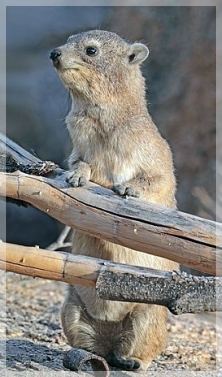 Making the point that wisdom is better than strength, the sage Agur spoke of the wisdom of ants, locusts, lizards, and sāphān. Often translated as badgers, rock-badgers, hyraxes, conies, or marmots, the animal’s exact identity is unknown but commentators suspect it to be the Syrian rock hyrax. Looking like a cross between a rabbit, guinea pig, and meerkat, these social animals gather in colonies of up to 80 individuals. Sleeping and eating together, they live in the natural crevices of rocks and boulders or take over the abandoned burrows of other animals.
 The above words are from Mere Christianity by C.S. Lewis. For Lewis, those first moments of wakefulness were the most important ones of the day because they set one’s frame of mind. When God is our first thought of the day, we begin the morning with a sense of peace and power – peace because we know the day is in His hands and power because we know that through Him we can get through anything it throws at us. It’s as if an invisible barrier has been set up between us and the desires, troubles, and cares of the world in which we live.
 Several years ago, I purchased a beautifully drawn coloring book featuring scenes from the Colorado mountain town that had been part of our lives for thirty-five years. Since it was a gift for one of my grands, I asked the artist to sign the book. She added these words to her signature: “Don’t be afraid to color outside the lines!” Was the artist’s advice limited to her book or was it about something more?
 Jesus offered fishing advice to the disciples twice after they’d spent a night of fishing with absolutely nothing to show for it and, twice, after doing as He directed, they ended up with a miraculous catch of fish. The first time, their catch was so heavy that their nets began to tear and the two boats hauling it in nearly sunk from the weight! The second time, unable to pull the net into their boat, the men had to get out and drag it into shore!
 Devotions of the Heart