
For no good tree bears bad fruit, nor again does a bad tree bear good fruit, for each tree is known by its own fruit. For figs are not gathered from thornbushes, nor are grapes picked from a bramble bush. [Luke 6:43-44 (ESV)]
 My son has a beautiful pomegranate tree in his yard but, when he first purchased the property, he didn’t know what it was. Although showy red flowers eventually appeared, it wasn’t until the flowers developed into deep-red globe-shaped fruit that he knew it was a pomegranate. The tree was recognized by its fruit and it is by our fruit that Christ’s followers are recognized.
We tend to think of the Fruit of the Spirit (love, joy, peace, patience, kindness, goodness, gentleness, faithfulness, and self-control) as nine different fruits—like a basket containing an orange, apple, kiwi, pineapple, grape, blueberry, banana, apricot, and mango. The Greek word used by Paul, however, was karpos and it was singular. Rather than describing nine different kinds of fruit, the Apostle was listing nine different characteristics of one fruit—the fruit of God’s grace working in us.
Along with having a delicious flavor that is both sweet and tart, the characteristics of a pomegranate’s fruit include its bright red color, hundreds of juicy edible seeds, being rich in powerful antioxidants called polyphenols, and containing fiber, magnesium, potassium, and vitamins E and K. Just as all of its characteristics are contained in a single pomegranate fruit, all nine of its virtues are contained in the Fruit of the Spirit. After all, even non-believers can love, exhibit patience, or use self-control at times, but it takes the power of the Holy Spirit to overcome our sin nature and possess love, joy, peace, patience, kindness, goodness, gentleness, faithfulness, and self-control all at the same time! These gracious dispositions should be found in the hearts of all who have the Holy Spirit living in them and they should be evident in the lives of all who claim to follow Jesus!
Fruit, however, has to grow and mature. After planting, it takes three to six years before a pomegranate is mature enough to develop a few small fruits. It takes another three to six years before the tree bears a proper harvest. Even then, the fruit doesn’t appear all at once. After the tree flowers, it takes six to seven months for the fruit to develop and ripen. Being reborn takes only a moment but becoming a Christian takes a lifetime. Like a fruit tree, we need to grow and mature before we bear good fruit and, like the pomegranate, our fruit needs time to ripen.
While my son’s tree produces ripe fruit between August and November, we are expected to bear the Fruit of the Spirit all year long! As with my son’s pomegranate tree, it is by our fruit that we are recognized. It identifies us as followers of Christ and, if our fruit doesn’t look a lot like love, joy, peace, patience, kindness, goodness, faithfulness, gentleness and self-control, there’s a problem! We’re like a diseased plant that bears only rotten fruit or no fruit at all!
Although the Spirit does the planting of this fruit, we are the ones who must tend the garden by weeding out the sin that threatens its health, fertilizing it with God’s word and prayer, and watering it with worship and fellowship. Without staying connected to the Lord, we’ll be like a broken branch from the pomegranate tree—unable to bear fruit. A Christ follower’s fruit comes from a relationship with God through Jesus Christ; it comes from staying connected to the vine.
The branch of the vine does not worry, and toil, and rush here to seek for sunshine, and there to find rain. No; it rests in union and communion with the vine; and at the right time, and in the right way, is the right fruit found on it. Let us so abide in the Lord Jesus. [Hudson Taylor]
 As Christ’s followers, we are saved through our faith and God’s grace. God takes us soiled sinners just as we are because there is no way we could be good enough to earn salvation. Nevertheless, just because God welcomes His immoral, angry, impatient, bad-tempered, anxious, sinful, and selfish children doesn’t mean He wants us to stay that way. When Jesus saved the woman caught in adultery, He told her to, “Go and sin no more” and, when we are saved, He tells us the same thing!
 Spiritual gifts build God’s Kingdom in a variety of ways including teaching, outreach, speaking, counseling, discipleship, serving, practical assistance, visitation, and prayer. Our gifts were given for the common good of Christ’s church and we need one another’s gifts for the body of Christ to function. Within the church, some gifts, like shepherding, evangelism, or leadership, are easily noticed while others, such as mercy, giving, intercession, and faith may be less obvious. While those gifted in service (the ability to see undone tasks in God’s work and get them done) often work behind the scene, the people gifted in hospitality (the ability to warmly welcome all people into home or church) are front and center Sunday mornings as they greet people by name and extend the hand of friendship to visitors.
 Jesus promised the disciples, “And I will ask the Father, and he will give you another Advocate, who will never leave you. He is the Holy Spirit, who leads into all truth.” [John 14:16-17] In fulfillment of that promise, the moment we accept Christ as our Savior, the Holy Spirit moves into our hearts. When He arrives, He helps us but, rather than making the bed or washing dishes, the Spirit comforts, counsels, and convicts us. He gives us the power to share His word, the strength to do His work, and confidence in the fullness of God’s promises.
 Jesus told several parables regarding the day of His return. The Parable of the Ten Bridesmaids stresses being ready before that day occurs and the Parable of the Sheep and Goats describes the separation of obedient followers from unbelievers and pretenders in the final judgment. It is between those two that we find the Parable of the Talents about serving our Master until the day of His return.
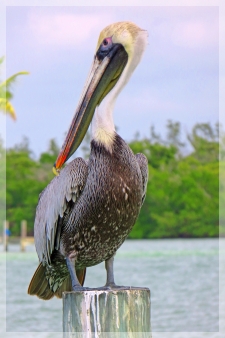 The patient Cormorant had been diving and resurfacing empty-beaked for several minutes before finally emerging victorious with a large fish crosswise in its beak. The fish thrashed in the cormorant’s beak while the bird tried to re-position its meal so it could be swallowed head first. A Brown Pelican suddenly crashed into the water and, after a great deal of wing flapping and water splashing, it was clear the Cormorant was no match for the larger bird. While the Pelican threw back its head and swallowed the unlucky fish, the unfortunate cormorant swam away still hungry.
 Devotions of the Heart